
Halloween Law

Not Randy Maniloff

Randy Maniloff has penned an interesting piece for the Wall Street Journal on what he calls the “Halloween Exception” to established legal principles.  Randy–a leading expert on Halloween law, the “baseball rule,” and other legal topics too numerous to list–discusses several instances where judges have departed from traditional legal principles to facilitate Halloween traditions.

In other words, on Halloween you can get away with mischief that would be criminal or tortious in other seasons.  Fascinating.

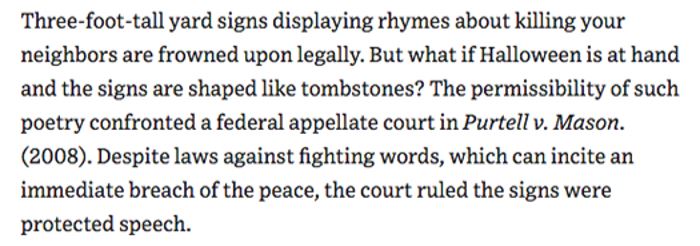
Here’s one of his examples:

It’s a great read!  Check it out.

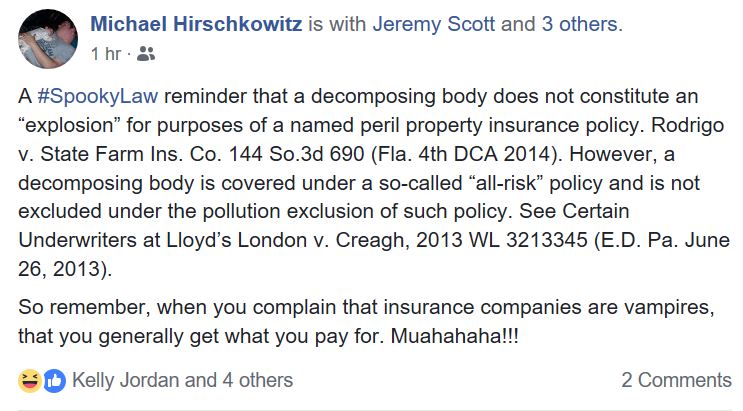
In other Halloween-related legal news, a former student explored the legal implications of insurance coverage for decomposing bodies in a Facebook post.  His research led him to conclude that a decomposing body does not qualify as an “explosion” under an insurance policy, but–good news!–is not excluded from coverage under a “pollution exclusion” in a policy.

Happy Halloween from Lawhaha.com!

Caution: Don’t Eat Gum From Urinal

This is one of those head-scratchers that leaves you wondering whether it’s fake news because it just seems too bizarre, even by wacky warning standards.  Let’s assume, probably justifiably, that there are indeed people who eat gum from urinals.  Are there really enough of them to warrant a laminated “Caution” sign?  And do people really need a warning not to do it?

“Dang, I was going to eat that piece of gum someone spit out that maybe a hundred people have peed on.  It’s a good thing I saw the sign in time!”

The image appears to be real (that is, not photoshopped), but I don’t know where it originated.  A person in my area posted it on the Next Door app, with the comment, “There’s one in every crowd.”  Don’t know if she took the picture.

Publish or Perish: “Get Me Off Your F****** Mailing List”

After reading a rundown on the day’s latest depressing news, it was a true joy to come across this Vox article about this real article accepted for publication in an “academic journal.”

In academia, it’s publish or perish.  Good teaching is important, but it won’t get you promoted or tenured without publishing.  To assist academics on their climb up the steps of the ivory tower, professors in all disciplines are constantly bombarded with email from dubiously credentialed sources offering to publish their books and articles.

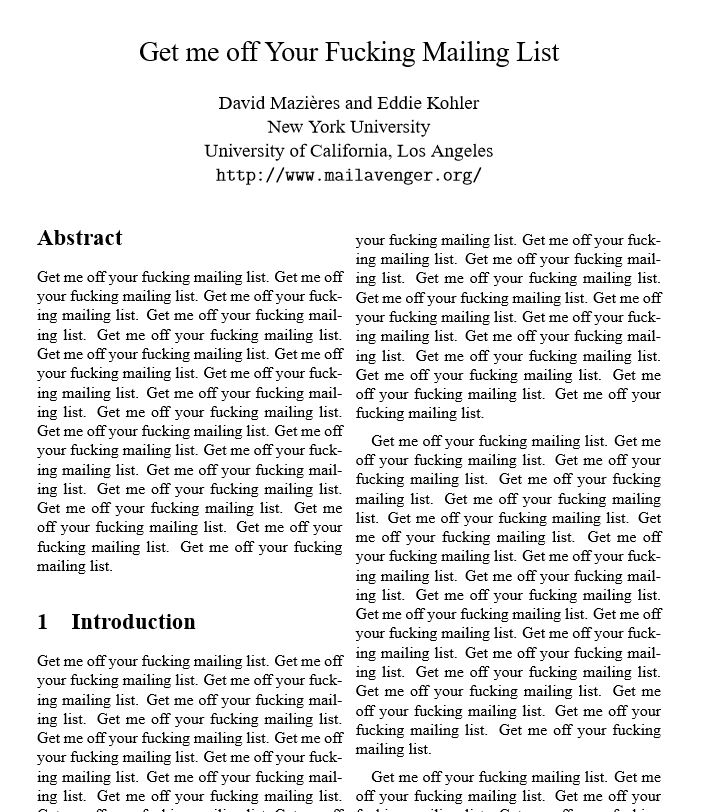
As the Vox article explains, this classic work, Get Me Off Your Fucking Mailing List, was actually accepted for publication by something called the “International Journal of Advanced Computer Technology.”  The ten-page article is nothing but the sentence, Get me off your fucking mailing list, repeated hundreds of times.

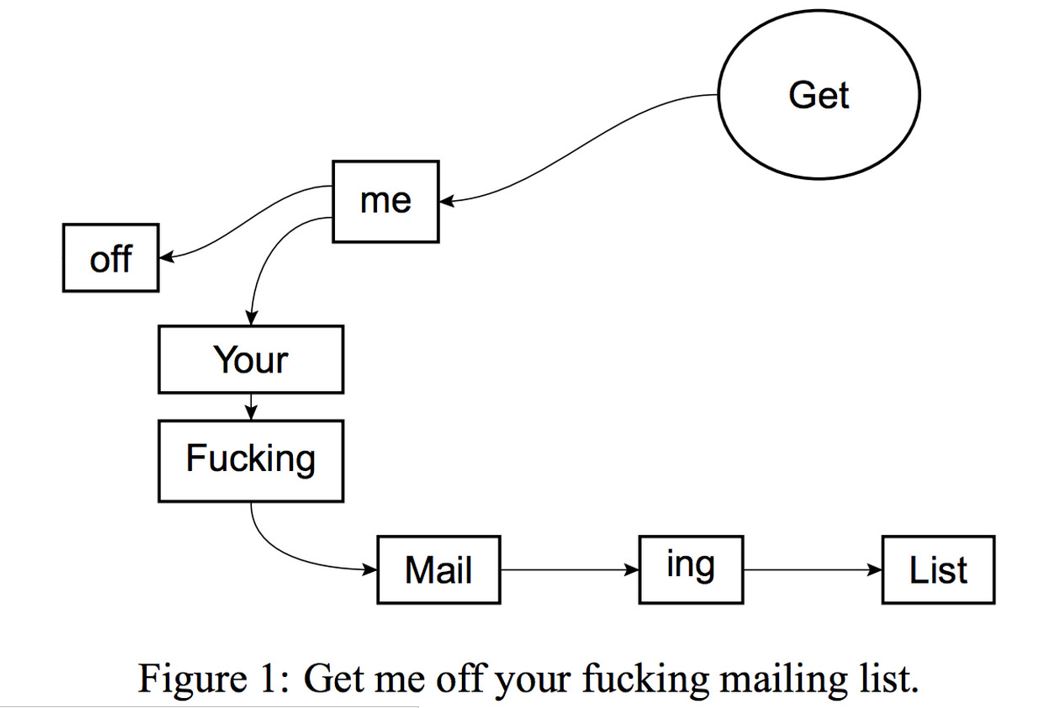
If it’s over your head, as much of the best academic stuff can be, no worries.  The authors included this helpful flow chart explaining the whole thing.

Oven Requires Waiving Your Legal Rights Before Using

Waive your rights to warm up your dinner.

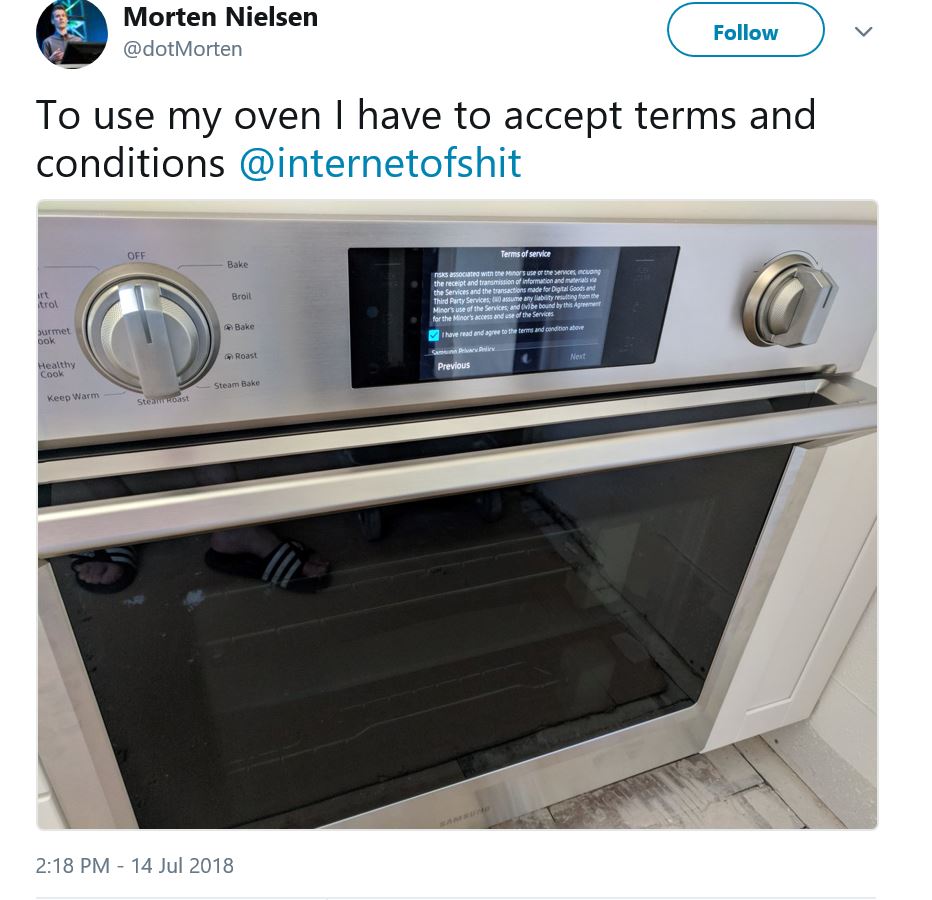
One of my students sent me this tweet from Morten Nielsen regarding a new oven requiring on the touch screen that, before using the product, the happy new appliance owner must waive their legal rights by agreeing to the “Terms of Service.”  Even in just the snippet of text visible in the picture, the user is assuming risks and waiving legal claims.

Stripping away the legalese, before you can warm up a pizza, you have to give up some legal rights.

A “contract of adhesion” is a form contract where the party being asked to sign it has no choice but to take it or leave it.  They’re always unfair because there’s no bargaining power.  That’s the very definition of a contract of adhesion.

The original concept of a contract is a bargained-for exchange of goods or services.  Courts supposedly look unfavorably on contracts of adhesion, but unless they involve a service on which the public depends (such as medical services or public transportation or public education), they’re upheld.

Did you know that each time you click “Accept” on an online click-thru agreement, you’ve bound yourself to a legal contract?  One survey found that 56 percent of people were not aware they were entering into binding agreement.

But, even there, you at least theoretically have the right to not use the service.  Don’t want to accept iTune’s or Facebook’s terms of service?  Don’t use those services.  But where is that choice when you’ve had a new appliance installed and can’t use it without first agreeing to the Terms of Service?

Welcome to the Internet of Things.  It’s only going to get worse, much worse.  The next generation oven will come with a built-in corporate lawyer who will send you threatening cease and desist alerts if you overcook or undercook your food and bill at a rate of $300 per hour.  If you don’t put a lid on the food and it spatters the inside, you will be sued for punitive damages.

At least this is what I heard from some person I met in a bar.  I think her name was Alexa.

–Thanks to Sean O’Brien for sending this along.

Warning: Sign Tells Robbers to “Have a Nice Day”

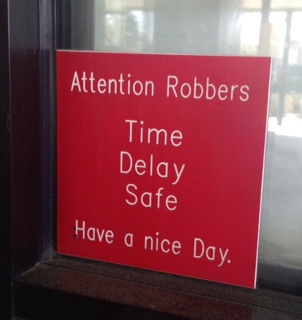
I’ve always heard that folks in Virginia are nice, and here’s proof, a warning sign to criminals in the window of a Sonic restaurant near the Norfolk airport:

Attention Robbers

Time Delay Safe

Have a nice Day.

I take issue with the unnecessary capitalization of “Day,” and I suppose if they were super-nice, they could have put an exclamation point at the end instead of period.  But this is quibbling.

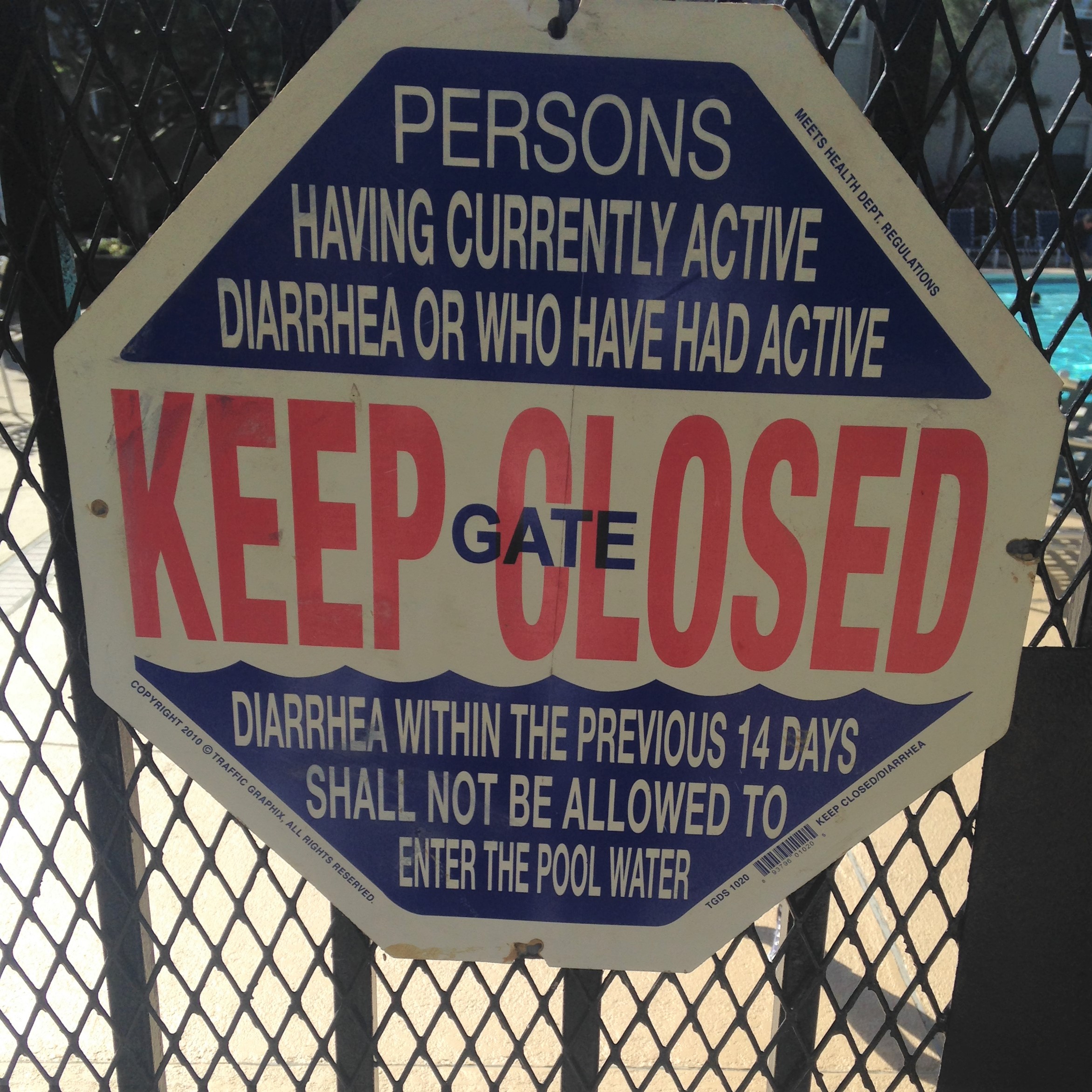
Warning: Diarrhea? Keep the Gate Closed

Like the old Certs commercial, “It’s two, two signs in one!”

Were they trying to save money by combining these two unrelated instructions on one sign?  Or maybe they really were telling people with diarrhea to keep the gate closed, especially the sphincter gate.

(And do they really think people who have had diarrhea within the past two weeks are going to follow this instruction?)

–Thanks to Randy Maniloff.

Law Review Humor – Ode to the Bluebook

As faculty advisor to a law review, I deliver opening remarks at the law review’s annual banquet.  Mostly these consist of giving thanks to the graduating law review members for their dedication and hard work.  They devote thousands of hours each year to painstakingly selecting, editing, formatting, proofing and–of course, cite-checking–scholarly articles.

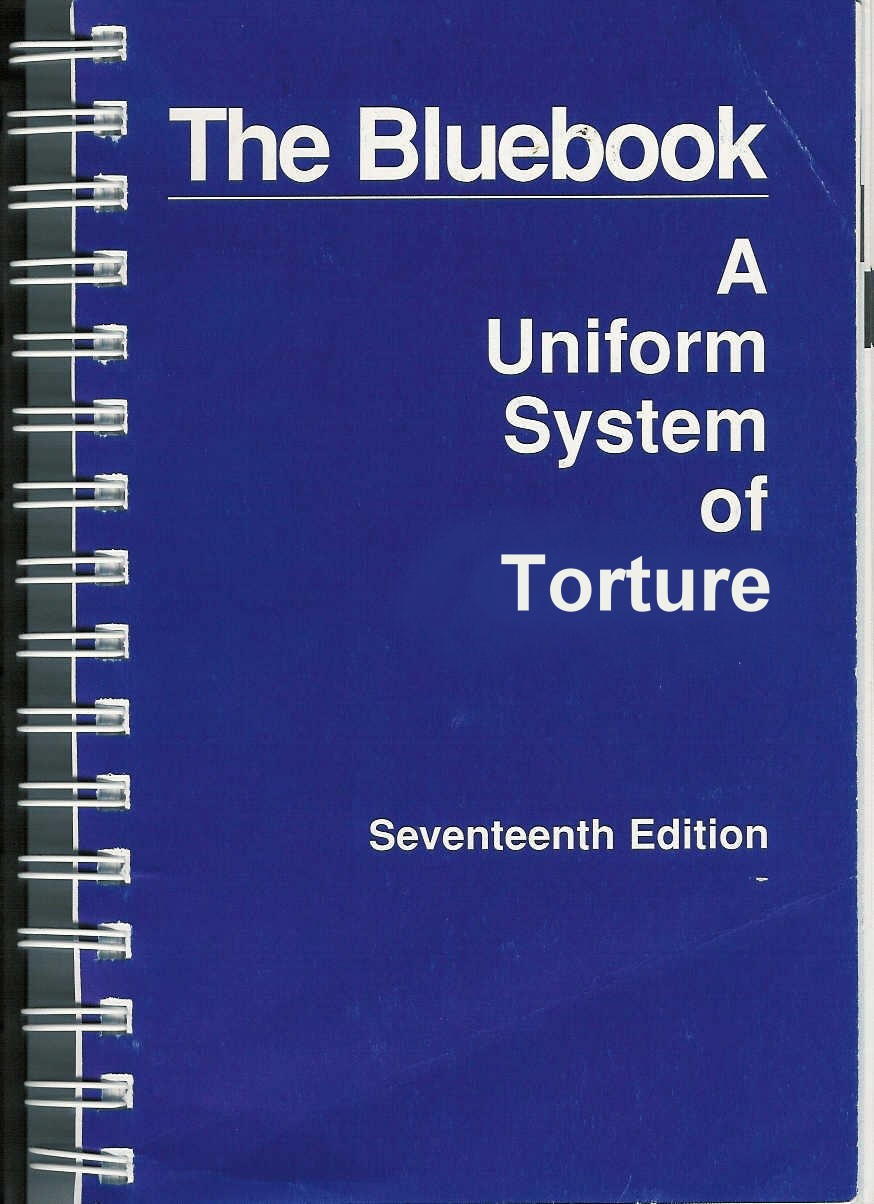
Cite-checking requires mastering The Bluebook: A Uniform System of Citation, a ridiculously-but-addictively complex 560-page manual of rules for referencing legal authorities.  (See The World’s Greatest Law Review Article.)

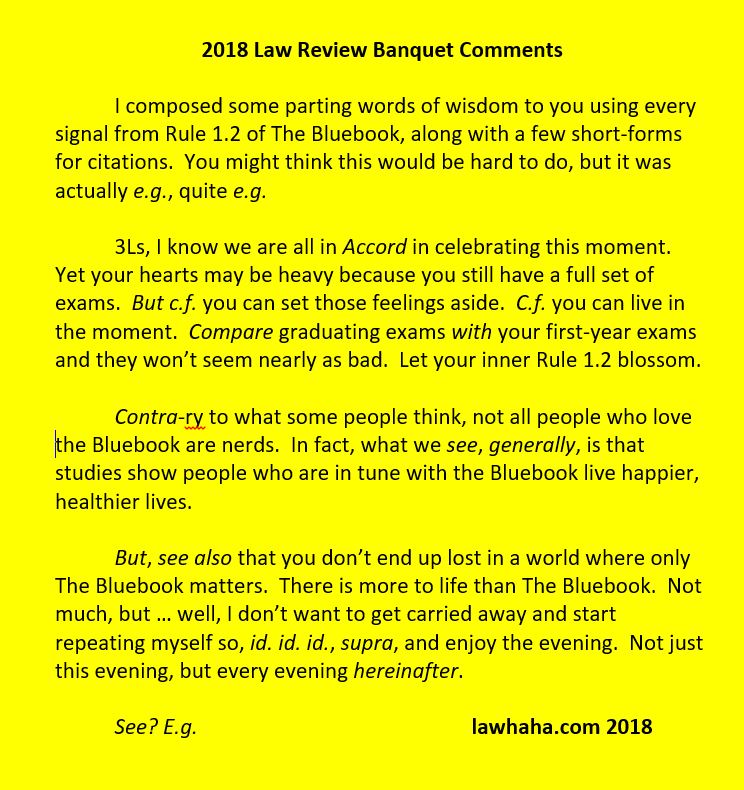
This year I tried to add levity to my remarks with some words of wisdom incorporating every “introductory signal” from Rule 1.2 of The Bluebook and throwing in a few “short-form” citation rules.  (If you are not a law review or Bluebook geek, this will make no sense at all.)

Corny, but it went over well, maybe because law review students are starved for frivolity.

Warning: Don’t Touch Fire

Warning: Do Not Put Hands in Fire

An age-old products liability dilemma for manufacturers:

What will a court consider, in hindsight, to be an “obvious” product danger?

Generally, under U.S. law, there is no legal duty for product makers or sellers to warn of product dangers that are obvious?  Why?  Because if they’re obvious, people will already know about them and the warning won’t accomplish anything.  Google dictionary synonyms for obvious include plain to see, evident, apparent, conspicuous, prominent, noticeable,” even unmissable.

But what’s obvious to most people may not be obvious to everyone, so why not go ahead and warn, even when it seems obvious, such as the risk of burns from sticking your hands into a fire?  The major problem here it that it looks like you have to stick your head into the fire to see the warning, which says:

WARNING: Do Not Touch The Fire Or The Fire-Glass.  Severe Burning And Cutting May Occur

Whoa!  Burning AND Cutting?  That, I did not see coming until my face was already on fire.

–Thanks to the Randy Maniloff, who took this picture at a local restaurant.  Check out his Coverage Opinions site for intelligent legal commentary and humor, along with his fascinating interviews with everyone from Richard Posner and John Grisham to the guitarist-turned-lawyer from Blind Melon.

Spot the Tort: The Latest in Overloaded Vehicle Torts

A rolling tort doubling as a mobile movie theater.

“Rolling Torts” is the label Lawhaha gives to overloaded vehicles presenting dangers on America’s roads and highways.  They’re everywhere.  On the one hand, you have to admire the ingenuity and ability of people to load moving-truck sized packages onto ordinary passenger vehicles.  On the other hand, if one of these items breaks loose, especially on a highway, the risk to other drivers and passengers is severe.

(Of course, technically speaking, “Spot the Tort” entries are actually potential torts.  An actual tort doesn’t occur until the risk manifests itself in injury.)

No Trial Delay for Solar Eclipse

U.S. District Judge Steven “Not So” Merryday denied an Assistant U.S. Attorney’s (AUSA) motion to delay a trial because a witness employed by the Bureau of Alcohol, Tobacco, Firearms and Explosives (ATF) had prepaid for a trip to view the August 21, 2017 solar eclipse in totality.

The court reasoned that the delay would “subordinate the time and resources of the court … to one person’s aspiration to view a ‘total’ solar eclipse for no more than two minutes and forty-two seconds.”

Can’t take issue with the result, but instead of just saying that, the magistrate–perhaps seeking his own two minutes and forty-two seconds of fame–penned a silly too-cute-for-words order built around Carly Simon’s 1972 hit “You’re So Vain.”

You may recall that Simon’s anonymous, self-absorbed antagonist (suspected to be Warren Beatty) “flew [his] Learjet up to Nova Scotia to see the total eclipse of the sun.”  (Speculation has it that Carly was referring to the 1970 total eclipse that was viewable along the East Coast of the United States).

In his order denying the motion to postpone, Judge Merryday mocked the AUSA who filed the motion for “boldly mov[ing] … where no AUSA has moved before”  and for “oddly” describing the eclipse “‘scheduled to occur,’ as if someone arbitrarily set the eclipse, as an impresario sets a performer to appear at a chosen time and place.”

He unnecessarily ridiculed the witness for his prepaid “personal indulgence,” again invoking the Carly Simon song, which featured this line immediately preceding “the total eclipse of the sun” line: “Well I hear you went to Saratoga, and your horse naturally won.”

When an indispensable participant, knowing that a trial is imminent, pre-pays for some personal indulgence, that participant, in effect, lays in a bet.  This time, unlike Carly Simon’s former suitor, whose “horse, naturally won,” this bettor’s horse has–naturally–lost.

Meanwhile, he diminished the significance of a total solar eclipse as “just another astral event.”  The rare August 21 total eclipse will be the first to travel from coast to coast within the United States in nearly 100 years.

–Order, United States v. Joseph Bishop, U.S. District Court, Middle District of Florida, Tampa Div., Case No. 8:17-cr-266-T-23JSS (Aug. 18, 2017) (Thanks to David Barman.)