Welcome back to lawhaha.com. Sorry for the long hiatus. The original WordPress site theme expired and it took a while to migrate to a new theme. But lawhaha.com is back for good. New content is being added, but in the meantime, enjoy twenty-five years of the best in legal humor! Strange Judicial Opinions, Legal Oddities, Funny Law School Stories, Wacky Warning Signs and Labels, Spot the Tort, and much more.
New Fifth Edition of 1L of a Ride
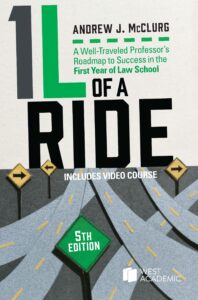 New 2025 edition includes free access to the 13-part 1L of a Ride Video Course. Available in paperback and Kindle formats.
Assigned as required or recommended reading at law schools throughout the country, 1L of a Ride: A Well-Traveled Professor’s Roadmap to Success in the First Year of Year of Law School provides a candid, comprehensive roadmap to both academic and emotional success in law school’s crucial first year.
Legal education continues to evolve and so does this classic work, now in its fourth edition.
Told in an accessible first-person voice, covered topics include: pre-planning, top student fears, the first-year curriculum, the Socratic and case methods of teaching, effective class participation, the top habits of successful students, essential study techniques, legal research and writing, exam strategies, maintaining well-being, and much more.
Combines comments from hundreds of law students, empirical research, and authentic samples of signature documents from the 1L experience, including exam questions, Socratic dialogue, and student case-briefs, class notes, and course outlines.
McClurg taught at six different law schools and received numerous awards for both teaching and research.
McClurg’s Novels

McClurg also writes award-winning fiction under the pen name “Dorian Box.” He likes to blend dark themes with heart, hope, and humor with a goal of evoking tears and laughs over the same book.
At one time or another his novels have been the Amazon No. 1 Bestseller in categories such as Thrillers, Psychological Thrillers, Legal Thrillers, and Women Sleuths (for The Emily Calby Series), and General Humorous Fiction, Humorous Dark Comedy, and Amateur Sleuth Mysteries (for The Danny Teakwell Series).
Awards and honors for his novels include: Writer’s Digest Award for Genre Fiction; Two-time Publishers Weekly BookLife Prize Finalist in Mysteries/Thrillers; Two-time National Indie Excellence Award Finalist, IndieReader Discovery Award for Fiction; Feathered Quill Medal for Mystery/Suspense; Best Psychological Thriller of 2021, and Finalist, Best Legal Thriller of 2022 (BestThrillers); Readers’ Favorite medals in four different categories (Suspense, Legal Thriller, Humor, and New Adult Fiction).
Here’s a complete list with Amazon links:
Grave Waves (Danny Teakwell Book 3) (Friction Press 2026)
The Girl Goes Home (Emily Calby Book 4) (Friction Press 2025)
Funeral Daze (Danny Teakwell Book 2) (Friction Press 2023)
Target: The Girl (Emily Calby Book 3) (Friction Press 2021)
The Girl in Cell 49B (Emily Calby Book 2) (Friction Press 2021)
The Hiding Girl (Emily Calby Book 1) (Friction Press 2020)
Psycho-Tropics (Danny Teakwell Book 1) (Friction Press 2015)
Interview with “Legal” Artist Cassou
 Lawhaha.com was happy to “sit down” recently for an email interview with Belgian artist Cassou, who uniquely specializes in whimsical, even humorous, legally themed paintings. Her “Judicial Series” has been exhibited in courthouses throughout Europe.
She started drawing and painting as a child. Before turning to painting fulltime, she studied classical philology and Egyptology at the Free University of Brussels, and has taught Latin, Ancient Greek, and French.
Q. Cassou, thanks for participating in this interview. Before we get to some of your individual paintings, tell us what led you to specialize in legal-themed paintings?
A. My obsession with painting justice seized me naturally, driven by two powerful forces. First, a deep conviction that the law is the vital backbone keeping society from collapse. Second, I’m profoundly fascinated with the “sacred theater” of the courtroom, complete with its elaborate costumes, gripping rituals, and near-divine authority. This sacred arena—the realm of Law and Justice—is also a stage for human passions, so it naturally caught my eye and sparked my curiosity. What a pleasure it is to depict that world!
Q. “Sacred theater.” I like that. We see a lot of theater in both law and politics here in U.S., too much of decidedly un-sacred. Before we turn to some samples, what medium do you paint in and how would you briefly describe your process for coming up with and executing ideas?
A. I use acrylic on linen canvas. Although I sometimes start with a key notion, I do not plan my painting in detail. I do not need to look for ideas, they emerge and become refined as I paint.
Q. Let’s look at some of your works. You’ve been kind enough to share five of them with us. The first one is titled Se Frotte Les Mains (Rubbing His Hands). Explain what it depicts.
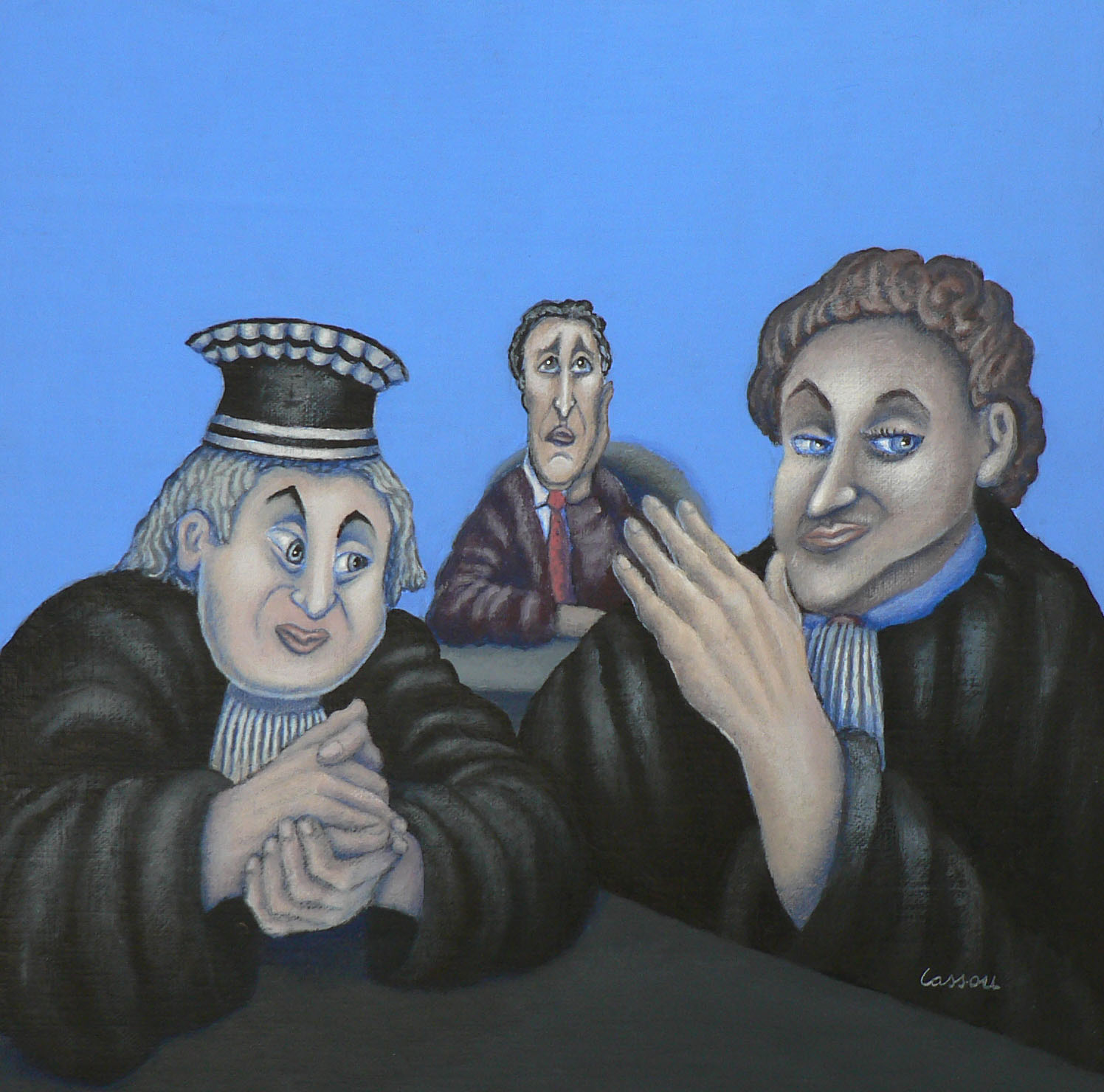
A. We see the judge rubbing his hands with glee and the lawyer contemplating a strategy, but the client is left wondering what’s going to happen to him, terrified of being eaten alive!
Q. What is it trying to say or express?
A. Welcome to the ultimate legal restaurant. It shows a justice system that looks all at once like a circus, a theater, or an inn where the judge, acting as a food critic, is rejoicing, getting ready to savor the client as his daily special.
Q. Yikes! What about this second one? Animaux Domestiques (Household Pets). Here, we see a judge surrounded by a snail and a dinosaur. What do they represent?
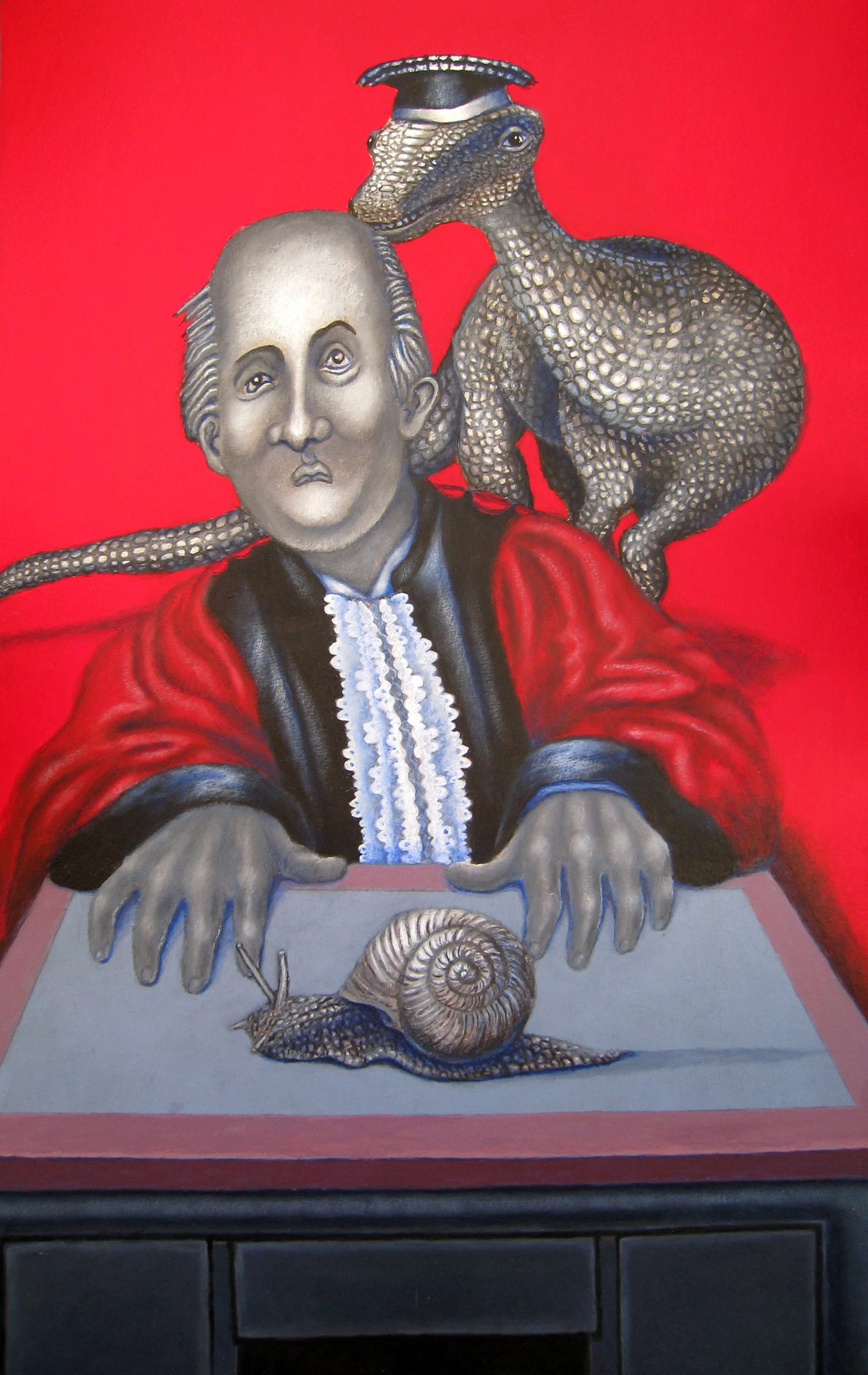
A. The two animals of justice. The snail serves as a symbol for the slow pace of the justice system, where a case can sometimes take many years to be resolved. Some comedians have poked fun at this. As for the dinosaur, the legal language—inaccessible to the average citizen—seems to hail from the obsolete world of the dinosaurs. “Domestique” comes from the Latin word domus, which means house or home. Thus, an animal domestique is literally an animal that belongs to the house or home. Here, the snail and the dinosaur seem to be “animaux domestiques”: they belong to the House of Justice.
Q. Our third one is titled Haut Les Mains (Hands Up!). It shows two lawyers exiting the courtroom as two judges step up to the bench. The female judge points a finger at her male colleague, who throws his hands up like a criminal surrendering to the police. What is this painting saying?
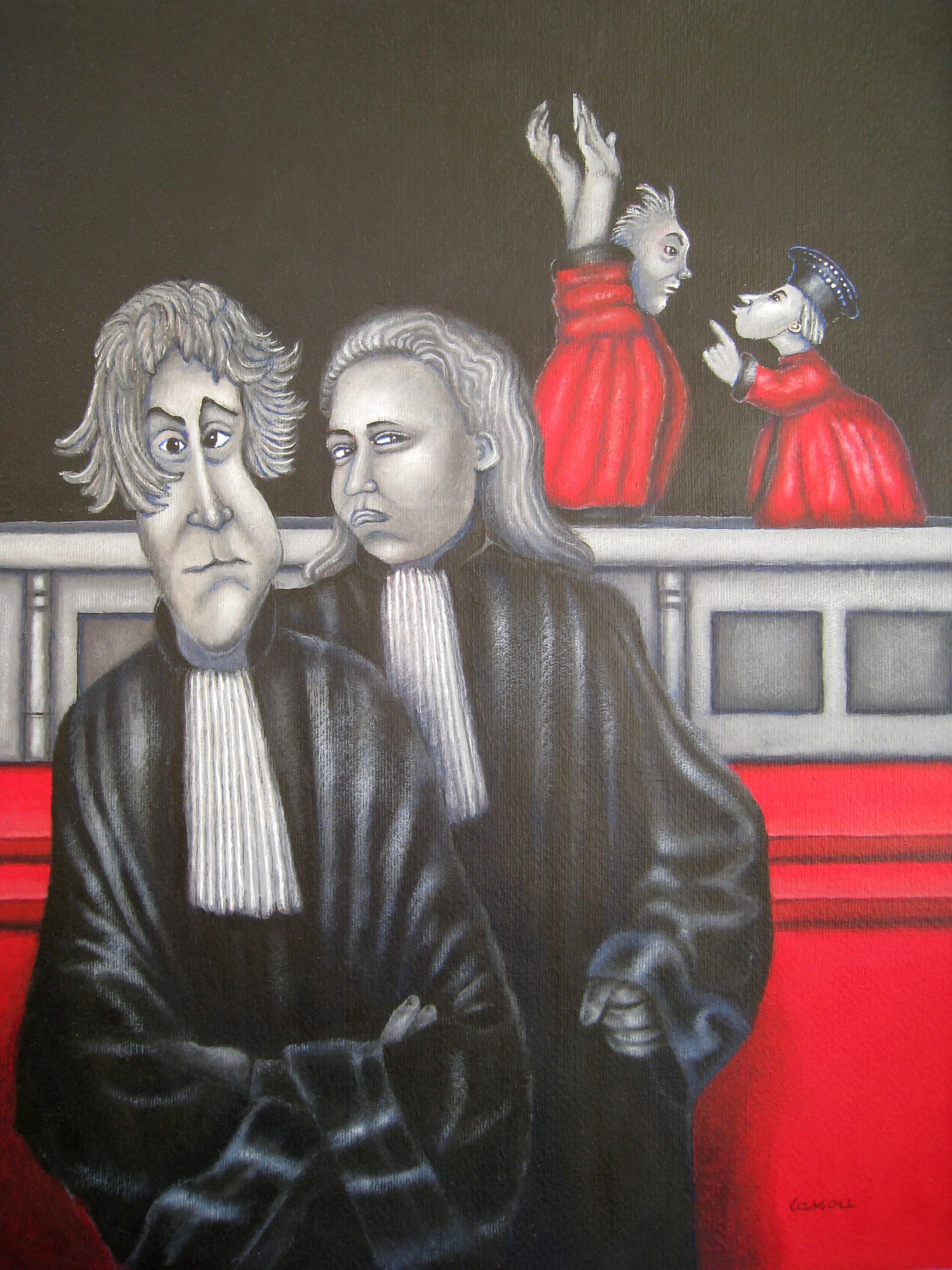
A. One might wonder what the judges do when all the lawyers have left the courtroom. I imagined them arguing, disagreeing with each other. This has to happen, right? Let’s imagine that one of them, out of courtesy or simply to escape the bickering, throws his hands up in surrender, as if playing cops and robbers. It is funny for judges, isn’t it? This has to happen, right? What would the two of them look like if the scene were observed? They would look like children. Their mask of seriousness, dignity, and power would fall. They would show themselves to be human, all too human. The scene shows us a humanity revealing itself, a power becoming humanized.
Q. I’d love to see our U.S. Supreme Court justices deliberating. Then we have number four, Haute Tension (High Tension). What do we have here?
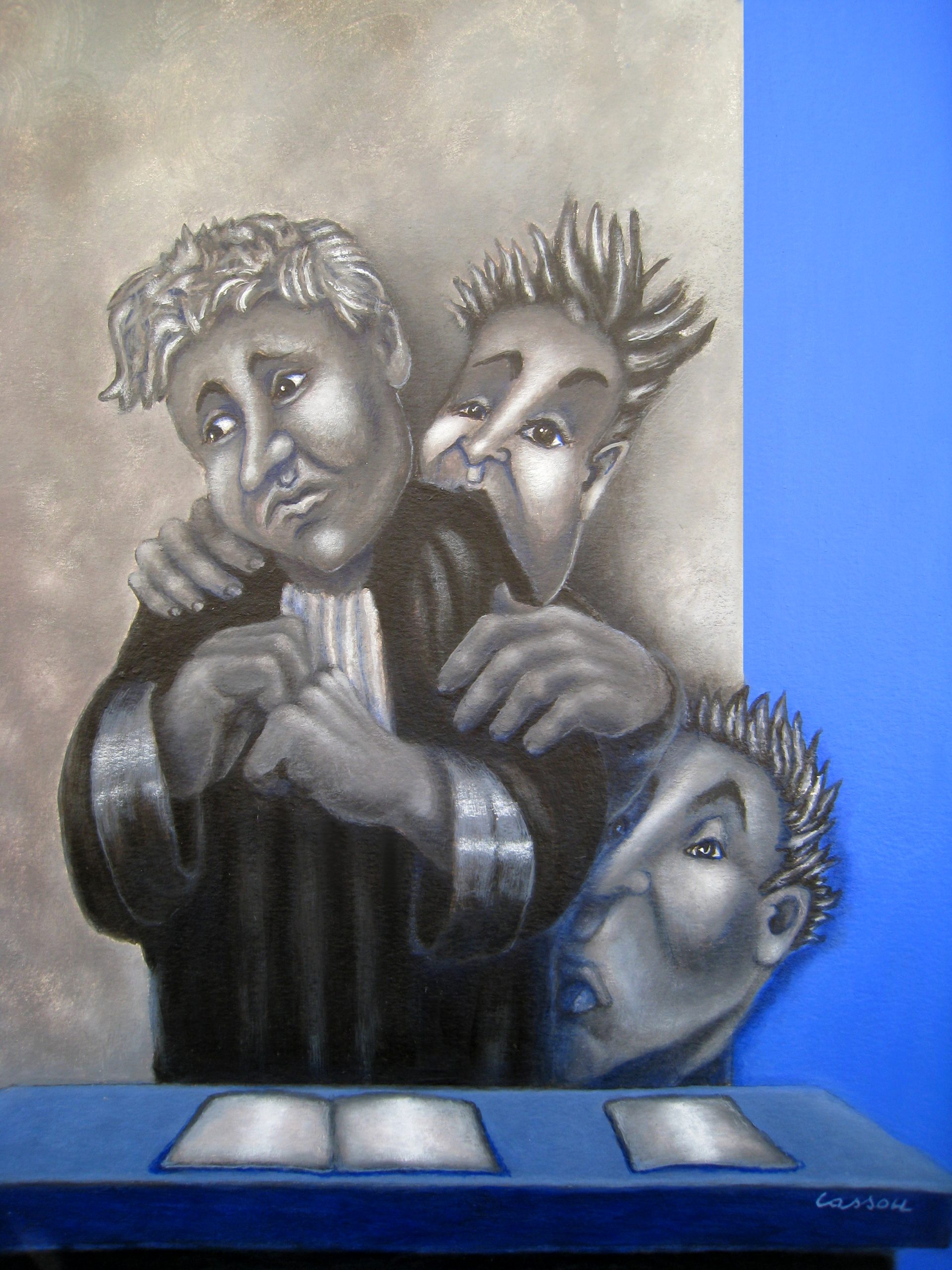
A. Talk about a high-voltage nightmare. We have clients so utterly terrified they are practically trying to climb inside their lawyer’s robe for safety. The poor attorney looks less like a legal expert and more like a human lightning rod, visibly strained under the crushing weight of their survival. The pomp, theatricality, and solemnity of the courtroom, along with the high stakes of the trial, all can induce a sense of dread in the public, which is exactly what is expressed here, absolute panic.
Q. Yes, the lawyer does look quite sympathetic to their plight. Finally, we come to Esprit Libre (Free Spirit) and find a judge sticking his tongue out. What is that painting saying?
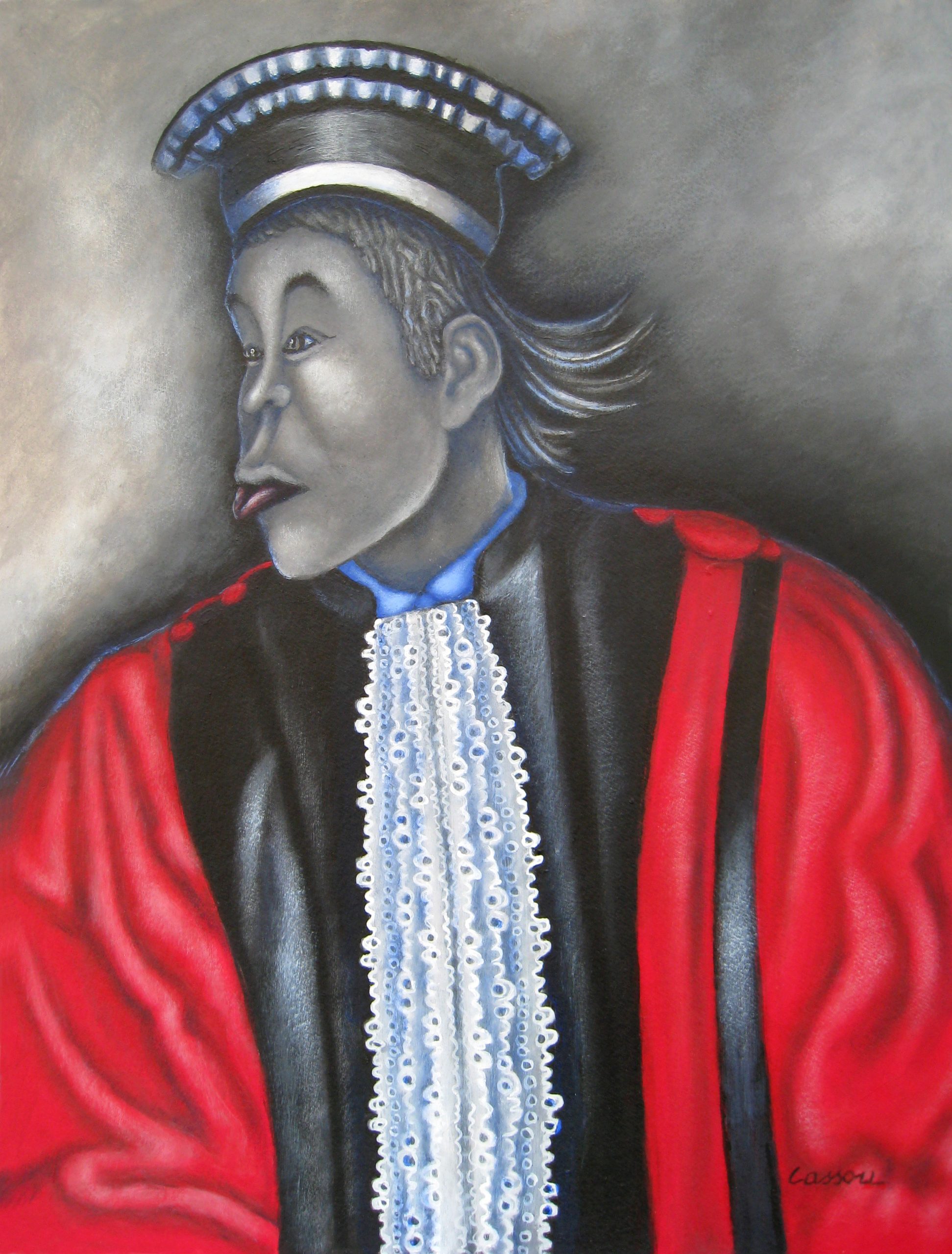
A. Well, I just feel like a judge should always rule according to his own conscience. I tried to present a joyful reminder of that. Nowadays, there’s so much political pressure, and it’s easy to get influenced. I wanted to show that a judge needs to stay completely independent, no matter what.
Q. Why is he sticking his tongue out?
A. Honestly, I wanted to break through that cold, heavy atmosphere. Sometimes all that strict formality makes people forget the human side of justice. Shaking things up a bit is just a way to remind everyone that true justice comes from a free mind. So, I gave this judge the maturity of a five-year-old sticking his tongue out as a sign of rebellion and defiance: “No, you don’t scare me!”
Thanks to Cassou for sharing her unique works and classing up Lawhaha.com. For information about either exhibiting or purchasing her paintings, go to her website: http://www.art-cassou.com
Walking in Memphis – Spot the Tort
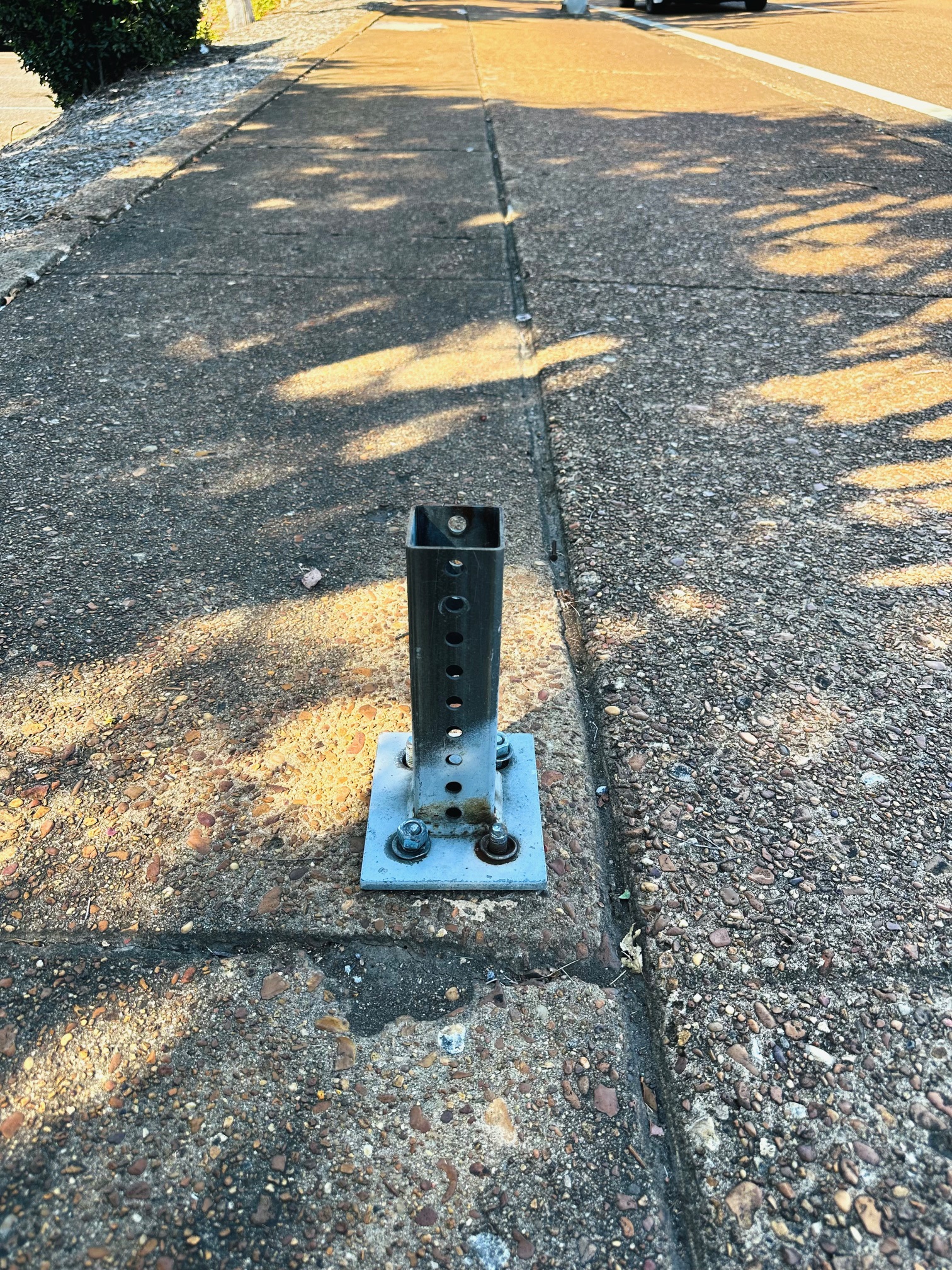 You probably never realized that Marc Cohn’s great song, Walking in Memphis, was actually giving sound personal injury-avoidance advice with the line “walking with my feet ten feet off of Beale.”
It applies to sidewalks as well.
Most tortious property conditions are the result of negligent maintenance or oversight. But sometimes that’s not enough. Sometimes you have to go out of your way to create a tortious condition. In other words, spotting the tort doesn’t always cut it. If you build it, they will fall.
On this busy sidewalk on Union Avenue in front of a Fresh Market, someone, presumably someone official, inexplicably installed this bolted-down, six-inch steel pole right in the middle of the sidewalk.
“Helpful Hint”: Look for “Small Stones” in Your Lentils
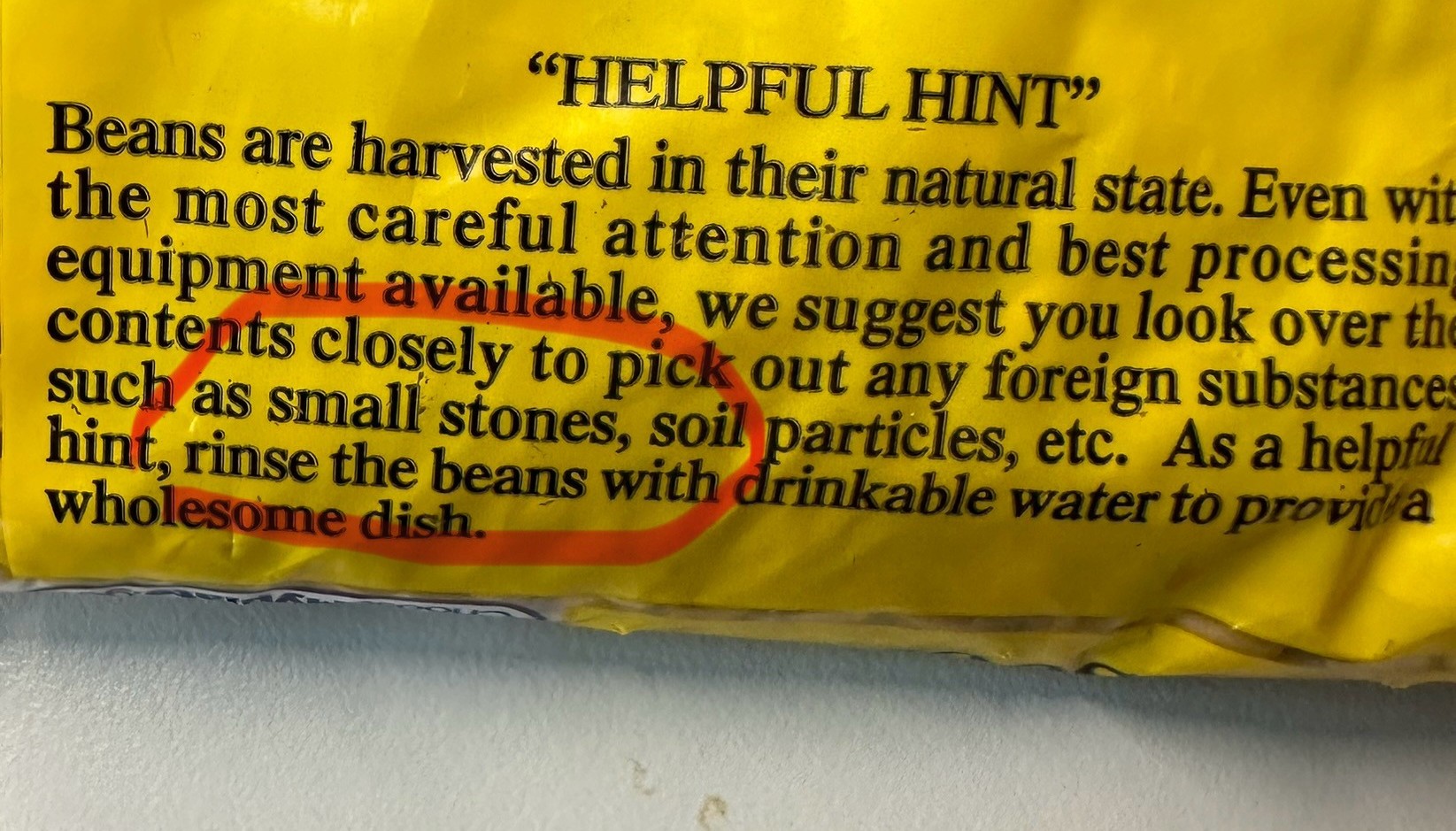 Maybe I expect too much, but as a consumer, I want more than a “HELPFUL HINT” to notify me there might be stones in the food I buy. In this case, a package of lentils. Because a stone can easily break teeth, a strong “WARNING” should be given. Even better, get rid of small stones and other foreign objects in lentils.
Here’s the “HELPFUL HINT”:
“Beans are harvested in their natural state. Even with the most careful attention and best processing equipment available, we suggest you look over the contents closely to pick out any foreign substances, such as small stones, soil particles, etc.”
Not crazy about soil particles in food, but they’re much less likely to cause harm. A little worried what “etc.” could include.
Tort law on unexpected, harmful objects in food products was traditionally based on a “foreign” vs. “natural” distinction. For example, a piece of chicken bone in chicken salad might be considered natural and not a basis for liability. That is still the law in some jurisdictions, but the modern law is whether a consumer would “reasonably expect” the harm-causing object to be in the food product. Stones, anyone?
(Quick research I can’t vouch for says modern equipment and methods eliminate 99.9 percent of foreign objects in beans and lentils. After following the prominent hint on the package, I didn’t discover any in the package I purchased.)
“Friendly” New Yorker Warning
 My best friend lived in New York and swears that New Yorkers are actually more friendly than Southerners. She thinks Southern friendliness is fake (we disagree) and that New Yorkers, while they can be blunt, are actually being more friendly because they’ll be honest and real with you.
The example she gives is, “Let’s say you go into a drugstore to get a tube of toothpaste. You go to buy it and clerk says, ‘Nah, you don’t want that toothpaste. You want THIS toothpaste.’ That’s real friendliness.”
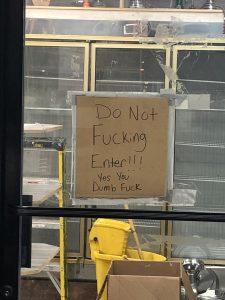
If she’s right, this blunt warning sign a Facebook friend grabbed a picture of in NYC might actually be a “friendly” warning. It says”
“Do Not Fucking Enter!!! Yes You Dumb Fuck”
Is It Dumb to Make Intentionally Funny Warning Signs?
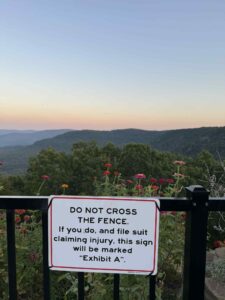 Many people find intentionally funny warnings labels or signs to be amusing. Take this one (verified as real), taken at an overlook at the Arkansas Grand Canyon. It’s amusing and probably effective. Poking fun at tort lawsuits and the tendency of humans to do stupid things while also making it clear that one should not climb over the railing or fence and fall to their death or severe injury.
Nevertheless, viewing it from a Torts professor point of view, I stay with my legal opinion (expressed in previous posts) that it is unwise to turn severe risks of physical harm into a joking matter.
Socratically speaking, let us suppose an onlooker fell over the railing because (1) someone accidentally pushed them, (2) they were a child and didn’t appreciate the risk, (3) there was a defect in the railing, (4) or even because they were careless in stretching to get a better picture.
A plaintiff’s attorney could have a field day with this sign, already conveniently identified by the defendant as “Exhibit A.”
DO NOT CROSS THE FENCE.
If you do, and file suit claiming injury, this sign will be marked “Exhibit A”.
Hilarious! A gut-buster! … Oh, the plaintiff’s quadriplegic? His guts actually busted? For real? Not as funny as I thought.
Maybe the scenarios I posed are unlikely. I can’t tell how high the “fence” is. Still, why even think about resorting to humor when conveying a risk of death or disabling physical injury?
–Thanks to former student Ginger Stuart for the photo!
“Bee Careful” — A Warning with a Personal Touch
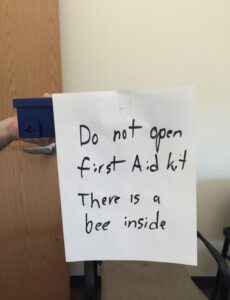
“Warning, live without warning,” sang Billie Joe Armstrong on the Green Day song, Warning. Good tune, terrible advice. While, as lawhaha.com fans know, the world is flooded with warnings of dubious value, warnings can alert people to dangers they might not have otherwise recognized or known about.
Surely that holds true for this warning a former law student of mine reposted on Facebook to commemorate what she hilariously described as her “first major decision” as an assistant director of a youth services agency:
“Do not open first aid kit. There is a bee inside.”
This seems like really helpful information to me. On the other hand, the good news is that, absent the warning, there would probably be supplies in the first-aid kit to treat a bee sting.
Dangerous Highway Conditions: More Rolling Torts
One of easiest and most common potential torts to spot if you like to play “Spot the Tort” (i.e., identify conditions around you that may present unreasonable danger of harm to persons or property) is a form of a dangerous highway condition that we at lawhaha.com call “rolling torts.”
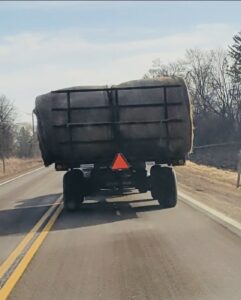
These are ubiquitous. Why? Because people often need to move large objects, but lack the proper vehicles and/or trailers to move them down the road. Here are couple of recent ones a Facebook friend pointed out. Lawhaha.com is loaded with other examples of rolling torts. Samples include this one, this one, and this one.