Motion to file Box of Crayons

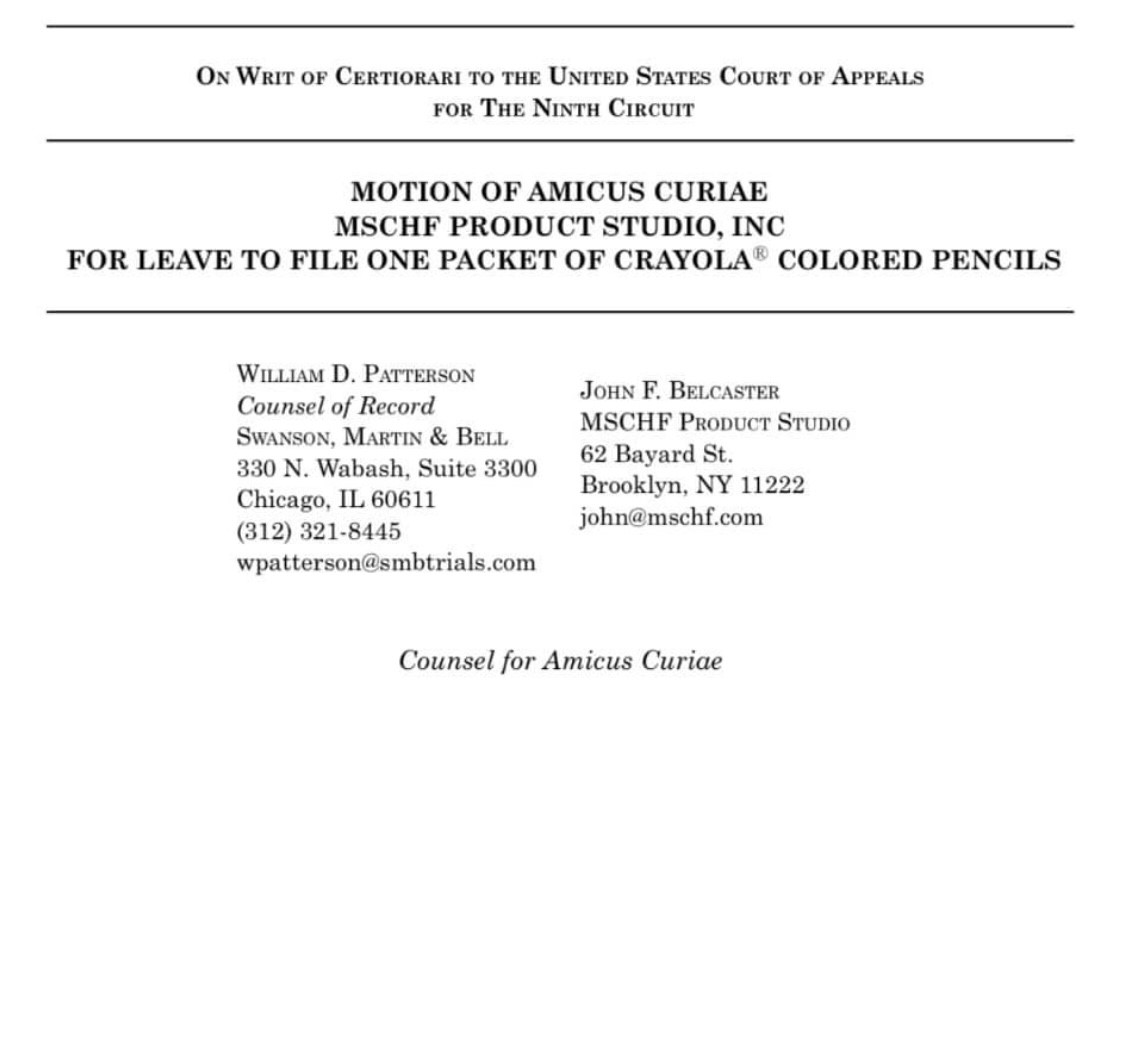
When you come across a motion to file a box of crayons in a case seeking a writ of certiorari in the U.S. Court of Appeals for the Ninth Circuit, you just have to know more.  Specifically, why are the lawyers asking “FOR LEAVE TO FILE ONE PACKET OF CRAYOLA COLORED PENCILS”?

(I borrowed this from the Facebook page of a former student of mine at the Florida International University College of Law.)

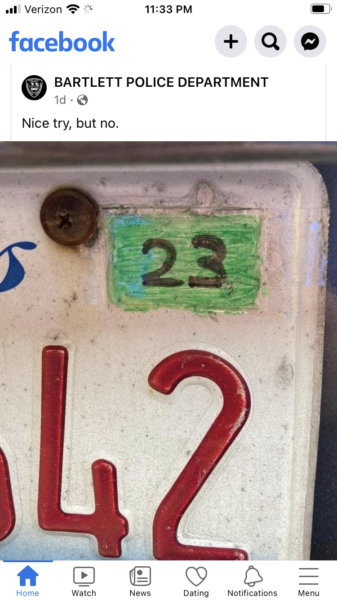
Forged License Plate Is Art for Art’s Sake

This effort to forge a license plate’s vehicle registration renewal sticker must have been art for art’s sake, because it surely had no chance of fooling anyone.
Bartlett is an incorporated suburb of Memphis. The Bartlett police recently posted this picture on their Facebook feed.

Give them credit for their sense of humor. “Nice try, but no,” they said.

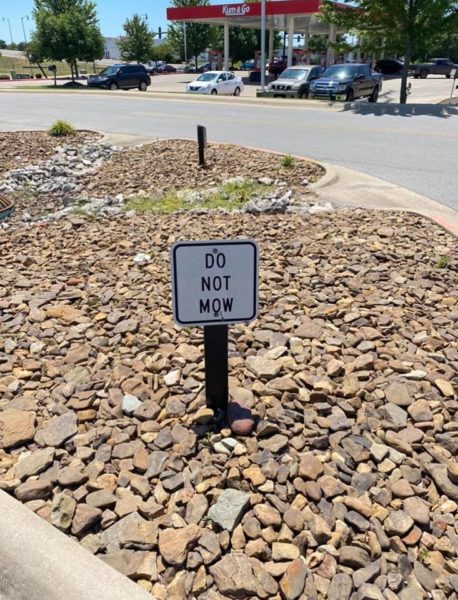
Wacky Warning: Do Not Mow Rocks

Help me figure out this wacky warning/instruction sign in a bed of stones that says “Do Not Mow.” Comes via a friend of a Facebook friend.
Possibilities:

  1. The property owner recently redid the landscaping and replaced the grass with rocks.
  2. The property owner lacks confidence in the skill and judgment of the person or company responsible for maintaining the landscaping.
  3. The property owner’s lawyer is one of my former Torts students to whom I taught the adage, “Tort law is a world where everything that can go wrong does.”

McClurg Interviewed for “Criminal” Podcast Re “Mantraps”

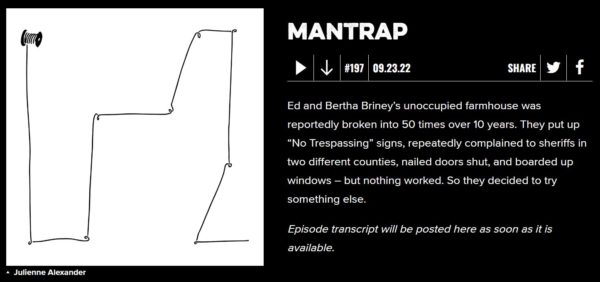
“Criminal,” the highly rated podcast of true crime stories run by former NPR reporters, interviewed me for its newest episode called “Mantrap.” It addresses civil liability for harm caused by deadly booby traps set to protect uninhabited property. Here’s a link to the website podcast and here’s a link to all of the links where the podcast can be heard (e.g., Spotify, Google Play, iTunes, etc.).
My contribution involved one of my favorite tort law cases, Katko v. Briney, the infamous Iowa spring-gun case.

Plaintiff Marvin Katko broke into Ed and Bertha Briney’s uninhabited farmhouse in Eddyville, Iowa, in search of old jars and bottles he considered to be antiques, only to have his leg blown off by a shotgun wired to a bed in one of the bedrooms. The Brineys were fed up with people breaking into the house, which had stood empty for years, so they wired a shotgun to an inside door.

The court described the shotgun-trap as follows:

“After Mr. Briney cleaned and oiled his 20-gauge shotgun, the power of which he was well aware, defendants took it to the old house where they secured it to an iron bed with the barrel pointed at the bedroom door. It was rigged with wire from the doorknob to the gun’s trigger so it would fire when the door was opened. Briney first pointed the gun so an intruder would be hit in the stomach but at Mrs Briney’s suggestion it was lowered to hit the legs.” (Emphasis added.)

(In a previous post, I describe, image included, the amazing claim by the current property owner that he is in possession of the actual wire used for the trap.)

Katko sued the Brineys and—despite the fact that he broke into their farmhouse with an intent to steal—won a substantial jury verdict for both compensatory and punitive damages. Unable to pay it, the Brineys had to sell eighty acres of their farm to three neighbors who agreed to hold it in trust for the Brineys in the expectation that the Iowa Supreme Court would reverse the trial court’s judgment for Katko. But that didn’t happen. The judgment was affirmed on the ground that deadly force cannot be used to protect property only.

Criminal’s new podcast explores the Briney case along with a few other “mantrap” cases.

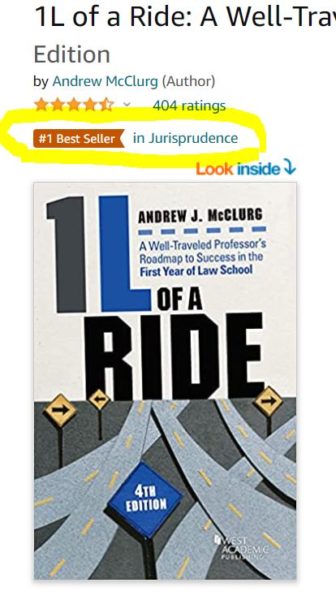
1L of a Ride Number One Bestseller … in Jurisprudence?

Karl Llewellyn, Roscoe Pound, Ronald Dworkin … McClurg?
And you thought 1L of a Ride was simply a helpful law school prep book, but it’s the number #1 Best Seller on Amazon in “Jurisprudence.”

Yale, Chicago, Harvard, I’ll be waiting for your calls.

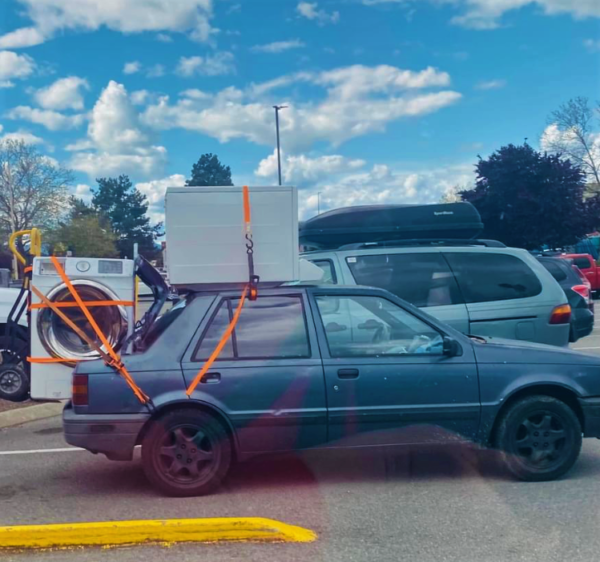
Tips for How NOT to Move a Washer and Dryer

At lawhaha.com, we love what we call “rolling torts,” also known as “accidents waiting to happen.” A rolling tort consists of an effort to move large objects via a vehicle in a way that creates an unreasonable danger to other motorists.
Courtesy of a former student, here we find a valiant effort to transport a full-size washer and dryer with a compact car. To the driver’s credit, the elaborate straps show a solid effort to arrive at the destination without disaster.

More rolling torts can be found scattered through these pages, including here, here, and here.

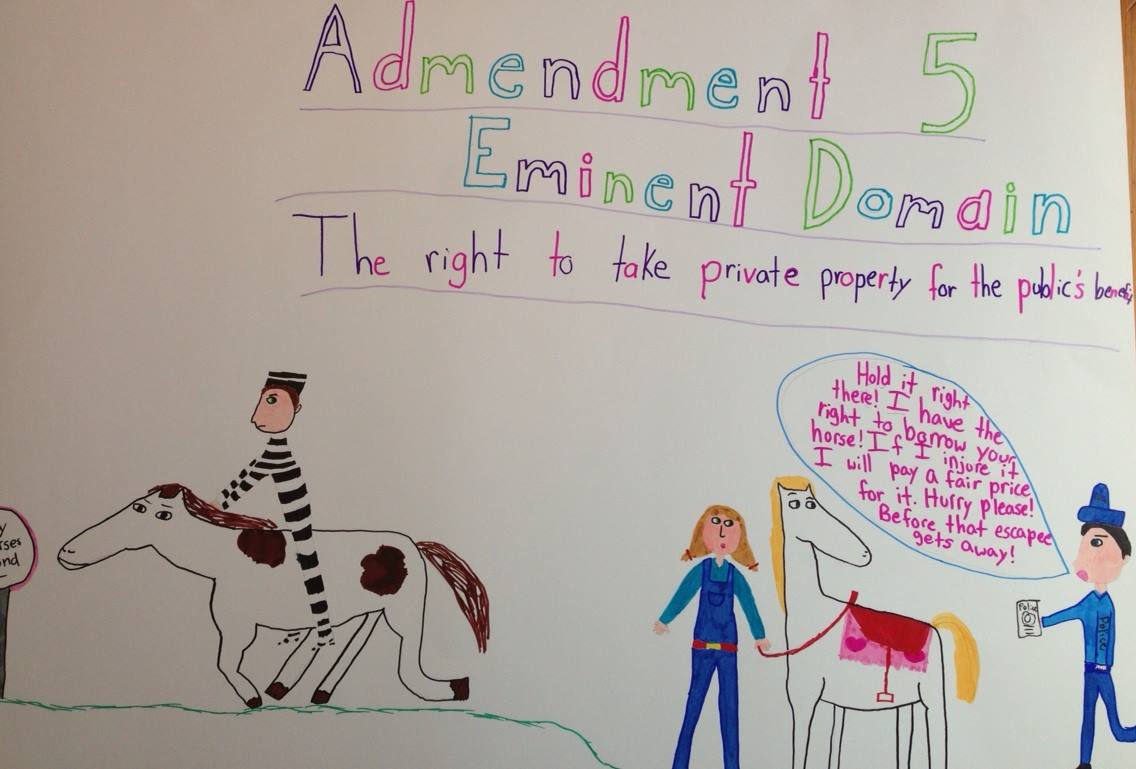
The Eminent Domain Power Explained in a Child’s Drawing

“Eminent domain” is the power of federal and state governments to “take” private property for public use. In 1879, the U.S. Supreme Court held that the power “requires no constitutional recognition” because it is an inherent power of sovereign governments. But governments can’t just take your property without paying for it. The Fifth Amendment to the United States Constitution provides that no private property can be taken for “without just compensation.” Here’s a good history of it.

The Fifth Amendment eminent domain clause is often called “the taking clause,” for obvious reasons. While it only applies to federal actions, all states provide for the power of eminent domain in legislation and/or their state constitutions.

Through the years, lawyers and judges have spent untold hours litigating thousands of eminent domain cases. Many legal treatises addressing the doctrine exist, including the definitive Nichols on Eminent Domain.

But leave it a child to unravel this complex doctrine in a single illustration. This comes from the daughter of two former law students of mine, who gave me permission to post it. I love the expressions on the characters’ faces. Even the getaway horse looks slightly nefarious. And the constable’s words capture the doctrine beautifully: “Hold it right there! I have the right to borrow your horse! If I injure it I will pay a fair price for it. Hurry please! Before that escapee gets away!”

How To Know If You’re a Small-Town Lawyer

While many law students crave the riches and prestige of Biglaw, small-town lawyering is where the real action is at. But how do you know if you really are a small-town lawyer?

The answer came to me courtesy of former student Jim Jackson, who practices tort law in Arkansas (and generously says he was inspired to pursue that area after taking my Torts and Products Liability courses at the UALR School of Law).  He shared a quiz of sorts compiled by a friend named Michael who practices in Crossett, Arkansas. Crossett, on the Louisiana border,  is the county seat and has a population of about six thousand. It’s the very definition or small-town, rural law practice.

Michael’s small-town lawyer test (posted on a trial lawyer’s listserv) consists of a summary of various cases he handled in 2021 (I took the liberty of editing punctuation):

Hi all,

As we begin 2022 I thought I would take a moment and reflect back on some of my more memorable cases as a small town lawyer. So, without further ado …

You might be a small town lawyer if:

1. You have ever had to explain to a client that your “dignity” would not allow you to have a hearing to determine who gets the “Texas Instrument” calculator.

2. You have ever filed a petition seeking an “emergency order of custody” for a goat, because the husband had announced his intentions of having a barbeque, featuring your client’s beloved pet, Marvin.

3. You have ever settled a divorce case by virtue of an agreement with opposing counsel that the attorneys would pitch in $100 each and buy the horse since the parties could not agree on who was going to be awarded the horse.

4. You have ever been involved in a hearing for order of protection that began when the spouse/wife declared to your client that she was going to “take his two pet service squirrels and turn them into owl shit as soon as he left the house!!!!” … and that’s when the fight started.

5. You have ever defended “your secretary” in district court for delivering an “ass” whipping to her ex-boyfriend’s current girl friend in the middle of the Walmart parking lot.  Sigh. Unfortunately, the camera footage pretty well eliminated any hope of a defense. On the bright side, it was a hell of a video.

6. You have ever defended a man in district court over a battery charge that all began with a simple misunderstanding following the girlfriend’s announcement of her pregnancy.

My client took what he deemed to be the “high road” and promptly declared, “Well if it’s mine, I will help support it.” His view on this being that was an appropriate offer under the circumstances. To say that the young lady did not take his offer in the spirit with which it was intended would be a gross understatement. The best way to describe her response would be to say it was “volcanic.”

My 6-foot-tall, 250-pound client was chased out of the house in his boxers by an irate and irrational 5-foot-3, 135 pound female wielding a Ginsu kitchen knife. He lost the tip of his thumb in the scramble and had to sneak back later to get his clothes off the roof of the neighbor’s house (apparently his keys, wallet and cell phone were all in the clothes).

My argument to the court was that he had already suffered a punishment worse than anything the court could impose on him and we should let it go on a “time served” basis. The judge took the matter under advisement.

We are still awaiting a ruling. It has been 7 months.

May your 2022 be as much fun as 2021 was for me.

May you remember it’s not always about how much money we make. Sometimes it’s about how much of a difference we make in the lives of our clients who have trusted us with their problems in their times of need.

It is a blessing and an honor to be able to practice law.

Okay, Biglaw associates. The billable-hour clock is ticking. Time to get back to reviewing documents and doing due diligence. Me, I’m heading to Crossett for some excitement!

Experts Predict the Job Market in 20 Legal Specialties

Law students spend too much time reading cases and too little time thinking or learning about what kind of legal job would be the best fit for them. In the cover story for the Fall 2021 issue of The National Jurist Magazine, I and my co-authors of Law Jobs: The Complete Guide (West Academic Publishing 2019) seek to predict the job market in 20 legal specialties.

Read 20 Hottest Law Jobs for the Next Decade

Worthwhile reading for all law students. But it’s not enough. Your goal in choosing a legal career isn’t just to find a job, but find one that fits your values, personality, and overall goals in life. Is money the most important thing to you? Autonomy? Work-life balance? In more than six hundred pages, Law Jobs covers in detail the pros and cons of every major legal career type. Only by knowing these, will you be in a position to find your dream job. Check it out.

Meanwhile, enjoy reading our predictions for twenty legal specialties for the next decade!

What is this Graphic Warning Sign Trying to Say?

Can you figure out all the things this sign is trying to tell you?

Pictorial or graphic warning and instruction signs and labels are intended to be universally understood. That’s why they exist. There are roughly 6,500 different languages on this planet and space limitations, among other concerns, limit the ability to use multiple languages to explain warnings and instructions.

Many product makers and public space operators do use multiple languages in their warnings, but they generally stick to a few top choices, usually selected by anticipated regional audiences. Dual English and Spanish warnings, for example, are common in the U.S.

The problem is that it’s difficult to convey warnings or instructions using only graphics. I don’t recall how this sign came to me, but let’s use it as an example. My first reaction looking at it is it’s too complicated and no one’s going to notice or pay attention to it in the first place.

Studying it, let’s try to guess what it is trying to convey to people:

  1. Don’t touch anyone (or maybe just women or geishas)?
  2. Don’t sit?
  3. Don’t lean?
  4. Don’t smoke.
  5. Don’t eat.
  6. Don’t litter.
  7. Don’t take selfies?

Sounds like a fun place! But they left off, “Don’t breathe,” “Don’t blink,” “Don’t come here.”