“Criminal,” the highly rated podcast of true crime stories run by former NPR reporters, interviewed me for its newest episode called “Mantrap.” It addresses civil liability for harm caused by deadly booby traps set to protect uninhabited property. Here’s a link to the website podcast and here’s a link to all of the links where the podcast can be heard (e.g., Spotify, Google Play, iTunes, etc.).
My contribution involved one of my favorite tort law cases, Katko v. Briney, the infamous Iowa spring-gun case.
Plaintiff Marvin Katko broke into Ed and Bertha Briney’s uninhabited farmhouse in Eddyville, Iowa, in search of old jars and bottles he considered to be antiques, only to have his leg blown off by a shotgun wired to a bed in one of the bedrooms. The Brineys were fed up with people breaking into the house, which had stood empty for years, so they wired a shotgun to an inside door.
The court described the shotgun-trap as follows:
“After Mr. Briney cleaned and oiled his 20-gauge shotgun, the power of which he was well aware, defendants took it to the old house where they secured it to an iron bed with the barrel pointed at the bedroom door. It was rigged with wire from the doorknob to the gun’s trigger so it would fire when the door was opened. Briney first pointed the gun so an intruder would be hit in the stomach but at Mrs Briney’s suggestion it was lowered to hit the legs.” (Emphasis added.)
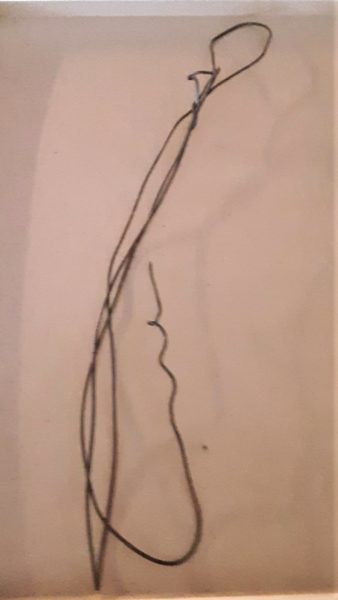
(In a previous post, I describe, image included, the amazing claim by the current property owner that he is in possession of the actual wire used for the trap.)
Katko sued the Brineys and—despite the fact that he broke into their farmhouse with an intent to steal—won a substantial jury verdict for both compensatory and punitive damages. Unable to pay it, the Brineys had to sell eighty acres of their farm to three neighbors who agreed to hold it in trust for the Brineys in the expectation that the Iowa Supreme Court would reverse the trial court’s judgment for Katko. But that didn’t happen. The judgment was affirmed on the ground that deadly force cannot be used to protect property only.
Criminal’s new podcast explores the Briney case along with a few other “mantrap” cases.
The actual wire used to set up the shotgun trap in Katko v. Briney
Lawhaha.com has uncovered new details—and a Torts artifact—regarding the infamous “Iowa spring-gun case”: Katko v. Briney. Most law students read and remember this unusual case, in which plaintiff Marvin Katko broke into Ed and Bertha Briney’s abandoned farmhouse in Eddyville, Iowa, in search of old jars and bottles he considered to be antiques, only to have his leg blown off by a shotgun wired to a bed in one of the bedrooms.
“After Mr. Briney cleaned and oiled his 20-gauge shotgun, the power of which he was well aware, defendants took it to the old house where they secured it to an iron bed with the barrel pointed at the bedroom door. It was rigged with wire from the doorknob to the gun’s trigger so it would fire when the door was opened. Briney first pointed the gun so an intruder would be hit in the stomach but at Mrs Briney’s suggestion it was lowered to hit the legs.” (Emphasis added.)
Now stop and take a look at the image. That’s right, it’s purportedly the actual wire used to rig the shotgun to the doorknob. How did I obtain this artifact (actually, only the picture of it)? Read on.
Katko sued the Brineys and—despite the fact that he broke into their farmhouse with an intent to steal—won a substantial jury verdict for both compensatory and punitive damages. Unable to pay it, the Brineys had to sell eighty acres of their farm to three neighbors who agreed to hold it in trust for the Brineys in the expectation that the Iowa Supreme Court would reverse the trial court’s judgment for Katko. But that didn’t happen. The judgment was affirmed on the ground that deadly force cannot be used to protect property only.
Last fall, teaching Katko to a class of 1Ls, a student raised her hand and volunteered that her boyfriend’s parents owned the Iowa property where the legendary farmhouse once stood and were in possession of the actual wire that was used in the shotgun trap.
The student arranged for me to interview “Jim,” her boyfriend’s father. (I’ll leave out last names for privacy reasons). Jim’s parents were one of the neighbors who bought the Briney’s property to hold in trust.
(Caveat: I have no way to confirm the following tidbits Jim shared with me, so take them as one observer’s memory of events that happened several decades ago).
I asked Jim what the Brineys were like.
“Well, they were a little strange,” he said. “They used to leave food in the house because they thought the ghosts of Mrs. Briney’s mother and father lived there. They left the house fully furnished, the table set, et cetera. They left food in the cupboard behind the table.”
If true, this may answer one of the questions students often have about the case. The Brineys set the shotgun trap because the abandoned house had been repeatedly broken into. Students commonly ask, “Why didn’t they just take anything of value out of the house?”
Seeking to establish the provenance of the purported Briney wire, I asked, “How did you know to keep the wire?”
“It was still attached to the bed,” Jim said. “My wife took it off and we kept it.” That was before they intentionally burned down the house, a barn, and a machine shed because they “weren’t worth anything.” (I suggested he consider donating the wire to the American Museum of Tort Law, but he said they wanted to keep it.)
As for Marvin Katko, Jim said he knew him from school. He said they were in the school band together. Marvin played saxophone and even had a local dance band at one point.
“It was after high school that he [Katko] started being known as a delinquent,” Jim said. “He had somewhat of a reputation around town.”
Jim claims Katko was suspected of stealing a marble-top dresser from the Briney’s house prior to the occasion where he was shot. He also asserted, “Ed Briney tried to shoot Katko himself. Many nights he laid on his stomach in the house with his gun waiting for Katko to come.”
After the Iowa Supreme Court affirmed the jury’s verdict, a dispute arose as to the land held in trust by the neighbors. According to the Prosser, Wade & Schwartz Torts casebook, the Brineys and Katko joined together to sue the neighbors and the lawsuit was settled for enough to pay the judgment against the Brineys. Jim says his father bought out the other two neighbors and handed the property down to him.
Jim said there was a great debate in Eddyville at the time of the case and for years after, with some people siding with Marvin Katko and others defending the Brineys. A niece of Marvin Katko once sent me an email affirming that it was very difficult for the Katko family to regain friends after the event.
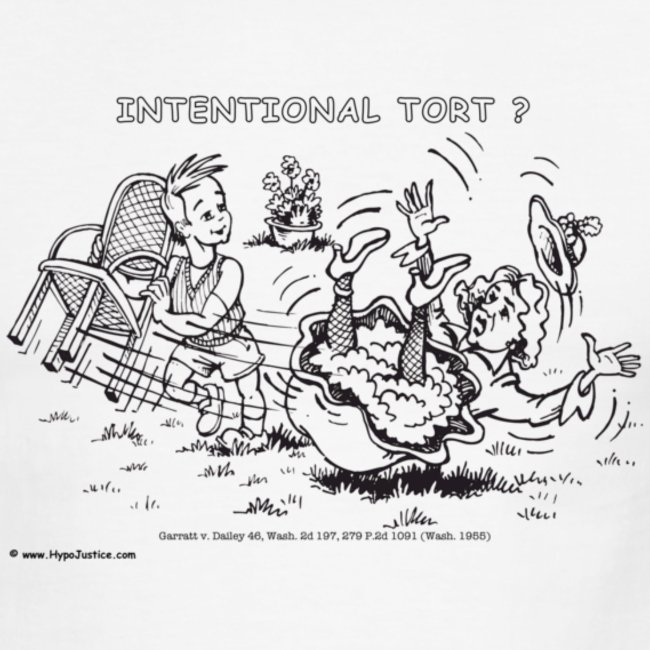
Yesterday I taught my first Torts class of the year and, as always, we began with Garratt v. Dailey, 279 P.2d 1091 (Wash. 1955), where an elderly woman sued a five-year-old boy for battery for pulling a chair out from under her as she was (allegedly) trying to sit in it.
The main issue was whether the Brian Dailey, the five-year-old, had what is called “belief intent” (aka “substantial certainty” intent) that the plaintiff would try to sit where the chair had been previously situated in the backyard.
But an interesting side issue was whether a five-year-old is capable of forming the requisite “intent” to commit an intentional tort. Perhaps surprisingly to non-lawyers, the Garratt court, as have other courts, held that even young children have the mental capacity to form the intent to inflict a harmful or offensive bodily contact upon another.
Students often question this principle, arguing that five-year-olds lack the mental capacity to appreciate the consequences of their acts. Importantly, the law of intent does not require that the child intended to “injure” the other or to appreciate all the ramifications of his or her acts (such as, in Garratt, that the elderly plaintiff would suffer a fractured hip when she fell to the ground).
But now a video clip of a young girl walloping her infant brother into a foam pit strongly suggests the courts got it right on this point:
People frequently ask me, What makes for a good lawyer? “Problem-solving skills” is the first answer that comes to mind. Do you possess them? Take this test and see.
Problem: A high school baseball game is scheduled. Unfortunately, the field is wet from heavy rain. How do you solve this problem?
Answer choices:
(a) Play the game on the wet field because what’s the big deal with that?
(b) Recognizing that a wet field risks injury to players, make your best efforts to squeegee off or soak up the water.
(c) Recognizing that (b) would be too much freaking work, cancel the game and reschedule it for when the field is dry.
(d) Pour 24 gallons of gasoline on the field and set the damn thing on fire.
(d) was the choice made at a high school baseball field in Connecticut, turning the field into a toxic mess that will cost an estimated $50,000 to clean up. The town posted the news on its Facebook page, generously taking responsibility for the incident: “A poor decision was made … to ‘dry the field quicker’ and 24 gallons of gasoline was poured and set on fire.”
If you picked (d), congratulations! You should avoid law school (please), but have potentially positioned yourself to be an influencer for a major oil company.
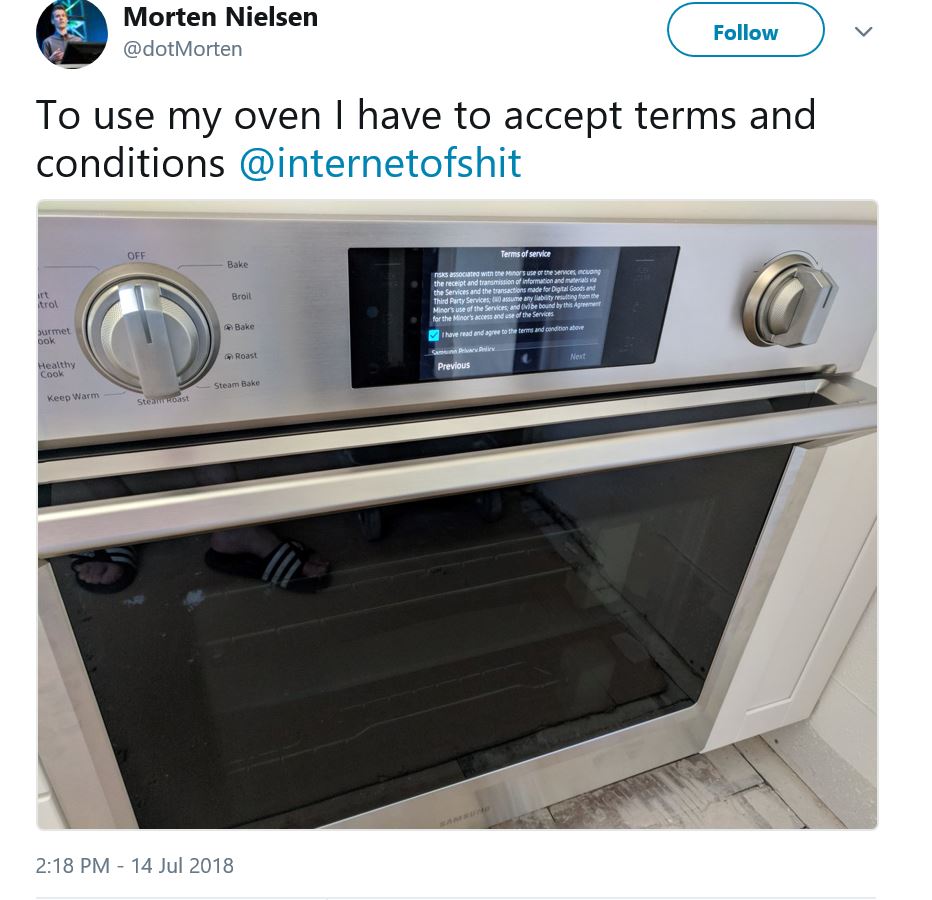
One of my students sent me this tweet from Morten Nielsen regarding a new oven requiring on the touch screen that, before using the product, the happy new appliance owner must waive their legal rights by agreeing to the “Terms of Service.” Even in just the snippet of text visible in the picture, the user is assuming risks and waiving legal claims.
Stripping away the legalese, before you can warm up a pizza, you have to give up some legal rights.
A “contract of adhesion” is a form contract where the party being asked to sign it has no choice but to take it or leave it. They’re always unfair because there’s no bargaining power. That’s the very definition of a contract of adhesion.
The original concept of a contract is a bargained-for exchange of goods or services. Courts supposedly look unfavorably on contracts of adhesion, but unless they involve a service on which the public depends (such as medical services or public transportation or public education), they’re upheld.
Did you know that each time you click “Accept” on an online click-thru agreement, you’ve bound yourself to a legal contract? One survey found that 56 percent of people were not aware they were entering into binding agreement.
But, even there, you at least theoretically have the right to not use the service. Don’t want to accept iTune’s or Facebook’s terms of service? Don’t use those services. But where is that choice when you’ve had a new appliance installed and can’t use it without first agreeing to the Terms of Service?
Welcome to the Internet of Things. It’s only going to get worse, much worse. The next generation oven will come with a built-in corporate lawyer who will send you threatening cease and desist alerts if you overcook or undercook your food and bill at a rate of $300 per hour. If you don’t put a lid on the food and it spatters the inside, you will be sued for punitive damages.
At least this is what I heard from some person I met in a bar. I think her name was Alexa.
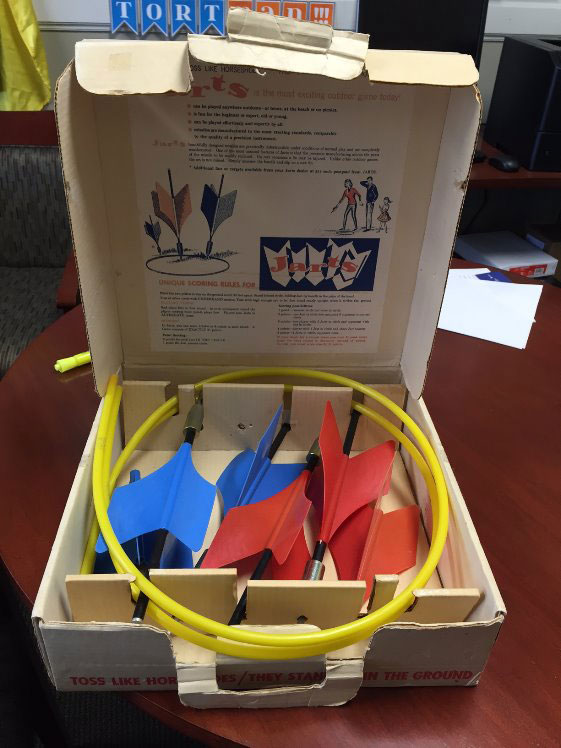
[Great News. The Torts Museum accepted my invitation. My lawn darts will be safely displayed in the museum’s “Dangerous Toys” section.]
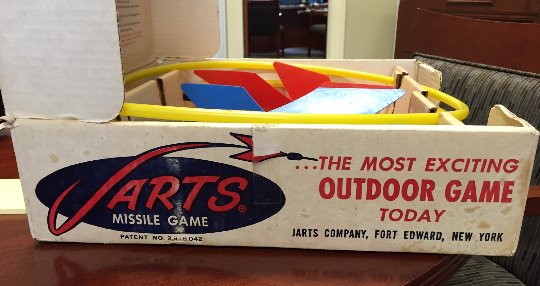
When I first heard the news about Ralph Nader’s new American Museum of Tort Law, my first thought was, “Awesome! A Torts Museum.” My second thought was, “My lawn darts! They belong there.”
In case you missed the news, the Torts Museum opened last month in Nader’s home town in Winsted, CN. The museum offers a history of American tort law, with exhibits covering everything from the infamous McDonald’s hot coffee case to the even more infamous Ford Pinto exploding gas tank fiasco.
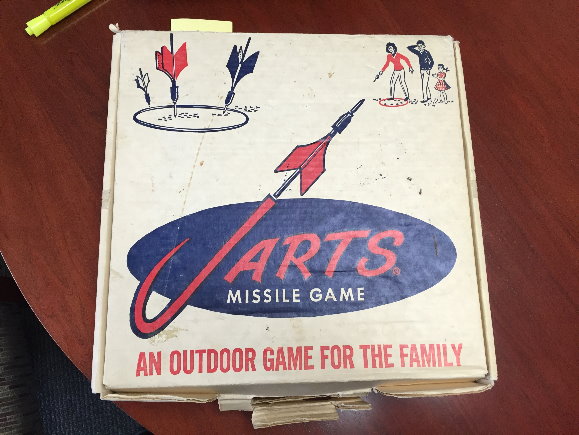
I bought my lawn darts about twenty years ago at a garage sale. Never used. No dirt or even bloodstains. Pristine. I knew it would be selfish for me to keep enjoying them, like hiding a Rembrandt in a private studio.
Lawn darts were banned by the Consumer Product Safety Commission in 1988 on the basis that their risk outweighed their social usefulness. The Commission reported three deaths associated with lawn darts from 1970-1988 and an estimated 700 annual emergency room cases. Then-Commissioner Anne Graham explained the Commission’s risk-utility analysis (which my current first-year students will recognize as Judge Hand’s famous formula for negligence):
What limited recreational value lawn darts may have is far outweighed by the number of serious injuries and unnecessary deaths. This week another child was severely injured by a lawn dart. She is now in critical condition. There are numerous alternatives to lawn darts, and I would urge adults who have lawn darts to throw them away now.
The most amazing aspect of my set of Jarts is that the packaging doesn’t include a single warning.
To the contrary, it touts lawn darts as “The Most Exciting Outdoor Game Today.” No doubt. Nothing like a screaming ambulance to liven up the neighborhood.
Best of all, it was a game for the whole family, except … oops, that missile on the cover appears headed straight for mom!
The Consumer Product Safety Commission’s original notice of the ban “urge[d] consumers to discard or destroy all lawn darts immediately” and instructed them to call the Commission’s hotline if they find any still for sale.
Leave it to insurance coverage guru/legal humorist Randy Maniloff to track down the most interesting cases for his monthly publication, Coverage Opinions. Among this month’s excellent articles (which include a mock interview with Tom Brady), Randy revisits his insurance Coverage for Dummies contest with the case of Blank-Greer v. Tannerite Sports, LLC, No. 13-1266 (N.D. Ohio Apr. 21, 2015).
Here are the basic facts, borrowed from Randy’s excerpts from the court’s opinion:
In May 2012, [James] Yaney’s friend, Jason Vantilburg, in anticipation of the birth of his first child, asked Yaney to host a party to celebrate. Yaney and Vantilburg fashioned the party into a ‘diaper shootout,’ where guests could bring diapers for the new baby and enjoy an afternoon shooting guns in Yaney’s backyard. As a ‘grand finale’ to the party, they also decided to blow up an old refrigerator.
In preparation, Yaney used his [Yaney] Motorsports truck to haul the refrigerator from Vantilburg’s home to his property. He then used his trailer to tow a box van to his backyard so that guests had a target to shoot. On the day of the event, Yaney set up the Motorsports truck and trailer as a staging area for guns and ammunition. ***
Towards the end of the event, Yaney and Vantilburg decided it was time to blow up the refrigerator. They hauled the refrigerator from Yaney’s pole barn into the backyard. Guests stood behind tables fifty meters away from where the refrigerator was located. Vantilburg moved into position behind his rifle, fired at the explosives [H2] inside the refrigerator, and detonated them. The refrigerator immediately blew apart and sent shrapnel flying across the yard. A piece of shrapnel hit (guest) Plank–Greer’s hand, nearly severing it.
Read Randy’s full account of the case, which addressed the issue of whether the party host was acting in the scope of employment with respect to insurance coverage from his business. The court said no.
Thanks to legal humorist extraordinaire Randy Maniloff for a nice shout-out to Lawhaha.com as part of his recent article exploring cartoon accident clichés that found their way to the courthouse.
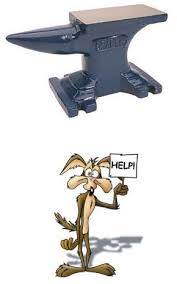
Exploding cigars, falling anvils, you name it. Turns out the experiences of Wile E. Coyote and Tom and Jerry also happen to ordinary people, and Randy cites the cases to prove it.
That’s one of the things we most appreciate about him. Like Lawhaha.com (and unlike so many purveyors of legal humor), Randy doesn’t circulate undocumented anecdotes that may or may not have really happened. He researches and provides citations to everything.
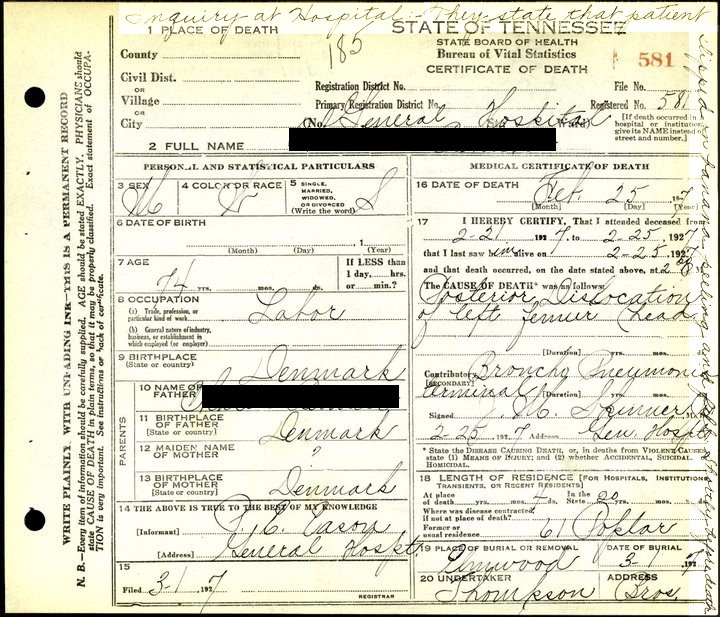
Slipping on a banana peel is, of course, a classic clichéd accident depicted in cartoons. As my 1Ls get ready to tackle the famous trilogy of banana peel slip and fall cases in the Prosser, Wade & Schwartz Torts casebook next week, the nagging question that lingers is: do people really slip on banana peels?
A previous post discussed this issue, but check this out. It’s a 1927 Tennessee death certificate for a 74-year-old hospitalized man. A bit hard to read, but the highlighted note written across the top and going down the right side says:
Inquiry at Hospital: They state that patient slipped on banana peeling and fell shortly before death.
A while back I posted a picture of a coffee cup, reportedly from Canada, that made fun of U.S. tort law and, indirectly, poor Stella Liebeck, the plaintiff in the infamous McDonald’s coffee spill.
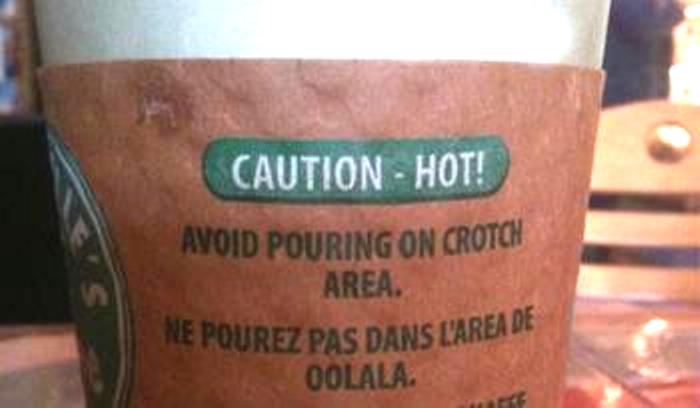
Now Chris Fergus, a professor in Australia, sends along this photo showing another coffee cup maker having a grand old time with the case by including a warning on its cups stating, “Avoid Pouring on Crotch Area.” I don’t speak French, but can guess the French version amounts to something like “Don’t Pour It on Your Oolala.” Chris said he received the photo from one of his students and is unsure where it originated.
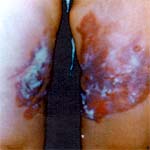
Hilarious, unless you happen to end up like Ms. Liebeck. Sorry for the graphic pic, but this is actually one of the milder pictures of her burn injuries:
And so here we are more than a decade later continuing to distort the American tort system with a case in which dangerously hot coffee sold through a drive-thru window caused third-degree burns to a 79-year-old woman who accidentally spilled it while a passenger in a stopped vehicle trying to add cream and sugar. Consult the original post for links to some eye-opening information about what really happened in the McDonald’s coffee spill case.

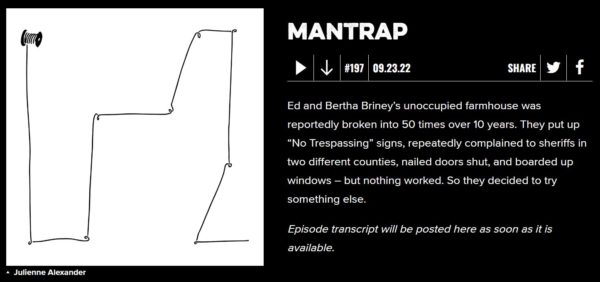 “Criminal,” the highly rated podcast of true crime stories run by former NPR reporters, interviewed me for its newest episode called “Mantrap.” It addresses civil liability for harm caused by deadly booby traps set to protect uninhabited property. Here’s a link to the website podcast and here’s a link to all of the links where the podcast can be heard (e.g., Spotify, Google Play, iTunes, etc.).