Wacky Patents: Ohio State Seeks to Trademark “The”

The Ohio State University has filed a patent application for the word “THE”.  What THE … !! oops, sorry, don’t want to get a cease and desist letter.  But it’s no joke.  See Trademark application No. 88571984, filed Aug. 8, 2019.  Here’s an article about it.

I knew it would happen someday.  Eighteen years ago, in a Harmless Error column in the American Bar Association Journal, I published an intellectual property parody titled The© Controversy, about a made-up cease and desist letter I received claiming a copyright in the word “the”.  Here’s an excerpt from the column:

The letter asserts that Mr. Ug—allegedly a Homo erectus Peking Man domiciled in a cave in China 500,000 years ago—was first to utter the word the. The heirs are claiming a copyright in the and want me to quit using it. They also seek damages for past infringement. I could use some legal advice. Here’s the letter:

Dear Sir:

We recently became aware of your meager attempts to achieve humor through the© deliberate and willful exploitation of our client’s property; to wit, the© word the©.

Specifically, in the© past 48 months, we have documented more than 7000 copyright infringements of the© protected work in your humor columns, email, bathroom graffiti and other writings, all in violation The© Copyright Act of 1976, §101 et seq.

Mr. Ug copyrighted the© in or about 498,000 B.C. when, as a result of an apparent misunderstanding of the properties of fire, he pressed tongue to palate while simultaneously exhaling, thereby authoring theeeeaaaaahhhhieeeee, one of the most enduring and highly-creative works of the 498th century, B.C.

(Immediately thereafter, he authored another dramatic work — ump, ump, ump — while bludgeoning himself with a club to distract from the pain in his flaming foot.)

As Mr. Ug’s lawful heirs, our clients assert a copyright in the© entire compilation work and a derivative right in each subpart: the, eee, aaaaa, hhhh, ieeeee, as well as ump (which we are currently disputing with Major League Baseball).

As you may know, copyright law requires that the protected work be expressed in a tangible form. Fortunately, Mr. Ug was a Peking Man of great foresight.

Enclosed is a photograph of the inside of Mr. Ug’s residence where you can clearly see the copyrighted works carved in the rock directly above the crude drawing of what appears to be a sabre-tooth tiger devouring Mr. Ug’s neighbor (we also assert a copyright in all pictures of tigers, neighbors and food products). According to our expert anthropologist, the chisel mark at the end is in fact a © symbol.

We demand that you immediately cease and desist using the© either orally or in writing and that you compensate our clients for past use. Be advised that This Letter© is copyrighted and that copying, quoting or even reading it will subject you to additional legal action.

Very truly yours,

We Own It, the Macho IP Firm

I received an email from a lawyer who took the column seriously (seriously?), arguing that “the” cannot be copyrighted.  But can it be trademarked?  We’ll wait and see.

Hilarious New Book: UnVentional by Tom Giesler

How do you describe a book that is so original, creative and wacky that the best comparison to it is to MAD Magazine?  (Fitting since Al Jaffee, the legendary MAD cartoonist and creator of the fold-in cover, wrote the forward to it.)

We’re talking about Patent Illustrator Tom Giesler’s new book, “UnVentional,” an unhinged collection of bizarre free inventions to save the world.  Watch his hilarious trailer for a clearer picture:

[embedyt] http://www.youtube.com/watch?v=ZDaCYW6ms-k[/embedyt]

Reviews:

Adam Savage, co-host of Mythbusters: “Tom Giesler has the illustrator’s version of perfect pitch. His drawings perfectly capture the sense of strange adventure inherent in every patent drawing. This book is a virtuoso performance.”

David Rees, author of How To Sharpen Pencils: “Brilliant, hilarious, and weirdly inspiring, unventional will forever change the way you look at objects that don’t actually exist.”

Fernando Cota, former U.S. Patent Office examiner: “Mr. Giesler has, for better or worse, applied the principles of open sourcing to the patent process. His cavalier vision is a world free from patent attorneys, licensing, patent examining fees, and, unfortunately, regard for public safety.”

This would make a perfect, unique gift.  Order it on Amazon.

Patent: How About Some Tequila with that Lime and Heart Attack?

patent for lime juice to prevent heart attackThe subject—heart attacks—is not funny, but U.S. Patent No. 6,457,474, issued October 1, 2002, and described as a method of alleviating chest pain, especially from angina pectoris, is amusing or at least interesting. What’s the amazing heart-attack fighting invention? Drinking lime juice.

But, wait, maybe I’m not being fair. Maybe I’m oversimplifying it. Let’s check out the official patent abstract and see:

A method of alleviating chest pain that stems from the heart, which method comprises: (a) noticing a pain in the chest; and shortly thereafter (b) taking an effective amount of lime juice into the body to alleviate the chest pain.

Nope. Guess not. It really is a patent on drinking lime juice. Here’s how the invention works:

In accordance with this invention, a person takes in lime juice after noticing the onset of the chest pain.

Don’t worry if you don’t understand it. It’s a very complex scientific procedure. But let’s at least clear up one other confusing point. What exactly is this secret ingredient? The patent explains:

“[L]ime juice” means lime juice or limeade or any combination that includes the juice of a lime ….

Pucker up because the inventor recommends “drinking at least a glass daily [of lime juice] in non-concentrate form” as a preventative measure.

Sound inconvenient? It’s not. In fact, one of the primary advantages of lime juice as a remedy for angina pectoris over nitroglycerin is that:

Since the juice is regularly stored in the refrigerator or freezer, it can be quickly located by the patient, particularly at nighttime where the refrigerator light plays a helpful role.

— U.S. Patent No. 6,457,474, Oct. 1, 2002. Thanks to David Barman.

Patent: Invention for Making a Sandwich

sandwich
Old-school, uninventive sandwich.

U.S. Patent No. 6,599,545, issued July 29, 2003, is for the new and exciting invention of “Method for making a sandwich.”

To be patentable, an invention must be new, useful and nonobvious. Does this one qualify?

Because it’s such a technical subject, let’s first explore the “The Background Art” of the invention as described in the patent:

Sandwiches typically comprise two slices of bread, and a combination of sandwich fixings disposed between the bread slices.

That’s food for deep thought. Har har. Now that we understand the background art, let’s explore the invention itself, which is:

A method for inserting one foodstuff, such as sandwich fixings, into a second foodstuff, such as a bread bun, which includes forming a cavity in the second foodstuff.

Way over my head, but deconstructed, it appears that invention is: Drill a hole in a bun and jam some cold cuts in there.

— U.S. Patent No. 6,599,545, issued July 29, 2003. Thanks to David Barman.

Patents: Balding Guys Beware — The “Comb-Over” is Patented

comb-over
It appears this famous soccer player did not follow the patent instructions.

Apparently, it’s not as hard to get a patent as people think:

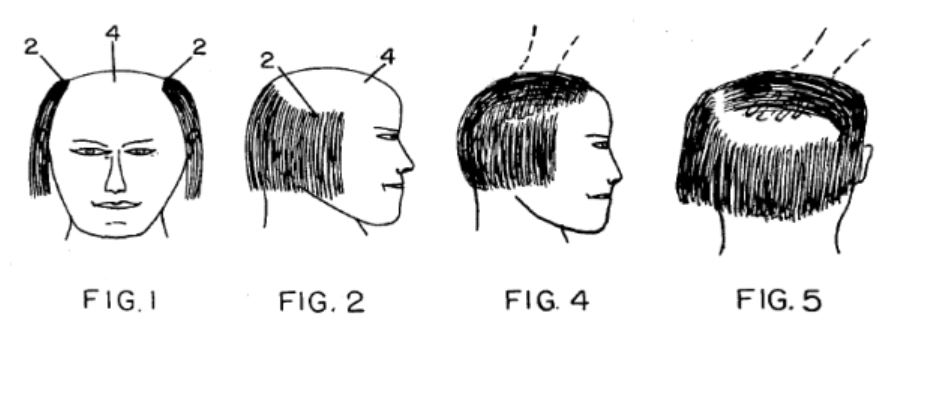
U.S. Patent 4,022,227 is a patent for a “Method of concealing partial baldness,” described more particularly in the abstract as “[a] method of styling hair to cover partial baldness using only the hair on a person’s head. The hair styling requires dividing a person’s hair into three sections and carefully folding one section over another.”

Comb-over patent imagesIt even comes with diagrams:


Yep. It’s a valid U.S. patent for the dreaded “comb-over.”  We’ve all witnessed the results of this amazing invention, which works so effectively that no one notices the baldness, provided they are sight-impaired and at a distance of more than 200 yards.

— U.S. Patent 4,022,227, May 10, 1977. Thanks to David Barman.

Patent: Dog Clean-Up Made Easy (For Experienced Lacrosse Players)

lacrosse stick
Not the patented dog waste catcher, but will work in a pinch.

Do have a dog? Do you like to take it for walks? Do you feel it’s your moral and social responsibility to clean up after it? Are you skilled at playing lacrosse?

If your answer is yes to all of the above, then the invention protected by U.S. Patent 7,090,268, Aug. 16, 2006, is the perfect dog-walking accessory for you.

As described in the patent application, the invention is “a simple portable device which allows the dog’s owner to catch and hold the dog waste in a plastic bag before it comes in contact with the ground or grass without bending over.”

Basically, the invention sounds like kind of a lightweight lacrosse stick that you use to catch dog feces in. But just as in the real sport, you have to be quick on your toes to use this baby effectively. As the patent explains: “As soon as the dog shows a motion to excrete, this device is … placed underneath the dog’s bottom and catches the dog waste, thus preventing the soiling of the ground or grass.”

Is it a good invention? Darn right it is. As everyone knows, “[d]ogs tend to excrete while they are walked” and “[o]nce the droppings fall on the ground or grass, it is difficult to collect them completely, especially when they are loose.” Which, of course, is why many dog owners prefer to leave it to their neighbors to deal with.

This sounds like a good invention, although I’m not sure the dogs are going to sit still for it.

— U.S. Patent 7,090,268, Aug. 16, 2006. Thanks to David Barman.

Patent: Humane Cock-Fighting?

roosterThat’s apparently what the inventors of the “non-lethal gamecock sparring match” and equipment are trying to sell. And they got a patent for it: U.S. Patent 6,928,960, Aug. 16, 2005.

With this invention, each fighting bird is fitted with a protective vest carrying sensors that send a signal to an electronic scoreboard each time they are pecked or clawed. The talons of each gamecock are also “covered with a protective device,” and their beaks are “taped shut.” Sounds very comfortable.

The “background” of the invention explains it was designed to remedy a “cultural clash of values” pitting aficionados of gamecock fighting (which the inventors assert is an accepted and enjoyable form of entertainment in Latin and Asian cultures and many U.S. states) against those who object to the birds being killed or injured.

The patent description reminded me of the Seinfeld episode where Kramer’s rooster, named “Little Jerry,” was about to become embroiled in cock-fighting because of a bad check Big Jerry wrote at the deli. Seinfeld’s explaining that cock-fighting is dangerous and that Little Jerry could get killed. Kramer says something like, “I thought they wore little gloves and helmets!” Well, now they might.

— U.S. Patent 6,928,960, Aug. 16, 2005. Thanks to David Barman.

Patent: Sorry Inventors, But “Head-Mounted Letter M” Already Taken

alphabet
Get busy inventors. "M" is already taken.

U.S. Patent 6,834,453 is for a piece of foam in the shape of an “M” worn on the head.

The invention, cleverly and appropriately named the “Head Mounted Letter ‘M’ Display,” is designed for sports fans who want to support their teams that begin with the letter “M.”

The funniest aspect of this patent (other than that one can get a patent for a head-mounted letter of the alphabet) is all the complex diagrams of a guy wearing an “M” on his head.

— U.S. Patent 6,834,453 , Dec. 28, 2004.

Patent: The Rockets’ Red Glare — And Nasty Odor

fireworksYou’ll be tempted to look this one up to be convinced it’s not made up.

The U.S. Patent and Trademark Office issued a patent for a toy rocket powered by flatulence.

That’s right. U.S. Patent No. 6,055,910 is for a “toy gas-fired missile” that is prepared for takeoff by the operator placing “the inlet tube with its valve open adjacent to his anal region from which a colonic gas is discharged.”

After being loaded, “[t]he ignitor is then activated to explode the mixture in the chamber and fire the missile into space.”

The “Status of the Prior Art” section of the patent offers a dissertation on flatulence, including way TMI in the form of revelations that a normal individual produces 400-600 ml of flatus per day and that the major components, in descending odor, er, order, are: nitrogen, hydrogen, carbon dioxide, methane, and oxygen. The odor-causing ingredients are sulfide, skatole, indole, volatile amines, and short-chain fatty acids.

Why is this invention needed? For consumer safety, of course.

The inventors offer the invention as a safer alternative to the “popular practice” of “ignition of one’s own flatus” by lit match or candle, or a cigarette lighter. Of course, “[a] major drawback” of this practice is the “hazardous coupling of fire, combustible gases and inebriated participants.” Serious burn reports are not uncommon, according to the patent application, “especially … when the participants remove their clothing.”

Accordingly, “[i]n view of the foregoing, the main object of this invention is to provide a safe toy which exploits combustible properties of flatus to fire a toy missile into space.”

— U.S. Patent No. 6,055,910, May 2, 2000. Thanks to David Barman.


Patent: Why Wait Until After Sex to Smoke?

patent for dangerous sex device
Why wait until after?

So you’re reading through the patent entries on the U.S. Patent & Trademark Office website, you know, just for fun, and come across a patent for an invention titled “Method of using a water pipe”:

Bor-ring. But wait. Not so fast. Turns out this inauspiciously titled invention is actually quite interesting:

A water pipe providing sexual stimulation includes a tube with an exit port at its upper end, an reservoir port at its lower end, and an inlet port. The inlet port is spaced from the lower end whereby the inlet port remains exposed when the lower end is inserted into a vagina. The lower end cooperates with the wall of the vagina to form a water reservoir holding water in the lower end and the vagina. A stem is received into the inlet port with an end opening submerged in the water reservoir. Suction applied at the exit port draws air through the stem to bubble through the water reservoir to generate stimulatory vibrations transmitted to the vagina. Optionally, a bowl holding combustible material communicates with the stem such that smoke bubbles through the water reservoir to simultaneously filter and cool the smoke and generate stimulatory vibrations.

 “Water pipe”? “Suction”? “Inlet port”? “Combustible material”? “Smoke”? All combined with a sensitive body part?

Is it just because I’m a Torts professor or does this sound like it fails Judge Hand’s risk-utility formula?

— U.S. Patent No. 7,122,000, issued Oct. 17, 2006. Thanks to David Barman.