Is It Dumb to Make Intentionally Funny Warning Signs?

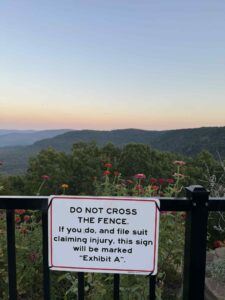
Many people find intentionally funny warnings labels or signs to be amusing. Take this one (verified as real), taken at an overlook at the Arkansas Grand Canyon. It’s amusing and probably effective. Poking fun at tort lawsuits and the tendency of humans to do stupid things while also making it clear that one should not climb over the railing or fence and fall to their death or severe injury.
Nevertheless, viewing it from a Torts professor point of view, I stay with my legal opinion (expressed in previous posts) that it is unwise to turn severe risks of physical harm into a joking matter.

Socratically speaking, let us suppose an onlooker fell over the railing because (1) someone accidentally pushed them, (2) they were a child and didn’t appreciate the risk, (3) there was a defect in the railing, (4) or even because they were careless in stretching to get a better picture.

A plaintiff’s attorney could have a field day with this sign, already conveniently identified by the defendant as “Exhibit A.”

DO NOT CROSS THE FENCE.

If you do, and file suit claiming injury, this sign will be marked “Exhibit A”.

Hilarious! A gut-buster! … Oh, the plaintiff’s quadriplegic? His guts actually busted? For real? Not as funny as I thought.

Maybe the scenarios I posed are unlikely. I can’t tell how high the “fence” is. Still, why even think about resorting to humor when conveying a risk of death or disabling physical injury?

–Thanks to former student Ginger Stuart for the photo!

“Bee Careful” — A Warning with a Personal Touch

“Warning, live without warning,” sang Billie Joe Armstrong on the Green Day song, Warning. Good tune, terrible advice. While, as lawhaha.com fans know, the world is flooded with warnings of dubious value, warnings can alert people to dangers they might not have otherwise recognized or known about.

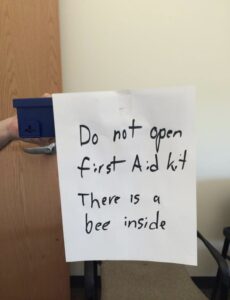
Surely that holds true for this warning a former law student of mine reposted on Facebook to commemorate what she hilariously described as her “first major decision” as an assistant director of a youth services agency:

“Do not open first aid kit. There is a bee inside.”

This seems like really helpful information to me. On the other hand, the good news is that, absent the warning, there would probably be supplies in the first-aid kit to treat a bee sting.

“Save the Baby” Medicine Cautions It Won’t Save Babies

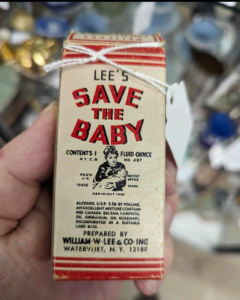
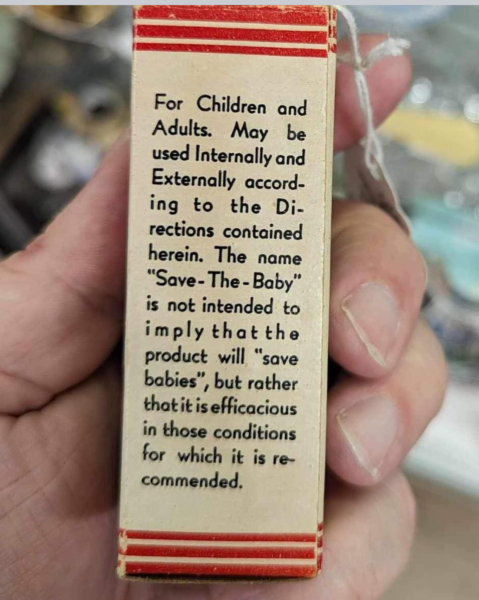
According to the Lancaster Medical Heritage Museum, Lee’s Save the Baby, made by William W. Lee & Co. in the early 1900s, was a children’s cough suppressant to be applied externally to the chest area (although the back cover of the box pictured here said it could be used “Externally or Internally”). The main ingredients included camphor.

Gotta love the foresight to include the disclaimer stating:

The name “Save-The-Baby” is not intended to imply that the product will save babies …

The Lancaster medical museum says:

“The liquid medication has a dark yellow color and it is contained in a glass bottle with a red screw on cap. … The original formula of this product died with Ester Lee in 1974, the last member of the Lee Family.”

Wacky Personal Injury Sticker: Injured? Good!

Talk about a wacky sticker. We’ve all seen the billboards and city benches and bumper stickers, etc., bearing advertisements from plaintiffs’ personal injury lawyers along the lines of:
INJURED? You may be entitled to compensation. Call Tammy the Terminator today for a free consultation!

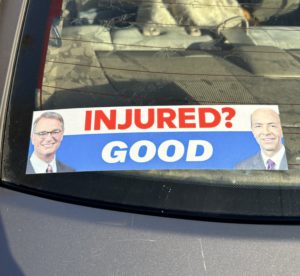
But walking to a gym last week, I passed a car with this sticker on the rear window:

INJURED? GOOD

Yikes! Surely it’s a joke … I hope. If anyone recognizes the two dudes pictured, let me know.

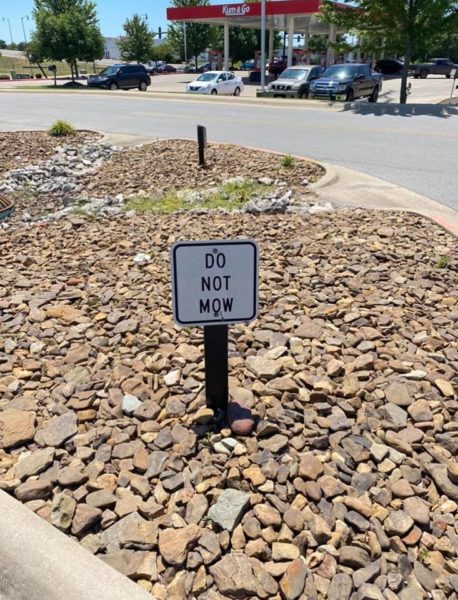
Wacky Warning: Do Not Mow Rocks

Help me figure out this wacky warning/instruction sign in a bed of stones that says “Do Not Mow.” Comes via a friend of a Facebook friend.
Possibilities:

  1. The property owner recently redid the landscaping and replaced the grass with rocks.
  2. The property owner lacks confidence in the skill and judgment of the person or company responsible for maintaining the landscaping.
  3. The property owner’s lawyer is one of my former Torts students to whom I taught the adage, “Tort law is a world where everything that can go wrong does.”

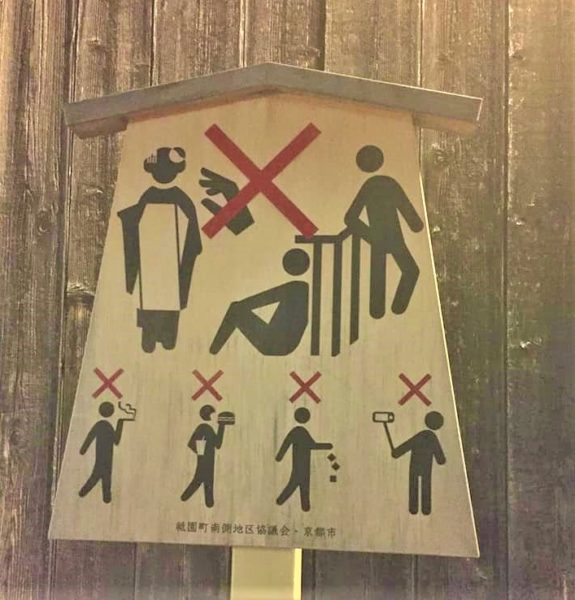
What is this Graphic Warning Sign Trying to Say?

Can you figure out all the things this sign is trying to tell you?

Pictorial or graphic warning and instruction signs and labels are intended to be universally understood. That’s why they exist. There are roughly 6,500 different languages on this planet and space limitations, among other concerns, limit the ability to use multiple languages to explain warnings and instructions.

Many product makers and public space operators do use multiple languages in their warnings, but they generally stick to a few top choices, usually selected by anticipated regional audiences. Dual English and Spanish warnings, for example, are common in the U.S.

The problem is that it’s difficult to convey warnings or instructions using only graphics. I don’t recall how this sign came to me, but let’s use it as an example. My first reaction looking at it is it’s too complicated and no one’s going to notice or pay attention to it in the first place.

Studying it, let’s try to guess what it is trying to convey to people:

  1. Don’t touch anyone (or maybe just women or geishas)?
  2. Don’t sit?
  3. Don’t lean?
  4. Don’t smoke.
  5. Don’t eat.
  6. Don’t litter.
  7. Don’t take selfies?

Sounds like a fun place! But they left off, “Don’t breathe,” “Don’t blink,” “Don’t come here.”

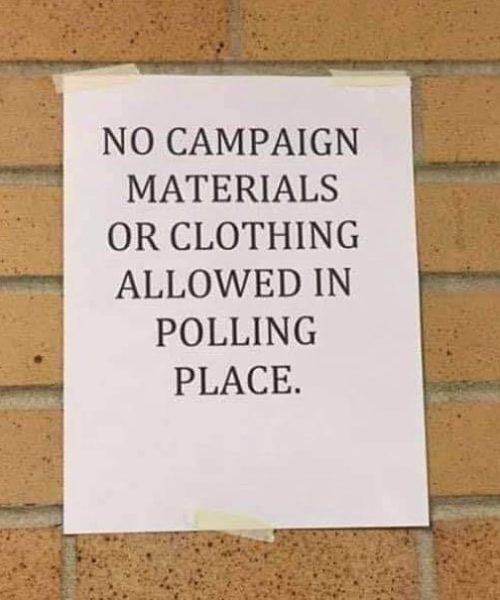
Wacky Sign: “No Campaign Materials or Clothing Allowed”

Let’s face it, even for the most dedicated voters, standing in line waiting to vote can be boring, unless you happened to be at this polling station in Arkansas. You may think of Arkansas as a conservative state, but if this wacky sign is any indication, they are having some wild times over there.


p.s. I’m convinced many if not most “wacky signs” that get circulated these days are fake, but as I recall, this one was posted by an Arkansas friend who took the photo at the polling station.

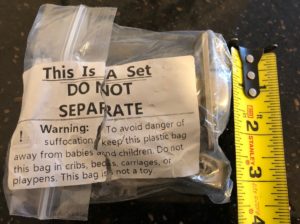
Suffocation Warning to Tiny Tots

Suffocation warning for the tiniest of tots.

If you take a close look at them, nearly all plastic bags in the U.S. contain a suffocation warning. In fact, it’s difficult to find plastic bags without such a warning.

Because most adults presumably know not to put plastic bags over their heads, these warnings are aimed primarily at people with children, especially babies. Because children, and especially babies can’t or don’t read warnings, the warnings are directed at their caretakers.

The risk of suffocation from a plastic bag seems like an obvious risk and there is no duty to warn of obvious risks under U.S. products liability law. But with the cost of a warning and the downsides of including one both being quite low, most product makers take a “might as well include one” approach.

It’s a sensible approach, but was it really necessary to include this large suffocation warning sticker on a bag this small?


Silly Product Warning: Don’t Pick Up Broken Glass with Bare Hands

As a professor of tort and products liability law, I appreciate that manufacturers often feel the need to warn consumers of obvious risks, even though products liability law does not impose a duty to warn of obvious risks.

First, it’s safer from a liability standpoint for the product maker/seller because it avoids the possibility that a jury might, in hindsight after an injury, disagree as to whether a particular risk was obvious. Moreover, warning of obvious risks serves a re-enforcement/reminder function.

The downside of being inundated with warnings of obvious risks is the “dilution effect.” When consumers are bombarded with warnings of risks that are patently obvious, it dilutes the impact of the warnings that really matter.

Case in point: Do we really need a verbal and pictorial warning that people should not pick up broken glass with their bare hands? … Probably, because we’ve all done it.

Boogie Board Guaranteed to be Unsafe (If You Try Hard Enough)

We love wacky product warnings at lawhaha.com, but as a Torts and Products Liability professor, I’ve never been a fan of product sellers trying to be funny in their product warnings or instructions. See, for example, here, here, and here.

But I concede that these “Guarantees” for a foam boogie board are pretty cute, including that it is guaranteed “to be unsafe in some way if you really work at it.”