As a professor of tort and products liability law, I appreciate that manufacturers often feel the need to warn consumers of obvious risks, even though products liability law does not impose a duty to warn of obvious risks.
First, it’s safer from a liability standpoint for the product maker/seller because it avoids the possibility that a jury might, in hindsight after an injury, disagree as to whether a particular risk was obvious. Moreover, warning of obvious risks serves a re-enforcement/reminder function.
The downside of being inundated with warnings of obvious risks is the “dilution effect.” When consumers are bombarded with warnings of risks that are patently obvious, it dilutes the impact of the warnings that really matter.
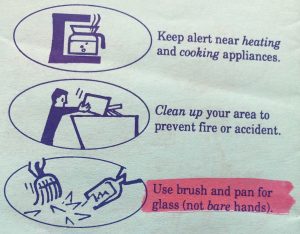
Case in point: Do we really need a verbal and pictorial warning that people should not pick up broken glass with their bare hands? … Probably, because we’ve all done it.
We love wacky product warnings at lawhaha.com, but as a Torts and Products Liability professor, I’ve never been a fan of product sellers trying to be funny in their product warnings or instructions. See, for example, here, here, and here.
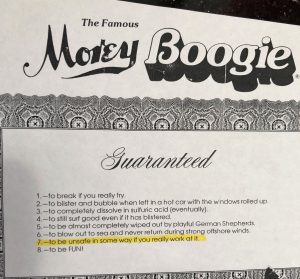
But I concede that these “Guarantees” for a foam boogie board are pretty cute, including that it is guaranteed “to be unsafe in some way if you really work at it.”
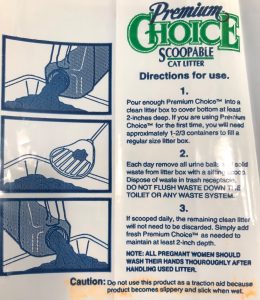
This is one of those warnings that may sound silly, but really isn’t. I wouldn’t be surprised if a whole lot of people have tried to use kitty litter as a traction aid for icy walkways:
Do not use this product as a traction aid because product becomes slippery and slick when wet.
I ding the seller one point for being redundant because “slippery” and “slick” are the same thing, but not a bad warning.
I have a bigger problem with the instructional photos. Does people really need illustrations to show how to pour cat litter?
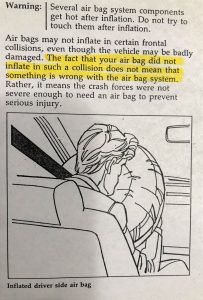
Maybe I have a litigious nature or have simply seen too many products liability cases, but I have a feeling that people who are injured because their airbag didn’t inflate in a collision are not going to be appeased by this assertion in the automobile product manual:
The fact that your air bag did not inflate in a collision does not mean something is wrong with the air bag system.
Oh, I beg to differ …
In all seriousness, I was once appointed as a Special Master for discovery in a federal products liability case involving just this issue: a woman lost control of her vehicle and careened into a wall at a sufficient velocity that both she and her child were killed. The airbags in her car did not inflate.
Her estate sued the vehicle manufacturer alleging a defect in the electronic module that controlled the airbags and had an expensive expert who was going to testify to that fact. The judge, however, excluded the expert’s testimony as failing the U.S. Supreme Court’s Daubert standard for scientific validity because he was unable to actually pinpoint specifically what was wrong with the airbag module.
Accordingly, after years of litigation and hundreds of thousands of dollars in litigation expenses, primarily for the expert, the case was dismissed. Very sad case.
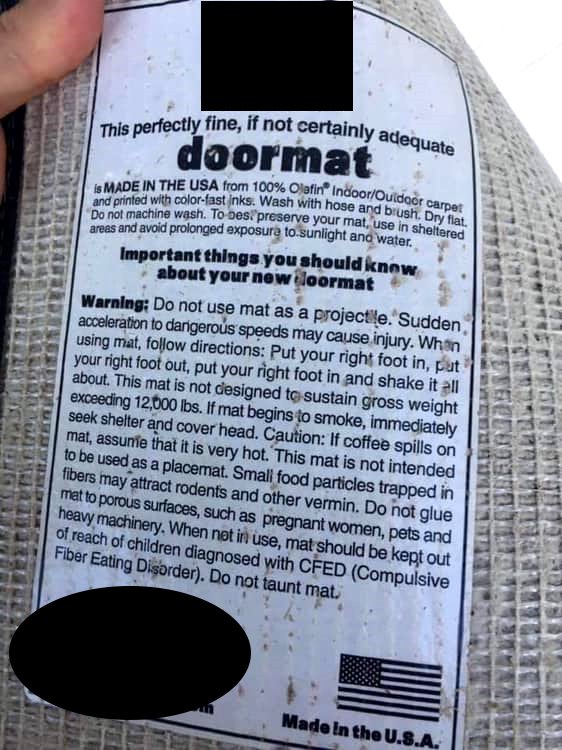
Many of my friends have posted this picture of a warning label on a doormat on Facebook and tagged me in it because they know I love wacky warnings. This one definitely qualifies as wacky, but intentionally so.
All of the comments mention how hilarious it is. It is amusing, but I have a different take on it. I think it’s a ridiculously dumb warning from a legal standpoint.
I concede that doormats are not very dangerous, and the probability of them causing injury is low. Admittedly, it’s not quite like putting funny warnings on a chainsaw or ladder.
However, people have sued over, for example, a slippery doormat that was advertised as “non-slip,” which doesn’t appear to be the case here. As any tort lawyer or professor can attest, in tort law, the worst than can possibly happen often does.
Why take the chance at all? Just suppose, hypothetically, that this doormat slipped on the floor, causing someone to fall and suffer a broken hip. Can you imagine the field day the plaintiff’s lawyer would have examining the corporate representative?
Plaintiff’s lawyer: So you believe that labels warning consumers of risks of your products are, literally, a joke. Isn’t that true?
Or what if the company sells other products that are more dangerous and gets sued for a defective warning on one of them? This attempt to be amusing on their doormat warning might still come back to bite them.
It simply makes zero legal sense to treat product warnings as a joke, no matter how low the risk of a product causing harm is perceived to be.
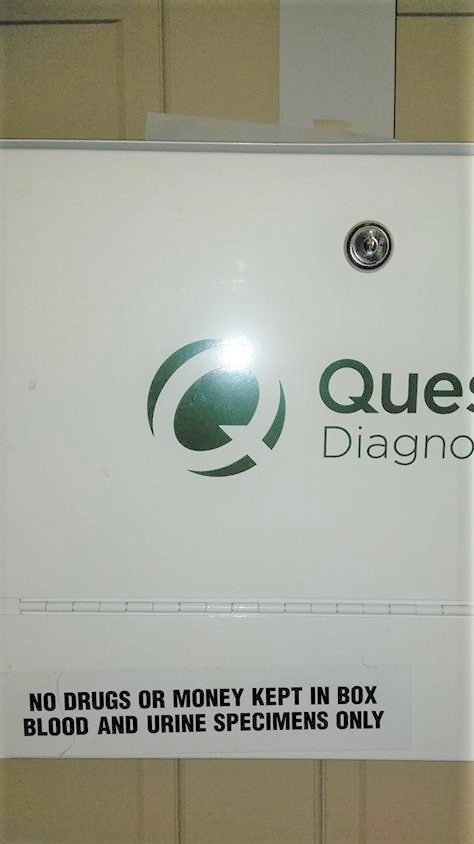
Not a legal warning, but an interesting notice posted on a lock box at a local medical facility: “No Drugs or Money Kept in Box; Blood and Urine Specimens Only.”
Probably effective unless, of course, it’s encountered by someone actually looking to steal blood or urine samples, in which case it’s an invitation. Of course, that’s silly because no one would ever want to steal a blood or urine sample.
Or would they? (Spoiler alert: The link leads to an article about a man who stole his wife’s urine to submit as a sample, leading to the revelation the man was pregnant.)
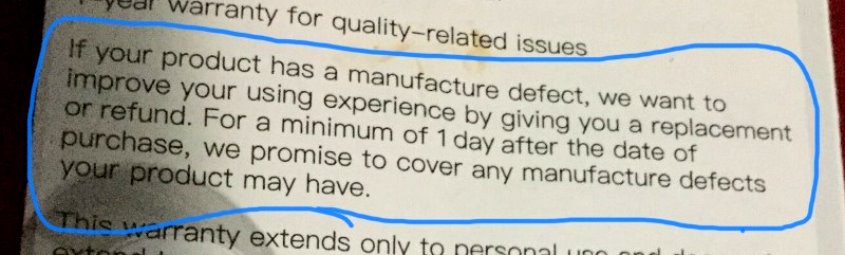
That’s what you might be saying to your new “Mini Garment Steamer” if you read the User’s Manual and come across this one-day warranty:
“If your product has a manufacture defect, we want to improve your using experience by giving you a replacement or refund. For a minimum of 1 day after the date purchase, we promise to cover any manufacture defects your product may have.” (Bold added.)
There are some other warranties in the manual, so this appears to be more a case of poor drafting than an effort to limit consumer remedies. After all, it doesn’t say a “maximum” of one day; only a minimum.
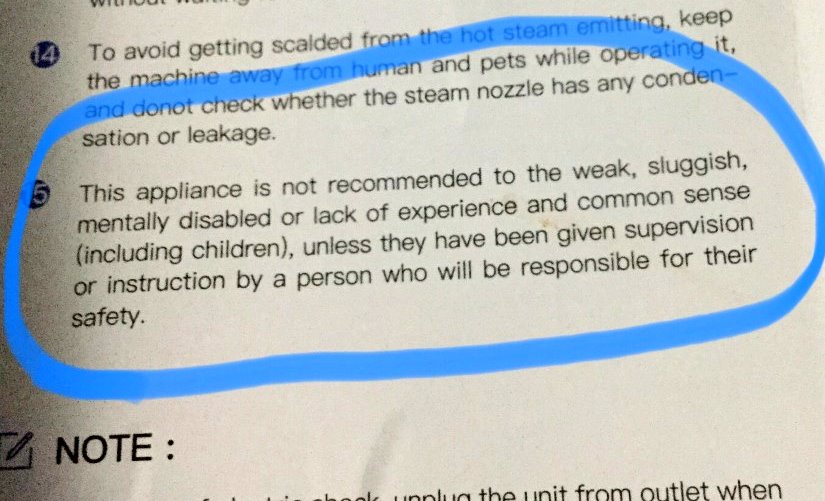
For further evidence of that conclusion, we offer this warning, also found in the User’s Manual:
So if you’re weak, sluggish, mentally disabled, lack experience with mini garment steamers, or just don’t have any common sense, avoid this product.
This is one of those head-scratchers that leaves you wondering whether it’s fake news because it just seems too bizarre, even by wacky warning standards. Let’s assume, probably justifiably, that there are indeed people who eat gum from urinals. Are there really enough of them to warrant a laminated “Caution” sign? And do people really need a warning not to do it?
“Dang, I was going to eat that piece of gum someone spit out that maybe a hundred people have peed on. It’s a good thing I saw the sign in time!”
The image appears to be real (that is, not photoshopped), but I don’t know where it originated. A person in my area posted it on the Next Door app, with the comment, “There’s one in every crowd.” Don’t know if she took the picture.
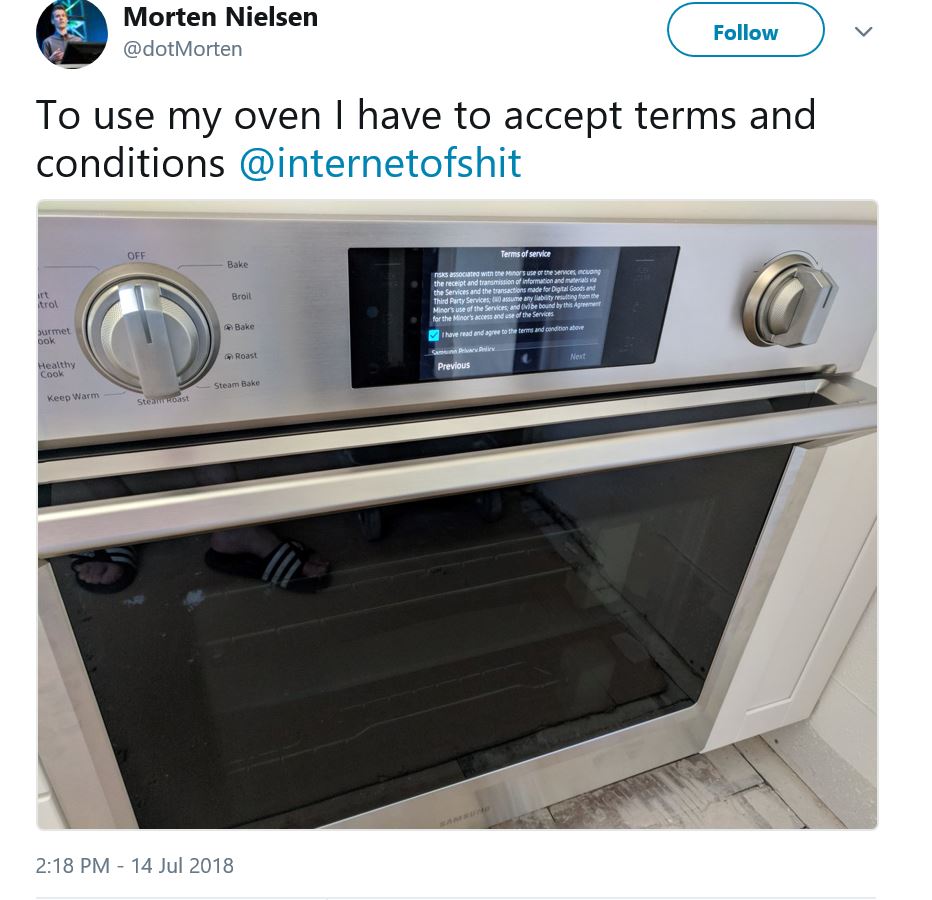
One of my students sent me this tweet from Morten Nielsen regarding a new oven requiring on the touch screen that, before using the product, the happy new appliance owner must waive their legal rights by agreeing to the “Terms of Service.” Even in just the snippet of text visible in the picture, the user is assuming risks and waiving legal claims.
Stripping away the legalese, before you can warm up a pizza, you have to give up some legal rights.
A “contract of adhesion” is a form contract where the party being asked to sign it has no choice but to take it or leave it. They’re always unfair because there’s no bargaining power. That’s the very definition of a contract of adhesion.
The original concept of a contract is a bargained-for exchange of goods or services. Courts supposedly look unfavorably on contracts of adhesion, but unless they involve a service on which the public depends (such as medical services or public transportation or public education), they’re upheld.
Did you know that each time you click “Accept” on an online click-thru agreement, you’ve bound yourself to a legal contract? One survey found that 56 percent of people were not aware they were entering into binding agreement.
But, even there, you at least theoretically have the right to not use the service. Don’t want to accept iTune’s or Facebook’s terms of service? Don’t use those services. But where is that choice when you’ve had a new appliance installed and can’t use it without first agreeing to the Terms of Service?
Welcome to the Internet of Things. It’s only going to get worse, much worse. The next generation oven will come with a built-in corporate lawyer who will send you threatening cease and desist alerts if you overcook or undercook your food and bill at a rate of $300 per hour. If you don’t put a lid on the food and it spatters the inside, you will be sued for punitive damages.
At least this is what I heard from some person I met in a bar. I think her name was Alexa.
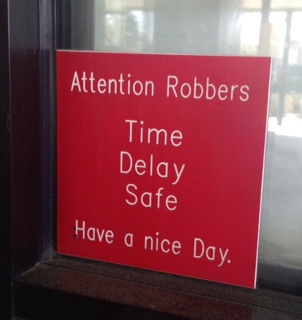
I’ve always heard that folks in Virginia are nice, and here’s proof, a warning sign to criminals in the window of a Sonic restaurant near the Norfolk airport:
Attention Robbers
Time Delay Safe
Have a nice Day.
I take issue with the unnecessary capitalization of “Day,” and I suppose if they were super-nice, they could have put an exclamation point at the end instead of period. But this is quibbling.
 As a professor of tort and products liability law, I appreciate that manufacturers often feel the need to warn consumers of obvious risks, even though products liability law does not impose a duty to warn of obvious risks.
 We love wacky product warnings at lawhaha.com, but as a Torts and Products Liability professor, I’ve never been a fan of product sellers trying to be funny in their product warnings or instructions. See, for example,
  This is one of those warnings that may sound silly, but really isn’t. I wouldn’t be surprised if a whole lot of people have tried to use kitty litter as a traction aid for icy walkways:
 Maybe I have a litigious nature or have simply seen too many products liability cases, but I have a feeling that people who are injured because their airbag didn’t inflate in a collision are not going to be appeased by this assertion in the automobile product manual: