
Plaintiffs Say “Boo!” to Haunted Halloween Tort Immunity

Randy Maniloff
Randy Maniloff explores Halloween tort cases.

Insurance expert, stand-up comic, and friend of Lawhaha.com, Randy Maniloff, penned an interesting article in his latest issue of Coverage Opinions about whether people who get frightened at Halloween haunted houses, with resulting injury, can sue.

He writes:

On any other evening, presenting a frightening or threatening visage might be a violation of a general duty not to scare others.  But on Halloween at trick-or-treat time, that duty is modified.  Our society encourages children to transform themselves into witches, demons, and ghosts, and play a game of threatening neighbors into giving them candy.”  Bouton v. Allstate Ins. Co., 491 So. 2d 56 (La. Ct. App. 1986) (also noting that the Louisiana legislature has recognized Halloween as a special occasion by exempting it from the statute which prohibits the wearing of masks in public places).

But does this “Halloween rule” apply to haunted houses?  All sorts of duties are imposed on property owners to maintain a safe premises.  Do these same rules apply when the premises are advertised as having, as their only purpose, to scare visitors?  Indeed, many visitors will leave a haunted house disappointed if they were not frightened while there.  That being the case, can the visitor of a haunted house now turn around and sue for injuries sustained in the process of getting what he asked (and paid) for?

His research turned up five reported judicial decisions in which visitors of haunted houses sought recovery for injuries “sustained on account of being scared.”  Notably, the plaintiffs lost every case based on assumption of the risk analysis and the social utility of keeping haunted houses scary and darkly lit.  In one case, a startled plaintiff in a pitch-dark house turned to run and ran smack into a brick wall.

Hate to be a party-pooper, but I think there’s a duty to act reasonably to prevent highly foreseeable injuries at premises open to the public.  The goal of a haunted house is to terrify, the expected result is that customers will be terrified, and the instinctive response to terror is to run.  But no one can see!  Give them helmets, maybe even put flashlights on them, or scare them outside where they can run into the cushy-walls of cornfield mazes.

“Eerily,” as Randy notes, all five cases are from Louisiana.
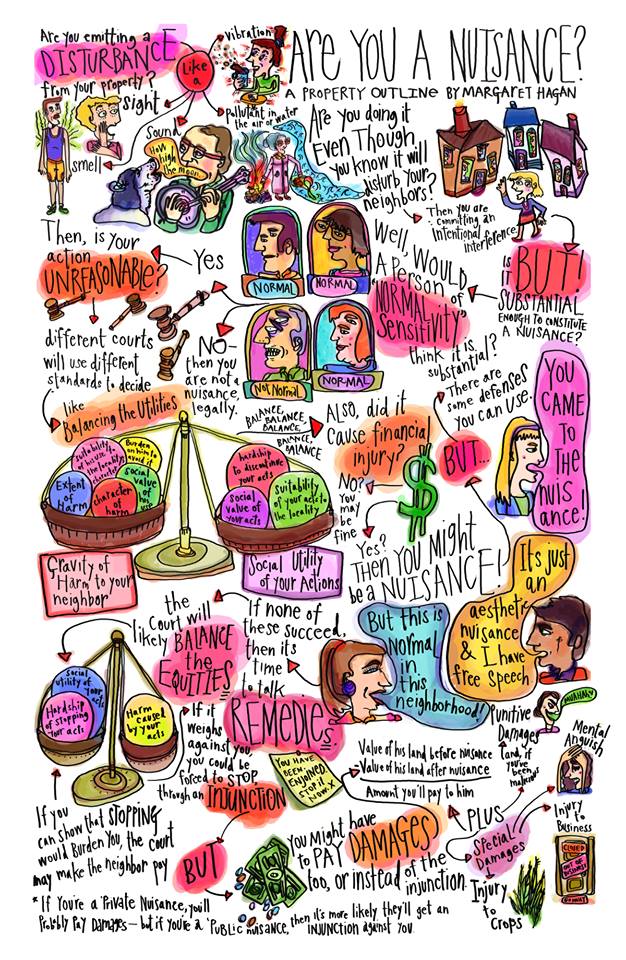
Flow Chart for the Tort of Nuisance

Nuisance Flow ChartA student from my very first Torts course a million years ago sent me this brilliant flow chart for the tort of nuisance, which comprises substantial and unreasonable interferences with the use and enjoyment of one’s property.   The most interesting thing about it is that it actually summarizes the law pretty well, assuming one has dropped acid before studying it.  Credit on the chart attributes this work of art to one Margaret Hagen.  Well done!

“Torts Illustrated”

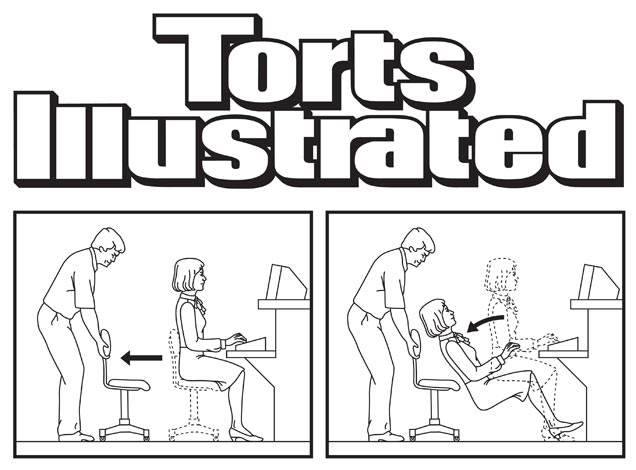
Torts IllustratedA 1L sent me this “Torts Illustrated” image, sort of a grown-up version of Garrett v. Daily, a famous case that all law students study in which a five-year-old was sued for pulling a chair out from under an elderly woman.  If anyone knows the original source, please send it along so we can give proper credit.

In the meantime, one can only imagine what the swimsuit issue would look like.

Warning: Canadian Coffee Seller Makes Fun of Hot Coffee Warnings

Liebeck coffee burn.
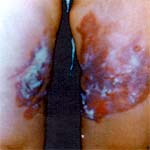
One of the milder pictures of  Stella Liebeck’s coffee burn injuries.

Any mention of lawsuits and hot coffee invariably invokes the grossly misunderstood “McDonald’s coffee spill” case of Stella Liebeck, a 79-old-woman who suffered third-degree burns after spilling a stryrofoam, takeout cup of McDonald’s coffee on her legs.

I apologize for the gruesome picture, but a large part of the misunderstanding of this case comes from people not appreciating that Ms. Liebeck suffered extremely severe injuries. There are much worse pictures of her injuries available on the internet. There is also a ton of information, and misinformation, out there about the McDonald’s case. Here (scroll down to “Public Perceptions: The McDonald’s Coffee Spill”) and here are a couple accounts of the facts. You might also want to check out the movie, Hot Coffee, which explores the McDonald’s case and, more generally, the tort reform movement.

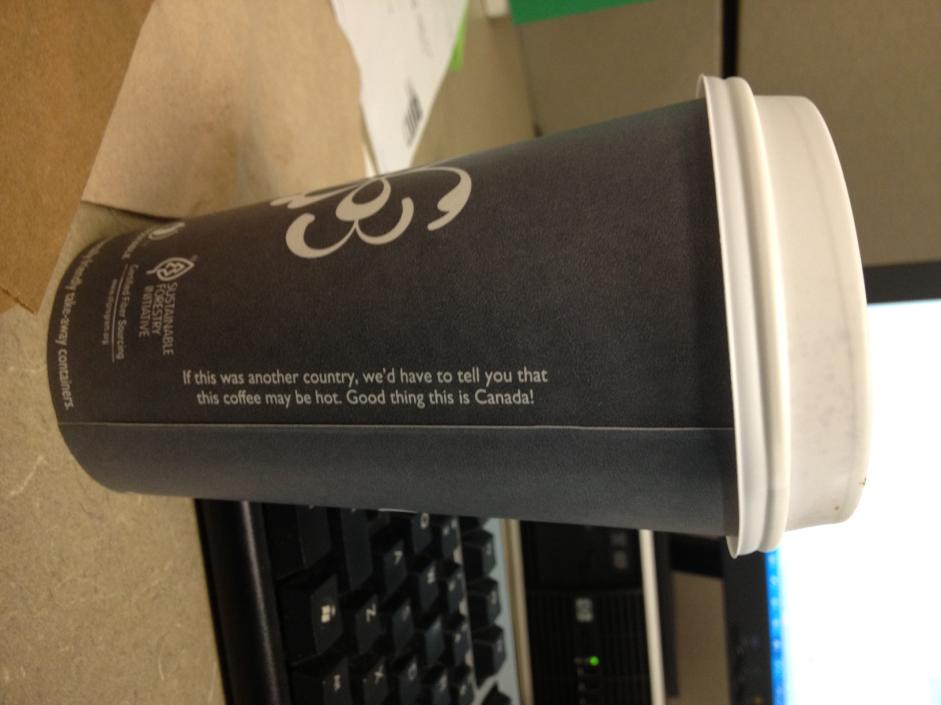
Canadian coffee cup warning
Sideways on purpose. Click to expand.

At least one Canadian coffee seller found the idea of warning consumers about hot coffee to be hilarious:

“If this was another country, we’d have to tell you this coffee may be hot. Good thing this is Canada!”

Dedicated Law Student Gets Judge Hand Tattoo

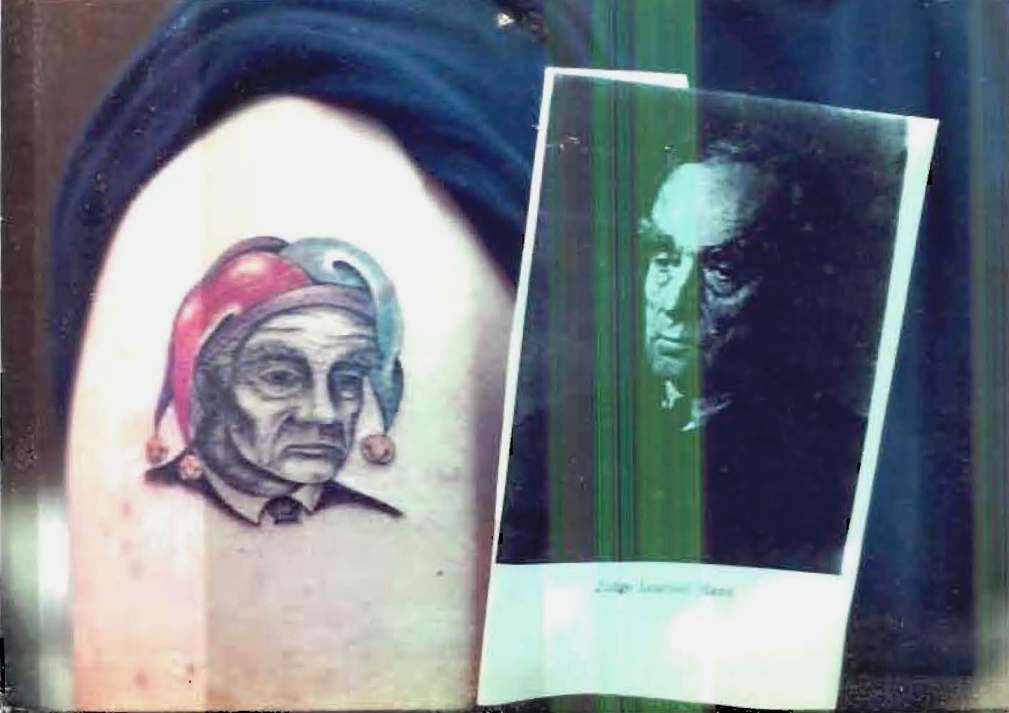
Judge Learned Hand tattooAre you in law school? Do you consider yourself to be a dedicated law student? Not sure? Measure yourself on McClurg’s simple 0-100 scale, with 0 being “I’m not totally thrilled with Judge Learned Hand” and 100 being “I aspire to be like the guy in this picture.”

Years ago, a student of mine at the University of Arkansas at Little Rock School of Law took a trip, to Philadelphia, I think. He struck up a conversation with a tattoo artist in a bar. When the artist learned he was in law school, she asked, “Have you ever heard of a judge named Learned Hand?”  “Of course!” the student replied.  All law students know and remember Judge Learned Hand.

The artist said the young man above came into her tattoo parlor with the accompanying picture of Judge Hand (the picture is from the famous Prosser, Wade & Schwartz Torts casebook used at 124 law schools) and asked to have Judge Hand, wearing a jester cap, tattooed on his arm. As proof, she followed up and sent this photograph to my student, who entrusted it to me.

For non-legals, Judge Hand was a famous judge who in a famous case–U.S. v. Carroll Towing–set forth a famous algebraic economic cost-benefit formula for determining whether injury-causing conduct was reasonable or unreasonable. If reasonable, the defendant is off the hook. If unreasonable, the defendant is liable for negligence and must pay damages. The formula is B < P x L. B stands for the burden of avoiding a risk of harm, P is the probability that the risk will actually cause harm, and L stands for the severity of the harm if it occurs. The formula states that if the burden of avoiding the harm is less than the probability of the harm occurring multiplied by the severity of the potential harm, the conduct is unreasonable (i.e., negligent). Conversely, if the burden of avoiding the risk outweighs the probability times the severity of harm, the conduct is reasonable (i.e., non-negligent).

The back of the picture is stamped with “Tattoo & Photo by Sherry Sears, Creative Images, Des Moines, IA.” So if you want to impress your professors and university’s counseling department, book a ticket to Des Moines.

Cardozo’s Pub

Cardozo's Pub Palsgraf
Two drink minimum; No packages wrapped in newspaper.

A student of mine posted this pic on Facebook of “Cardozo’s Pub” in Chicago. Is “Andrews’ Billiard Hall” next door by any chance?

For non-legals, Judge Benjamin Cardozo is one of the most famous American jurists. He authored several judicial opinions read by law students, including the majority opinion in Palsgraf v. Long Island Railroad. Judge William Andrews wrote a famous dissent in the same case.

Palsgraf, studied by every first-year law student, is the improbable tale of a set of scales allegedly knocked on top of the plaintiff, Mrs. Helen Palsgraf, as a result of an explosion that occurred when a man running to catch a train dropped a package of fireworks while being helped onto the train by railroad employees.

For the completely true fake inside story behind these opinions, check out Palsgraf Uncovered). Other posts related to the famous case are here, here, and here.

No known connection exists between this Chicago pub and the real Judge Cardozo.

Ill-Placed Bottle Rockets Create a “Palsgraf” for a New Generation

bottle rockets in anus lead to injuryA former student sent along the complaint below, which a friend of his suggested might be “the new Palsgraf for our generation.” Hmm, this might not be a good generational sign given the allegations.

For non-legals, Palsgraf v. Long Island Railroad is a famous tort law case all law students read involving a bizarre accident at a train station, where the court ruled that a tort defendant owes a legal duty to act with reasonable care to another only if the other is a reasonably foreseeable victim of the defendant’s conduct. More Lawhaha.com posts involving Palsgraf are here, here, here, and here.

A national Greek fraternity, Alpha Tau Omega, apparently held a “house party” at their frat house at a West Virginia university. The complaint alleges that many of the participants consumed intoxicating beverages. No surprise so far. But one of the guests  surprised at least one person (the plaintiff, allegedly) when he decided to light up–literally–the party by shooting bottle rockets from … er, I’d rather let the Complaint explain it:

Warning: Allegations are Disgusting

8. Defendant Hughes was highly intoxicated on this date and time, and decided in his drunken stupor that it would be a good idea to shoot bottle rockets out of his anus on the ATO deck, located on the back of the ATO house.

9. Upon information and belief, there were several other ATO fraternity members on the deck at the time of this incident, including one or more officers of the fraternity. Plaintiff and his girlfriend were also present on the ATO deck.

10. Defendant Hughes placed a bottle rocket in his anus, ignited the fuse, but instead of launching, the bottle rocket blew up in Defendant’s rectum, and this startled plaintiff and caused him to jump back, at which time he fell off of the ATO deck, and he became lodged between the deck and an air conditioner unit adjacent to the deck.

11. There was no railing on said deck at the time of the incident. Upon information and belief, the lack of a railing had existed for at least several months, if not years, before the incident. Upon further information and belief, the deck never had a railing when it was installed, or any time thereafter. The subject deck was approximately 3-4 feet high.

12. The subject deck was in the exclusive custody, maintenance and control of the ATO fraternity at all times relevant hereto.

Here’s your Palsgraf test: Was the plaintiff within the zone of foreseeable danger of the bottle rocket-defendant’s alleged conduct? Probably, although perhaps with some contributory negligence thrown in. Assuming the plaintiff was standing close by he could have been injured in any number of ways from someone setting off fireworks in such a dangerous, uncontrolled manner.

The more interesting question is the fraterity’s liability. Was it foreseeable to the fraternity that an intoxicated fraternity member would ignite fireworks in such a bizarre manner and cause a startled bystander to fall off the deck?  Probably not, but it is foreseeable that during social or other gatherings on a deck with no railing (which the complaint alleges violated building codes, likely making it negligence per se) someone would fall off it. Generally speaking, the precise manner in which the harm occurred need not be foreseeable so long as the same general kind of harm was foreseeable.  The injury that occurred–falling off the deck-is the risk that makes it negligent to not have a railing on a raised deck.

Just an off-the-cuff analysis of the facts as alleged.  As always, it will come down to the facts as proved–or, more likely, to a settlement.

—Complaint, Helmburg v. Alpha Tau Omega Fraternity, Case No. 12-C-57, Circuit Ct., Cabell County, West Va., filed Jan. 23, 2012.

The “Emergency Doctrine” According to Shakespeare

William Shakespeare
Judge Carlin LOVED this guy.

A unanimous Strange Judicial Opinions Hall of Fame opinion is Cordas v. Peerless Transportation Co., penned in 1941 by Judge Carlin (no relation to George) of the New York City Court.

The defendant was a chauffeur and the victim of an armed car-jacking by a fleeing robber who threatened to blow the chauffeur’s brains out. In fright, the chauffeur slammed on the brakes and jumped out of the vehicle, which kept moving and hit the plaintiff pedestrian and her children (fortunately, injuries were slight).

The case stands for the unremarkable principle that under the basic negligence standard of reasonable care “under the circumstances,” people aren’t expected to exercise as much care in emergency situations as in non-emergencies where they have time to weigh and deliberate. It also stands as a literary masterpiece of judicial opinion writing.

Full appreciation of this classic can come only with a full reading, but here’s how it starts:

This case presents the ordinary man–that problem child of the law–in a most bizarre setting. As a lowly chauffeur in defendant’s employ he became in a trice the protagonist in a breath-bating drama with a denouement almost tragic. It appears that a man, whose identity it would be indelicate to divulge, was feloniously relieved of his portable goods by two nondescript highwaymen in an alley near 26th Street and Third Avenue, Manhattan; they induced him to relinquish his possessions by a strong argument ad hominem couched in the convincing cant of the criminal and pressed at the point of a most persuasive pistol.

Carlin apparently was a learned Shakespeare fan. In excusing the chauffeur from liability for jumping out of the moving vehicle, Carlin said:

If the philosophic Horatio and the martial companions of his watch were ‘distilled almost to jelly with the act of fear’ when they beheld ‘in the dead vast and middle of night’ the disembodied spirit of Hamlet’s father stalk majestically by ‘with a countenance more in sorrow than in anger,’ was not the chauffeur, though unacquainted with the example of these eminent men-at-arms more amply justified in his fearsome reactions when he was more palpably confronted by a thing of flesh and blood bearing in its hand an engine of destruction which depended for its lethal purpose upon the quiver of a hair.

Translation: It’s not negligent to react in fright when a carjacker has a gun pointed at your head.

Cordas v. Peerless Transp. Co., 27 N.Y.S.2d 198, 199, 201 (City Court of N.Y. 1941). Thanks to all the folks who sent in this classic.

Is this a Judicial Opinion or a Cookbook?

cookbook
More appropriate publication vehicle than the Northeast Reporter?

A lawsuit brought by a woman who got a fishbone lodged in her throat while eating a bowl of fish chowder at a Boston restaurant moved the Massachusetts Supreme Court to write an opinion devoted more to the joys of New England fish recipes than actual law.

The legal dispute is an old one: To what extent is food containing a harmful ingredient a defective product when the substance is a natural one as opposed to a foreign one?

Most modern courts apply a reasonableness test that looks at whether the substance was one a consumer would reasonably expect to find in a prepared dish, but the Massachusetts Supreme Court in this 1964 case adopted the older approach that there is no liability for harm-causing natural substances (i.e., bones as opposed to pieces of glass) in food.

Reading the opinion, it wasn’t hard to predict the defendant was going to win in the end. The court reminisced fondly about the history of fish dishes, recounted several recipes for the same, and included statements such as “we consider that the joys of life in New England include the ready availability of fresh fish chowder.”

The court went so far as to note that “[a] namesake of the plaintiff, Daniel Webster, had a recipe for fish chowder which has survived into a number of modern cookbooks and in which the removal of fish bones is not mentioned at all.”

The court concluded:

[W]e consider a dish which for many long years, if well made, has been made generally as outlined above. It is not too much to say that a person sitting down in New England to consume a good New England fish chowder embarks on a gustatory adventure which may entail the removal of some fish bones from his bowl as he proceeds. We are not inclined to tamper with age old recipes by any amendment reflecting the plaintiff’s view of the effect of the Uniform Commercial Code upon them.

This is a must-read opinion for all products liability lawyers and anyone looking for a good fish-chowder recipe.

Webster v. Blue Ship Tea Room, Inc., 198 N.E.2d 309, 312 (Mass. 1964). Thanks to Daniel Green.

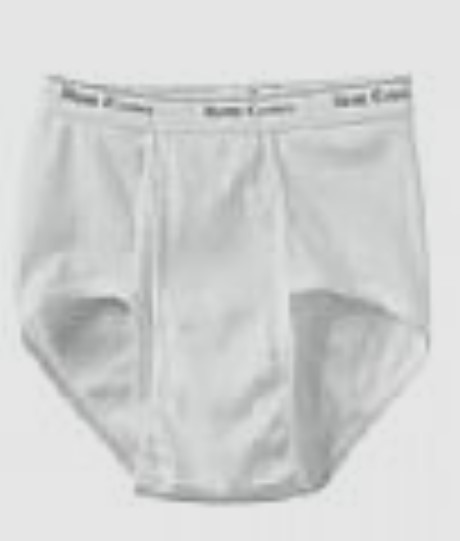
Unreasonably Dangerous Underwear

tighty whities
Dangerous product?

A large guy (280-90 pounds) ironically won a one-week trip to Hawaii as a reward for selling more than $20,000 in diet products. But in a lawsuit against Hanes, the underwear maker, he alleged his “dream trip” went awry due to allegedly defective briefs which “gaped open and acted like a sand belt on my privates,” causing injury.

We’ll let the court elaborate on this interesting products liability case:

Plaintiff testified that by the second day in Hawaii he was in debilitating pain. However, … he ignored the pain until he returned to Pensacola two weeks later. He explained he was able to ignore the pain because he was enjoying himself so much on this long anticipated vacation that he did not dwell on or focus on the pain to any degree.

Plaintiff testified he believed sand that he picked up in his swim trunks while enjoying the Hawaiian surf had irritated his penis. Over the next few days he and his wife “walked all over the place” until his condition worsened to the point that he “could hardly walk.” Plaintiff testified his inability to walk was caused by defendant’s defective manufacturing of his underwear which caused his “fly” to gap open. The gap resulted in his penis protruding from his underwear, whereupon the edges of the opening abraded his penis like “sandpaper belts.” …

Under cross examination plaintiff admitted he never examined his penis to assess the problem and/or treat the problem. He testified he is a “belly-man” and his “weight” prevents him from looking down and seeing his penis. He further testified he declined to use the hotel mirror to view the “injury” because that is “not something he would do.” He also testified he did not ask his wife to examine his penis because he would never ask her to do such a thing, nor would he want to let her know about his pain because it would have “ruined her vacation” as well. …

So how does one prove a complex products liability case like this one? How else? Bring on the experts! Nothing like an in-court reenactment to drive home a point (will resist the obvious “if they do not fit, you must acquit” joke):

Both the plaintiff and the defendant’s expert demonstrated the “tensions” that are placed on men’s underwear. This was done by holding the allegedly “defective” underwear and placing it under various “stresses” while comparing it with similar briefs made by other manufacturers, as well as other old, worn out Hanes brand briefs owned by plaintiff.

The uncontroverted expert testimony was that once a man’s genitalia are adjusted in his briefs, “vertical tension” is far greater than horizontal tension and there is no tendency for the fly to “gap.”

Based on the expert testimony, the judge concluded that “it was clear to the court that plaintiff’s underwear would not have ‘gaped’ open as contended by plaintiff because the tension load on men’s underwear is vertical and not horizontal.” The court speculated that it was more likely that plaintiff’s problems were caused by the “plaintiff’s manner of getting into his underwear,” which was to put them on at the same time as his pants.

The surprising legal lesson of this case is that expert testimony about tighty-whities fit can apparently pass scrutiny as scientifically valid under Daubert.

Freed v. Hanes Brands, Inc., Case No. 2009 SC 003087 (Fla. Escambia County Ct. Oct. 12, 2009). Thanks to Cecile Mendizabel and others.