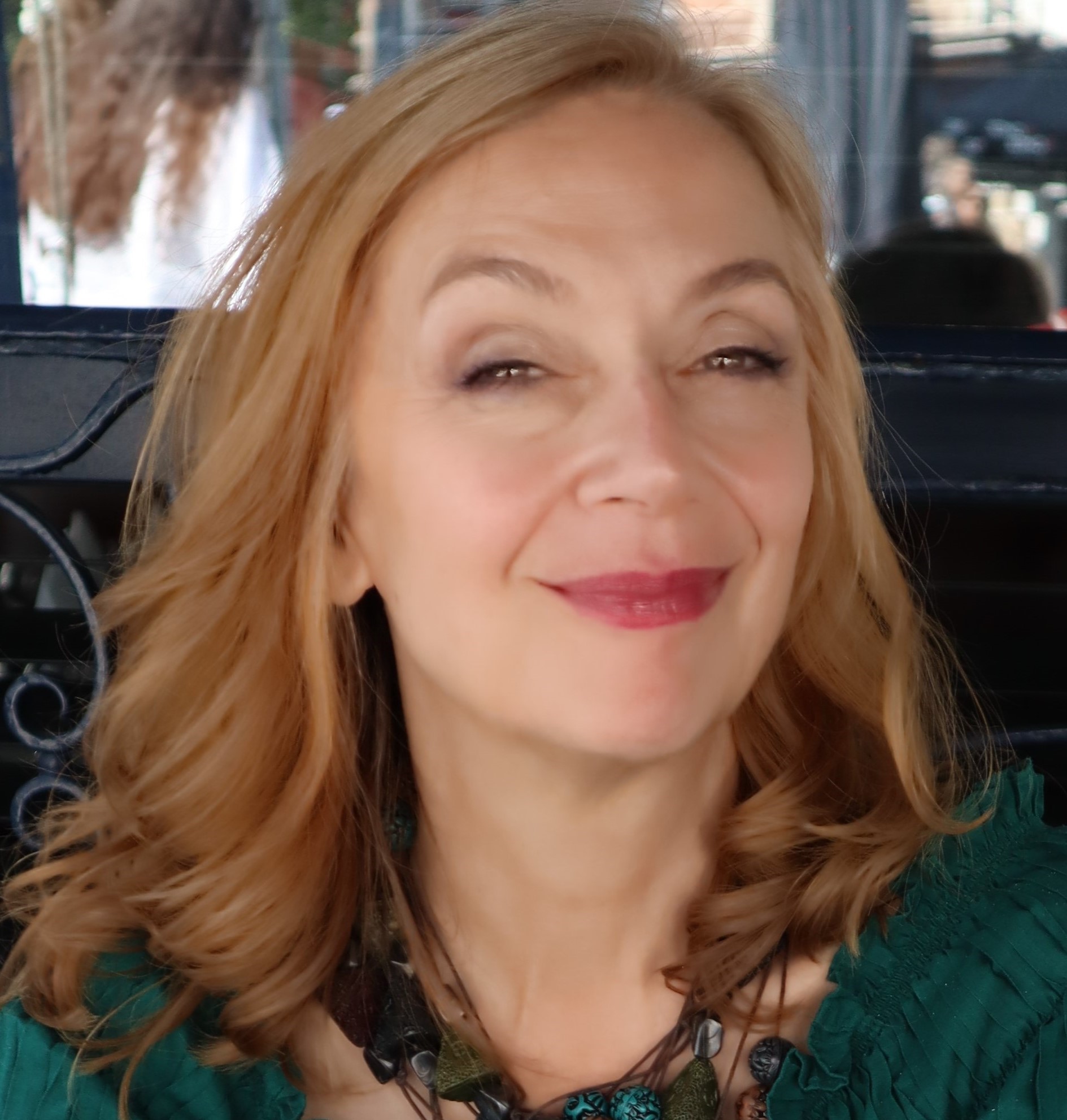
 Lawhaha.com was happy to “sit down” recently for an email interview with Belgian artist Cassou, who uniquely specializes in whimsical, even humorous, legally themed paintings. Her “Judicial Series” has been exhibited in courthouses throughout Europe.
She started drawing and painting as a child. Before turning to painting fulltime, she studied classical philology and Egyptology at the Free University of Brussels, and has taught Latin, Ancient Greek, and French.
Q. Cassou, thanks for participating in this interview. Before we get to some of your individual paintings, tell us what led you to specialize in legal-themed paintings?
A. My obsession with painting justice seized me naturally, driven by two powerful forces. First, a deep conviction that the law is the vital backbone keeping society from collapse. Second, I’m profoundly fascinated with the “sacred theater” of the courtroom, complete with its elaborate costumes, gripping rituals, and near-divine authority. This sacred arena—the realm of Law and Justice—is also a stage for human passions, so it naturally caught my eye and sparked my curiosity. What a pleasure it is to depict that world!
Q. “Sacred theater.” I like that. We see a lot of theater in both law and politics here in U.S., too much of decidedly un-sacred. Before we turn to some samples, what medium do you paint in and how would you briefly describe your process for coming up with and executing ideas?
A. I use acrylic on linen canvas. Although I sometimes start with a key notion, I do not plan my painting in detail. I do not need to look for ideas, they emerge and become refined as I paint.
Q. Let’s look at some of your works. You’ve been kind enough to share five of them with us. The first one is titled Se Frotte Les Mains (Rubbing His Hands). Explain what it depicts.
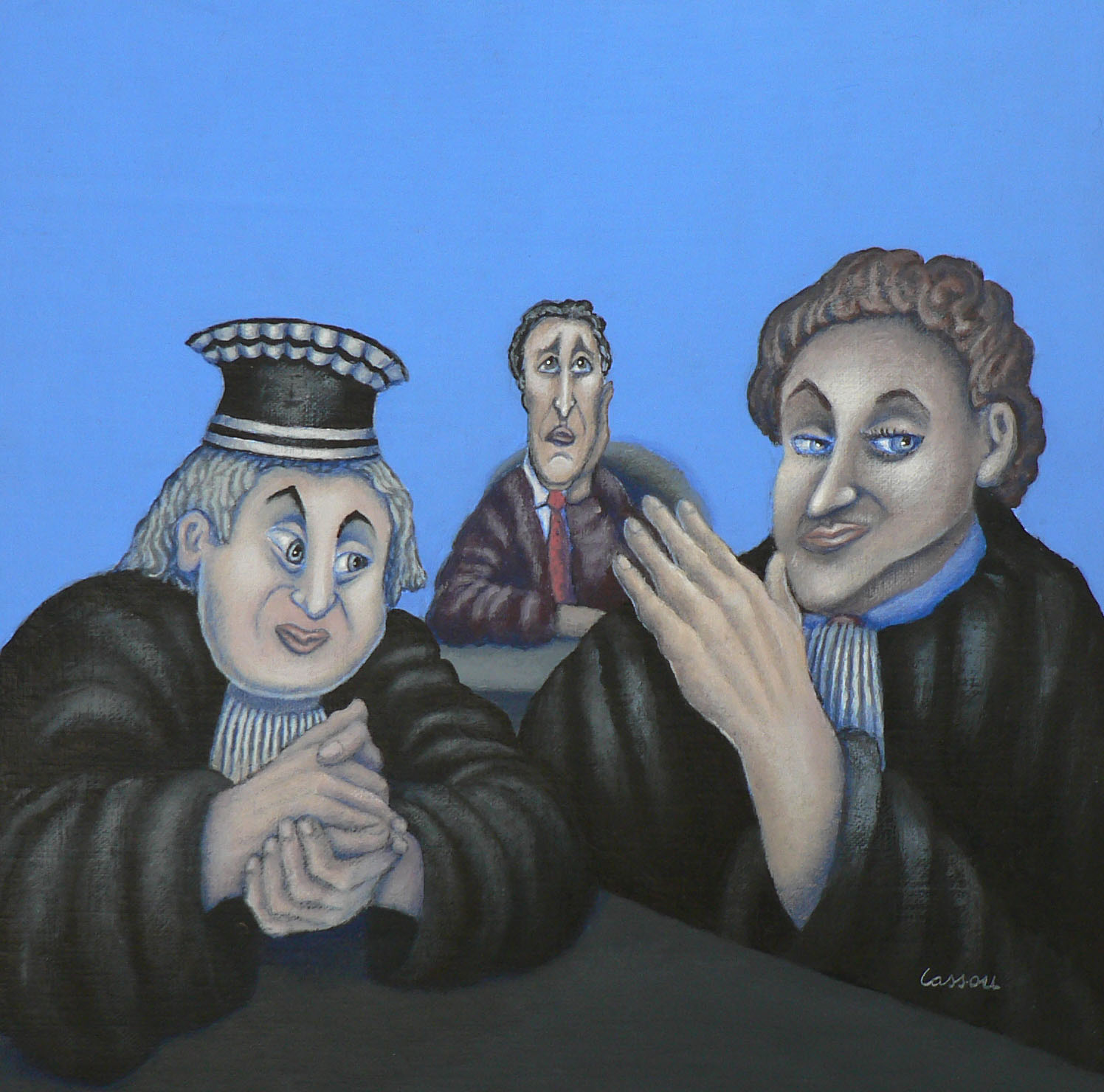
A. We see the judge rubbing his hands with glee and the lawyer contemplating a strategy, but the client is left wondering what’s going to happen to him, terrified of being eaten alive!
Q. What is it trying to say or express?
A. Welcome to the ultimate legal restaurant. It shows a justice system that looks all at once like a circus, a theater, or an inn where the judge, acting as a food critic, is rejoicing, getting ready to savor the client as his daily special.
Q. Yikes! What about this second one? Animaux Domestiques (Household Pets). Here, we see a judge surrounded by a snail and a dinosaur. What do they represent?
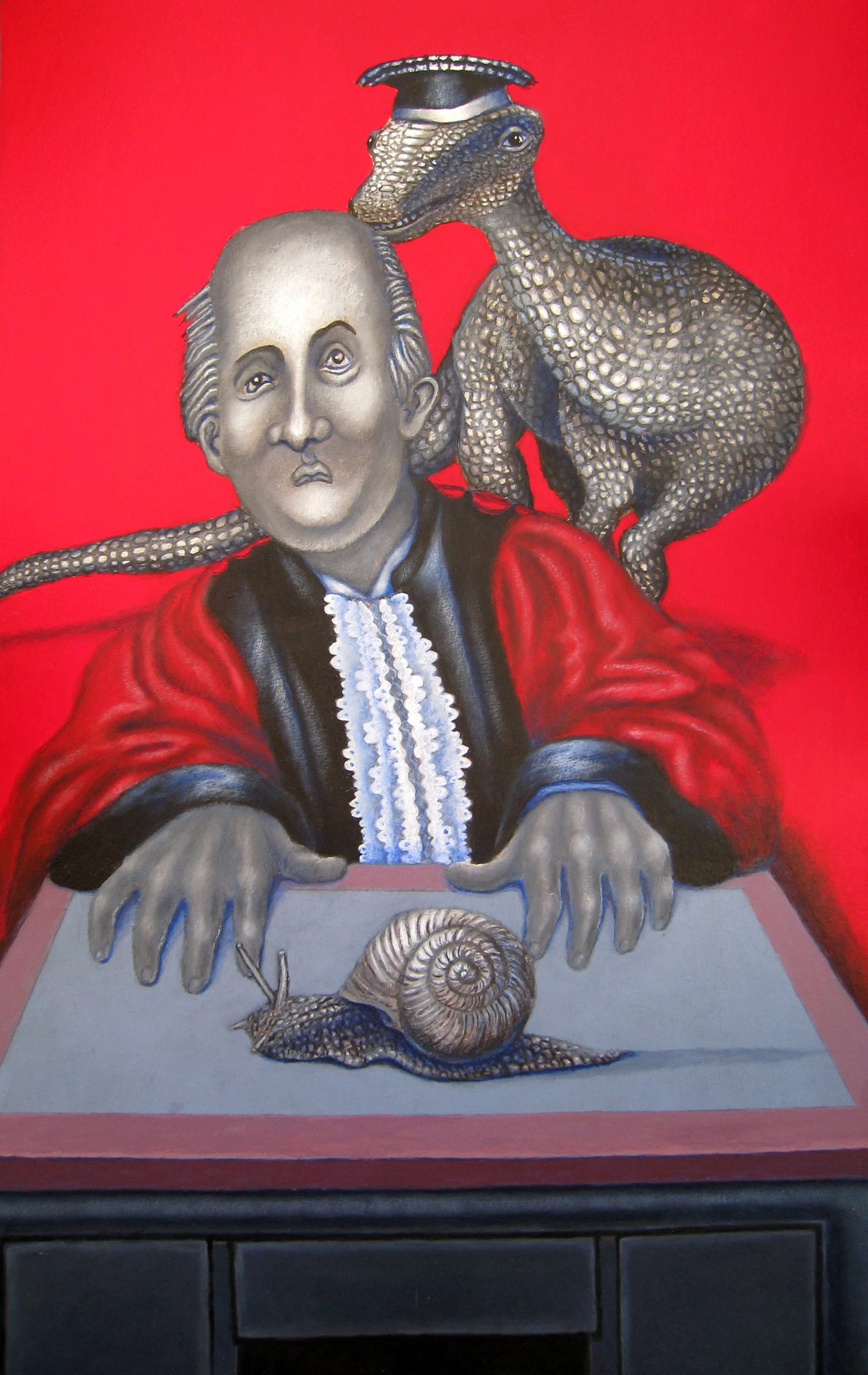
A. The two animals of justice. The snail serves as a symbol for the slow pace of the justice system, where a case can sometimes take many years to be resolved. Some comedians have poked fun at this. As for the dinosaur, the legal language—inaccessible to the average citizen—seems to hail from the obsolete world of the dinosaurs. “Domestique” comes from the Latin word domus, which means house or home. Thus, an animal domestique is literally an animal that belongs to the house or home. Here, the snail and the dinosaur seem to be “animaux domestiques”: they belong to the House of Justice.
Q. Our third one is titled Haut Les Mains (Hands Up!). It shows two lawyers exiting the courtroom as two judges step up to the bench. The female judge points a finger at her male colleague, who throws his hands up like a criminal surrendering to the police. What is this painting saying?
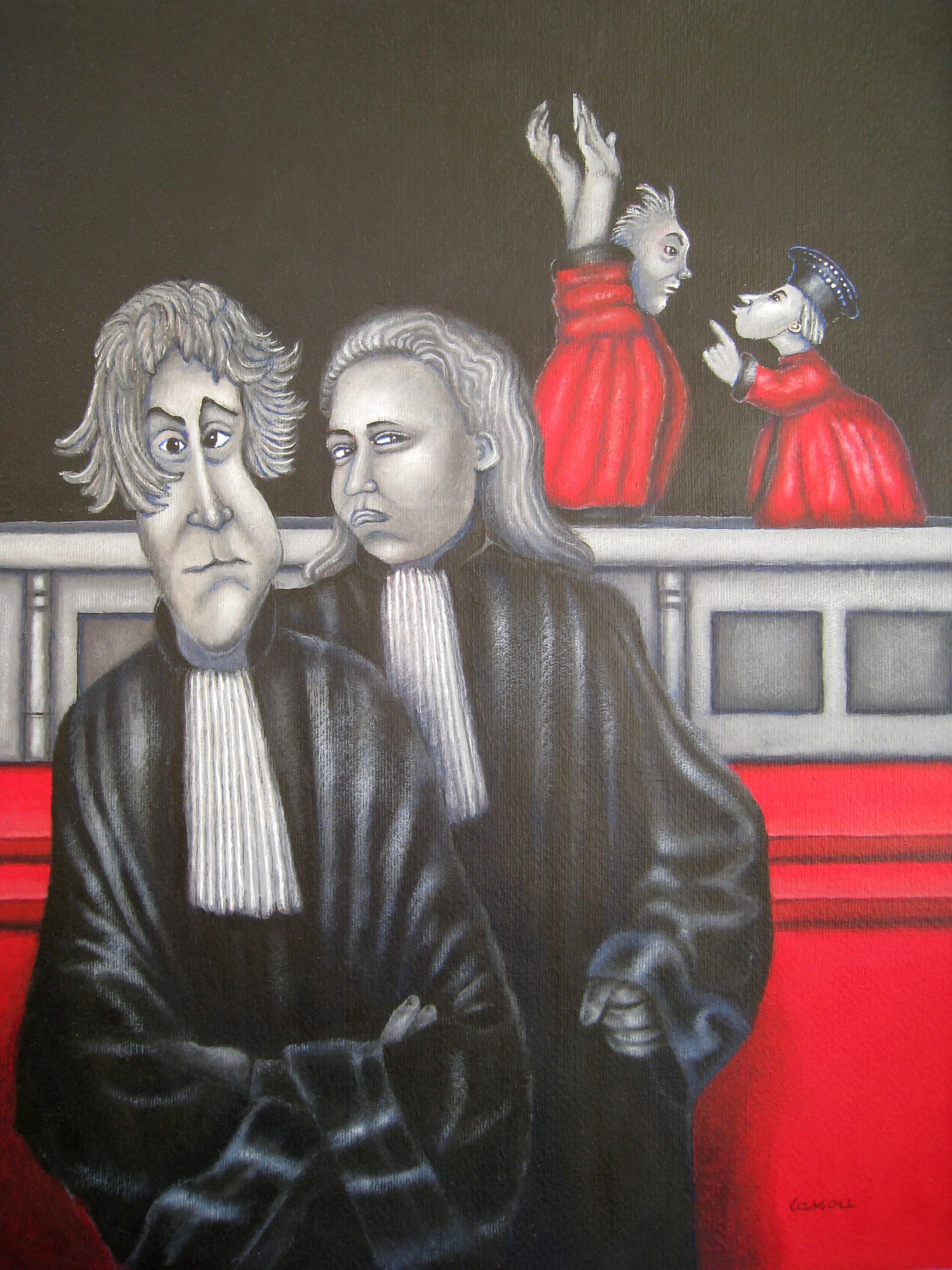
A. One might wonder what the judges do when all the lawyers have left the courtroom. I imagined them arguing, disagreeing with each other. This has to happen, right? Let’s imagine that one of them, out of courtesy or simply to escape the bickering, throws his hands up in surrender, as if playing cops and robbers. It is funny for judges, isn’t it? This has to happen, right? What would the two of them look like if the scene were observed? They would look like children. Their mask of seriousness, dignity, and power would fall. They would show themselves to be human, all too human. The scene shows us a humanity revealing itself, a power becoming humanized.
Q. I’d love to see our U.S. Supreme Court justices deliberating. Then we have number four, Haute Tension (High Tension). What do we have here?
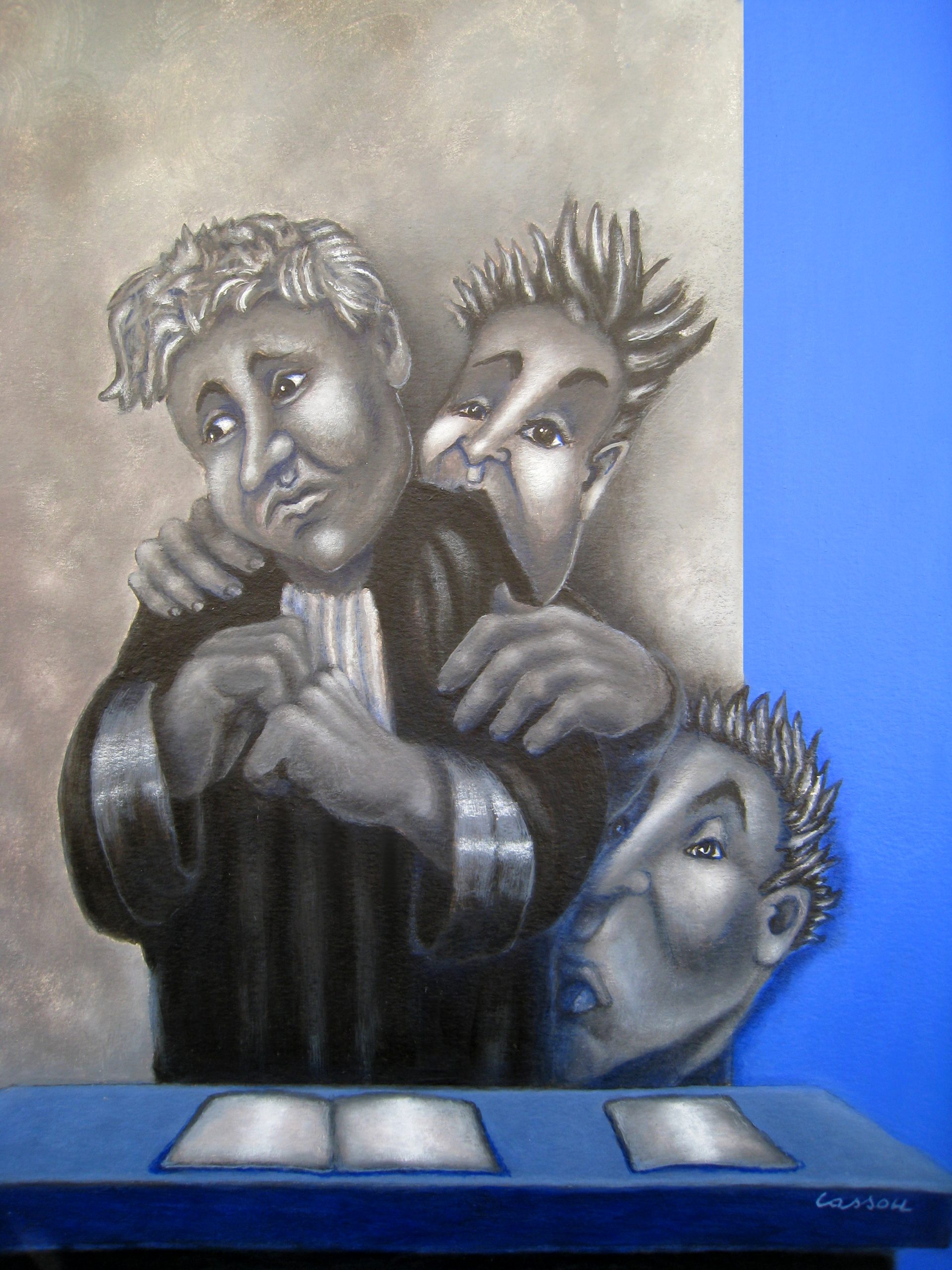
A. Talk about a high-voltage nightmare. We have clients so utterly terrified they are practically trying to climb inside their lawyer’s robe for safety. The poor attorney looks less like a legal expert and more like a human lightning rod, visibly strained under the crushing weight of their survival. The pomp, theatricality, and solemnity of the courtroom, along with the high stakes of the trial, all can induce a sense of dread in the public, which is exactly what is expressed here, absolute panic.
Q. Yes, the lawyer does look quite sympathetic to their plight. Finally, we come to Esprit Libre (Free Spirit) and find a judge sticking his tongue out. What is that painting saying?
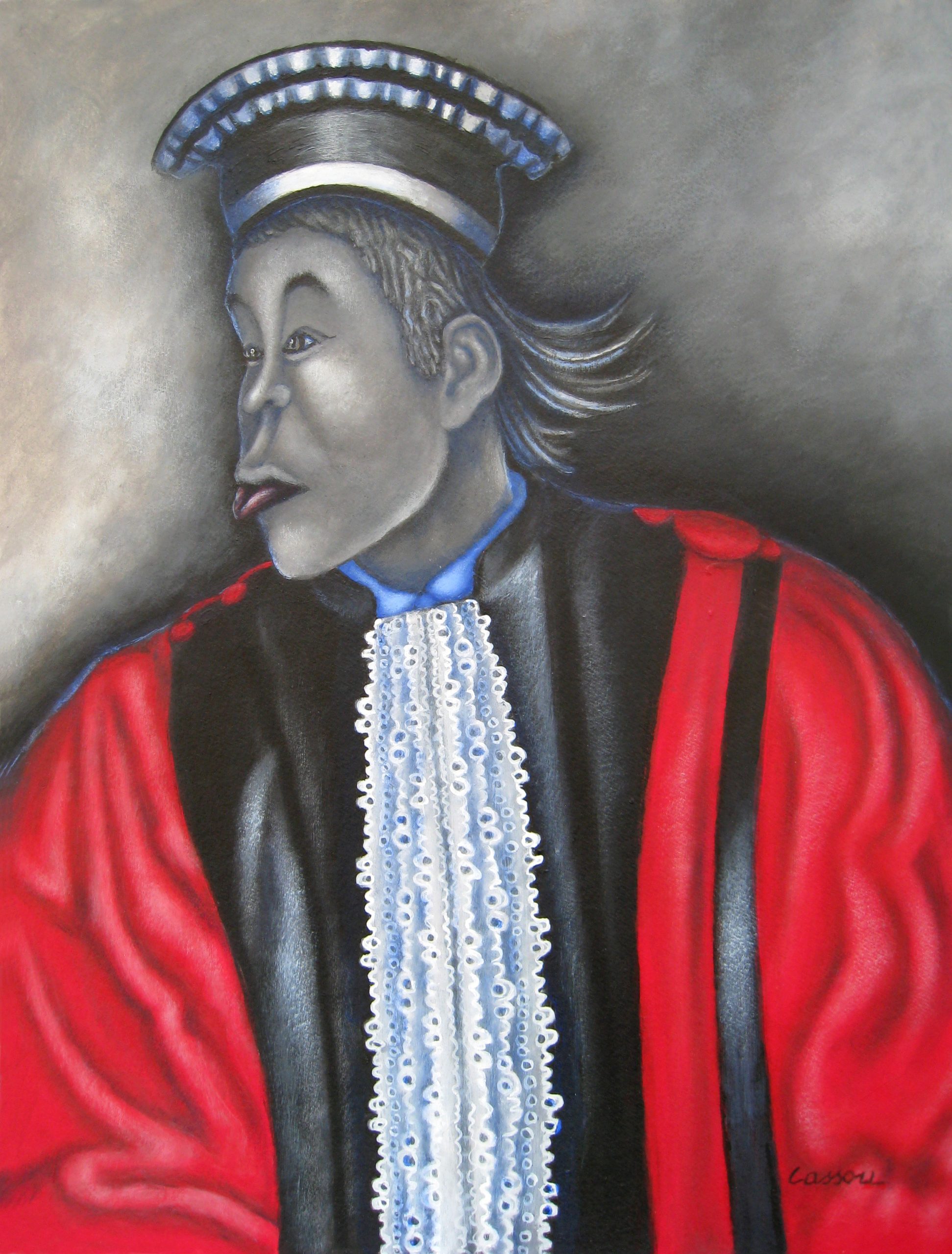
A. Well, I just feel like a judge should always rule according to his own conscience. I tried to present a joyful reminder of that. Nowadays, there’s so much political pressure, and it’s easy to get influenced. I wanted to show that a judge needs to stay completely independent, no matter what.
Q. Why is he sticking his tongue out?
A. Honestly, I wanted to break through that cold, heavy atmosphere. Sometimes all that strict formality makes people forget the human side of justice. Shaking things up a bit is just a way to remind everyone that true justice comes from a free mind. So, I gave this judge the maturity of a five-year-old sticking his tongue out as a sign of rebellion and defiance: “No, you don’t scare me!”
Thanks to Cassou for sharing her unique works and classing up Lawhaha.com. For information about either exhibiting or purchasing her paintings, go to her website: http://www.art-cassou.com