U.S. Patent No. 6,599,545, issued July 29, 2003, is for the new and exciting invention of “Method for making a sandwich.”
To be patentable, an invention must be new, useful and nonobvious. Does this one qualify?
Because it’s such a technical subject, let’s first explore the “The Background Art” of the invention as described in the patent:
Sandwiches typically comprise two slices of bread, and a combination of sandwich fixings disposed between the bread slices.
That’s food for deep thought. Har har. Now that we understand the background art, let’s explore the invention itself, which is:
A method for inserting one foodstuff, such as sandwich fixings, into a second foodstuff, such as a bread bun, which includes forming a cavity in the second foodstuff.
Way over my head, but deconstructed, it appears that invention is: Drill a hole in a bun and jam some cold cuts in there.
— U.S. Patent No. 6,599,545, issued July 29, 2003. Thanks to David Barman.
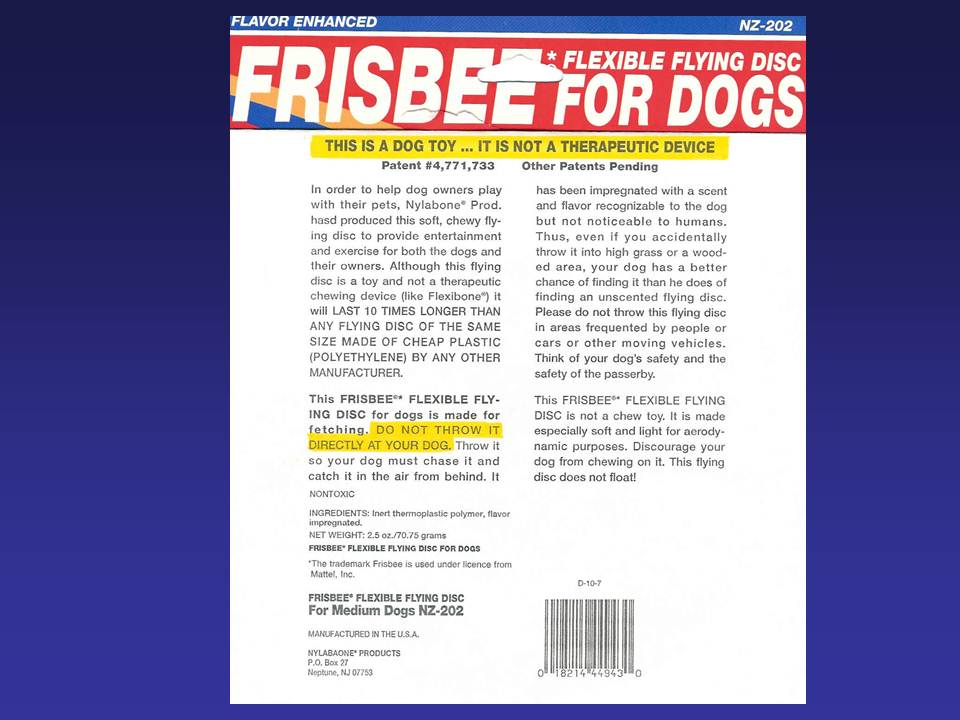
Have a dog? How’s he feeling? If he’s down in the dumps, maybe he’d enjoy a nice outdoor session chasing a Frisbee Flexible Flying Disc for Dogs.
But don’t expect it to change his mood completely by making the common consumer mistake that a plastic disc is a therapeutic device. As the manufacturer cautions across the top in all capital letters:
THIS IS A DOG TOY … IT IS NOT A THERAPEUTIC DEVICE
Lower down it warns:
DO NOT THROW IT DIRECTLY AT YOUR DOG
Why? Because he’s like to experience feelings of rejection and anxiety and require therapy, but as they just told you, it’s not a therapeutic device.
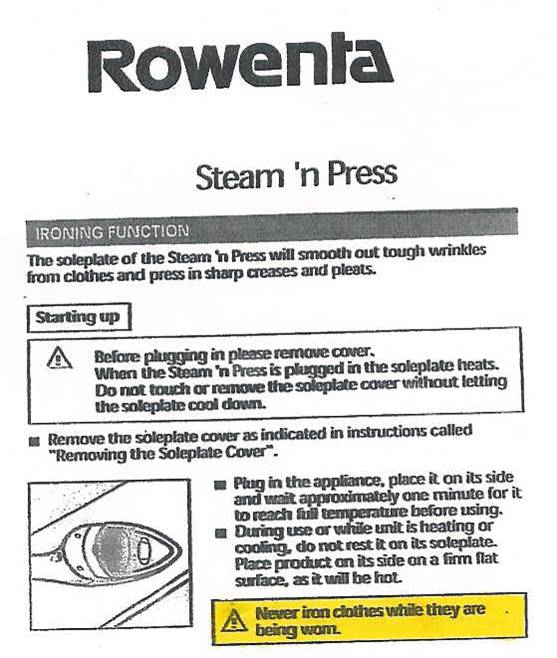
Rowenta felt the need to caution purchasers of its irons to:
Never iron clothes while they are being worn.
Sounds crazy, right? But when I asked my first-year law school class, filled with exceptionally intelligent people, if any of them had tried to iron clothes while wearing them, a lot of them nodded affirmatively.
A unanimous Strange Judicial Opinions Hall of Fame opinion is Cordas v. Peerless Transportation Co., penned in 1941 by Judge Carlin (no relation to George) of the New York City Court.
The defendant was a chauffeur and the victim of an armed car-jacking by a fleeing robber who threatened to blow the chauffeur’s brains out. In fright, the chauffeur slammed on the brakes and jumped out of the vehicle, which kept moving and hit the plaintiff pedestrian and her children (fortunately, injuries were slight).
The case stands for the unremarkable principle that under the basic negligence standard of reasonable care “under the circumstances,” people aren’t expected to exercise as much care in emergency situations as in non-emergencies where they have time to weigh and deliberate. It also stands as a literary masterpiece of judicial opinion writing.
Full appreciation of this classic can come only with a full reading, but here’s how it starts:
This case presents the ordinary man–that problem child of the law–in a most bizarre setting. As a lowly chauffeur in defendant’s employ he became in a trice the protagonist in a breath-bating drama with a denouement almost tragic. It appears that a man, whose identity it would be indelicate to divulge, was feloniously relieved of his portable goods by two nondescript highwaymen in an alley near 26th Street and Third Avenue, Manhattan; they induced him to relinquish his possessions by a strong argument ad hominem couched in the convincing cant of the criminal and pressed at the point of a most persuasive pistol.
Carlin apparently was a learned Shakespeare fan. In excusing the chauffeur from liability for jumping out of the moving vehicle, Carlin said:
If the philosophic Horatio and the martial companions of his watch were ‘distilled almost to jelly with the act of fear’ when they beheld ‘in the dead vast and middle of night’ the disembodied spirit of Hamlet’s father stalk majestically by ‘with a countenance more in sorrow than in anger,’ was not the chauffeur, though unacquainted with the example of these eminent men-at-arms more amply justified in his fearsome reactions when he was more palpably confronted by a thing of flesh and blood bearing in its hand an engine of destruction which depended for its lethal purpose upon the quiver of a hair.
Translation: It’s not negligent to react in fright when a carjacker has a gun pointed at your head.
— Cordas v. Peerless Transp. Co., 27 N.Y.S.2d 198, 199, 201 (City Court of N.Y. 1941). Thanks to all the folks who sent in this classic.
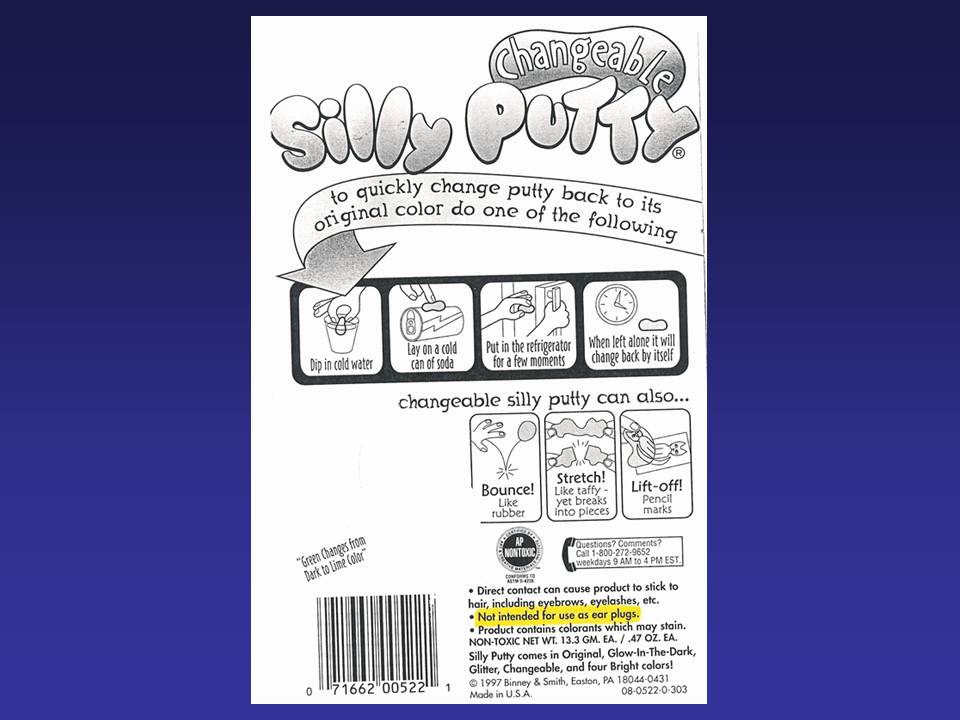
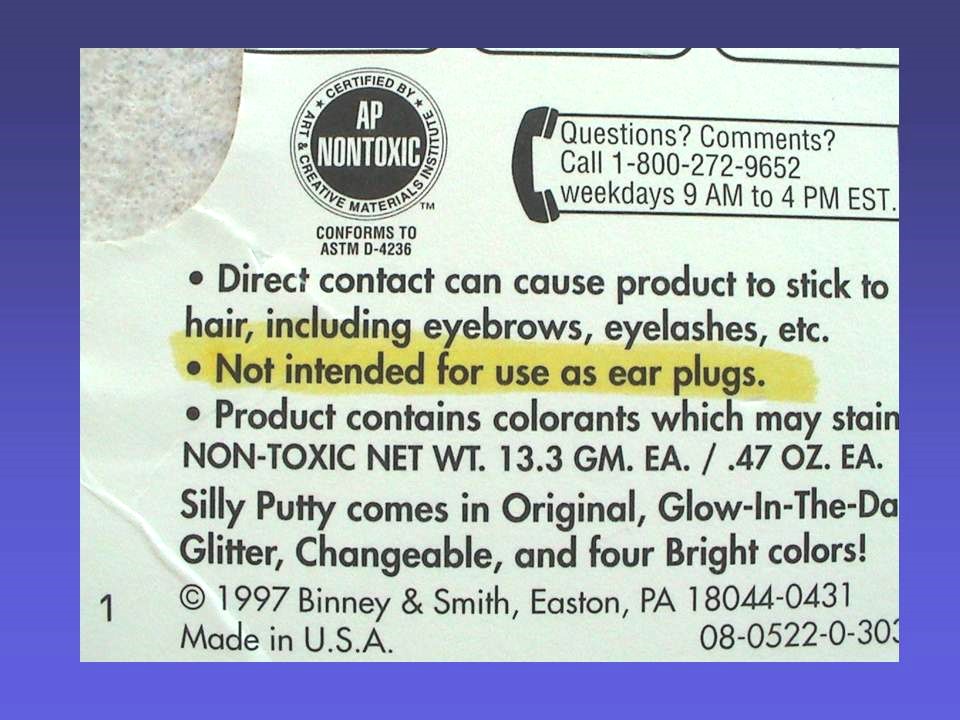
Silly Putty! What a great product. It’s may be the most successful product ever invented that lacks virtually any social utility. True, you can bend it around and pick up newsprint on it, but is it actually useful for anything?
This warning for a Slinky is mildly amusing because Slinkys just don’t seem very dangerous, but it’s the instructions that crack me up.
First, the warning:
CAUTION: Do not use in moving vehicle. Do not throw coils out any window. Keep Slinky away from face and eyes.
Now the instructions, and pay attention because they are complicated:
TO BOUNCE SLINKY UP AND DOWN: Hold a few coils tightly in one hand, allowing rest of Slinky to hang down. Now in a bouncing motion, move hand slowly up and down.
So that’s how you do it. I never could figure that out. I was always holding it up. Duh.
This is my favorite wacky warning of all time. Usually, if you ponder a warning, you can figure out why it’s there, even seemingly ridiculous warnings. So, for example, a warning on a heavy-duty power drill to not use it as a dental drill is probably there because some wayward consumer actually attempted to use it that way.
But I’ve never been able to conceive of a reason–even an unreasonable fear of lawsuits-based reason–why this manufacturer of home carbon monoxide detectors felt compelled to warn purchasers that the product is not a substitute for life insurance. If you have any ideas, send them along. Here’s the warning:
Carbon Monoxide detectors are not a substitute for life insurance. Though these detectors warn against increasing CO levels, we do not warrant or imply in any way that they will protect lives from CO poisoning. Homeowners and rents must still insure their lives.
There’s another issue with this warning. Why would any consumer want to buy a carbon monoxide detector that the manufacturer is not willing to warrant, or even “imply in any way,” will protect them from CO poisoning (the advertised purpose and utility of the product).