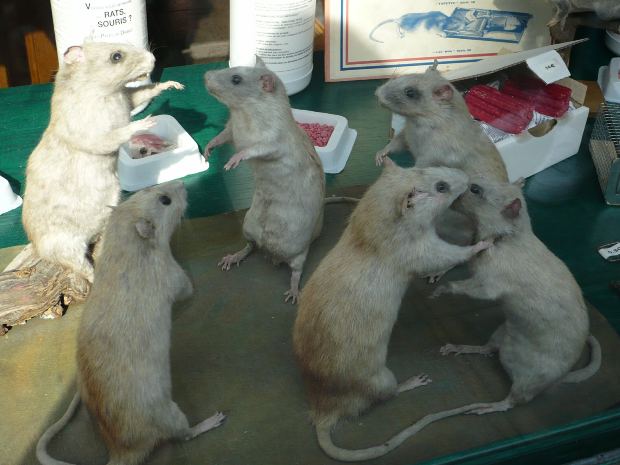
Rats, agitated about their shrinking legal rights after judge rules that squirrels are better than them.
In a 1954 Georgia case, an insured sued his insurance company for property damage caused by a squirrel. The insurance company denied coverage under an exclusion for “vermin.” The issue was whether squirrels are vermin or some higher grade species. The court ruled for the plaintiff, stating (some paragraph breaks inserted):
The brief of counsel for the defendant in error (which, incidentally; includes an excellent recipe for squirrel stew) concludes with the following words, with which this court is inclined to agree:
“‘Vermin’ is a mighty harsh word to hurl at our little friend the squirrel. He has long been well considered and much thought of as a pet and an attractive addition to the scenery of any city, garden, or country yard. He is praised in song and story as a shining example to mankind of industry and thrift. It is respectfully submitted that this court should not label the little fellow as nothing more than ‘vermin’.”
It is all the easier to agree with this encomium, as the question of whether squirrels are vermin was submitted to the jury, and the plaintiff offered without objection a wealth of technical and opinion evidence to the effect that it is not so classified (vermin being “any noxious, mischievous or disgusting animal”), whereas the defendant failed to place our furry friend within the limitations of this category.
He certainly does not belong there as a matter of law, and as a matter of fact we are well content to leave the verdict undisturbed, there being no evidence to the contrary.
Nutkin the Squirrel would be pleased. As someone pointed out in a comment, this case is amusing, but also a good lesson in the importance of paying attention to every word when drafting legal documents, especially documents such as insurance policies that by their very nature depend on definitions.
— North British & Mercantile Ins. Co. v. Mercer, 82 S.E.2d 41 (Ga. App. 1954). Thanks to Paul Scott.
In Pacific Grove, California, under a city ordinance, tourist monarch butterflies have a right to “peaceful occupancy” during their annual convention there.
Even if the butterflies are swarming one’s home, interfering with occupancy and use, they can only be removed to another location on application to the police. Here’s the ordinance:
11.48.010 Interference With Prohibited.
It is declared to be unlawful for any person to molest or interfere with, in any way, the peaceful occupancy of the monarch butterflies on their annual visit to the city of Pacific Grove, and during the entire time they remain within the corporate limits of the city, in whatever spot they may choose to stop in, provided, however, that if said butterflies should at any time swarm in, upon or near the private dwelling house or other buildings of a citizen of the city of Pacific Grove in such a way as to interfere with the occupancy and use of said dwelling and/or other buildings, that said butterflies may be removed, if possible, to another location upon the application of said citizen to the chief of police.
You can see it coming. A massive class action asserting equal protection claims on behalf of other bugs similarly situated under rapidly descending rolled-up newspapers and clouds of poison gas.
Seriously though, it’s a good law. Every year, monarch butterflies take up residence in Pacific Grove as part of their migration south. They winter in Mexico, after traveling 2500 miles, the only insect to accomplish such a feat. Pretty impressive.
— City of Pacific Grove, CA Ord. 210 N.S. §§ 8-3060, 1952. Thanks to Lihwei Lin.
U.S. District Judge Sam Sparks down in Austin, TX, peeved by the conduct of the lawyers in a pending case, chastised them for being “unable to practice law at the level of a first year law student” and ordering them to attend a kindergarten party at the courthouse. Here are the pertinent parts of his order:
You are invited to a kindergarten party … in Courtroom 2 of the United States Courthouse, … Austin, Texas.
The party will feature many exciting and informative lessons, including:
• How to telephone and communicate with a lawyer
• How to enter into reasonable agreements about deposition dates
• How to limit depositions to reasonable subject matter
• Why it is neither cute nor clever to attempt to quash a subpoena for technical failures of service when notice is reasonably given; and
• An advanced seminar on not wasting the time of a busy federal judge and his staff because you are unable to practice law at the level of a first year law student.
Invitation to this exclusive event is not RSVP. Please remember to bring a sack lunch! The United States Marshals have beds available if necessary, so you may wish to bring a toothbrush in case the party runs late.
This is the second time Judge Sparks has berated lawyers regarding their kindergarten skill-set.
Sparks’ boss, U.S. Fifth Circuit Court of Appeals Judge Edith Jones, was not amused by the “cute” order. Abovethelaw.com, via the Texas Lawyer, reported an email from Judge Jones to Judge Sparks that said in part:
It has not escaped my attention, or that of my colleagues or, I am told, nationally known blog sites that you have issued several ‘cute’ orders in the past few weeks. The order attached below is the most recent.
Frankly, this kind of rhetoric is not funny. In fact, it is so caustic, demeaning, and gratuitous that it casts more disrespect on the judiciary than on the now-besmirched reputation of the counsel. It suggests either that the judge is simply indulging himself at the expense of counsel or that he is fighting with counsel in what, as Judge Gee used to say, is surely not a fair contest. It suggests bias against counsel.
Guess we won’t be seeing any Sparks flying in Texas for a while.
— Order, Morris v. Coker, Case Nos. A-ll-MC-712-SS, A-ll-MC-713-SS, A-ll-MC-714-SS, A-ll-MC-7IS-SS, W.D. Tex., Aug. 26, 2011. Thanks to Professor Jodi Wilson, Douglas Giuliano, and others.
–From David Barman, Florida International University College of Law, Date of event: circa 2005
My son saw my first-year law school casebooks and picked up my Torts book. His first comment was: “Twelve hundred pages. That’s more than Harry Potter!”
Then he asked me, “What is Torts?” He’s a bright boy, but he is only nine. I asked him: “If you park your bike on the sidewalk, and a man hits your bike with a car, who did something wrong?” He said the man with the car. I asked why. My son answered “Because I’m allowed to put my bike on the sidewalk, but he isn’t allowed to drive on the sidewalk.” I said “Correct.”
Then I asked him: “Does the man in the car have to pay for the bike?” My son said yes. Then I said, “What if you get off your bike on the street and you leave it there just for a minute, and a man in a car hits it?” My son said, “It’s my fault.” I asked why, and he said, “Because I shouldn’t have left it in the street.”
Then I asked him if the man in the car has to pay for the bike. My son answered, “No.” I asked him why and he repeated, “Because I shouldn’t have left it in the street.”
I told him good job, that’s what Torts is. He said, “Is that it?” I told him “Yes.” Then he looked real confused and said, “Then why does the book have twelve hundred pages?”
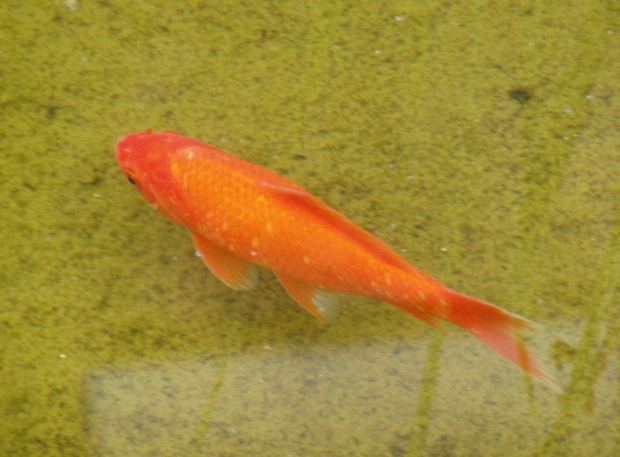
Goldfish have rights, so quit flushing them down toilets.
In People v. Garcia, the defendant appealed his conviction on multiple charges arising from a domestic assault episode that included stomping on some poor kids’ pet goldfish.
Judge James Catterson’s opinion explored the intriguing legal question of whether goldfish qualify as “animal companions” under statutes imposing enhanced felony penalties for abusing such companions.
The opinion started with an interesting history of animal domestication:
The earliest known domestic animal appears to be the dog, a companion to mankind as early as 15,000 B.C. Goats, sheep, pigs and cows followed in domestication in the next ten thousand years. Horses, however, did not succumb to the lure of mankind’s presence until 4000 B.C. The domestication of fish is believed to have begun much later, in China during the Tang Dynasty, around 620 A.D. The common goldfish (Carassius Auratus), a member of the carp family that was first domesticated in China, is now the most commonly kept aquarium fish. The goldfish’s leap from domesticated fish to family pet and companion may have happened as early as 1368 during the Ming Dynasty. The goldfish’s popularity in the West began as the first public aquarium opened in London in 1853. Keeping goldfish as companions and pets in the United States has been popular since that time.
The criminal statute at issue defined “companion animal” as any dog or cat or “other domesticated animal normally maintained in or near the household of the owner or person who cares for such other domesticated animal.” The defendant argued that goldfish don’t qualify.
Here’s a healthy excerpt of Judge Catterson’s terse, well-reasoned analysis of the issue:
The defendant contends that a fish is not a companion animal because it is not domesticated and because there is no reciprocity or mutuality of feeling between a fish and its owner, such as there is between a dog or a cat and its owner.
[The defendant cites to Am. Jur. 2d, which] defines “domesticated animals” as those that “no longer possess the disposition or inclination to escape,” and claims that “if dropped in a pond and offered the opportunity to swim away, a goldfish will do so without any hesitation and not look back”. He maintains that the statute’s reference to “any other” domesticated animal limits “companion animals” to those that are similar to dogs or cats, that is, those with a degree of sentience sufficiently elevated to enable them to enter into a relationship of mutual affection with a human being. Furthermore, “[b]eloved household pets (fish) may be, but ‘companion animals’ in the same vein as dogs or cats they are not”.
The defendant’s contention that all household pets are equal but some are more equal than others is manifestly not derived from the statute. The Legislature simply did not require a reciprocity of affection in the definition of “companion animal.” To the contrary, the statutory language is consistent with the People’s contention that “domesticated” is commonly understood to mean “to adapt (an animal or plant) to life in intimate association with and to the advantage of humans”. Thus, a goldfish such as the one herein is a domesticated rather than a wild animal within the common meaning of the term. Moreover, the goldfish was, as the statute requires, “normally maintained in or near the household of the owner or person who cares for [them].” Indeed, acknowledging that the goldfish is one of the most common household pets, defense counsel stipulated at trial that there are “millions of fish owners throughout the country”.
The defendant’s argument that goldfish are not domesticated animals because given the opportunity they would leave home is without merit. While this trait arguably distinguishes fish from dogs and, probably to a lesser extent cats, it fails to take into account that many other animals commonly considered pets, such as hermit crabs, gerbils, hamsters, guinea pigs and rabbits, would depart for less confining venues and greener pastures if given the opportunity. Loyalty, if that is what it is, is merely another characteristic urged by defendant-but not included by the Legislature-as a defining feature of a companion animal.
Moreover, [the statute] provides that “[n]othing contained in this section shall be construed to prohibit or interfere in any way with anyone lawfully engaged in hunting, trapping, or fishing ….” (emphasis added). This provision would be superfluous if a fish could not be considered a companion animal.
— People v. Garcia, 29 A.D.3d 255, 257, 260–61 (N.Y. App. Div. 2006). Thanks to Dan Green.
Longtime Lawhaha.com supporter Lihwei Lin sent this picture of a sticker inside a taxicab operating in the Pacific Rim.
Customers in these cabs must have been especially happy to reach their destinations. How could they not be? On entering the vehicle they are warned (italics added):
SAFETY-FIRST Please put on your seatbelt prepare for accident.
Out and about? Thirsty? Stop. Find a convenience store or a restaurant or even a liquor store. But don’t stoop (har har) to drinking out of the toilet. In case you forget, just read the warning sticker:
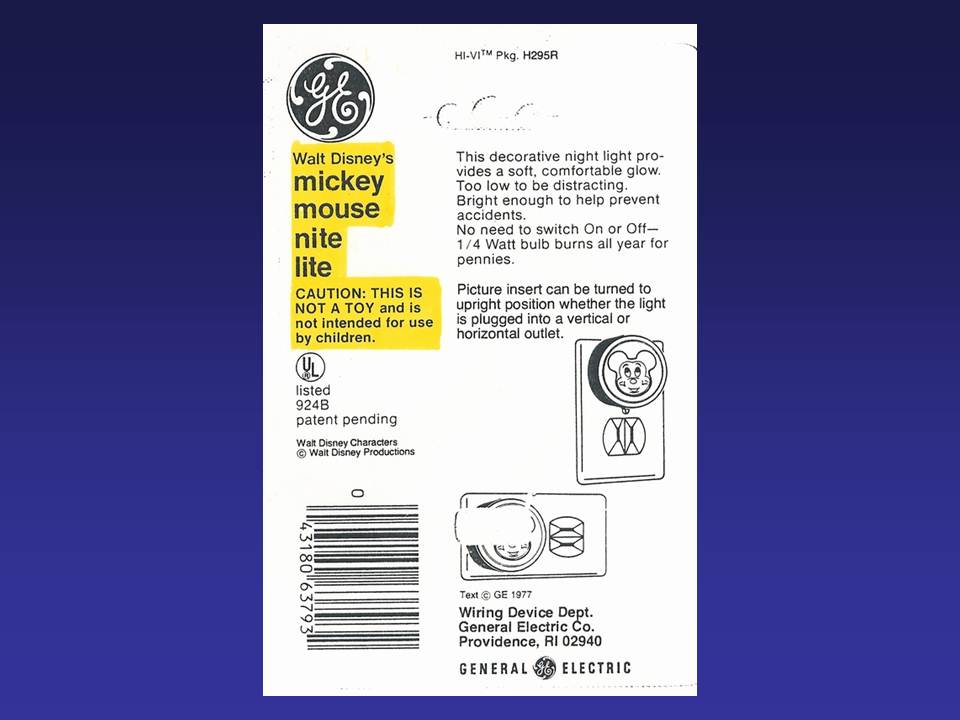
This warning makes sense because a plug-in night-light is, after all an electrical device that could be dangerous. But it still sounds funny to have a warning on a Mickey Mouse product that says:
CAUTION: THIS IS NOT A TOY and is not intended for use by children.
Here’s a great product to grow aragonite crystals just by adding white distilled vinegar. It’s hard to imagine a consumer product with greater social utility.
The packaging contains a seemingly silly warning that:
WARNING: Eating rocks may lead to broken teeth!
Maybe the rocks resemble candy, in which case it wouldn’t be such a silly warning. On the other hand, anyone who would mistake the rocks for candy probably wouldn’t be old enough to read the warning.