Lawhaha.com Cited in the Wall Street Journal

Nathan Koppel of the Wall Street Journal wrote an interesting front-page article about judges who use humor in their opinions, quoting McClurg and citing to Lawhaha.com.

Koppel explored the ongoing debate of whether and to what extent judges should use their written products as avenues for amusement.

What do you think?

Meanwhile, in the article, U.S. Ninth Circuit Court of Appeals Judge Alex Kozinski, a Lawhaha.com Hall of Famer, opined that Canadian judges are too boring and staid. Koppel quoted Kozinski saying: “I like my Canadian colleagues, but, boy, when it comes to reading their opinions, it’s like wading through molasses.”

But that’s not always true.  Koppel cited one example of Canadian judicial humor and we have a couple other good ones here and here.

The Santa Claus Lawsuits

Old Saint NickTwo of the most popular Harmless Error columns, Santa Suit (Children of the world sue Santa Claus) and Santa Strikes Back (Santa files his own suit), are featured here for your holiday pleasure.

Caroline Kennedy selected Santa Suit for inclusion in her anthology, A Family Christmas, where it appears alongside works by the likes of Mark Twain, Robert Frost, and Shakespeare.


Spot the Tort: Law Students Spot Torts, Law School Fixes Them

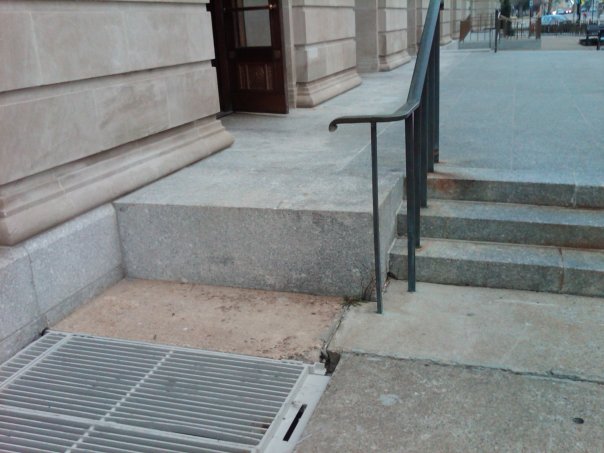
spot the tort dangerous drop-offIn 2010, the University of Memphis law school changed locations, moving from the main university campus to the magnificent, beautifully restored ($42 million worth) U.S. Customs House downtown on the Mississippi River.

The building is incredible, but as with any new gigantic construction project, quite a few punch-list items remained. Immediately, students started spotting and reporting dangerous premises conditions, which were forwarded to the administration.

This particular condition comprised significant drop-offs without barriers on both sides of the main entry doors.

spot the tort fixed drop-offThe administration must have agreed it was dangerous because the concrete planters were in place within two days.

Good fix! The drop-offs were not easily visible even in daylight as you can see in the second picture.

Marine Toughs Out Socratic Exchange with Hair-Drying Excuse

From Tom Walk, Wake Forest University College of Law, Date of event: circa 1980

One of my classmates was in a Marine Corps program and kept his hair in a buzz-cut. One day our Trusts professor called on him to recite a case. After about 30 seconds it was clear that the student had not read the case.

The prof stopped him and said “You are not prepared today, are you”? He responded “I’m sorry, Professor. I washed my hair last night and had to blow it dry.” The sheer ludicrousness of the answer left the professor just shaking his head as the rest of us rolled in the floor laughing.

Spot the Tort: Customers in for Shock at this Grocery Store

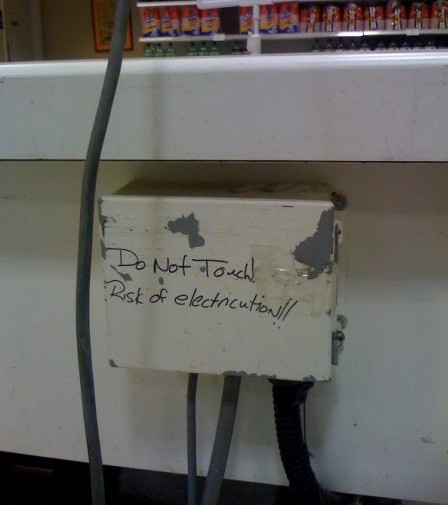
electrical dangerSpot the Tort isn’t just for lawyers and law students. A layperson was shocked (not literally, fortunately) to find this high-voltage electrical danger smack in the middle of an Atlanta grocery store.

Note to store: Your hidden warning on the back will not protect you from tort liability with regard to your “business invitee” customers. A business invitor has a duty to make the premises reasonably safe for invitees. Sometimes a warning may suffice, but only it if allows customers to negotiate the premises safely.

A lot of negligence questions are murky with no reliable answers, but I feel comfortable predicting that a judge or jury would consider placing these exposed high voltage cables in a place where children often wander freely to constitute an unreasonable risk.

electrical danger close-upIronically, getting close enough to read this warning actually increases the risk.

Warning: Do as We Say, Not as We Do

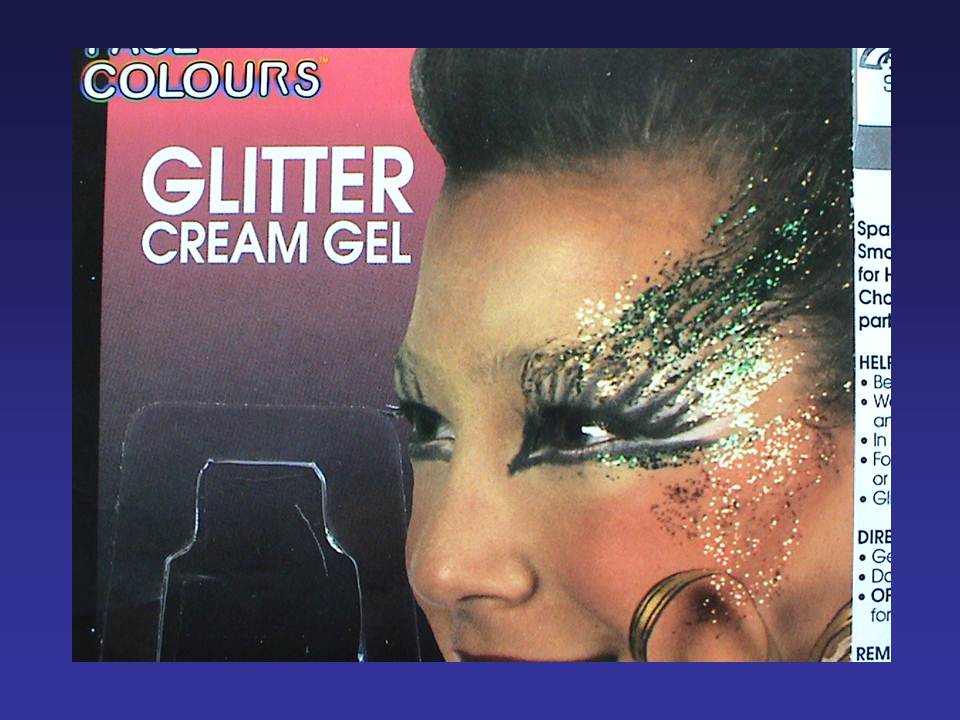
glitter makeup warning

glitter makeup warning

Glittery makeup is good stuff, for Halloween, your next glam band, or just for fun. And you can see how much fun this woman on the packaging is having with it. Go ahead and click on the image to expand it, so you can get the full realization of what an awesome opportunity this stuff presents to have a good time.

But wait, what’s that warning in small print on the back of the packaging?

Do not place glitter near the eye area.

Wishing Trial Judge Happy Birthday on Facebook Not an Ex Parte Communication


Facebook Button
Friend your trial judge on Facebook.

Facebook is creating a quickly growing pile of novel legal issues in a variety of areas. Here’s one of the first to reach a state supreme court: Does a witness’ wishing a trial judge happy birthday on the judge’s Facebook page violate the rules on ex parte communications?

The plaintiff in Onnen v. Sioux Falls Independent School District # 49-5 worked as the registrar for Southeast Technical Institute in Sioux Falls—an entity of the Sioux Falls School District. Plaintiff was terminated from employment in August 2007 due to improprieties relating to the registrar’s duty to verify a student’s compliance with graduation requirements. Among other things, some 28 students had been improperly awarded degrees, while 40-50 students entitled to a diploma did not receive one. The plaintiff appealed the termination. The trial court affirmed the decision and the South Dakota Supreme Court affirmed the trial court’s decision.

Among the issues raised on appeal, the plaintiff argued that a “major witness” for the School District had improperly engaged in an ex parte communication with the trial judge by wishing him “Happy Birthday” on the judge’s Facebook profile page. The court held that the trial judge was not required to disqualify himself and that an uninvited and unresponded-to happy birthday greeting on Facebook does not rise to the level of an improper ex parte communication.

I’m assuming the witness (who apparently was a distant relative of the judge) was a Facebook friend of the judge to be able to post a birthday greeting. If so, is that a problem? Some states have rules prohibiting judges from being on Facebook. Is that a free speech violation? An interesting legal question raised by social networking–one of first of what is going to be a long list.

Onnen v. Sioux Falls Independent School District, Case No. 49-5, 2011 S.D. 85 (2011). Thanks to Professor Roger Baron.

Patent: How About Some Tequila with that Lime and Heart Attack?

patent for lime juice to prevent heart attackThe subject—heart attacks—is not funny, but U.S. Patent No. 6,457,474, issued October 1, 2002, and described as a method of alleviating chest pain, especially from angina pectoris, is amusing or at least interesting. What’s the amazing heart-attack fighting invention? Drinking lime juice.

But, wait, maybe I’m not being fair. Maybe I’m oversimplifying it. Let’s check out the official patent abstract and see:

A method of alleviating chest pain that stems from the heart, which method comprises: (a) noticing a pain in the chest; and shortly thereafter (b) taking an effective amount of lime juice into the body to alleviate the chest pain.

Nope. Guess not. It really is a patent on drinking lime juice. Here’s how the invention works:

In accordance with this invention, a person takes in lime juice after noticing the onset of the chest pain.

Don’t worry if you don’t understand it. It’s a very complex scientific procedure. But let’s at least clear up one other confusing point. What exactly is this secret ingredient? The patent explains:

“[L]ime juice” means lime juice or limeade or any combination that includes the juice of a lime ….

Pucker up because the inventor recommends “drinking at least a glass daily [of lime juice] in non-concentrate form” as a preventative measure.

Sound inconvenient? It’s not. In fact, one of the primary advantages of lime juice as a remedy for angina pectoris over nitroglycerin is that:

Since the juice is regularly stored in the refrigerator or freezer, it can be quickly located by the patient, particularly at nighttime where the refrigerator light plays a helpful role.

— U.S. Patent No. 6,457,474, Oct. 1, 2002. Thanks to David Barman.

Squirrels Not “Vermin” According to Judge

Rats, agitated about their shrinking legal rights after judge rules that squirrels are better than them.

In a 1954 Georgia case, an insured sued his insurance company for property damage caused by a squirrel. The insurance company denied coverage under an exclusion for “vermin.” The issue was whether squirrels are vermin or some higher grade species. The court ruled for the plaintiff, stating (some paragraph breaks inserted):

The brief of counsel for the defendant in error (which, incidentally; includes an excellent recipe for squirrel stew) concludes with the following words, with which this court is inclined to agree:

“‘Vermin’ is a mighty harsh word to hurl at our little friend the squirrel. He has long been well considered and much thought of as a pet and an attractive addition to the scenery of any city, garden, or country yard. He is praised in song and story as a shining example to mankind of industry and thrift. It is respectfully submitted that this court should not label the little fellow as nothing more than ‘vermin’.”

It is all the easier to agree with this encomium, as the question of whether squirrels are vermin was submitted to the jury, and the plaintiff offered without objection a wealth of technical and opinion evidence to the effect that it is not so classified (vermin being “any noxious, mischievous or disgusting animal”), whereas the defendant failed to place our furry friend within the limitations of this category.

He certainly does not belong there as a matter of law, and as a matter of fact we are well content to leave the verdict undisturbed, there being no evidence to the contrary.

Nutkin the Squirrel would be pleased.  As someone pointed out in a comment, this case is amusing, but also a good lesson in the importance of paying attention to every word when drafting legal documents, especially documents such as insurance policies that by their very nature depend on definitions.

North British & Mercantile Ins. Co. v. Mercer, 82 S.E.2d 41 (Ga. App. 1954). Thanks to Paul Scott.

Butterflies are Free in Pacific Grove, CA

monarch butterfly

In Pacific Grove, California, under a city ordinance, tourist monarch butterflies have a right to “peaceful occupancy” during their annual convention there.

Even if the butterflies are swarming one’s home, interfering with occupancy and use, they can only be removed to another location on application to the police. Here’s the ordinance:

11.48.010 Interference With Prohibited.

It is declared to be unlawful for any person to molest or interfere with, in any way, the peaceful occupancy of the monarch butterflies on their annual visit to the city of Pacific Grove, and during the entire time they remain within the corporate limits of the city, in whatever spot they may choose to stop in, provided, however, that if said butterflies should at any time swarm in, upon or near the private dwelling house or other buildings of a citizen of the city of Pacific Grove in such a way as to interfere with the occupancy and use of said dwelling and/or other buildings, that said butterflies may be removed, if possible, to another location upon the application of said citizen to the chief of police.

You can see it coming. A massive class action asserting equal protection claims on behalf of other bugs similarly situated under rapidly descending rolled-up newspapers and clouds of poison gas.

Seriously though, it’s a good law. Every year, monarch butterflies take up residence in Pacific Grove as part of their migration south. They winter in Mexico, after traveling 2500 miles, the only insect to accomplish such a feat. Pretty impressive.

— City of Pacific Grove, CA Ord. 210 N.S. §§ 8-3060, 1952. Thanks to Lihwei Lin.