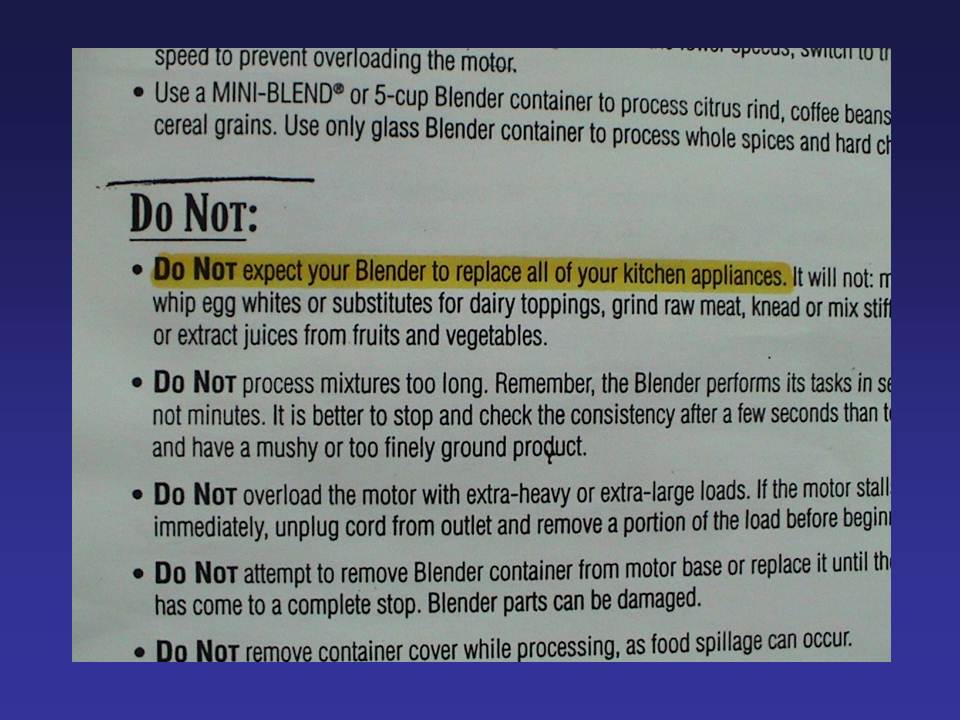
 Shoot, I read this instruction on a new blender too late:
DO NOT expect your Blender to replace all of your kitchen appliances.
I had already put my stove, microwave, dishwasher and fridge on Craigslist before I saw it.

Shoot, I read this instruction on a new blender too late:
DO NOT expect your Blender to replace all of your kitchen appliances.
I had already put my stove, microwave, dishwasher and fridge on Craigslist before I saw it.

A funny juxtaposition of a warning in a Hong Kong subway, directly above a Nike ad.
The translated warning at the top says (yellow highlighting):
DANGER! JUMPING INTO THE TUNNEL IS FORBIDDEN
The Nike ad below suggests one reconsider.
 Here are the warnings from a dust-mist-fumes respirator mask from a home improvement store. It’s a good product, but just be aware that:
This respirator does not supply oxygen.
and
Use only in atmospheres with adequate oxygen to sustain human life.
Another close call, saved by a product warning. Do not bother packing this mask for your upcoming trip through the solar system.
 (All photos are expandable thumbnails.)
Here’s a warning for a power drill, the kind you buy at Home Depot for the purpose of making holes in wood, metal and concrete.
But read up before using, people, because:
This product is not intended for use as a dental drill or in medical applications.
That last part threw me because I have this pain in my side and also this really nice 18-volt hammer drill. I was thinking, why not see what’s going on it there? I’m glad I read the warning first.
Most people enjoy this warning for the seemingly silly dental drill caution, but I also like this part:
Do not allow familiarity gained from frequent use of your rotary tool to become commonplace.
I know what they’re trying to say, and they do clear it up in the unbolded sentence that follows. It’s an issue worthy of addressing in product warnings because tons of “cognitive failure” research shows that humans are prone to mental slips when performing tasks, and, perhaps counterintuitively, that the more expert a person becomes in performing a task, the more likely he or she is to commit a mental slip. Familiarity and confidence breed inattention.
So it’s a well-intended warning, but the bolded sentence doesn’t say what it means. Essentially, it says don’t let familiarity with the tool become commonplace, which is a non-sequitur.
 In my Products Liability course, we have “Stupid Warning Day,” where each student is required to bring in an unusual warning label. When I was teaching at a law school in San Francisco, a student brought in this warning for a set of “Lock Up Your Lover Furry Handcuffs.”
It’s actually a pretty good warning though:
WARNING: Place an extra key in a safe place to avoid unnecessary discomfort, embarrassment and any need to call a locksmith or a police officer.
 … 50 yards from a preschool.
University of Memphis law student Leighann Ness sent this picture of a water-filled hole a stone’s throw away from the Nashville preschool attended by her daughter.
Meanwhile, while awaiting corrective action, we can all rest easy that this ribbon of yellow tape will effectively protect nearby toddlers and others.
Leighann reported that her non-lawyer husband is the one who actually spotted the problem. As I always say, Spot the Tort is a game for the whole family.
 Sounds like a warning one might expect to find on one of the Weasley twins’ products in the Harry Potter franchise, but this disclaimer on a pack of incense comes from the Muggle world.
 First, the incense promises a magical world of mystic knowledge and ecstasy, but the small print at the bottom takes it all back:
Sold as curio only, no magical effects are guaranteed.
To which they might want to add:
If you’re experiencing magical effects, it’s probably not from the incense, but from that other product you’re using the incense to cover up.
McClurg’s popular legal humor column, Harmless Error: A Truly Minority View on the Law, ran monthly on the Obiter Dicta page of the American Bar Association Journal, the official magazine of the American legal profession, from September 1997 to December 2001 for a total of fifty columns. Browse all Harmless Error columns.
Harmless Error tackled a wide variety of both pressing and purely ridiculous issues from a legal point of view most frequently described as “twisted.” Sampling of reader praise.
• Historical retakes on classic cases such as Palsgraf v. Long Island R.R. Co. and Hadley v. Baxendale (Palsgraf Uncovered and Hadley’s Reprise).
• Lawsuits against and by Santa Claus (Santa Suit and Santa Strikes Back).
• Harry Potter’s tortious victimization at the Hogwarts School of Witchcraft and Wizardry (Hogwarts Torts).
• A reimagining of the lyrics to the Beatles’ Sgt. Pepper’s album from John Lennon’s legal point of view (Yeah, Yeah, Yeah).
• Chin shots to monopolistic industries like managed health care (Heal Thy Self), insurance companies (Insurance Deterrence), and the cable industry (Cable Cartel).
• Legal protection for the heart (Cupid’s Covenant, My Phony Valentine).
• And, of course, the dramatic struggles of America’s favorite little litigator, Suzy Spikes, as she fought oppression by The Man. (Sentencing Suzy, Suzy Assumes the Risk, Suzy’s Re-dress, Suzy’s Breach, Suzy’s Soulmate). Read more About Suzy Spikes.
| 1. On Shelley’s Case (Oct. 1997) |
26. Say What? (Nov. 1999) |
| 2. 100 % Guarantee (Nov. 1997) |
27. Tot Tech (Dec. 1999) |
| 3. Please, Mr. Postman (Dec. 1997) |
28. Santa Suit (Jan. 2000) |
| 4. The Comma (Jan. 1998) |
29. Cupid’s Covenant (Feb. 2000) |
| 5. Sentencing Suzy (Feb. 1998) |
30. Cable Cartel (Mar. 2000) |
| 6. Perpetually Clueless (Mar. 1998) |
31. Cellular Rights (May 2000) |
| 7. Matter of Form (Apr. 1998) |
32. Ruff Justice (June 2000) |
| 8. Dog Daze (May 1998) |
33. eLawrealcheep.com (July 2000) |
| 9. Canned Sincerity (June 1998) |
34. Suzy’s Breach (Aug. 2000) |
| 10. Hadley’s Reprise (July 1998) |
35. Campaign Refinancing (Sept. 2000) |
| 11. Hep Catalogs (Aug. 1998) |
36. Rocket Science (Oct. 2000) |
| 12. Suzy Assumes the Risk (Sept. 1998) |
37. Hogwarts Torts (Nov. 2000) |
| 13. Agreeing to Disagree (Oct. 1998) |
38. Really Intellectual Property (Dec. 2000) |
| 14. Conquering Renters’ Blues (Nov. 1998) |
39. Palsgraf Uncovered (Jan. 2001) |
| 15. Fowl Play (Dec. 1998) |
40. My Phony Valentine (Feb. 2001) |
| 16. Legal Hoopholes (Jan. 1999) |
41. Insurance Deterrence (Mar. 2001) |
| 17. Hold Your Fire (Feb. 1999) |
42. Suzy’s Soulmate (Apr. 2001) |
| 18. Accidents Happen (Mar. 1999) |
43. Hair Piece (May 2001) |
| 19. Short Subjects (Apr. 1999) |
44. Reference Work (June 2001) |
| 20. Frequent Crier Miles (May 1999) |
45. Bad Law (July 2001) |
| 21. Yeah, Yeah, Yeah (June 1999) |
46. The© Controversy (Aug. 2001) |
| 22. Contract Sports (July 1999) |
47. Oil Fume (Sept. 2001) |
| 23. Hiring Squeeze (Aug. 1999) |
48. For Children’s Sake (Oct. 2001) |
| 24. Heal Thy Self (Sept. 1999) |
49. Return to Vendor (Nov. 2001) |
| 25. Suzy’s Re-dress (Oct. 1999) |
50. Santa Strikes Back (Dec. 2001) |
“I was laughing so hard people near my office thought I was crying.” — Sherry Cooper
“I have to tell you that in 38 years of perusing the ABA Journal I never have laughed as much as I did when I read your item on Canned Sincerity. I was laughing so hard that tears came to my eyes.” — Joe Frank
“Beyond superb, beyond funny … absolutely, positively, stupendously magnificent!” — Sheldon Finkelstein
“Laughed myself silly.” — Denise Sangster
“Your Hep Catalogs piece in the ABA Journal is the funniest thing I have come across in ages. I laughed until I cried. Thanks for brightening my day!” — Kent Schneider
“You are the Dave Barry of our profession.” — Charles R. Crawford
“It has been a long time since I read anything as funny. Thanks for the laughter.” — Cooka Hillebrand
“It’s a rainy cold Sunday … No one else is in the office and it’s a good thing because I am howling with laughter. This column is your best ever!” — Dianne Dailey
“I loved your piece on A Civil Action. I read much of it aloud to my Civil Procedure class. They howled.” — Gerry Hess
“When I receive the ABA Journal the first thing I always flip to is Harmless Error. I am a third-year law student and I have been religiously reading Harmless Error since I began law school. Keep up the humor! In the law we definitely need to see the lighter side.” — Erin Eckert
“The Rule Against Perpetuities moved me to tears on more than one occasion while a law student, but your column actually moved me to tears of hysterical laughter. Thanks for the welcome break from the insanity.” — Michelle Katz
“Just read your article in the ABA Journal!!! I laughed so hard—the best laugh I’ve had all summer!” — Deborah K. Comini
“I am an attorney who has been practicing for almost 20 years. Your article was hilarious. What a great way to start my day. Thanks!” — Barbara Burnett
“Your article regarding the mailbox rule was hysterical.” — J.L. Kessler
“You’ve really got a gift for writing in a way that slides right through the brain and goes straight to the funny bone. Thanks for all the giggles.” — Jacquie Brennan

Apparently, it’s not as hard to get a patent as people think:
U.S. Patent 4,022,227 is a patent for a “Method of concealing partial baldness,” described more particularly in the abstract as “[a] method of styling hair to cover partial baldness using only the hair on a person’s head. The hair styling requires dividing a person’s hair into three sections and carefully folding one section over another.”
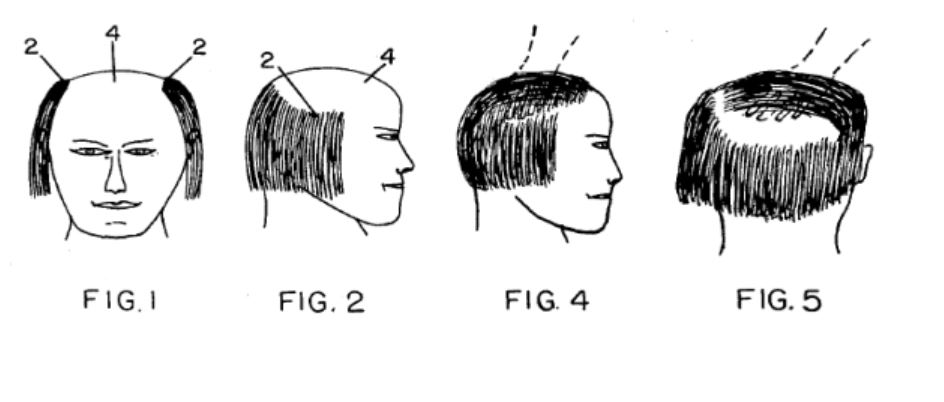 It even comes with diagrams:
Yep. It’s a valid U.S. patent for the dreaded “comb-over.” We’ve all witnessed the results of this amazing invention, which works so effectively that no one notices the baldness, provided they are sight-impaired and at a distance of more than 200 yards.
— U.S. Patent 4,022,227, May 10, 1977. Thanks to David Barman.
Do have a dog? Do you like to take it for walks? Do you feel it’s your moral and social responsibility to clean up after it? Are you skilled at playing lacrosse?
If your answer is yes to all of the above, then the invention protected by U.S. Patent 7,090,268, Aug. 16, 2006, is the perfect dog-walking accessory for you.
As described in the patent application, the invention is “a simple portable device which allows the dog’s owner to catch and hold the dog waste in a plastic bag before it comes in contact with the ground or grass without bending over.”
Basically, the invention sounds like kind of a lightweight lacrosse stick that you use to catch dog feces in. But just as in the real sport, you have to be quick on your toes to use this baby effectively. As the patent explains: “As soon as the dog shows a motion to excrete, this device is … placed underneath the dog’s bottom and catches the dog waste, thus preventing the soiling of the ground or grass.”
Is it a good invention? Darn right it is. As everyone knows, “[d]ogs tend to excrete while they are walked” and “[o]nce the droppings fall on the ground or grass, it is difficult to collect them completely, especially when they are loose.” Which, of course, is why many dog owners prefer to leave it to their neighbors to deal with.
This sounds like a good invention, although I’m not sure the dogs are going to sit still for it.
— U.S. Patent 7,090,268, Aug. 16, 2006. Thanks to David Barman.