
No Cash Here, Just Blood and Urine

Not a legal warning, but an interesting notice posted on a lock box at a local medical facility: “No Drugs or Money Kept in Box; Blood and Urine Specimens Only.”

Probably effective unless, of course, it’s encountered by someone actually looking to steal blood or urine samples, in which case it’s an invitation.  Of course, that’s silly because no one would ever want to steal a blood or urine sample.

Or would they?  (Spoiler alert:  The link leads to an article about a man who stole his wife’s urine to submit as a sample, leading to the revelation the man was pregnant.)


The Amazing One-Day Warranty

“Hurry up and break!”

That’s what you might be saying to your new “Mini Garment Steamer” if you read the User’s Manual and come across this one-day warranty:

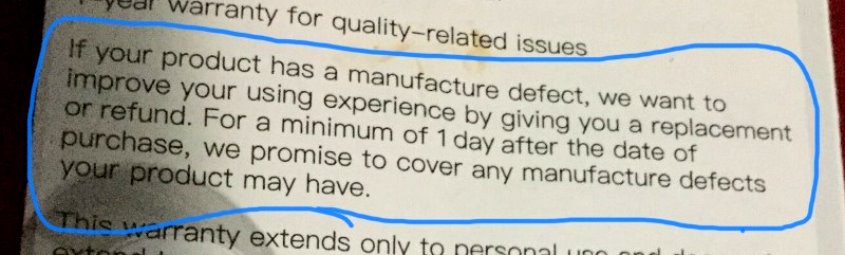
“If your product has a manufacture defect, we want to improve your using experience by giving you a replacement or refund.  For a minimum of 1 day after the date purchase, we promise to cover any manufacture defects your product may have.”  (Bold added.)

There are some other warranties in the manual, so this appears to be more a case of poor drafting than an effort to limit consumer remedies.  After all, it doesn’t say a “maximum” of one day; only a minimum.

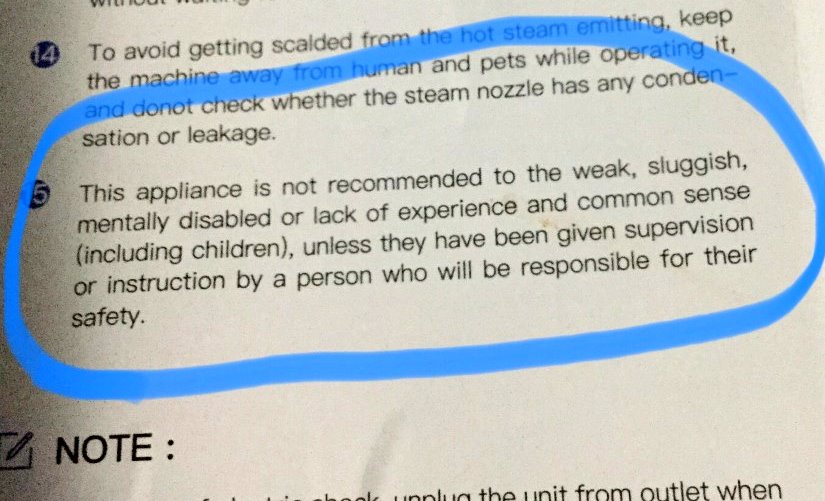
For further evidence of that conclusion, we offer this warning, also found in the User’s Manual:

So if you’re weak, sluggish, mentally disabled, lack experience with mini garment steamers, or just don’t have any common sense, avoid this product.

Halloween Law

Not Randy Maniloff

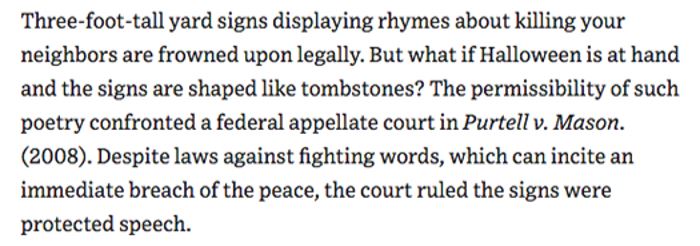
Randy Maniloff has penned an interesting piece for the Wall Street Journal on what he calls the “Halloween Exception” to established legal principles.  Randy–a leading expert on Halloween law, the “baseball rule,” and other legal topics too numerous to list–discusses several instances where judges have departed from traditional legal principles to facilitate Halloween traditions.

In other words, on Halloween you can get away with mischief that would be criminal or tortious in other seasons.  Fascinating.

Here’s one of his examples:

It’s a great read!  Check it out.

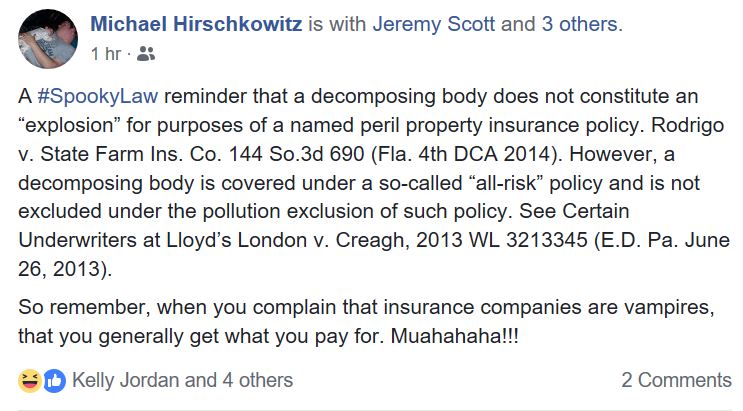
In other Halloween-related legal news, a former student explored the legal implications of insurance coverage for decomposing bodies in a Facebook post.  His research led him to conclude that a decomposing body does not qualify as an “explosion” under an insurance policy, but–good news!–is not excluded from coverage under a “pollution exclusion” in a policy.

Happy Halloween from Lawhaha.com!

Publish or Perish: “Get Me Off Your F****** Mailing List”

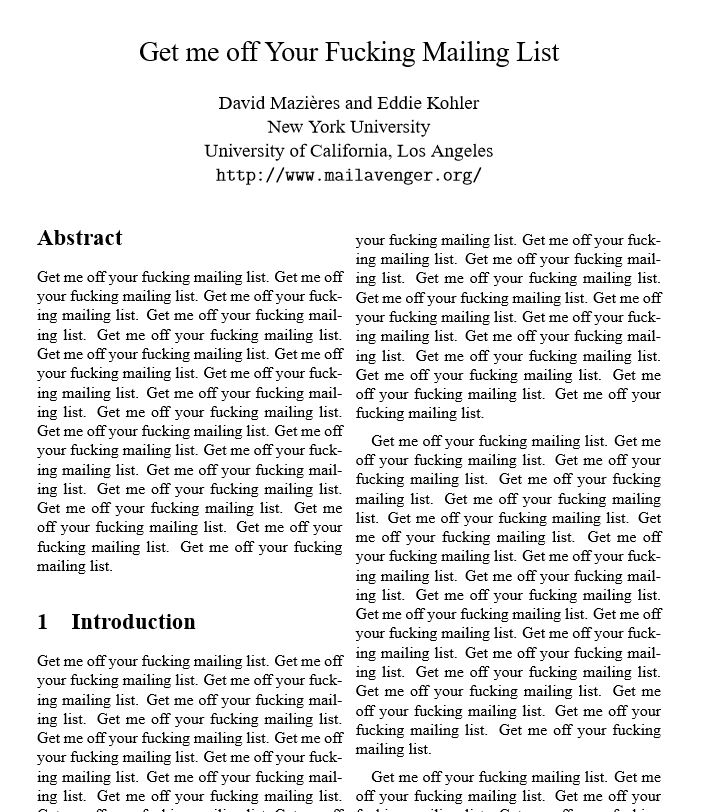
After reading a rundown on the day’s latest depressing news, it was a true joy to come across this Vox article about this real article accepted for publication in an “academic journal.”

In academia, it’s publish or perish.  Good teaching is important, but it won’t get you promoted or tenured without publishing.  To assist academics on their climb up the steps of the ivory tower, professors in all disciplines are constantly bombarded with email from dubiously credentialed sources offering to publish their books and articles.

As the Vox article explains, this classic work, Get Me Off Your Fucking Mailing List, was actually accepted for publication by something called the “International Journal of Advanced Computer Technology.”  The ten-page article is nothing but the sentence, Get me off your fucking mailing list, repeated hundreds of times.

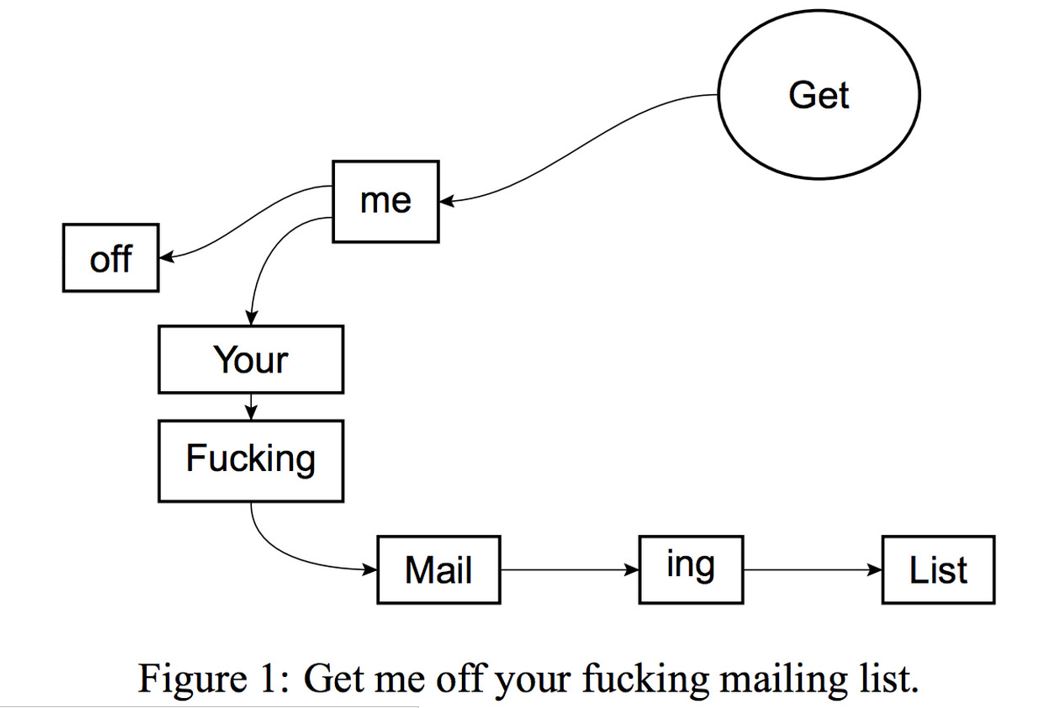
If it’s over your head, as much of the best academic stuff can be, no worries.  The authors included this helpful flow chart explaining the whole thing.

No Trial Delay for Solar Eclipse

U.S. District Judge Steven “Not So” Merryday denied an Assistant U.S. Attorney’s (AUSA) motion to delay a trial because a witness employed by the Bureau of Alcohol, Tobacco, Firearms and Explosives (ATF) had prepaid for a trip to view the August 21, 2017 solar eclipse in totality.

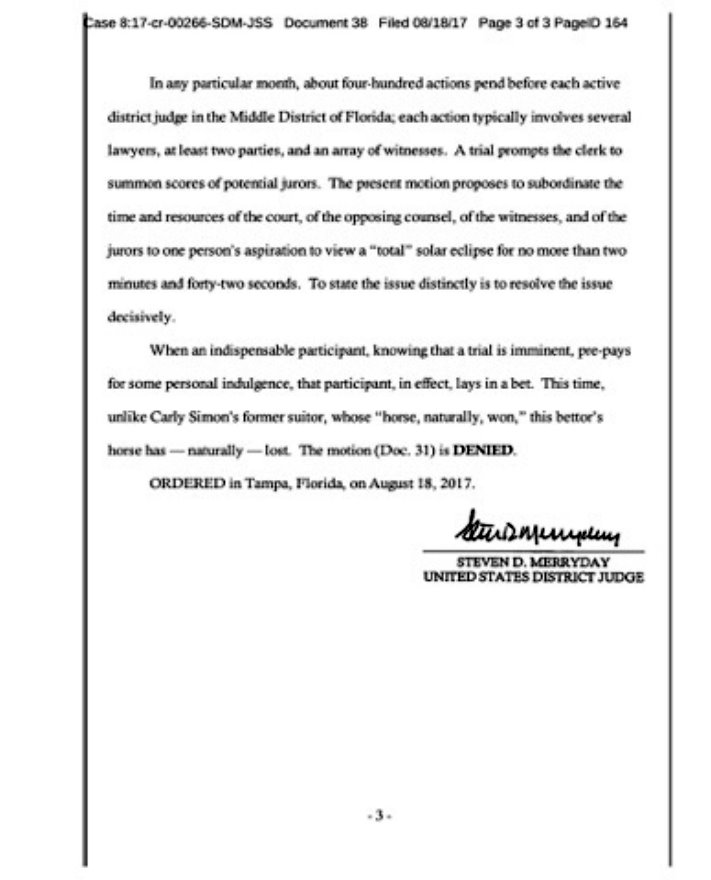
The court reasoned that the delay would “subordinate the time and resources of the court … to one person’s aspiration to view a ‘total’ solar eclipse for no more than two minutes and forty-two seconds.”

Can’t take issue with the result, but instead of just saying that, the magistrate–perhaps seeking his own two minutes and forty-two seconds of fame–penned a silly too-cute-for-words order built around Carly Simon’s 1972 hit “You’re So Vain.”
You may recall that Simon’s anonymous, self-absorbed antagonist (suspected to be Warren Beatty) “flew [his] Learjet up to Nova Scotia to see the total eclipse of the sun.”  (Speculation has it that Carly was referring to the 1970 total eclipse that was viewable along the East Coast of the United States).

In his order denying the motion to postpone, Judge Merryday mocked the AUSA who filed the motion for “boldly mov[ing] … where no AUSA has moved before”  and for “oddly” describing the eclipse “‘scheduled to occur,’ as if someone arbitrarily set the eclipse, as an impresario sets a performer to appear at a chosen time and place.”

He unnecessarily ridiculed the witness for his prepaid “personal indulgence,” again invoking the Carly Simon song, which featured this line immediately preceding “the total eclipse of the sun” line: “Well I hear you went to Saratoga, and your horse naturally won.”

When an indispensable participant, knowing that a trial is imminent, pre-pays for some personal indulgence, that participant, in effect, lays in a bet.  This time, unlike Carly Simon’s former suitor, whose “horse, naturally won,” this bettor’s horse has–naturally–lost.

Meanwhile, he diminished the significance of a total solar eclipse as “just another astral event.”  The rare August 21 total eclipse will be the first to travel from coast to coast within the United States in nearly 100 years.

–Order, United States v. Joseph Bishop, U.S. District Court, Middle District of Florida, Tampa Div., Case No. 8:17-cr-266-T-23JSS (Aug. 18, 2017) (Thanks to David Barman.)

Legal Trivia Question: Largest Arrest in U.S. History

Just as doctors need patients, lawyers need clients.  One can surmise that local criminal defense lawyers got plenty of business during the largest mass arrest in U.S. history.  How many people were arrested and where did it occur?

  1. 140 in Peoria, Illinois
  2. 1500 in Boston, Massachusetts
  3. 12,000 in Washington, D.C.
  4. 17,500 in Los Angeles, California

ANSWER: In May 1971, more than 500,000 anti-Vietnam War protesters descended on Washington, D.C. with the intention of shutting down the federal government by blocking the streets.  As of that date, 45,000 American soldiers had died in Vietnam and more than 250,000 troops were still stationed there.  At least 12,000 protesters were arrested from May 3 through May 5, including Daniel Ellsberg.

Ellsberg, a former Defense Department analyst, had helped compile a report on the history of U.S. involvement in Vietnam from 1945–68 for Defense Secretary Robert McNamara.  The study, which became known as the “Pentagon Papers,” exposed controversial, previously hidden truths about the scope and purpose of U.S. participation in the Vietnam War.  Ellsberg leaked the Pentagon Papers to the New York Times, which began publishing them in installments.

The Nixon administration sued for an injunction, which resulted in a landmark U.S. Supreme Court case, New York Times Co. v. United States, 403 U.S. 713 (1971), where the Court ruled in favor of the newspaper by a 6-3 vote, a major victory in troubled times for the First Amendment right to free speech and a free press.  Publication of the Pentagon Papers helped turn the tide of public opinion against the war.  It took until June 2011, forty years to the day from the original publication of the Pentagon Papers by the New York Times, before the U.S. government officially declassified and released the papers.

The answer, therefore, is C.

Truth About McDonald’s Coffee Spill Case in Five Minutes

Several former students sent me this video of Adam Ruins Everything’s explanation of the infamous McDonald’s coffee spill case.  They thanked me for telling them the truth in Torts about the grossly distorted case.  I actually stopped talking about it a few years ago, but may need to bring it back because the distorted view still seems prevalent.  I guess we could call it an early form of “fake news.”  Unfortunately, it was all too real for poor Stella Liebeck.

[embedyt] http://www.youtube.com/watch?v=KNWh6Kw3ejQ[/embedyt]

The video does a great job, in a humorous way, of summarizing key points, including: (1) Stella was a 79-year-old passenger in a parked car when she accidentally spilled the coffee on herself (not driving while trying to add cream and sugar); (2) She initially sought only a small amount from McDonald’s for her medical expenses (not a greedy, litigious person); (3) She suffered third-degree burns that her doctor said was the one of the worst cases he had ever seen; (4) The temperature of the coffee was around 190 degrees; (5) Evidence at trial showed 700 prior McDonald’s coffee burn instances; (6) McDonald’s own witness testified the coffee was a hazard at the temperature it was served; (7) The $2.7 million verdict was mostly punitive damages, which the jury calculated by awarding what testimony showed would equal two days worth of McDonald’s coffee sales; and (8) The damages award was reduced by the trial court so that, in the end, Stella only received about $600,000 (of which her lawyer probably received a third, plus expenses).

Only thing missing to drive the point home that this case was anything but frivolous is an image of Stella’s horrific injuries from a spilled cup of coffee, which we included in previous mentions of the case here and here.

1L of a Ride Video Course

1L of a Ride Video Course Marketing Video

The 1L of a Ride Video Course is based on McClurg’s bestselling law school prep book of the same name.  In addition to McClurg, the 13-part series features award-winning law professors Christine Coughlin (Wake Forest), Meredith Duncan (University of Houston), and Nancy Levit (University of Missouri-Kansas City).

Each video is a concise ten minutes, followed by a short self-assessment quiz. The videos include:

1. Introduction to the Video Course
2. Planning Ahead and Biggest Fears
3. Structure and Role of U.S. Courts
4. Socratic and Case Methods
5. Overview of First-Year Curriculum
6. First-Year Sample Course: Torts
7. How to Read and Brief a Case
8. The C.R.E.D.O.—Top Five Habits of Successful Law Students
9. Essential Study Techniques
10. Legal Research Basics
11. Legal Writing Basics
12. Managing Stress and Maintaining Well-Being
13. Professionalism

Research shows students gain not only from reading, but seeing and hearing, in part because video helps accommodate diverse learning styles. Use the videos to enhance comprehension and retention. Studies also show students prefer and benefit from one-on-one facetime with professors, which the videos, while no match for the real thing, can help simulate.

The video course is available as a standalone product or bundled with a print or e-copy of the book (recommended) at the West Academic Publishing Store.

Freudian Slip By Defense Lawyer?

What would this guy have to say about it?

When a defense lawyer in a defective building case says “scare and kill” when he means to say “care and skill,” is that just being tongue-tied, or is it a Freudian slip?

From a judge friend comes this:

In a recent motion hearing in a multi-party construction case, the attorney for the developer of the allegedly defective building intended to refer in his argument to his client’s “care and skill” in constructing the involved building. He got a little tongue-tied, however: instead of referring to his client’s construction method as involving “care and skill,” he identified it as one involving “scare and kill.”

Simplistically, a Freudian slip is an unintentional word snafu that reveals subconscious thoughts or feelings.

No Prejudice in This Dismissal

GavelA lawyer friend in Jacksonville, FL sent along this funny story about a plaintiff who objected to his complaint being dismissed “with prejudice”:

At a mediation, a settlement agreement was reached, so the mediator formalized it in a written document.  The plaintiff’s lawyer was going over each of the terms in the document  with the plaintiff.  When they  got to the term that stated “Plaintiff will dismiss the Complaint with prejudice,” the client looked up and adamantly stated, “I will not!  I am not prejudiced, and believe everyone is equal under the eyes of God.”

For non-lawyers, “dismissed with prejudice” is a legal term of art meaning that a case cannot be re-filed.  “Dismissed without prejudice” means that case can later be re-filed.  Needless to say, for settlements and other final dispositions of cases, defendants insist that the case be dismissed with prejudice.