“Eminent domain” is the power of federal and state governments to “take” private property for public use. In 1879, the U.S. Supreme Court held that the power “requires no constitutional recognition” because it is an inherent power of sovereign governments. But governments can’t just take your property without paying for it. The Fifth Amendment to the United States Constitution provides that no private property can be taken “without just compensation.” Here’s a good history of it.
The Fifth Amendment eminent domain clause is often called “the taking clause,” for obvious reasons. While it only applies to federal actions, all states provide for the power of eminent domain in legislation and/or their state constitutions.
Through the years, lawyers and judges have spent untold hours litigating thousands of eminent domain cases. Many legal treatises addressing the doctrine exist, including the definitive Nichols on Eminent Domain.
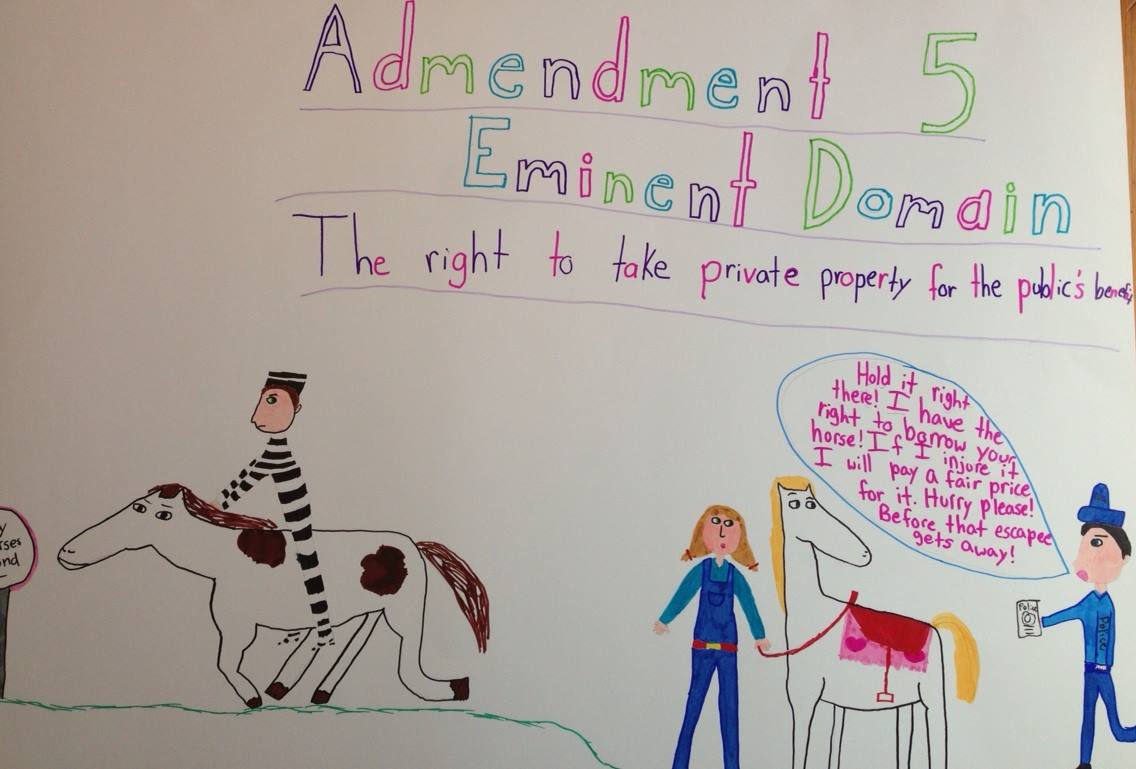
But leave it a child to unravel this complex doctrine in a single illustration. This comes from the daughter of two former law students of mine, who gave me permission to post it. I love the expressions on the characters’ faces. Even the getaway horse looks slightly nefarious. And the constable’s words capture the doctrine beautifully: “Hold it right there! I have the right to borrow your horse! If I injure it I will pay a fair price for it. Hurry please! Before that escapee gets away!”
While many law students crave the riches and prestige of Biglaw, small-town lawyering is where the real action is at. But how do you know if you really are a small-town lawyer?
The answer came to me courtesy of former student Jim Jackson, who practices tort law in Arkansas (and generously says he was inspired to pursue that area after taking my Torts and Products Liability courses at the UALR School of Law). He shared a quiz of sorts compiled by a friend named Michael who practices in Crossett, Arkansas. Crossett, on the Louisiana border, is the county seat and has a population of about six thousand. It’s the very definition or small-town, rural law practice.
Michael’s small-town lawyer test (posted on a trial lawyer’s listserv) consists of a summary of various cases he handled in 2021 (I took the liberty of editing punctuation):
Hi all,
As we begin 2022 I thought I would take a moment and reflect back on some of my more memorable cases as a small town lawyer. So, without further ado …
You might be a small town lawyer if:
1. You have ever had to explain to a client that your “dignity” would not allow you to have a hearing to determine who gets the “Texas Instrument” calculator.
2. You have ever filed a petition seeking an “emergency order of custody” for a goat, because the husband had announced his intentions of having a barbeque, featuring your client’s beloved pet, Marvin.
3. You have ever settled a divorce case by virtue of an agreement with opposing counsel that the attorneys would pitch in $100 each and buy the horse since the parties could not agree on who was going to be awarded the horse.
4. You have ever been involved in a hearing for order of protection that began when the spouse/wife declared to your client that she was going to “take his two pet service squirrels and turn them into owl shit as soon as he left the house!!!!” … and that’s when the fight started.
5. You have ever defended “your secretary” in district court for delivering an “ass” whipping to her ex-boyfriend’s current girl friend in the middle of the Walmart parking lot. Sigh. Unfortunately, the camera footage pretty well eliminated any hope of a defense. On the bright side, it was a hell of a video.
6. You have ever defended a man in district court over a battery charge that all began with a simple misunderstanding following the girlfriend’s announcement of her pregnancy.
My client took what he deemed to be the “high road” and promptly declared, “Well if it’s mine, I will help support it.” His view on this being that was an appropriate offer under the circumstances. To say that the young lady did not take his offer in the spirit with which it was intended would be a gross understatement. The best way to describe her response would be to say it was “volcanic.”
My 6-foot-tall, 250-pound client was chased out of the house in his boxers by an irate and irrational 5-foot-3, 135 pound female wielding a Ginsu kitchen knife. He lost the tip of his thumb in the scramble and had to sneak back later to get his clothes off the roof of the neighbor’s house (apparently his keys, wallet and cell phone were all in the clothes).
My argument to the court was that he had already suffered a punishment worse than anything the court could impose on him and we should let it go on a “time served” basis. The judge took the matter under advisement.
We are still awaiting a ruling. It has been 7 months.
May your 2022 be as much fun as 2021 was for me.
May you remember it’s not always about how much money we make. Sometimes it’s about how much of a difference we make in the lives of our clients who have trusted us with their problems in their times of need.
It is a blessing and an honor to be able to practice law.
Okay, Biglaw associates. The billable-hour clock is ticking. Time to get back to reviewing documents and doing due diligence. Me, I’m heading to Crossett for some excitement!
Law students spend too much time reading cases and too little time thinking or learning about what kind of legal job would be the best fit for them. In the cover story for the Fall 2021 issue of The National Jurist Magazine, I and my co-authors of Law Jobs: The Complete Guide (West Academic Publishing 2019) seek to predict the job market in 20 legal specialties.
Worthwhile reading for all law students. But it’s not enough. Your goal in choosing a legal career isn’t just to find a job, but find one that fits your values, personality, and overall goals in life. Is money the most important thing to you? Autonomy? Work-life balance? In more than six hundred pages, Law Jobs covers in detail the pros and cons of every major legal career type. Only by knowing these, will you be in a position to find your dream job. Check it out.
Meanwhile, enjoy reading our predictions for twenty legal specialties for the next decade!
I have a judge friend who’s a stickler for grammar. Today, she sent this little gem along:
If you ever doubted the importance of the correct placement of prepositional phrases to the meaning of a sentence … The following is drawn from a motion sent to me today:
“More significantly, the Husband attempted to drive a vehicle with the minor children in a clearly intoxicated state ….”
An important rule for young lawyers to know is that it’s essential to counsel clients to wear appropriate attire to court hearings.
Sometimes clients will come to court, for example, without wearing a suit or tie, but only in Zoom land, and possibly Florida, would a client show up bare-chested and wearing only a bathing suit.
A Florida judge friend received an abject apology from an attorney after her client “showed up” for his final divorce hearing (via Zoom) so attired. The lawyer assured the judge that they always go over with clients the appropriate attire for court hearings.
To her credit, the judge took it all in stride, responding to the attorney with this email (names omitted). The bolded part is pretty funny:
Ms. [deleted]:
I appreciate your emailed note, apologizing that your client was not properly attired for his Zoom dissolution of marriage hearing. Please be assured that I am entirely confident that you advise clients what to wear for their dissolution of marriage hearings. I am aware that some clients, especially those under stress in family law cases, simply do not hear or register the instructions.
Of course, given Mr. [deleted]’s attire (swim trunks, bare chest, and – I can’t remember which – either flip flops or bare feet) and location (beach), I’m not sure I would classify him as terribly stressed….
From the cold lands of Minnesota, comes lawyer Adam Johnson and his work-in-progress satirical legal dictionary found here, titled Deuce-Ace’s Law Dictionary.” It contains helpful definitions like this one:
adultery. 1. to act upon instinct. 2. a proximate cause of manslaughter.
Always happy to promote legal humor, I asked Adam to write an introduction to his work:
When one contemplates the idea of a legal dictionary – which one probably is not in the habit of doing of a quiet evening, but whatever – Black’s invariably comes to mind. That profuse work by Henry Campbell Black continues to dominate the legal lexicographical field. It is a seminal work, and this humble writer would not deny Professor Garner that claim. Black’s achievement is magnificent and its ubiquity is self-evident. It is relied on by the Alaskan judge, the weary Floridian student of law and the hack divorce lawyer in Billings. Thousands of copies fall from shelves yearly in all the blessed states of the union. We should rejoice in such an authoritative voice.
Yet there is a certain natural gloominess in the amalgamation of lexical authority in a single source: an almost inorganic limitation, if one may be so bold as to make such an unclear claim. At times it is necessary for the mutterings of another, if only to second or oppose a motion. Language is a thing argued over interminably by lawyers, and it is unfortunate that no Burrill, Kinney, Wharton, Bouvier or Mouldycastle has arisen in this century to add their say about words. True, there is Ballentine’s and Oran’s, both capable and extensive works, and Webster’s has made a go of it. But the field is wanting of something more.
A successful lexicographical work is sometimes that which arises from frank observation. It is simply candor at its truest, or not. It is the unfiltered examination of words by conventional understanding. It is stuff.
I reckon there are those pedants who won’t suffer Dr. Deuce-Ace’s work ab ante, but it is not for them he wrote. It adduces truth through farce, in a way, I suppose, perhaps, maybe. There are on the one hand mockeries and simple jests, while on the other serious relations of latent truths, or something. Scholarly square-toes will find much objectionable about the dictionary, as will the somber office drudge. This because the bloody thing wasn’t written for the serious type, but for your average mouth-breather, such as yours truly.
Dr. Deuce-Ace’s dictionary is a thing to be chuckled at over toilet-rites, not cited in a paper. It should sit on a ceramic tank – it should not rest on a cherry shelf. It is unconcerned with being authoritative simply because it is anti-authority and altogether brief. It needs no defenders because it is so patently in the wrong. It is a twaddling little bit of burlesque fit for the easy eyes of a man or woman at their leisure. It is, in fine, a bit of butter fat, nothing more. It is what it is, and it doesn’t pretend to be what it is not. And even if it were what it is not, it would still be what it is. At the very least, we may comfort ourselves with these final aspects of it.
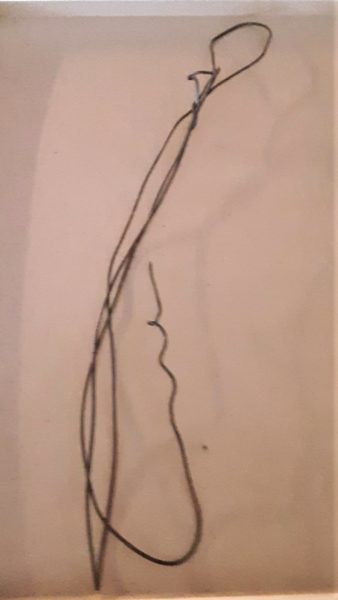
The actual wire used to set up the shotgun trap in Katko v. Briney
Lawhaha.com has uncovered new details—and a Torts artifact—regarding the infamous “Iowa spring-gun case”: Katko v. Briney. Most law students read and remember this unusual case, in which plaintiff Marvin Katko broke into Ed and Bertha Briney’s abandoned farmhouse in Eddyville, Iowa, in search of old jars and bottles he considered to be antiques, only to have his leg blown off by a shotgun wired to a bed in one of the bedrooms.
“After Mr. Briney cleaned and oiled his 20-gauge shotgun, the power of which he was well aware, defendants took it to the old house where they secured it to an iron bed with the barrel pointed at the bedroom door. It was rigged with wire from the doorknob to the gun’s trigger so it would fire when the door was opened. Briney first pointed the gun so an intruder would be hit in the stomach but at Mrs Briney’s suggestion it was lowered to hit the legs.” (Emphasis added.)
Now stop and take a look at the image. That’s right, it’s purportedly the actual wire used to rig the shotgun to the doorknob. How did I obtain this artifact (actually, only the picture of it)? Read on.
Katko sued the Brineys and—despite the fact that he broke into their farmhouse with an intent to steal—won a substantial jury verdict for both compensatory and punitive damages. Unable to pay it, the Brineys had to sell eighty acres of their farm to three neighbors who agreed to hold it in trust for the Brineys in the expectation that the Iowa Supreme Court would reverse the trial court’s judgment for Katko. But that didn’t happen. The judgment was affirmed on the ground that deadly force cannot be used to protect property only.
Last fall, teaching Katko to a class of 1Ls, a student raised her hand and volunteered that her boyfriend’s parents owned the Iowa property where the legendary farmhouse once stood and were in possession of the actual wire that was used in the shotgun trap.
The student arranged for me to interview “Jim,” her boyfriend’s father. (I’ll leave out last names for privacy reasons). Jim’s parents were one of the neighbors who bought the Briney’s property to hold in trust.
(Caveat: I have no way to confirm the following tidbits Jim shared with me, so take them as one observer’s memory of events that happened several decades ago).
I asked Jim what the Brineys were like.
“Well, they were a little strange,” he said. “They used to leave food in the house because they thought the ghosts of Mrs. Briney’s mother and father lived there. They left the house fully furnished, the table set, et cetera. They left food in the cupboard behind the table.”
If true, this may answer one of the questions students often have about the case. The Brineys set the shotgun trap because the abandoned house had been repeatedly broken into. Students commonly ask, “Why didn’t they just take anything of value out of the house?”
Seeking to establish the provenance of the purported Briney wire, I asked, “How did you know to keep the wire?”
“It was still attached to the bed,” Jim said. “My wife took it off and we kept it.” That was before they intentionally burned down the house, a barn, and a machine shed because they “weren’t worth anything.” (I suggested he consider donating the wire to the American Museum of Tort Law, but he said they wanted to keep it.)
As for Marvin Katko, Jim said he knew him from school. He said they were in the school band together. Marvin played saxophone and even had a local dance band at one point.
“It was after high school that he [Katko] started being known as a delinquent,” Jim said. “He had somewhat of a reputation around town.”
Jim claims Katko was suspected of stealing a marble-top dresser from the Briney’s house prior to the occasion where he was shot. He also asserted, “Ed Briney tried to shoot Katko himself. Many nights he laid on his stomach in the house with his gun waiting for Katko to come.”
After the Iowa Supreme Court affirmed the jury’s verdict, a dispute arose as to the land held in trust by the neighbors. According to the Prosser, Wade & Schwartz Torts casebook, the Brineys and Katko joined together to sue the neighbors and the lawsuit was settled for enough to pay the judgment against the Brineys. Jim says his father bought out the other two neighbors and handed the property down to him.
Jim said there was a great debate in Eddyville at the time of the case and for years after, with some people siding with Marvin Katko and others defending the Brineys. A niece of Marvin Katko once sent me an email affirming that it was very difficult for the Katko family to regain friends after the event.
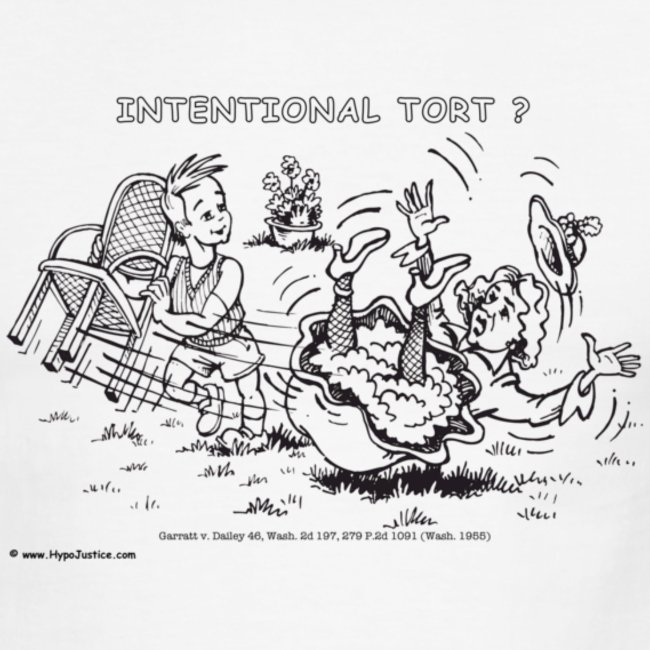
Yesterday I taught my first Torts class of the year and, as always, we began with Garratt v. Dailey, 279 P.2d 1091 (Wash. 1955), where an elderly woman sued a five-year-old boy for battery for pulling a chair out from under her as she was (allegedly) trying to sit in it.
The main issue was whether the Brian Dailey, the five-year-old, had what is called “belief intent” (aka “substantial certainty” intent) that the plaintiff would try to sit where the chair had been previously situated in the backyard.
But an interesting side issue was whether a five-year-old is capable of forming the requisite “intent” to commit an intentional tort. Perhaps surprisingly to non-lawyers, the Garratt court, as have other courts, held that even young children have the mental capacity to form the intent to inflict a harmful or offensive bodily contact upon another.
Students often question this principle, arguing that five-year-olds lack the mental capacity to appreciate the consequences of their acts. Importantly, the law of intent does not require that the child intended to “injure” the other or to appreciate all the ramifications of his or her acts (such as, in Garratt, that the elderly plaintiff would suffer a fractured hip when she fell to the ground).
But now a video clip of a young girl walloping her infant brother into a foam pit strongly suggests the courts got it right on this point:
No surprise, I’m a fan of humor. One of my most reliable defense mechanisms to life’s dark moments is to find humor in the situation. I’m also a big proponent of using humor in the arena of public speaking, although I’ve written about the risks of doing so. (See Andrew J. McClurg, The Risks of Being Funny, GPSolo, Apr. 2003, at 60.)
Humor in a court proceeding, however, is a different ballgame. Starting out my career as a law clerk to a federal district judge, I saw humor, usually unplanned and spontaneous, work well in court on several occasions. But in an excellent ABA Journal article, Texas attorney John G. Browning makes a strong case for avoiding any effort to be funny in court, primarily by discussing a number of cringeworthy examples from real cases.
Such as when attorney Jay Floyd, arguing to defend Texas’s abortion laws before the U.S. Supreme Court in Roe v. Wade, made the decision to begin his oral argument with: “It’s an old joke, but when a man argues against two beautiful ladies like this, they are going to have the last word.” Browning recounts that, not surprisingly, this “tone-deaf and sexist attempt at humor was met with an extended painful silence from the justices.”
Available for the first time in one place, below is the complete inventory of McClurg’s Harmless Error humor column in the American Bar Association Journal, which ran monthly from October 1997-December 2001.
Many of these columns have been reprinted elsewhere. Caroline Kennedy included Santa Suit (Jan. 2000) in her anthology, A Family Christmas, where it appears alongside works by the likes of Mark Twain, Robert Frost, and Shakespeare. (Use the Contact link for permissions requests.)

 “Eminent domain” is the power of federal and state governments to “take” private property for public use. In 1879, the U.S. Supreme Court held that the power “requires no constitutional recognition” because it is an inherent power of sovereign governments. But governments can’t just take your property without paying for it. The Fifth Amendment to the United States Constitution provides that no private property can be taken “without just compensation.” Here’s a good history of it.
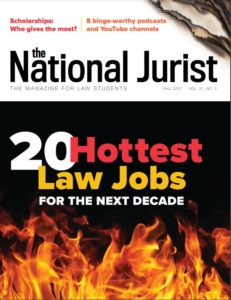 Law students spend too much time reading cases and too little time thinking or learning about what kind of legal job would be the best fit for them. In the cover story for the Fall 2021 issue of The National Jurist Magazine, I and my co-authors of
  I have a judge friend who’s a stickler for grammar. Today, she sent this little gem along:
 An important rule for young lawyers to know is that it’s essential to counsel clients to wear appropriate attire to court hearings.