Warning: No Blindfolded Kids Swinging Bats

no pinatasDuring a Torts class last semester, we were discussing various applications of Judge Learned Hand’s formula for negligence, when a student asked, “Why isn’t it negligent to hold pinata parties?” To which I replied, “It probably is!”

Judge Hand’s formula, explained in a famous case called United States v. Carroll Towing Co., is that if the burden of avoiding a risk is less than than probability of the risk resulting in harm multiplied by the potential severity of the harm, it is negligent to engage in the conduct.

As applied to pinata parties, the only burden to avoiding the risk is to choose a different, safer game to entertain kids at a party, compared to the risk that a blindfolded kid swinging a bat could whack some other kid in the head and cause serious injury.

Some students thought I was just being, as usual, overly cautious Tortman, but then I came across this sign at a picnic area while bike-riding in Shelby Farms. Vindicated.

But wait, what is up with that prohibition on metal detecting?

Warning: No Happy Children

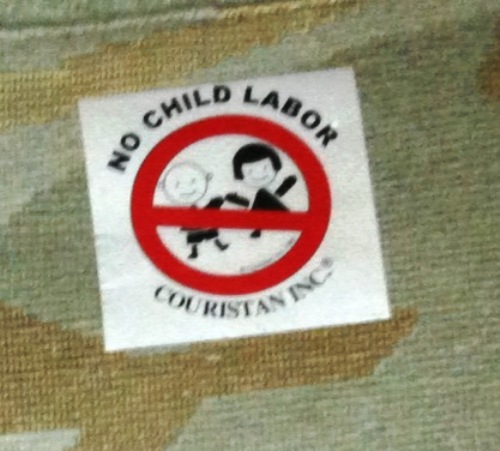
No child labor pictorial announcement.If you come here often, you know we love pictorial product warnings. Pictorial warnings are intended to explain product dangers in a universal symbol or picture that can be universally understood even by people who cannot read or who speak and read a different language.

Here we have a pictorial product announcement on the back of a rug indicating the company uses no child labor. Very commendable.

The test for a pictorial symbol is whether it communicates its intended message without textual explanation.  So take away the “No Child Labor” words and what do you see?  A “No Happy Children” warning.

Not quite sure why the manufacturer felt it necessary to include a pictorial symbol in the first place, unless universal pictorial warnings have been transmuted into marketing tools–which will further dilute their already limited uility as product-risk warnings.

Or, maybe the manufacturer really is warning consumers not to use child labor. I can see some kid whose allowance includes vacuuming balking to mom and dad, “You’re violating this warning! I’m calling the labor department!”


Warning: Hurry When You Cross This Street!

Crosswalk sign with energy drink.Okay, that’s probably not the original message of this crosswalk sign, found on the University of Florida campus, but a sense of urgency was added when someone doctored the sign by adding a can of Red Bull … and angel wings?

Warning: Canadian Coffee Seller Makes Fun of Hot Coffee Warnings

Liebeck coffee burn.
One of the milder pictures of  Stella Liebeck’s coffee burn injuries.

Any mention of lawsuits and hot coffee invariably invokes the grossly misunderstood “McDonald’s coffee spill” case of Stella Liebeck, a 79-old-woman who suffered third-degree burns after spilling a stryrofoam, takeout cup of McDonald’s coffee on her legs.

I apologize for the gruesome picture, but a large part of the misunderstanding of this case comes from people not appreciating that Ms. Liebeck suffered extremely severe injuries. There are much worse pictures of her injuries available on the internet. There is also a ton of information, and misinformation, out there about the McDonald’s case. Here (scroll down to “Public Perceptions: The McDonald’s Coffee Spill”) and here are a couple accounts of the facts. You might also want to check out the movie, Hot Coffee, which explores the McDonald’s case and, more generally, the tort reform movement.

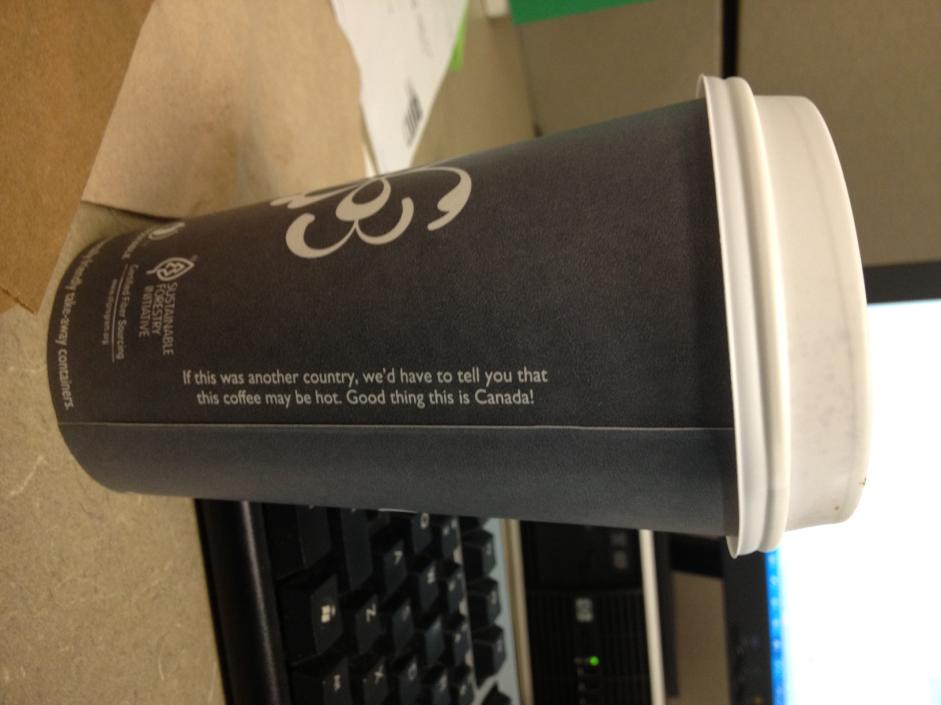
Canadian coffee cup warning
Sideways on purpose. Click to expand.

At least one Canadian coffee seller found the idea of warning consumers about hot coffee to be hilarious:

“If this was another country, we’d have to tell you this coffee may be hot. Good thing this is Canada!”

Warning: Sad Pumpkins Should Avoid Hair Rubberbands

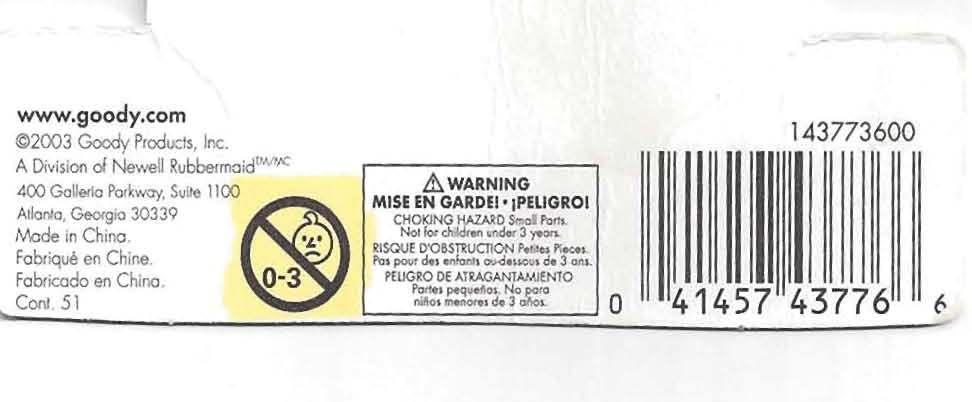
Goody hair bands pictorial warningPictorial warnings are intended to explain product dangers in a universal symbol or picture that can be universally understood even by people who cannot read or who speak and read a different language.

Unfortunately, coherently explaining product risks usually is hard to do in a single image. A picture may be worth a thousand words, but product warnings can be better explained in words (unfortunately, many litigation risk-averse product makers insist on using the full thousand or more, but that’s a different issue).

Here we have a pictorial warning about hair rubberbands. As the written part of the pictured warning shows (all thumbnails are expandable), they can present a choking hazard to young children. But what if one can’t read the printed warning?  That’s where the symbol warning against use by children under three comes in.

But wouldn’t it be easy to do and more effective to create a symbol that looked more like a child and less like a melancholy pumpkin?

Warning: Halloween Grease Makeup Promises Tricks, Not Treats

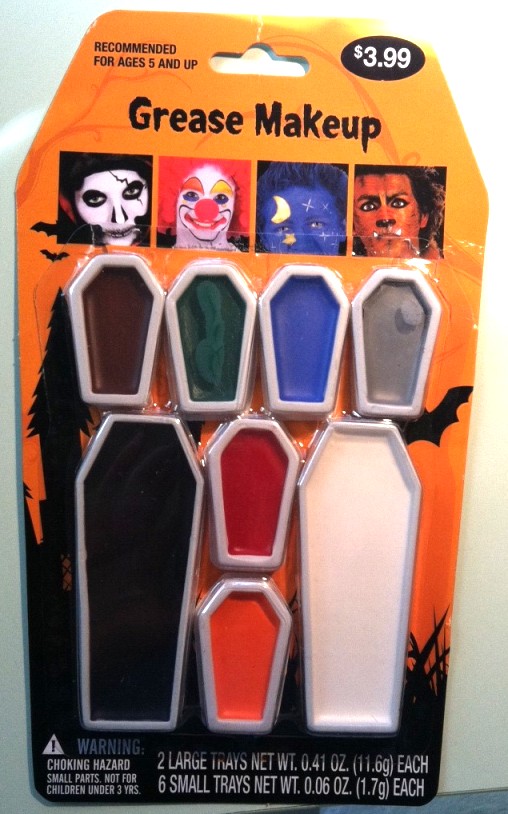
Grease paint product warnings.Getting in the Halloween spirit, I was in a drug store reading warning labels for Halloween products and came across this Grease Makeup. Looks like fun stuff, right?

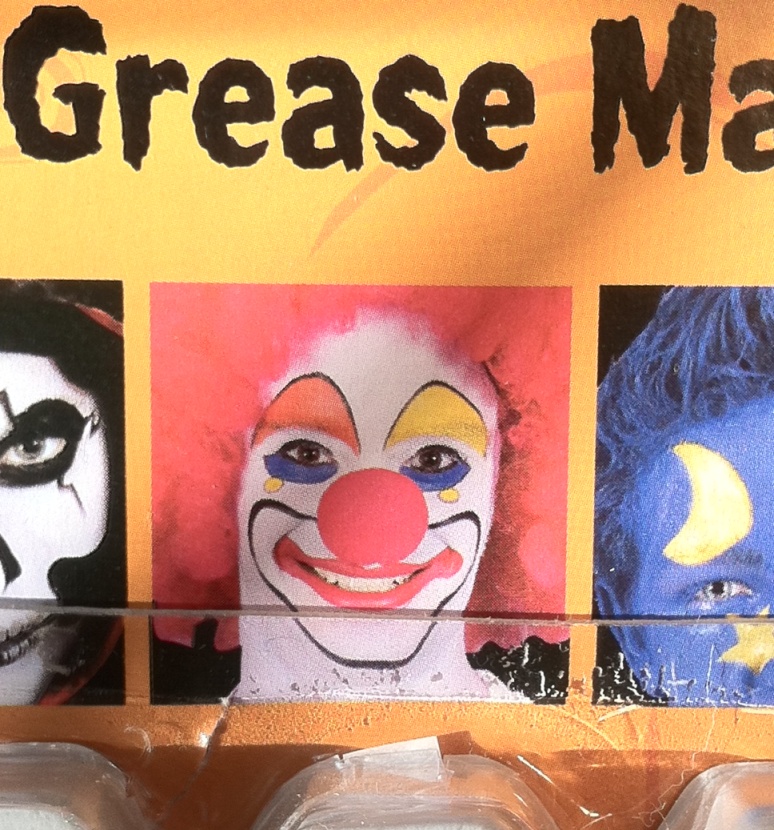
Not as fun as you might think. First, don’t expect to end up looking like this clown.Grease paint product warnings.


Why? Because–Bozo warning alert–the instructions on the back of this one quarter-inch thick transparent package clearly state: “COSTUMES AND ACCESSORIES SHOWN IN PHOTO NOT INCLUDED.”

Grease makeup product warnings.But things get worse. Ready to have some fun applying your grease makeup? Like the thought of sporting red or maybe yellow eyes at the costume party? Forget about it. How about pink or purple?  Scratch those too. Maybe green? Orange? No, No. All of those colors are banned from eye-area application. And don’t even think about going with blue, green or purple lips:

Grease makeup product warnings.Have a happy, complicated Halloween with your grease makeup!

Warning: Call for a Shower Mat

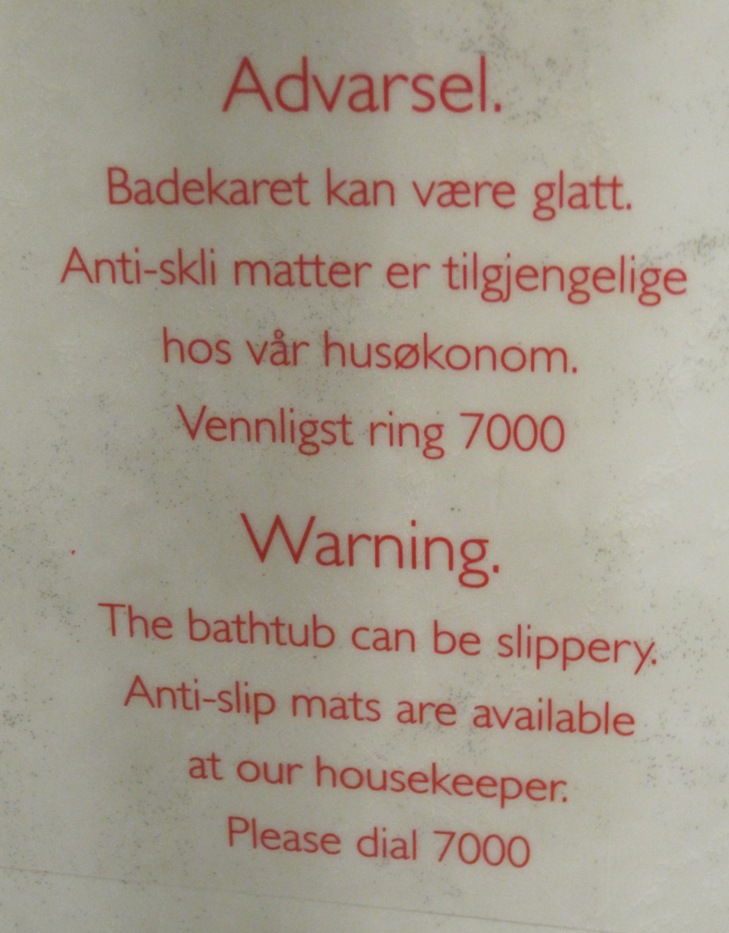
bathtub warningOne of my colleagues was amused and bemused by this warning sticker inside the shower stall of her hotel room during a vacation to Norway:

Warning.

The bathtub can be slippery. Anti-slip mats are available at our housekeeper.

Please dial 7000.

Hmm, if the bathtubs are slippery, shouldn’t they already have mats in them? And isn’t it a bit too late to be dialing up the housekeeper for a mat once you’re already in the bath?

Warning: Defective Pictorial Warning on How to Deal with Mountain Lion Attacks

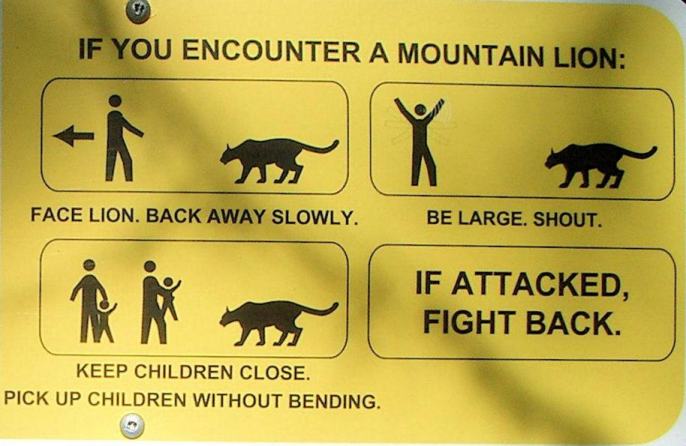
defective pictorial warningCourtesy of a rising 2L at the University of Memphis law school, we have another failed attempt at conveying warnings and instructions via pictorial symbols.

In evaluating pictorial warnings, remember that the principal purpose of pictorial warnings is to convey warnings to people who can’t read or read in a different language. If people could read the warnings, we wouldn’t need the pictures.

Thus, interpreting only the pictures, here’s what a non-English speaking park visitor might take away from these four frames of a sign warning about how to handle mountain lion attacks:

1. Top left: “After lion has bitten off your right hand, run AWAY from the lion. Follow the arrow. Never run toward a mountain lion.”

2. Top right: “Once you realize you can’t outrun a mountain lion and are handless, say the hell with it and give up.”

3. Bottom left: “If accompanied by children, offer them to the lion.”

4. Bottom right: “Don’t know. Can’t read it. That’s why I needed the pictures!”

Warning: You Lost Me at “Important”

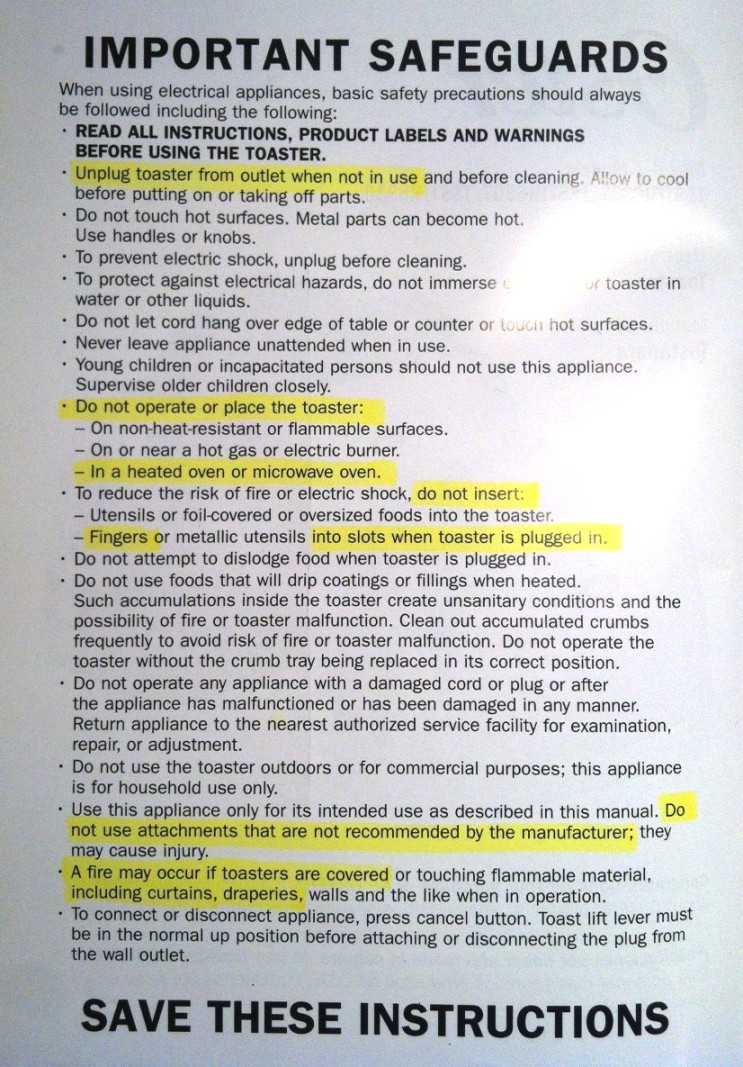
Too many warnings.When manufacturers overwarn, it dilutes the impact of warnings that consumers really need to know about. Over-warning is a serious problem — not to be confused with global-warming, which is also really bad.

Given some of the silly and dangerous ways consumers misuse products, one can have sympathy for manufacturers that don’t want to take chances. I’ve done consulting work writing product warnings and instructions for manufacturers and confess that I advise erring on the side of giving too many warnings.

But to waste space and, more importantly, short consumer attention span on worthless warnings that lead with telling consumers to:

1. Read these instructions.

2. Keep these instructions.

3. Heed all warnings.

4. Follow all instructions

… is just stupid. The most important warnings should come first. Even diligent consumers are going to tune out quickly reading these warnings (which led to the headline, a reversal of the famous line from Jerry McGuire, “You had me at hello”). No manufacturer has been or ever will be held liable for failing to warn consumers to read and keep their warnings and instructions.

Meanwhile, the list of warnings for this apparently incredibly dangerous alarm clock went on much longer, but I cut it off.

Warning: Candy May Contain “Human Flesh”

human flesh in candyA Facebook friend posted this picture of a candy wrapper, featuring the warning:

MAY CONTAIN TRACES OF PEANUTS AND HUMAN FLESH

Not sure where he got it or if it’s real. It doesn’t look Photoshopped (but it’s hard to tell sometimes).

Human tissue does sometimes end up in food products during the manufacturing process, probably more often than we would want to know.

My favorite “flesh in food” cases is a 94-year-old Mississippi Supreme Court case where the plaintiff found a human toe in a plug of chewing tobacco. That’s one way to “kick” the habit.  Har, har.

The plaintiff couldn’t prove how the toe got there, so he invoked res ipsa loquitur. For non-legals, res ipsa loquitur is a procedural device that allows a tort plaintiff to get his case to a jury despite a lack of specific evidence that the defendant was negligent if: (1) the injury-causing event is of a nature that ordinarily would not happen unless someone was negligent; and (2) the defendant had control of the instrumentality at the time the negligence most likely occurred.

I have always loved the Mississippi court’s terse analysis of the first element: “We can imagine no reason why, with ordinary care, human toes could not be left out of chewing tobacco, and if toes are found in chewing tobacco, it seems to us that somebody has been very careless.” Pillars v. R.J. Reynolds, 78 So. 365 (1918).

But is human flesh getting into food really such an extensive problem that manufactuters feel obligated to warn about it? This is either a fishy warning or our food supply and worker safety programs are in worse shape than believed. Or, a third possibility is that California passed a law.