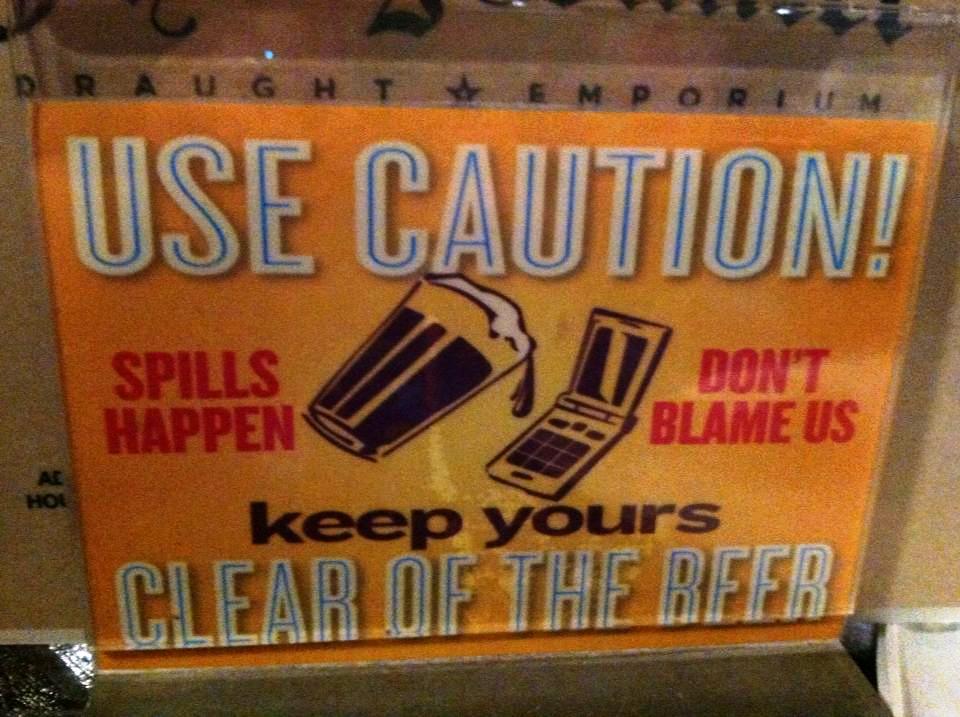
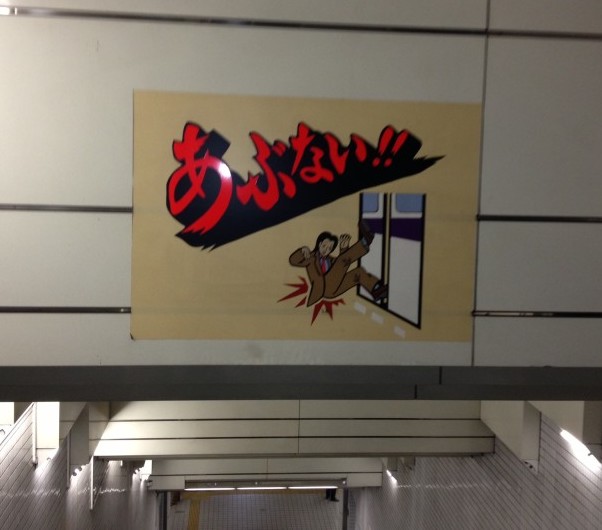
This very large sign in a Tennessee restaurant contends with the Tokyo Subway warning for The World’s Largest Warning, but it’s more interesting than that.
In the Southern United States, and perhaps in other parts of the country, it is popular for some restaurants to serve peanuts and encourage customers to throw the shells on the floor. Forget that it’s an unreasonable risk for a business invitor to have debris or other objects on the floor where customers are known to walk, or that slip and fall cases rank in the double digits percentage-wise among all tort lawsuits. It’s FUN to throw trash on the floor!
The fact that customers are on notice that peanut shells litter the floor– and it would be hard to content otherwise given this enormous sign, give them credit for that–probably is not sufficient to protect a business from liability if someone slips and gets injured. The fact that a danger is obvious is a defense only if the danger can be navigated safely with knowledge of the risk which, I would argue, is not true of a shell-strewn floor, which is probably dark and traveled on frequently by customers consuming alcohol.
As for the “Loud Music” warning, this could be an attempt at humor, as the entire sign could be, or it could be a legitimate warning that the music played in the establishment is loud enough to cause hearing damage. It raises an interesting question I have long wondered about: Is a music venue negligent if it plays music at a level that causes hearing damage or is that a risk music fans assume? Even though I sing and play in loud rock bands, I assert it is negligent to play music the venue owner reasonably knows or should know is above the decibel-level known to cause hearing damage.
One year when I was teaching at a law school in San Francisco, I was at a Fillmore show. I forget who the band was but the music was so loud that it felt literally deafening. My ears ached and I could see my clothes flatten with every bass note. I went to the soundman and tried to explain it was too loud. He couldn’t hear what I was saying, of course. I shouted louder and when he figured it out, he looked at me like I was crazy.
Persons and entities with a duty to warn of risks under tort law are often accused of hiding the warnings in the fine print or otherwise not making them sufficiently conspicuous. But the administrators of the Tokyo subway could never be accused of that, as shown in this mural-size slip and fall warning.
If there’s a Guinness Book of World Records entry for the largest risk warning, this one might contend. Good job, Tokyo subway.
Comparative Law Tangent: Many Americans think personal injury lawsuits are common only in the United States and attributable to far out U.S. tort law principles. Actually, basic tort law principles are remarkably similarly throughout much of the world. I learned this co-authoring Practical Global Tort Litigation: United States, Germany and Argentina with Adem Koyuncu and Luis Sprovieri.
Oversimplified, the principal tort law and litigation differences between the United States and many countries can be reduced to five:
1. Higher noneconomic damages (e.g., damages for intangible injuries such as physical and mental pain and suffering, disability and disfigurement) in the United States .
2. The fact that most developed countries have public health care with the result that injured tort victims do not have to sue to recover large medical expense obligations (lifetime medical expenses in the United States for catastrophic injury cases such as quadriplegia can exceed $20 million).
3. The availability of civil punitive damages in the United States to punish and deter particularly egregious wrongdoers, which are not available in most other countries (but other countries may be more willing to criminally prosecute and fine offenders who endanger public safety).
4. The “loser pays” rule that applies in most countries, but generally not in the United States. The loser pays rule requires the losing party to bear not only their own attorney fees and litigation costs, but their opponent’s. In the United States, each side generally bears its own legal fees, win or lose.
5. The wider availability of discovery in the United States. Discovery is a process by which each side gets access to the facts in the possession of the other side, with the goal that all relevant facts will be presented at trial and the case will be decided on those facts.
But I got carried away. The point of this post is that this is one huge warning!
As a hobby, I sing and play in Memphis rock cover bands. At the Young Avenue Deli in the Cooper-Young neighborhood of Memphis, the sound guy has a sign posted warning bands: “$20 Fine for Playing Brown-Eyed Girl or Mustang Sally.”
If you’re a music fan, you might be thinking, “Why? Those are both great songs.” They definitely are, which is why 90 percent of cover bands play them, which in turn is why sound guys hate them.
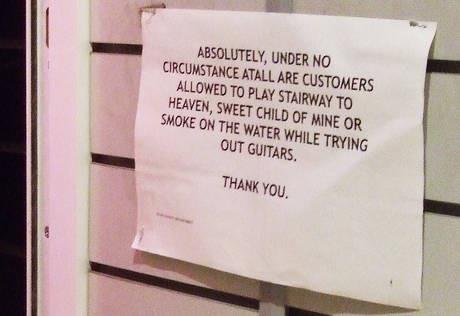
We encounter a similar phenomenon with guitar players. Every guitar player learns or tries to learn certain fundmental songs and riffs, including Stairway to Heaven (first song I ever learned back in college), Smoke On the Water, and Sweet Child O’ Mine.
In response we get this admonishment from a music store that:
ABSOLUTELY, UNDER NO CIRCUMSTANCE AT ALL ARE CUSTOMERS ALLOWED TO PLAY STAIRWAY TO HEAVEN, SWEET CHILD OF MINE OR SMOKE ON THE WATER WHILE TRYING OUT GUITARS. THANK YOU.
–Thanks to my bandmate Ron Lefkowitz for this one.
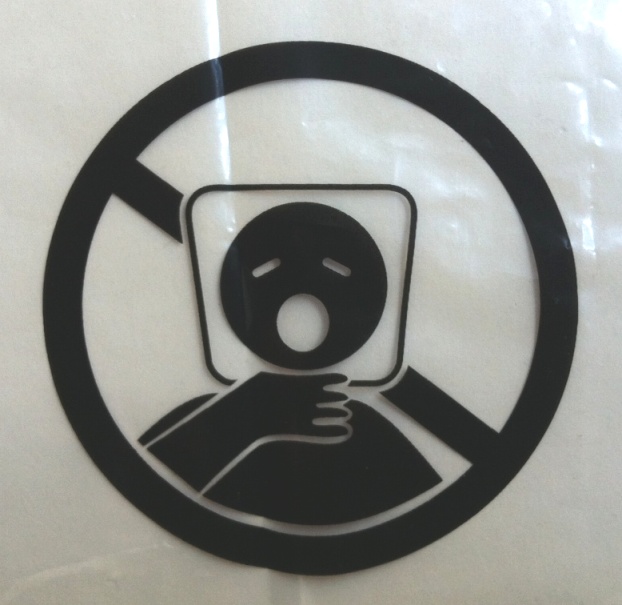
In Torts, we were talking about product warning defects and, particularly, the warnings found on most plastic bags. These are warnings to adults to keep plastic bags away from babies, cribs, etc. because they present a suffication hazard. Using various bags as examples, we talked about the efficacy of such warnings in terms of size, placement and whether they needed to be in multiple languages. (We also discussed whether the risk is obvious, in which case there would be no duty to warn of it.)
This week a student brought me a plastic bag that attempted to solve the efficacy problems by omitting written warnings and relying solely on pictorial warnings. Did they succeed? You be the judge.
First, we have this one. Here’s your test.
Question. This pictorial warning is intended to convey the following risk information:
(a) Keep plastic bags away from babies to prevent suffocation.
(b) Impressions of Edvard Munch’s The Scream are prohibited.
(c) Do not place large adult mitts around babies’ throats.
(d) This haz-mat suit does not work properly.
A is the correct answer.
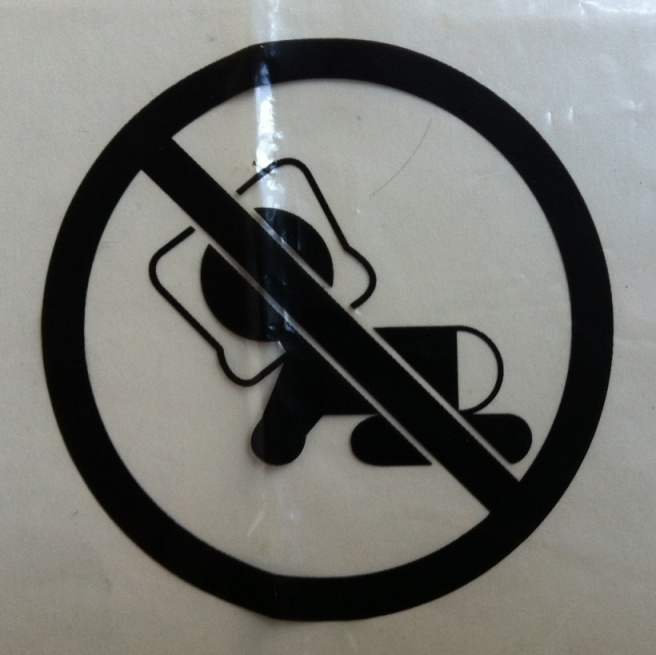
This next one was on the same bag.
Question. This pictorial warning is intended to convey the following risk information:
(a) Keep plastic bags away from babies to prevent suffocation.
(b) Diapers required.
(c) Do not press pieces of toast against baby’s head.
When you were a kid, or maybe still, did you ever wonder why, no matter how hard you tried, you couldn’t reproduce the product results with your toys similar to those represented in the advertising? These failures caused massive wounds to self-esteem to millions of children. The examples are too many too count. Legos, Erector Sets, Lincoln Logs. How were we supposed to build that 10,000-piece castle on the box with fifty pieces?
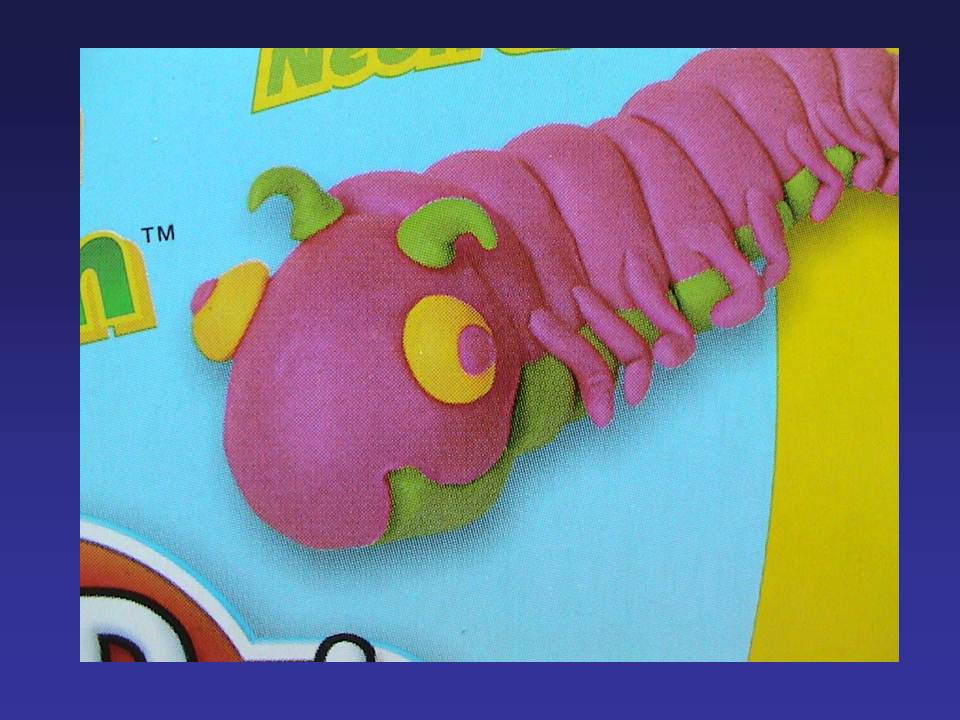
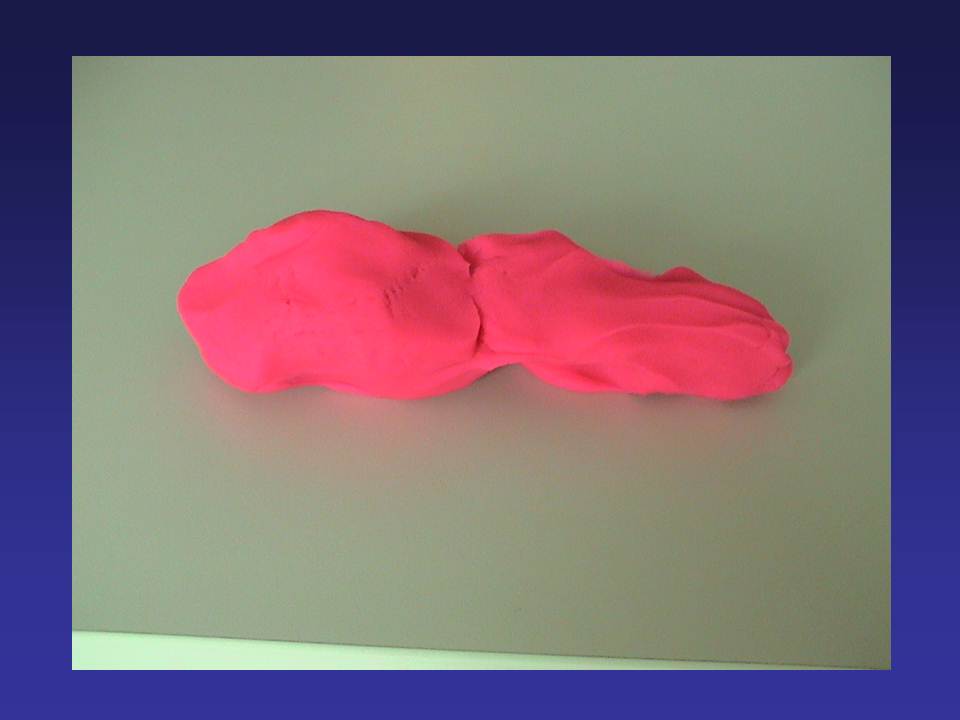
At least one modern manufacturer is paying attention to protecting the egos of today’s youth via product warnings. Play-Doh warns kids, at least the ones who read product warnings, to not get their artistic hopes up because:
Reading this made me feel much better about myself because I recently attempted to replicate this delightful bug on the same packaging:
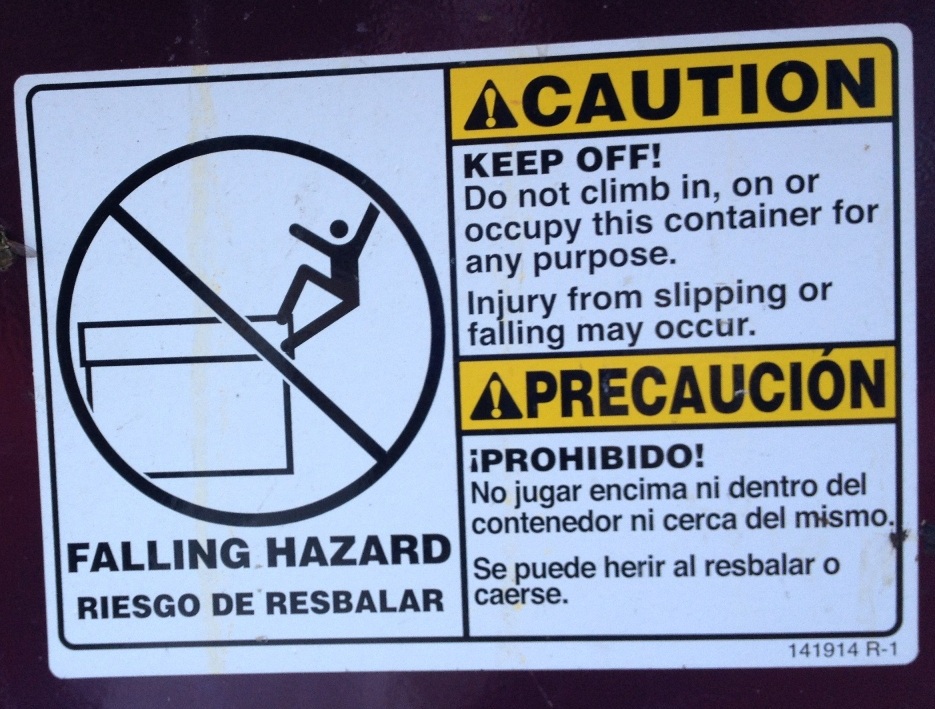
The entertainment lawyer who sent it along thought maybe her landlord was warning tenants not to practice their parcours on the trash dumpster. “That stick figure is having far too much fun,” she wrote. “Look at his exuberant arms!
He definitely does appear to be celebrating a “Ta-Da!” kind of moment.
Remember: In evaluating a pictorial warning, you have to imagine you can’t read the textual warnings, either because you can’t read at all or can’t read English or other language the verbal warning is printed in.
This one rates only a 1.0 on Lawhaha.com’s proprietary 4.0 “Pictorial Warning Clarity” scale.
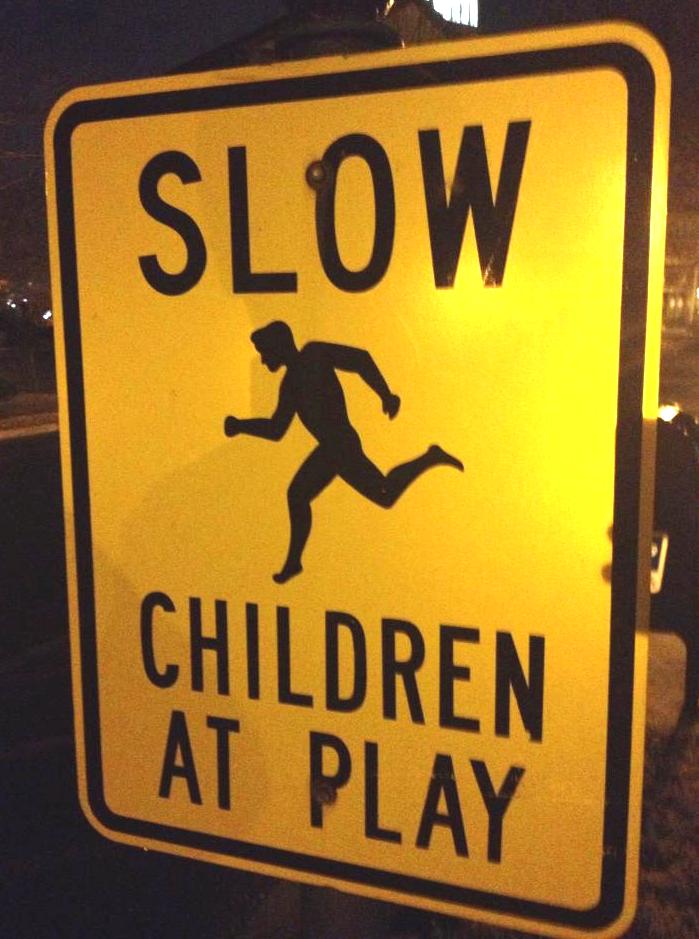
Slow down. The Incredible Hulk’s offspring may be playing in your neighborhood.
Hmm, maybe kids really are getting bigger. First, we had the titan-tyke falling from the diaper-changing station and now we have, courtesy of a first-year law student at the University of Memphis, this sign cautioning that children are at play. Very large children. Children who, judging by the picture, could contend in the decathlon at the Olympics.
It’s always fun, fun, and more fun deciphering pictorial warnings.
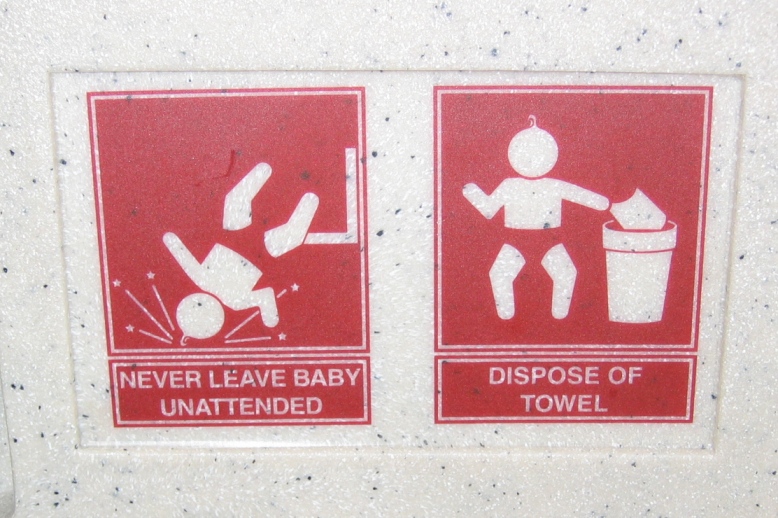
Here’s a warning, along with a request, from a restaurant restroom in Naples, Florida: be careful not to let your baby fall off of the changing station, and also, don’t forget to throw away the dirty diaper! A good warning and reasonable request.
Remember, to interpret pictorial warnings, you have to imagine you can’t read the textual warnings below the symbols, either because you can’t read at all or can’t read English or other language the verbal warning is printed in. That’s the purpose of a pictorial warning: to convey a danger or instruction to persons for whom verbal warnings are inadequate.
The first picture–the falling baby–does a pretty good job of communicating the risk, although that is one huge baby. His feet are way above the changing table while his head is already touching the floor. Recommended height for a wall-mounted baby changing station is 45.5 inches. At that height, this baby would be approximately six-feet tall judging by the picture.
Because the child is portrayed as a giant, the flecks flying up around his head look like they could be pieces of floor tile. Maybe the intended warning is: “Do Not Damage Floor with Falling Objects.” Or: “No Sumo Wrestlers on Changing Table.”
But the poor “little guy” is resilient. The second picture shows him cleaning up afterwards, and good news! He looks fit as a fiddle.
These accidents do happen and are terrible to imagine. The risk is obvious, but maybe a picture serves a useful reminding function.
On the 4.0 point “Pictorial Product Symbol Clarity” rating system recently developed at secret Lawhaha.com laboratories, I would give these pictorial symbols a 3.5. What do you think?
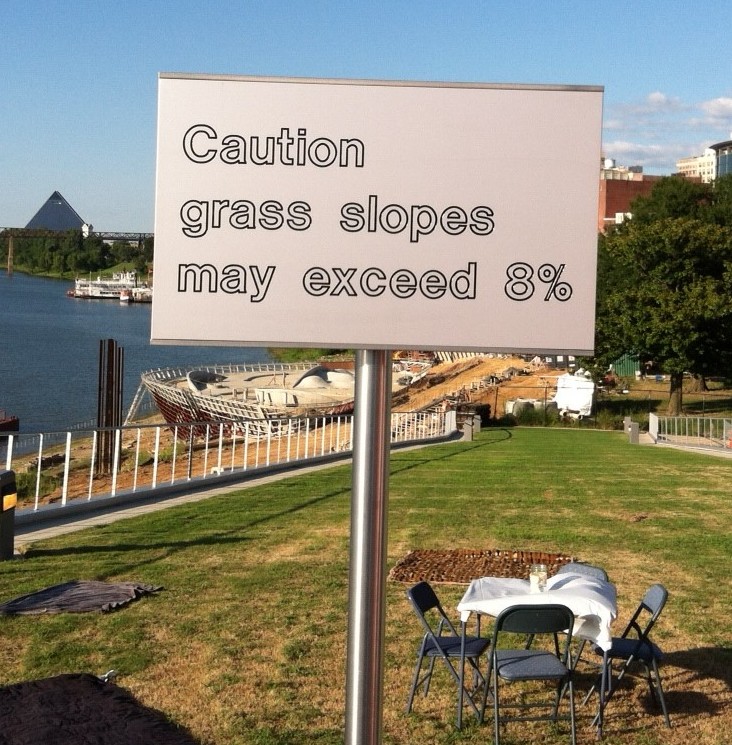 Curious warning sign at the Beale Street Landing on the Mississippi River in downtown Memphis. It says: