Share the Road … Or Else

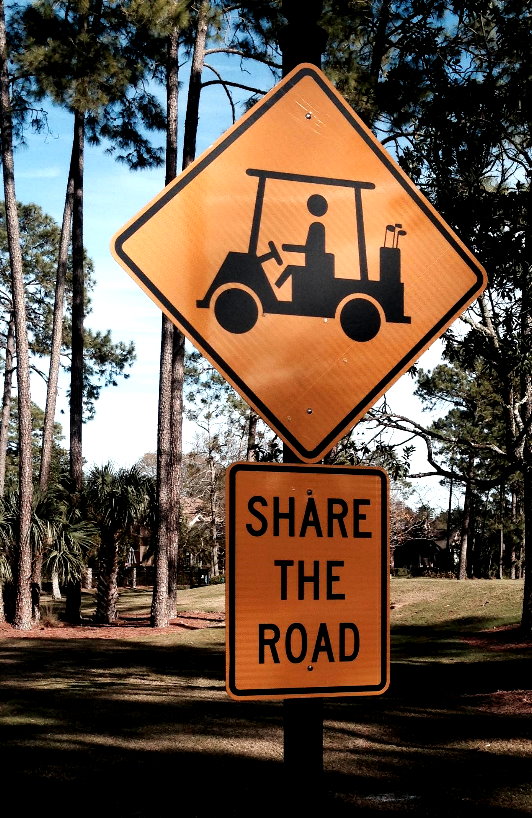
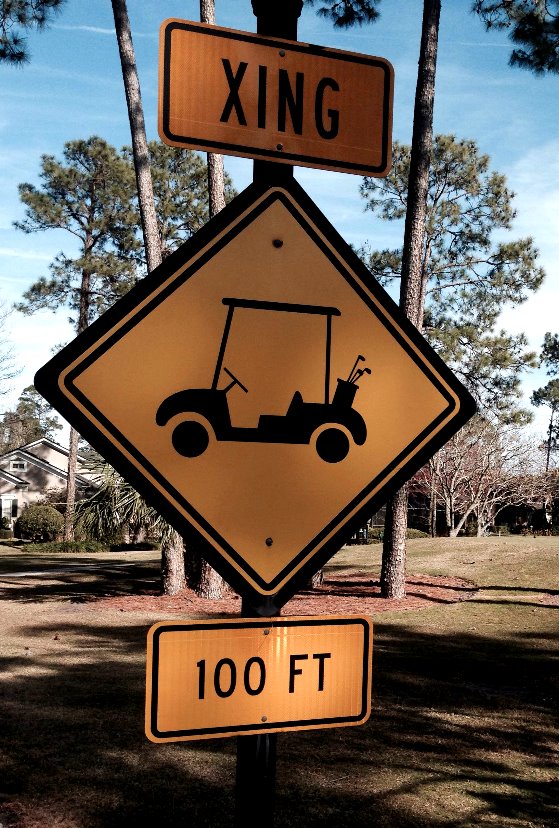
Share the RoadFrom a golf course in Florida, comes this pair of signs.

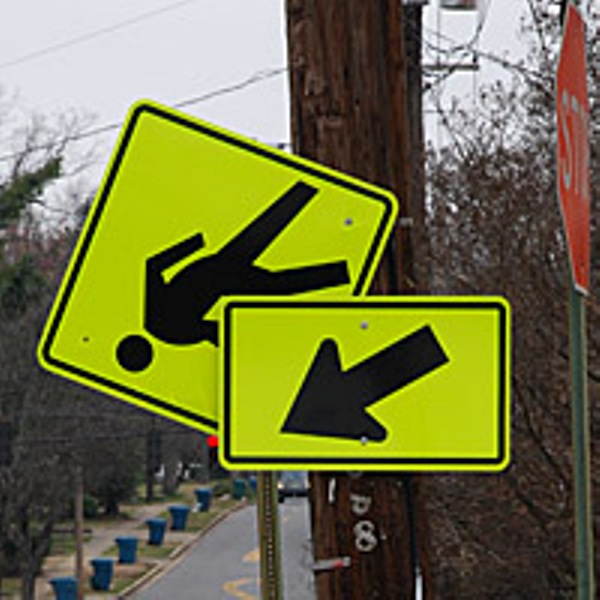
The first one features a seemingly contented (despite having a decapitated head) golf-cart driver cruising along above a warning to “Share the Road.”

Twenty yards farther along we get a much more ominous sign.  Same cart, but the driver has been “disappeared.”  Did he fail to share the road?

An investigation is underway.

Or else.


Warning: Figure Out These Pictorial Warnings

Dehumidifier Warning - Let's Dance
“Let’s Dance”

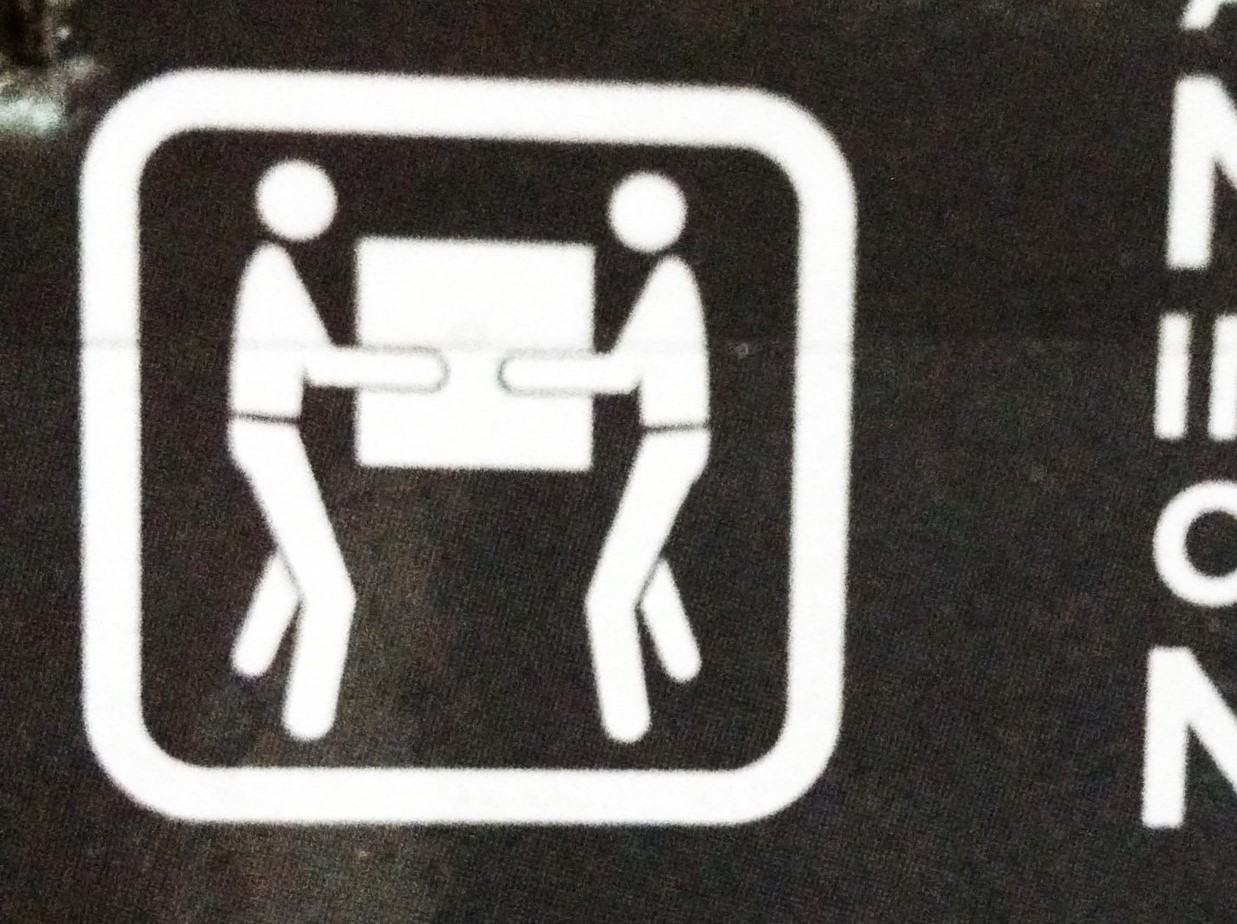
We love pictorial warnings at Lawhaha.com, as shown by the samples here, here, herehere, and here.  These are supposedly universal warnings designed to be understood by everyone.  As in these warnings on the outside of a dehumidifier box, they are often accompanied by written warnings.  But not everyone can read the written warnings, either because of language barriers or simply an inability to read.

So how do these pictorial warnings rate?  When I look at the first one, all I can think of is the David Bowie song, “Let’s Dance.”  What is it trying to convey?  That you need two people to pick the thing up.  I think that one probably works, assuming for the sake of argument that people need a warning not to pick up large heavy objects without assistance.

Dehumidifier Warnings Part 2These next three warnings on the same box are a mixed bag.  No idea what “4” stands for.  Assuming it’s something on a scale, but “4” out of what?  And what is it measuring?  Please send word.  The second one might be a warning to not put your wine glass on the dehumidifier, but, on the outside packaging, it’s probably a warning that the contents are breakable.  The third one?  Who knows?  Don’t stomp on it?  Don’t kick it?  Hmm, maybe don’t stand on it, which I could see, but if that’s the case, shouldn’t they have a box under the boot?

We like to have fun with these, but let’s face it, the real problem is that it’s almost impossible to meaningfully convey most product warnings via a symbol.

Warning: Smoking Causes Impotence

Graphic cigarette warnings

And a whole lot of other undesirable results.

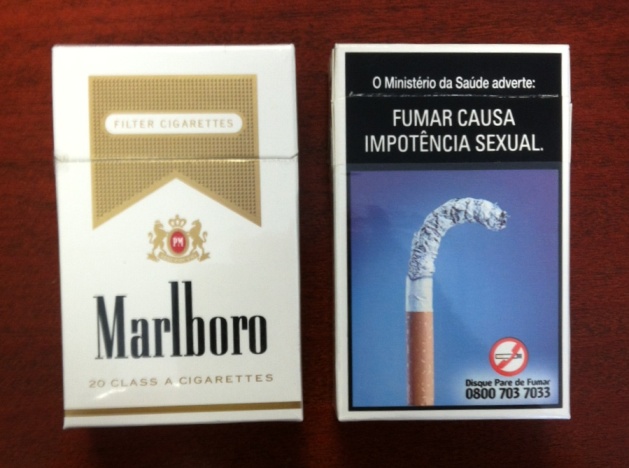
The World Health Organization (WHO) directs, in Article 11 of the WHO Framework Convention on Tobacco Control, that parties to the convention “implement large, rotating health warnings on all tobacco product packaging and labelling.”

The WHO website shows twenty countries (and their mandated warnings) currently participating, including Brazil, which is where the Florida International University law student who gave me this pack of Marlboros purchased it.

Some of the warnings are much more graphic.

Other countries mandate pictorial warnings without belonging to the WHO convention.  In the United States, graphic pictorial warnings on cigarette packages were torpedoed by a lawsuit in which the tobacco industry successfully argued before the U.S. Circuit Court of Appeals for the D.C. Circuit in R.J. Reynolds Tobacco Co. v. FDA that requiring them to put pictorial warnings on “the top 50 percent of the front and rear panels of cigarette packages and 20 percent of the area of each cigarette advertisement” violated their First Amendment rights.

The warnings were authorized by the Family Smoking Prevention and Tobacco Control Act of 1989, which directed the U.S. Dep’t of Health and Human Services to adopt regulations requiring cigarettes to bear “color graphics depicting the negative health consequences of smoking.”

The Obama Administration backed away from the requirements after the decision.

The data is mixed as to whether pictorial cigarette warnings change smoking behavior.  A study of 4000 smokers in Malaysia and Thailand found the warnings had an effect in Thailand, but not Malaysia.
Warning: Do Not Roast a Turkey in Toaster

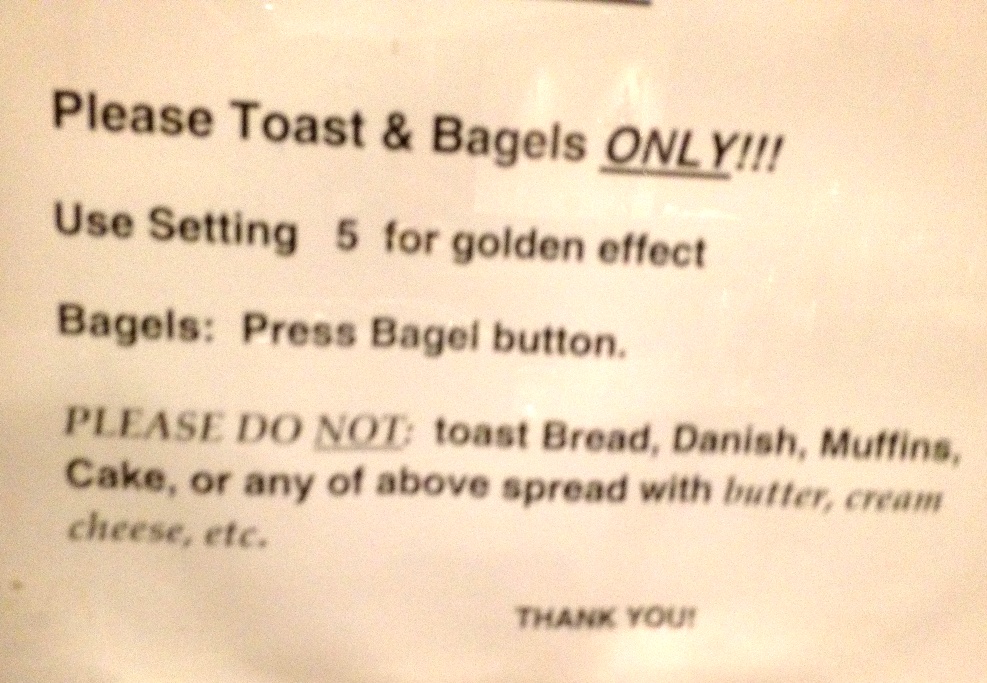
Toaster WarningOkay, this warning label, sent along by lawyer comic and insurance expert Randy Maniloff, does not actually cover turkey roasting, but maybe that’s because there wasn’t any room left after warning people not to toast their “Danish, Muffin [or] Cake” in the toaster.

But wait, what’s up with the warning to not put “Bread” in the toaster?

–Thanks to Randy Maniloff.

Warning: Another Coffee Cup Maker Thinks Hot Coffee Is a Joke

More hot coffee warningsA while back I posted a picture of a coffee cup, reportedly from Canada, that made fun of U.S. tort law and, indirectly, poor Stella Liebeck, the plaintiff in the infamous McDonald’s coffee spill.

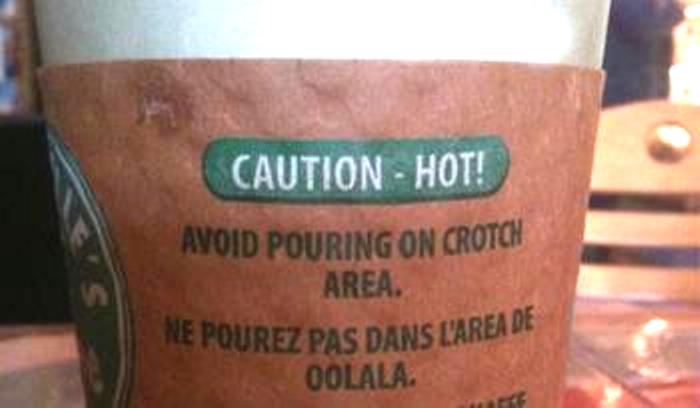
Now Chris Fergus, a professor in Australia, sends along this photo showing another coffee cup maker having a grand old time with the case by including a warning on its cups stating, “Avoid Pouring on Crotch Area.”  I don’t speak French, but  can guess the French version amounts to something like “Don’t Pour It on Your Oolala.”  Chris said he received the photo from one of his students and is unsure where it originated.

Hilarious, unless you happen to end up like Ms. Liebeck.  Sorry for the graphic pic, but this is actually one of the milder pictures of her burn injuries:

Stella Liebeck's burn injuries

And so here we are more than a decade later continuing to distort the American tort system with a case in which dangerously hot coffee sold through a drive-thru window caused third-degree burns to a 79-year-old woman who accidentally spilled it while a passenger in a stopped vehicle trying to add cream and sugar.  Consult the original post for links to some eye-opening information about what really happened in the McDonald’s coffee spill case.

–Thanks to Chris Fergus

Warning: Don’t Trip on the Banana Peel Caution Cone

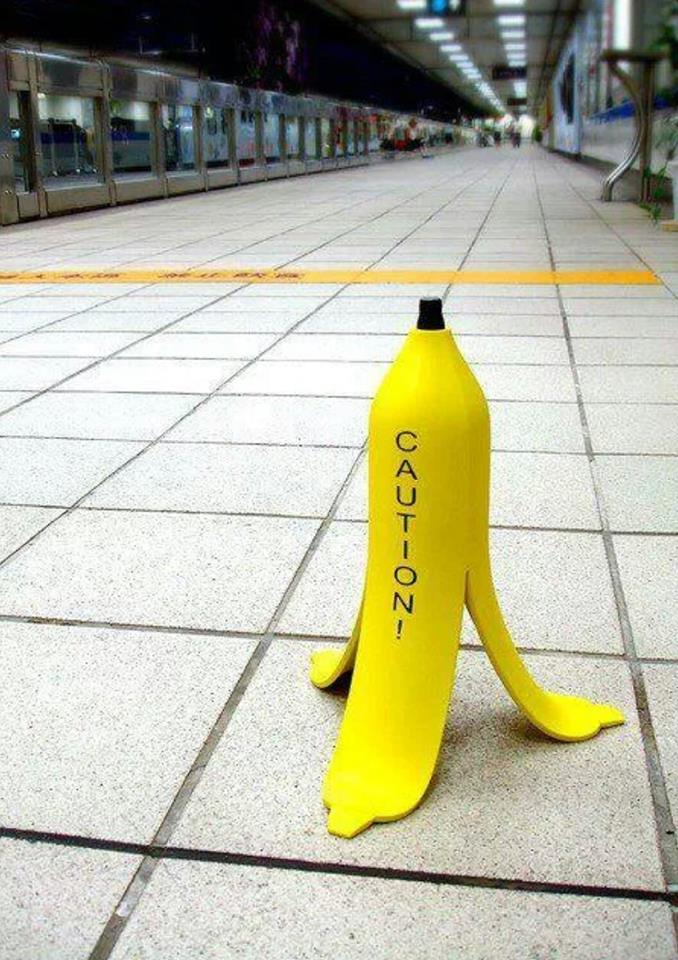
banana peel warning coneA student sent me this.  Not sure where it was taken, but gotta love it.  A much better attention-getter than the usual caution cones.

It raises the larger question of “Do people really slip on banana peels?”  Yes.  While slipping on a banana peel is a comedic cliché, it happens.

The famous Prosser, Wade & Schwartz Torts casebook contains a trilogy of cases involving plaintiffs who slipped on banana peels.  In keeping with the comedic tradition, our discussion of the cases ends with this question:  “Before we move on, what do the three banana cases all have in common?”  Pause, bewildered looks.  “They all went up on … a peel.”  Drum roll.

Mythbusters found there’s nothing particularly slippery about banana peels, but Googling the issue brings up several recent instances of people falling on them.  In December 2013, a Staten Island man slipped on a banana peel and fell onto the subway tracks.

Warning: Guitar Strings Can Cause Death

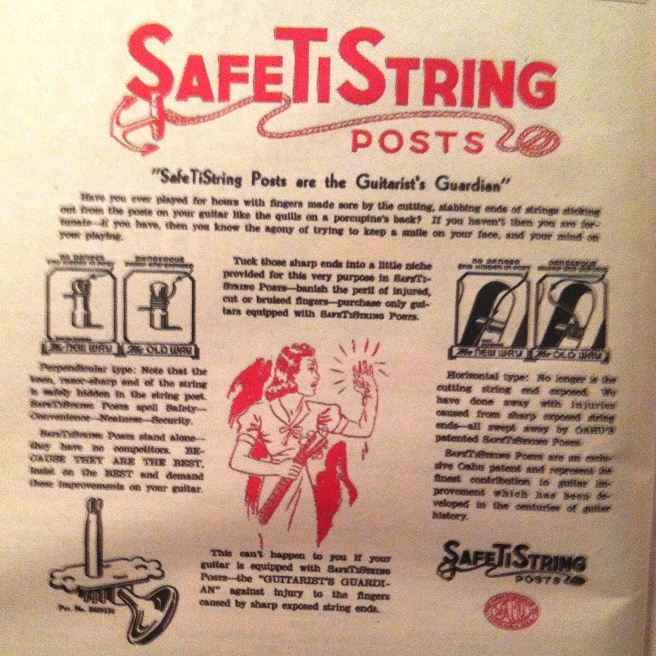
Guitar Strings Are DangerousAll guitar players have been painfully poked more than once by the sharp ends of the strings where they wrap around the tuners.  In the 1930s, Kluson marketed “SafeTiString” tuner posts where the string ends could be neatly tucked away in a slot in the posts to “banish the peril of injured, cut or bruised fingers.”

Neat invention, but apparently too late to save the poor woman pictured in this advertisement reprinted in Vintage Guitar magazine in the Feb. 2013 issue.  She appears to be bleeding to death.

Click to enlarge the thumbnail to appreciate her plight.

Warning: Why Not Just Say “Steep Hill”?

Weird warning of steep slope.Curious warning sign at the Beale Street Landing on the Mississippi River in downtown Memphis.  It says:

Caution grass slopes may exceed 8%

Is “8%” meaningful information?  Would it not be better to say “Caution: Steep Hill”?

Also, this is a multi-million dollar new development.  Couldn’t they come up with a more professional sign.  Maybe someone texted the sign maker:

btw, we need some signage for the slope, something like Caution grass slopes may exceed 8%.  Why 8%?  To mess with them!  LOL

Warning: Don’t Spill Beer on Your Phone

beer spill warningA recent graduate sent me this warning from a bar: “USE CAUTION!  SPILLS HAPPEN … DON’T BLAME US … keep yours [your phone] CLEAR OF THE BEER.”

Nice!  Makes nuclear power plant warnings pale in comparison.  But then, those only involve radiation poisoning.  We’re talking phone deprivation here.

–Thanks to Sarah Atkinson.