Alaska Judge a Parrot Head

strange judicial opinions volcano moves trialChanging venue because of a volcano? Sure, it sounds far-fetched, but don’t blow your stack.

It really happened in U.S. v. McDonald, a 1990 federal bribery prosecution in Alaska. Fearful that an unpredictable volcano named Mt. Redoubt would act up and disrupt the trial, Judge James M. Burns granted a motion to change venue for the trial from Fairbanks, Alaska to Tacoma, Washington.

Judge Burns noted he could find “no precedent for changing venue because of an earthquake, hurricane, tornado, flood, volcanic eruption, or other natural disaster,” but said Mt. Redoubt was “entitled to a modicum of judicial respect.”

Judge Burns might be a Jimmy Buffett fan. Usually, when you think of Buffett, you think frozen margaritas, not frozen tundra, but footnote 17 quotes the entire lyrics of the Jimmy Buffett song “Volcano,” observing that Buffett’s lyrics express feelings apropos to the circumstances of the case.

Buffett sang, “I don’t know, I don’t know where I’m a-gonna go when the volcano blow.”

Here they knew. The judge sent everyone to Tacoma.

United States v. McDonald, 740 F. Supp. 757, 764 nn.17 & 18 (D. Alaska 1990) (Burns, J.). Thanks to Tom Gaylord.

Happily, It’s Still a MAD, MAD World

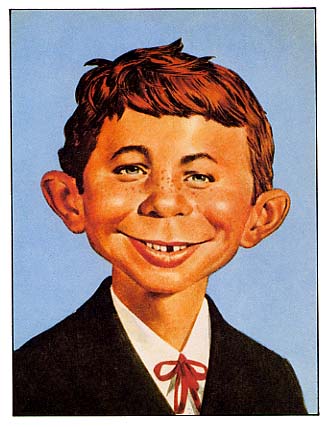
Alfred E. NeumanAs a kid, I couldn’t wait to get my hands on each new issue of MAD Magazine. Alfred E. Neuman and company had a lot to do with shaping (warping) my sense of humor. One of my favorite features, and the first thing I looked at every month, was the folding back covers, which showed one picture unfolded but ingeniously formed a different, wacky picture when folded.

I’m glad to see that MAD has not been forgotten, even in the hallowed halls of justice, as shown by Cabiness v. Town of James Island, South Carolina Supreme Court case.

The case involved a third failed attempt by the Town of James Island to incorporate itself. The complicated facts aren’t important for our purposes. Suffice it to say that one of the biggest issues was the “contiguity” of certain property.

In considering this issue, the court said the most convincing evidence were the courtroom exhibits of maps, which apparently, resembling MAD fold-in back covers, showed the all-important contiguity of certain properties at issue in the case:

Perhaps the most convincing exhibits illustrated the “but for” concept of contiguity in a “MAD Magazine” style back-page folding manner, where a map of two areas alleged to be contiguous was folded in such a manner as to eliminate the previously-annexed publicly-owned property.

Perhaps worried, as I am, that this great literary device is being forgotten, Justice Hearn, in a footnote, directed readers “not familiar with this reference” to a New York Times interractive compilation of MAD Magazine fold-in covers.

Cabiness v. Town of James Island, Opinion No. 26989, S.C. Sup. Ct, June 20, 2011. Thanks to Jim Bogle.

Federal Appellate Judge Makes Soap Opera of Ordinance Dispute

strange judicial opinion detergent brands
A washing machine laughing hysterically at Judge Brown's opinion.

In 1973, the Fifth Circuit struck down a Dade County detergent labeling ordinance, finding that the ordinance, intended to reduce pollution from ingredients found in household detergents, was preempted by the Federal Hazardous Substance Labeling Act.

Chief Judge John Brown concurred, managing to work in the brand names of just about every detergent product available, becoming a humorous opinion-writing path-breaker.

Let us know if we’re wrong, but Judge Brown’s opinion–published in 1973–may be the first overtly intentional effort by a federal court of appeals judge to write a clever and funny opinion.  It’s a lot easier for a state judge to get away with being amusing than a federal judge, certainly a court of appeals judge.

So, while the opinion isn’t particularly hilarious, Judge Brown’s boldness and innovation gets this case into the Strange Judicial Opinions Hall of Fame.

Here’s a taste of his detergent-filled ruling (italics inserted):

As Proctor of this dispute … the Court holds that Congress has specifically preempted regulatory action by Dade County. Clearly, the decision represents a Gamble since we risk a Cascade of criticism from an increasing Tide of ecology-minded citizens. Yet, a contrary decision would most likely have precipitated a Niagara of complaints from an industry which justifiably seeks uniformity in the laws with which it must comply. Inspired by the legendary valor of Ajax, who withstood Hector’s lance, we have Boldly chosen the course of uniformity in reversing the lower Court’s decision upholding Dade County’s local labeling laws. And, having done so, we are Cheered by the thought that striking down the regulation by the local jurisdiction does not create a void which is detrimental to consumers ….

And so we hold. This is all that need be said. It is as plain as Mr. Clean the proper Action is that the Dade County Ordinance must be superseded, as All comes out in the wash.

Chem. Specialties Mfrs. Ass’n v. Clark, 482 F.2d 325, 328–29 (5th Cir. 1973) (Brown, C.J., concurring). Thanks to Craig A. Wilson.

The Encyclopedic Footnote of Pop Culture (Kozinski)

U.S. Ninth Court of Appeals Judge Alex Kozinski is well known for sprinkling pop culture references throughout his opinions, particularly in the famous Syufy opinion, which wove in the titles of more than 200 movies. (See “Coming Soon to a Footnote Near You”)

A less noticed, but just as fun pop culture-laden opinion was his dissent to an order denying rehearing en banc in White v. Samsung Electronics America, Inc., a case where the Ninth Circuit upheld a “right of publicity” claim by former game show hostess Vanna White against Samsung for using a robot resembling her game show persona in a television commercial.

Complaining that, “[u]nder the majority’s opinion, it’s now a tort for advertisers to remind the public of a celebrity,” Kozinski excoriated the court for over-extending intellectual property rights in an opinion jammed full of pop culture references.

(That’s one thing to love about Kozinski’s writing: he can be pithy, insightful, and amusing in less than twenty words.)

Pop culture ran amuck in a single footnote (footnote 6) that includes references to (in order): grunge rocker Tad Doyle, the Hell’s Angels, Marvel Comics, Breakfast at Tiffany’s, Breakfast of Champions, The Electric Kool-Aid Acid Test, Looking for Mr. Goodbar, The Coca-Cola Kid, The Kentucky Fried Movie, Harley Davidson and the Marlboro Man, The Wonder Years, Wonder Bread, Joseph and the Amazing Technicolor Dream Coat, Janis Joplin, Paul Simon, Leonard Cohen, Bruce Springsteen, Prince, dada, Monty Python, Roy Clark, Mel Tillis, the Talking Heads, Andy Warhol, REO Speedwagon, 38 Special, Jello Biafra and the Dead Kennedys.

White v. Samsung Elec. Am., Inc., 989 F.2d 1512, 1512 n.6, 1514 (9th Cir. 1993) (Kozinski, J., dissenting from order denying rehearing en banc). Thanks to Katherine Shipman.

The Never-Ending Story of Bill Clinton’s Sex Life (Kozinski)

Where do scandals go when they die? They travel upwards, of course … to a U.S. Court of Appeals. At least if they’re scandals involving the saga of President Bill Clinton’s sexcapades.

U.S. Ninth Circuit Court of Appeals Judge Alex Kozinski faced an appeal in a defamation suit filed by former lounge-singer Gennifer Flowers against Hillary Rodham Clinton, James Carville and George Stephanopoulos. With that cast of characters (including Judge K), you know it’s going to be an interesting opinion.

This is an opinion to be admired as much for its lucidity as its colorful take on the events. Here’s a taste from the opening paragraphs (some paragraph breaks inserted):

Long after the public spotlight has moved on in search of fresh intrigue, the lawyers remain. And so we find ourselves adjudicating a decade-old dispute between Gennifer Flowers and what she affectionately refers to as the “Clinton smear machine”: James Carville, George Stephanopoulos and Hillary Clinton. Flowers charges that said machine destroyed her reputation by painting her as a fraud and a liar after she dis-closed her affair with Bill Clinton. We decide whether Flowers’s claims are timely and, if so, whether they survive a motion to dismiss.

Background and Proceedings Below

In the heat of the 1992 presidential primary campaign, the Star—that ubiquitous supermarket source for celebrity scandal—ran a story claiming that Bill Clinton had carried on an affair with an Arkansas woman named Gennifer Flowers. Clinton and Flowers both denied it at first, but a few days later Flowers (doubtless realizing that honesty is the best policy after all) sold her story to the Star.

Clinton continued vigorously denying the allegations and appeared on 60 Minutes with his wife to say they weren’t true. The following day, Flowers responded by holding a press conference where she played recordings of intimate phone calls from Clinton that she’d secretly taped. Later news reports suggested that the tapes may have been selectively edited.

According to Flowers, Hillary Clinton and her two “henchmen,” George Stephanopoulos and James Carville, conspired to protect Bill Clinton’s presidential candidacy from Flowers’s damaging revelations. Flowers claims that during the 1992 campaign and in later political memoirs and interviews, Carville and Stephanopoulos defamed her and painted her in a false light by claiming that she had lied in her story to the Star and “doctored” the tape-recorded phone calls.

Hillary Clinton, the alleged mastermind of the conspiracy, not only orchestrated the defamatory exploits, but also exposed private information about Flowers and organized break-ins of her residence. Flowers claims that, as a result of all this schemery, her reputation has wilted and her blossoming career as a Las Vegas lounge singer has been nipped in the bud.

It’s like the beginning of an intriguing political spy novel you want to keep reading. In the not-as-exciting climax, the Ninth Circuit panel felt compelled under the law to reverse the district court, which had dismissed all of Flowers’ claims.

Meanwhile, Kozinski gave us another Syufy-type mystery (see “Coming Soon to a Footnote Near You!”) by burying an amusing reference in one of the citations. I won’t spoil the mystery. See if you can find it.

Flowers v. Carville, 310 F.3d 1118, 1122 (9th Cir. 2002) (Kozinski, J.). Thanks to Elise Hendrick .

But Did the Defendant Come in Through the Bathroom Window?

As a member of a Memphis rock cover band that plays several Beatles songs and a huge Beatles fan, I have a special appreciation for Montana Judge Gregory R. Todd’s order in a 2007 criminal case.

After the defendant pleaded guilty to burglary, he was asked to fill out portions of a pre-sentence investigation report. In response to the question, “Give your recommendation as to what you think the Court should do in this case,” the defendant replied, “Like the Beetles say, ‘Let It Be.’”

Judge Todd took issue with both the defendant’s apparent plea for leniency and also his misspelling of the name of the Beatles, for whom Judge Todd obviously has great fondness. The judge penned a caustic sentencing memorandum, written to the defendant, that managed to work in the titles of thirty-nine Beatles songs:

Act Naturally

Baby It’s You

Bad Boy

Carry That Weight

Come Together

Day in the Life

Do You Want to Know a Secret?

Fixing a Hole

Fool on the Hill

Get Back

Hard Day’s Night

Hello Goodbye

Help

Here, There and Everywhere

Hey Jude

Honey Don’t

I Don’t Want to Spoil the Party

I Feel Fine

I Should Have Known Better

I, Me, Mine

I’ll Cry Instead

I’ll Get You

I’m a Loser

Let It Be

Long and Winding Road

Magical Mystery Tour

Misery

Mr. Moonlight

Nowhere Man

Run for Your Life

Something

Strawberry Fields Forever

The Word

Think for Yourself

Ticket to Ride

Wait

We Can Work It Out

When I’m 64

You Really Got a Hold on Me

Here’s a taste from the last paragraph of the memorandum:

Later when you thought about what you did, you may have said I’ll Cry Instead. Now you’re saying Let It Be instead of I’m A Loser. As a result of your Hard Day’s Night, you are looking at a Ticket To Ride that Long and Winding Road to Deer Lodge. Hopefully you can say both now and When I’m 64 that I Should Have Known Better.

Judge, what can I say, but Thank You Girl, er rather, Your Honor. Til There Was You, most judicial opinions were just so Yesterday. I hope we have a chance to Come Together for lunch or Something. Why? Well, just Because.

State v. McCormack, No. DC06-0323, Montana Thirteenth Judicial District, Yellowstone County, Feb. 26, 2007. Thanks to Pat Smith.

Paranoia Will Destroy Ya

freak out at phish concertThe Kinks got it right in their song, “Destroyer,” when they sang that paranoia will destroy ya.

It certainly did so for the defendant in a case where, after getting paranoid at a 1999 Phish concert in Oswega, NY, presumably while under the influence of an hallucinogenic drug, he became convinced the police were following him and that the band was sending him messages through the music. Fleeing the concert, he traveled 250 miles on foot and by hitch-hiking, convinced the police were after him the whole way. (He believed that every car with an “A” in the license number contained police officers.)

Some thirty-six hours later, he finally turned up at the police barracks in Westport, NY, where he told an investigator, “You know who I am.” When the cops didn’t know who he was or why he was there, he told them he was growing marijuana plants back at his home in Rochester, NH. He then consented to a search of the house.

When the cops in Rochester searched the house, they found marijuana plants and liquid acid. Though a New Hampshire Superior Court ultimately ruled that the evidence should be suppressed (because of insufficient proof the defendant received and waived his Miranda rights), the University of Memphis law student who sent me this opinion correctly opined that it should serve as “a gentle reminder to any students planning to reunite with Phish over the summer break.”

State v. Augur, Case Nos. 01-S-388, 01-S-389, 2001 N.H. Super. LEXIS 17 (N.H. Super. Ct., Oct. 22, 2001). Thanks to Adam Ragan.

Sing This Tax Opinion with a Twang

Think judges of the U.S. Tax Court are staid? Well, yes, probably. But in 1983, one of them cut loose with a rhyming opinion in a case involving country singer Conway Twitty’s defunct “Twitty Burger” restaurants:

Twitty Burger went belly up

But Conway remained true

He repaid his investors, one and all

It was the moral thing to do.

His fans would not have liked it

It could have hurt his fame

Had any investors sued him

Like Merle Haggard or Sonny James.

When it was time to file taxes

Conway thought what he would do

Was deduct those payments as a business expense

Under section one-sixty-two.

In order to allow these deductions

Goes the argument of the Commissioner

The payments must be ordinary and necessary

To a business of the petitioner.

Had Conway not repaid the investors

His career would have been under cloud,

Under the unique facts of this case

Held: The deductions are allowed.

Interesting factoids in the opinion include the revelations that Conway Twitty’s real name was Harold Jenkins and that he began his career in rock and roll before crossing over to country music in 1965.

Jenkins v. Comm’r, 47 T.C.M. (CCH) 238 (T.C. 1983). Thanks to Professor Jose Gabilondo.

The Real Slim Shady Is Not a Michigan Trial Judge

Michigan Circuit Court Judge Deborah Servitto rapped part of her recent decision dismissing a defamation case brought against Eminem.

Eminem’s 1999 CD, “The Slim Shady LP,” included a song called “Brain Damage” in which Eminem accused one DeAngelo Bailey of bullying and battering him while the two were in elementary school: “Way before my baby daughter Hailey, I was harassed daily by this fat kid named DeAngelo Bailey … He banged my head against the urinal until he broke my nose, soaked my clothes in blood, grabbed me and choked my throat.”

Bailey sued for defamation, denying that he ever bullied or battered Em. Servitto dismissed the complaint on the ground that the statements in the song were mere rhetorical hyperbole, rather than statements that could be construed as stating actual facts about a person.

Thanks to several loyal lawhaha.com visitors, we now have the full text of the attempted rap for you, which is found in the last footnote of Servitto’s 14-page opinion:

11. To convey the Court’s opinion to fans of rap, the Court’s research staff has helped the Court put the decision into a universally understandable format:

Mr. Bailey complains that his rap is trash

So he’s seeking compensation in the form of cash

Bailey thinks he’s entitled to some monetary gain

Because Eminem used his name in vain

Eminem says Bailey used to throw him around

Beat him up in the john, shoved his face in the ground

Eminem contends that his rap is protected

By the rights guaranteed by the first amendment

Eminem maintains that the story is true

And that Bailey beat him black and blue

In the alternative he states that the story is phony

And a reasonable person would think it’s baloney

The Court must always balance the rights

Of a defendant and one placed in a false light

If the plaintiff presents no question of fact

To dismiss is the only acceptable act

If the language used is anything but pleasin’

It must be highly objectionable to a person of reason

Even if objectionable and causing offense

Self-help is the first line of defense

Yet when Bailey actually spoke to the press

What do you think he didn’t address?

Those false light charges that so disturbed

Prompted from Bailey not a single word.

So highly objectionable it could not be

–Bailey was happy to hear his name on a CD

Bailey also admitted he was a bully in youth

Which makes what Marshall said substantial truth

This doctrine is a defense well known

And renders Bailey’s case substantially blown

The lyrics are stories no one would take as fact

They’re an exaggeration of a childish fact

Any reasonable person could clearly see

That the lyrics could only be hyperbole

It is therefore this Court’s ultimate position

That Eminem is entitled to summary disposition

Will Bailey appeal? Judge Servitto probably would advise him to just “peace out, dawg.”

— Bailey v. Mathers, Case No. 2001-3606-NO, slip op. at 13 n. 11 (Macomb County Circuit Court, Oct. 17, 2003). Thanks to Jason Blalock, Geoff Brown, Mark Rodan, and Melanie Ware.

Wanted: Expert Witness in Nizzle Shizzling

In a copyright battle between two British rap bands, an English court ruled that rap lyrics should for practical purposes be considered a “foreign language,” requiring expert testimony as to their interpretation.

British band Ant’ill Mob sued another band, Heartless Crew, alleging the defendant disparaged the band’s copyright for its 2001 hit song, “Burnin’,” by remixing the song using lyrics the plaintiff considered objectionable because they allegedly refer to drugs and violence, including the terms “shizzle my nizzle,” “mish mash man,” and “string dem up.”

Even after playing the record at half speed and consulting the Urban Dictionary, Judge Kim Lewison said he could not determine the meaning of the phrases without an expert witness.

The amusing predicament of three uppercrust, white, middle-aged judges trying to unravel rap slang was not lost on Judge Kim, who commented on the “faintly surreal experience of three gentlemen in horsehair wigs examining the meaning of such phrases.”

According to the Urban Dictionary (urbandictionary.com), “shizzle my nizzle” means:

a bastardization of “fo’ sheezy mah neezy,” a bastardization of “for sure mah n—,” a bastardization of “I concur with you wholeheartedly my African-American brother.

Confetti Records v. Warner Music UK Ltd, [2003] EWHC 1274 (Ch). Thanks to Cynthia Cohan, Elise Hendrick, and Catherine Seville for sending this opinion. Catherine is the Director of Studies in Law at Newnham College in Cambridge and reports that Judge Lewison is “a good Cambridge man.” Indeed.