

It’s Great to be a Georgia Gator!

georgia gatorAs a University of Florida alumnus and Florida Gator fan, I couldn’t help but be tickled by Wright v. State of Georgia Dep’t of Natural Resources, from the Georgia Court of Appeals.

Few college football rivalries are as intense or long-running as that between the Florida Gators and the Georgia Bulldogs. Held in Jacksonville, FL and billed as “The World’s Largest Cocktail Party,” the Florida-Georgia game is a sacred rite of autumn in the two states. The Bulldogs ruled the series for what seemed like an eternity, inflicting untold suffering on the Gator Nation courtesy of players like Herschel Walker and Lindsay Scott. Then Coach Spurrier and Company came to the rescue, winning 10 of 11 games from 1990-2001.

Which brings us to Wright, a lawsuit in which the plaintiff claimed that certain actions by the Georgia Department of Natural Resources constituted a government “taking” of some alligators that were born and raised on plaintiff’s Georgia farm.

Judge Smith, obviously a jurist with keen political sensibilities, included this footnote:

1. Several times in this opinion, we refer to “Georgia alligators.” We do so reluctantly and soley for the sake of convenience and brevity. We recognize that for literally millions of Georgians and Floridians, the term “Georgia Gators,” or any approximation thereof, is an inherently offensive oxymoron. We apologize for any pain or distress caused by this unfamiliar and unfortunate juxtaposition.

We’ll let it slide this time, Your Honor, but if you ever happen to take up a dog-bite case involving a pug-faced nonresident defendant to the south, please don’t start talking about “Florida Bulldogs.” It would be more than we could stand.

— Wright v. Georgia Dep’t of Natural Res., 562 S.E.2d 515, 517 (Ga. Ct. App. 2002). Thanks to Jessie Cranford.
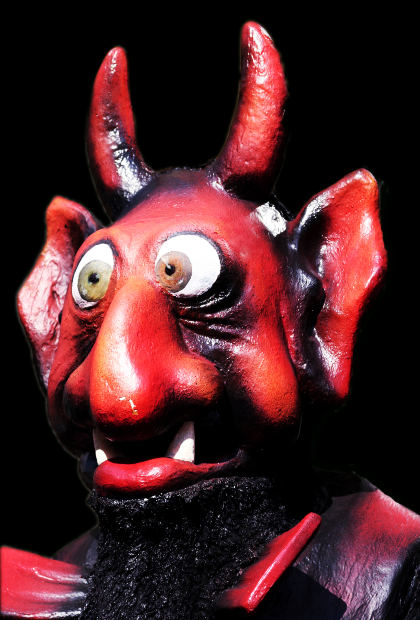

No Jurisdiction Over Satan

lawsuit against satanDoes a court have personal jurisdiction over the Prince of Darkness? Depends where he lives.

In Mayo v. Satan and His Staff, the plaintiff filed a civil rights action alleging Satan and his employees “on numerous occasions caused plaintiff misery and unwarranted threats, against the will of plaintiff” and “placed deliberate obstacles in his path and caused plaintiff’s downfall.” Plaintiff asserted these transgressions violated his constitutional rights. He sought the court’s permission to proceed in forma pauperis.

U.S. District Judge Weber denied the application, noting several complicated legal issues the plaintiff’s lawsuit would raise (some paragraph breaks inserted):

Even if plaintiff’s complaint reveals a prima facie recital of the infringement of the civil rights of a citizen of the United States, the Court has serious doubts that the complaint reveals a cause of action upon which relief can be granted by the court.

 We question whether plaintiff may obtain personal jurisdiction over the defendant in this judicial district. The complaint contains no allegation of residence in this district. While the official reports disclose no case where this defendant has appeared as defendant there is an unofficial account of a trial in New Hampshire where this defendant filed an action of mortgage foreclosure as plaintiff.

The defendant in that action was represented by the preeminent advocate of that day, and raised the defense that the plaintiff was a foreign prince with no standing to sue in an American Court. This defense was overcome by overwhelming evidence to the contrary. Whether or not this would raise an estoppel in the present case we are unable to determine at this time.

If such action were to be allowed we would also face the question of whether it may be maintained as a class action. It appears to meet the requirements of Fed.R. of Civ.P. 23 that the class is so numerous that joinder of all members is impracticable, there are questions of law and fact common to the class, and the claims of the representative party is typical of the claims of the class. We cannot now determine if the representative party will fairly protect the interests of the class.

We note that the plaintiff has failed to include with his complaint the required form of instructions for the United States Marshal for directions as to service of process.

For the foregoing reasons we must exercise our discretion to refuse the prayer of plaintiff to proceed in forma pauperis.

Hmm, that’s interesting that a plaintiff purporting to be the devil filed a mortgage foreclosure action way back in the day. Maybe that’s who’s behind the current mortgage meltdown.

— United States ex rel. Gerald Mayo v. Satan & His Staff, 54 F.R.D. 282, 283 (W.D. Pa. 1971).

Reversed, With Love and Admiration


judge richard posner
Judge Richard Posner

Friend of lawhaha.com, Lihwei Lin, has made several choice contributions to Strange Judicial Opinions, including one posing this question: What would you do if you were a judge and had to reverse a case in which your boss had sat as the presiding judge? And what if your boss was none other than the legendary Richard Posner? Here is Lihwei’s take on the situation:

Imagine yourself in this situation: You are a newly-appointed circuit judge sitting in a circuit with the likes of Frank Easterbrook, “Rick” Posner and other judicial demigods. One day, your Chief Judge, Posner, apparently runs out of things to do in between being a chief judge, mediating the Microsoft case, and writing 5000 books, and decides to make a guest appearance by special designation in a federal trial court. In that role, he makes a few clearly reversible errors in a case, Chicago School-style no less. The case has come up for review and you are the presiding judge. What would you do?

Judge Evans confronted this dilemma of judicial review in Bankcard America, Inc. v. Universal Bancard Systems, Inc., 203 F.3d 477 (7th Cir. 2000). His footnote only three sentences into the opinion leaves you with the feeling than reversing one’s own Chief Judge is a bit more delicate than reversing your typical trial court:

It is a testament to the dedication of Chief Judge Posner that he volunteer to sit in the district court and hear this case which, at the time, needed the guiding hand of a new judge. Judge Posner, of course, carries a full load of cases on this court. He also discharges a multitude of administrative duties as the circuit’s chief judge. But that’s only part of what he does. He has written more books than many people read in a lifetime. On top of all this, in his spare time he is working as a court-appointed special mediator in the government’s blockbuster antitrust suit against Microsoft. Obviously, Judge Posner has more on his plate than a long-haul trucker working an “all you can eat” buffet line. It is a tribute to Judge Posner’s talent that he handles his many roles with such vigor, brilliance, and panache.

The only thing missing is: “I’m sooooo sorry about this, Judge. Please don’t take away my parking space.”

— Bankcard America, Inc. v. Universal Bancard Sys., Inc., 203 F.3d 477, 479 n.1 (7th Cir. 2000). Thanks to Lihwei Lin.

One Person’s Muppet is Another Person’s Gelatinous Block of Meat

spam lawsuit over muppetsIn Hormel Corp. v. Jim Henson Productions, Inc., Hormel sued the Muppet master for infringing the trademark of its delicious product SPAM® by naming a character in the 1996 movie, Muppet Treasure Island, “Spa’am.” The U.S. District Court for the Southern District of New York rejected Hormel’s claims and the Second Circuit affirmed. Among the highlights:

• Hormel was worried that sales of SPAM would suffer if they were linked with Spa’am, the movie character, a wild boar puppet allegedly depicted as “evil in porcine form.” Not to worry. An expert in children’s literature persuaded the court that Spa’am, although not “classically handsome” and introduced as a threatening character at the beginning of the movie, ultimately becomes a positive character when he befriends the Muppets and helps them escape from the film’s villain, Long John Silver. Thank goodness we could find an expert in children’s literature to unravel that puzzle. Would that kind of testimony pass Daubert scrutiny?

• The court opined that Hormel should lighten up because, even though SPAM is a high-quality product, it is already the butt of jokes because of “the public’s unfounded suspicion that SPAM is the product of less than savory ingredients.” The court pointed out that in the television cartoon, Duckman, Duckman discovers the secret ingredient to SPAM as he gazes upon “Murray’s Incontinent Camel Farm.” The court also quoted a columnist who joked that SPAM contained all five major food groups: snouts, ears, feet, tails and brains. The court said that, given all the ribbing, “one might think Hormel would welcome the association with a genuine source of pork.”

• The court also rejected Hormel’s claim that Jim Henson Productions’ merchandising of the Spa’am character would interfere with Hormel’s own merchandising of SPAM, including its character, “SPAM-man,” a giant can of SPAM with arms and legs.

Hormel lost the case, but may have had the last laugh. It has sold more than five billion cans of SPAM . SPAM is eaten in 30 percent of American homes. I probably ate a thousand fried SPAM sandwiches when I was a kid, although I try not to think about it.

— Hormel Foods Corp. v. Jim Henson Prods., Inc., 73 F.3d 497, 501–02 (2d Cir. 1996). Thanks to Lihwei Lin.

“Motion to Kiss My ***”

Anyone who has ever worked as a staff attorney or law clerk to a federal judge or magistrate knows all too well the burdens of dealing with pro se inmate complaints (prisoners representing themselves).

In Washington v. Alaimo, the pro se inmate plaintiff pushed his luck too far when he filed a “Motion to Kiss My Ass,” in which he moved “all Americans at large and [the judge in one of his cases] to kiss my got [sic] damn ass.”

Other motions filed by the inmate included:

“Motion to Behoove an Inquisition”

“Motion for Restoration of Sanity”

“Motion for Publicity”

“Motion for Psychoanalysis”

“Motion to Invoke and Execute Rule 15—Retroactive Note: The Court’s School Days are Over”

“Motion for Skin Change Operation”

“Motion for Catered Food Service”

 The court imposed restrictions on all future filings by the inmate.

— Washington v. Alaimo, 934 F. Supp. 1395 (S.D. Ga. 1996). Thanks to Lihwei Lin.

No Degrees of Separation

Six degrees of separation? Forget about it.

In Wheat v. Fraker (Ga. App. 1963), there weren’t any. The plaintiff, Doug Fraker, sued the defendant, Judd Wheat, for damages arising from an automobile collision. The jury returned a verdict for plaintiff and the defendant appealed on the ground that (pay attention because this gets complicated) the wife of the foreman of the jury was the first cousin to the plaintiff’s wife. But wait, she was also the second cousin of the defendant! How could any judge pass up the opportunity to have fun with this family affair? Here are excerpts from the poetic opinion:

“Foul, foul play,” the defendant cried.

“That I by kinsman be not trammeled

Let the issue again be tried

Before another jury impanelled.”

…

“With juror mine adversary durst

Try the cause, whose wife is second cousin to my wife

And to plaintiff’s wife a first.

A new trial, sire, I demand to settle strife.”

“No foul play do I find or see,”

The judge replied. “Foreman’s wife to thine

And to plaintiff’s wife may kinsman be,

but to Doug and thee no kinship do I find.

“Thus, it doth not appear

For any cause or reason told

That the juror was not thy peer

The case to try and verdict mold.”

“Moreover, when kinships we sought to learn

It doth not appear that as best befits

One who would a kinsman spurn

Thou revealed that cousin did on the panel sit.”

…

— Wheat v. Fraker, 130 S.E.2d 251, 252 (Ga. Ct. App. 1963). Thanks to Senior District Judge James Barlow, San Antonio, TX.

Knocking Down Worshipper Not an “Act of God”

churchThe intersection of church and tort law is an interesting area. For the most part, courts–wisely so–have been reluctant to entangle tort law with church and religion except in cases of intentional physical batteries.  In Bass v. Aetna Ins. Co., the court had to decide whether “trotting under the Spirit of the Lord” in church, with the result of running into and injuring the plaintiff, was actionable or a protected “Act of God.”

Plaintiff attended the Shepard’s Fold Church in Louisiana, where moving or running in the aisles “in the Spirit” apparently is a common practice. During a revival, a fellow worshiper ran down the aisle where plaintiff was kneeling and praying and knocked her down, causing injury. Plaintiff sued for negligence.

At trial, the defendant testified he was “‘trotting’ under the Spirit of the Lord” and was not in control of his actions at the time of the collision. He raised “Act of God” as a defense and also asserted the plaintiff assumed the risk of the collision and was contributorily negligent. For non-legals, an Act of God under law is a harm-causing force of nature, such as a tornado or flood, the consequences of which humans generally are not held responsible for.

The trial court dismissed the case, finding that the plaintiff assumed the risk of the collision by praying in the aisle with her eyes closed, a decision affirmed by the court of appeals. But the Louisiana Supreme Court reversed.

The West headnote writers summed up the holdings succinctly:

[1] Negligence: Notwithstanding that worshiper testified he was trotting under the Spirit of the Lord, “Act of God” defense did not apply in action by worshiper who was injured while praying in the aisle against second worshiper who was running in church inasmuch as “Act of God” meant force majeure.

[14] Religious Societies: It is not contributory negligence to bow one’s head while praying in church, whether in the pew or in the aisle.

— Bass v. Aetna Ins. Co., 370 So. 2d 511 (La. 1979). Thanks to a fellow Torts professor.

Court Crosses Line in Making Fun of Mentally Ill Plaintiff

In Searight v. New Jersey, the plaintiff sued the State of New Jersey alleging that the state unlawfully injected him in the left eye with a radium electric beam. As a result, he asserted that someone began talking to him inside his brain.

The court rejected the claim as time-barred by the statute of limitations, but also observed that proper jurisdiction for unlicensed radio communications would lie with the FCC. The court also offered plaintiff a terribly insensitive self-help suggestion. Here’s an excerpt from the opinion:

The allegations, of course, are of facts which, if they exist, are not yet known to man. Just as Mr. Houdini has so far failed to establish communication from the spirit world …, so the decades of scientific experiments and statistical analysis have failed to establish the existence of ‘extrasensory perception’ (ESP). But, taking the facts as pleaded, and assuming them to be true, they show a case of presumably unlicensed radio communication, a matter which comes within the sole jurisdiction of the Federal Communications Commission, 47 U.S.C. § 151, et seq.

And even aside from that, Searight could have blocked the broadcast to the antenna in his brain simply by grounding it. See, for example, Ghirardi, Modern Radio Servicing, First Edition, p. 572, ff. (Radio & Technical Publishing Co., New York, 1935). Just as delivery trucks for oil and gasoline are ‘grounded’ against the accumulation of charges of static electricity, so on the same principle Searight might have pinned to the back of a trouser leg a short chain of paper clips so that the end would touch the ground and prevent anyone from talking to him inside his brain.

Sounds like poor Searight was suffering from schizophrenia. Schizophrenia is a cruel neurological brain disorder that affects 2.2 million Americans.  Lawhaha.com is a fan of judicial humor, but this one never should have seen the light of day. Many of the most unusual and sometimes amusing judicial opinions occur because of the unusual or weird parties involved. But this court went out of its way to humuliate Searight. In fairness, it was 1976. Society has much more awareness of and sensitivity to mental illness, although we still have a long way to go. Schizophrenia.com is a good source info about the condition suffered by people like Searight.

— Searight v. New Jersey, 412 F. Supp. 413, 414–15 (D.N.J. 1976). Thanks to Lihwei Lin.

This Judicial Humor Resulted in Censure

The Kansas Supreme Court publicly censured a rhyming judge in a 1975 case for a tasteless piece of doggerel in which he publicly humiliated a woman arrested for prostitution. His poetic order was deemed to be in violation of the judicial ethical canon that “[a] judge should be patient, dignified, and courteous to litigants, jurors, witnesses, lawyers, and others with whom he deals in his official capacity.”

We won’t  perpetuate the misdeed by setting forth the offending rhyme here. Suffice it to say the judge repeatedly called the young woman a “whore” (in addition to showing bad judgment, he should be chastised for being a lousy poet; that’s what he came up with to rhyme with “1974” — the year of defendant’s arrest).

The most interesting aspect of the case was the Kansas Supreme Court’s commentary on judicial humor. In defense to the disciplinary proceeding, the censured jurist cited to several poetic judicial opinions and argued he should not be censured for following in this grand judicial tradition. The court observed:

Judges have long been enjoined from the use of humor at the expense of the litigants before them for reasons which should be apparent. Under the heading of “Ancient Precedents” in the canons of judicial ethics adopted in 1924 by the American Bar Association this appears:

“Judges ought to be more learned than witty; more reverend than plausible; and more advised than confident. Above all things, integrity is their portion and proper virtue ….”

“Patience and gravity of hearing is an essential part of justice; and an over speaking judge is no well-tuned cymbal ….” — Bacon’s Essay “of Judicature.” (198 Kan. xi.)

In 1967 a long time member of the supreme court of Arkansas in advising new judges on opinion writing had more to say on the subject. We quote:

“. . . Judicial humor is neither judicial nor humorous. A lawsuit is a serious matter to those concerned in it. For a judge to take advantage of his criticism-insulated, retaliation-proof position to display his wit is contemptible, like hitting a man when he’s down.” (Smith, A Primer of Opinion Writing, For Four New Judges, 21 Ark. L. Rev. 197, 210.)

Judges simply should not ‘wisecrack’ at the expense of anyone connected with a judicial proceeding who is not in a position to reply. … Nor should a judge do anything to exalt himself above anyone appearing as a litigant before him. Because of his unusual role a judge should be objective in his task and mindful that the damaging effect of his improprieties may be out of proportion to their actual seriousness. He is expected to act in a manner inspiring confidence that even-handed treatment is afforded to everyone coming into contact with the judicial system.

— In re Rome, 542 P.2d 676, 685 (Kan. 1975). Thanks to Lihwei Lin.

Funny or Bully Pulpit? (Kent)

Before his flame-out, Judge Samuel Kent in Galveston, Texas, garnered a lot of attention for his abrasive writing style. Opinion was split in the legal community. Examples are here, here, here and here.

Some lawyers considered his sarcastic, often rude and insulting opinions hilarious. Some considered them very unjudicial and inappropriate. Probably many others viewed them as a combination of both.

Professor Steven Lubet of Northwestern University law school weighed in on the issue with a piece called “Bullying from the Bench,” in The Green Bag. Steve took issue with Kent’s humor, particularly his ad hominem attacks on lawyers. Here’s a brief excerpt:

Federal judges exercise enormous power over lawyers and their clients. Armed with life tenure and broad discretion, a judge can do great damage to an attorney’s reputation and career, while the lawyer has almost no recourse. So when Judge Kent decided to torment the hapless counsel in the Bradshaw case are identified by name in the published opinion—he was taking aim at people who could not defend themselves. …

In litigation, the judge is the maximum boss. Everyone else is a supplicant, compelled to engage in stylized demonstrations of obedience. We stand when the judge enters and leaves the room. Our “pleadings” are “respectfully submitted.” Before speaking, we make sure that it “pleases the court.” We obey the judge’s orders and we even say “thank you” for adverse rulings. …

By belittling the lawyers who appear before him, Judge Kent used his authority to humiliate people who—in the courtroom environment—are comparatively helpless. There is a name for that sort of behavior, and it isn’t adjudication. It’s bullying.

Steven got it right, of course. The relationship between judge and lawyers is about as one-sided as it gets.  The judge holds all the cards. Sometimes lawyers deserve to get chewed out, but Kent was over the top.

— Steven Lubet, Bullying from the Bench, 5 Green Bag 2d 11, 12 (2001).