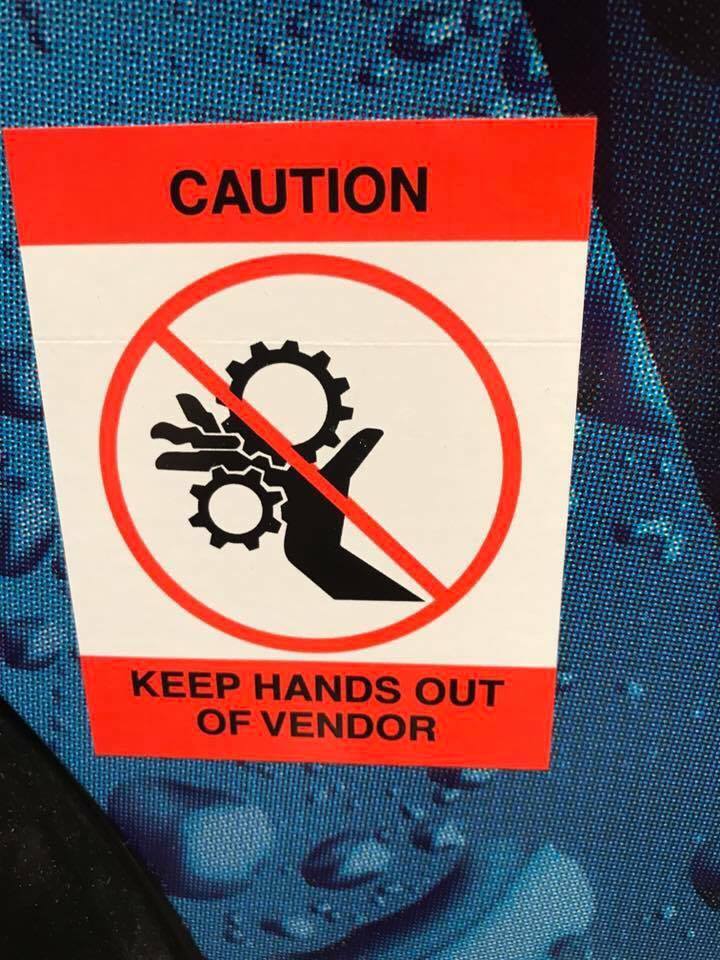
Wacky Warning Sign: World’s Safest Road Excavation

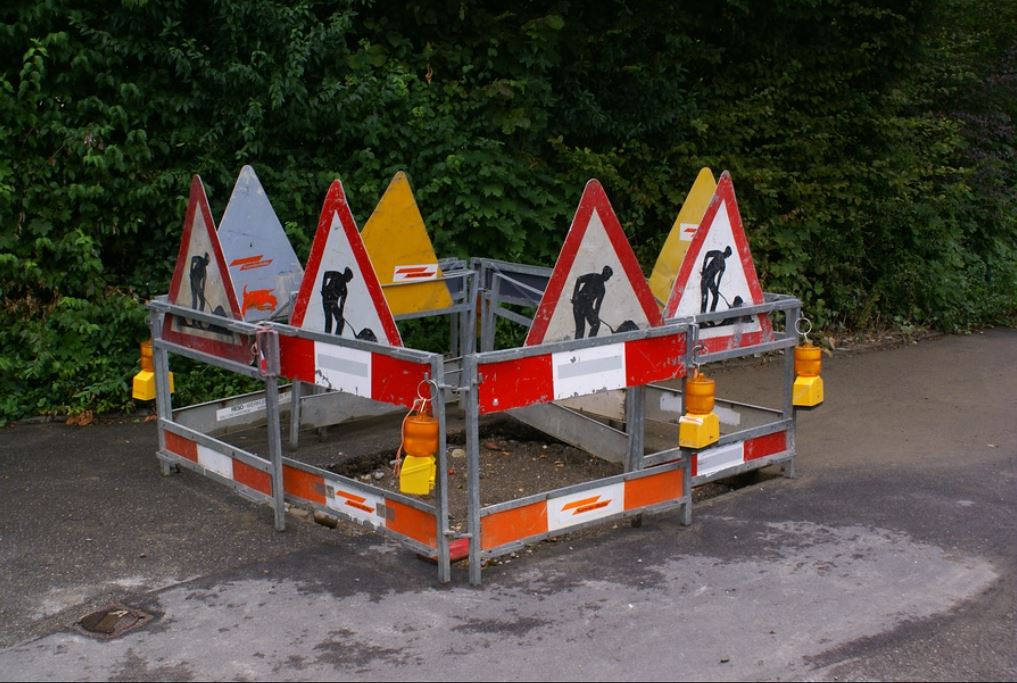
Thanks to my Swiss friend for this link to a variety of wacky warning signs in Switzerland.  The Swiss are very safe people, no doubt about it.  Look closely at what this monstrous, overdone barrier and warning contraption is protecting: what looks to be about a four-inch deep road excavation.

Compare the Swiss approach to how we handle this type of hazard in good old Memphis.

–Thanks to Pat Crowell.

Diabolical Slip and Fall Combo – Ice and Banana Peel

Thanks to a former student at the Florida International University College of Law for spotting this particularly diabolical slip and fall risk.  As if ice or banana peels weren’t risk enough by themselves, here we get a combo.

Slip and falls are no laughing matter.  According to OSHA, they cause 15 percent of all workplace deaths.

Ice is a lot more dangerous than banana peels, but people do slip on banana peels, and not just in cartoons.  One of lawhaha.com’s most visited posts is this death certificate for a poor fellow in Tennessee, noting that shortly before his death, he slipped on a banana peel.

–Thanks to Armando Torres.

Truth About McDonald’s Coffee Spill Case in Five Minutes

Several former students sent me this video of Adam Ruins Everything’s explanation of the infamous McDonald’s coffee spill case.  They thanked me for telling them the truth in Torts about the grossly distorted case.  I actually stopped talking about it a few years ago, but may need to bring it back because the distorted view still seems prevalent.  I guess we could call it an early form of “fake news.”  Unfortunately, it was all too real for poor Stella Liebeck.

[embedyt] http://www.youtube.com/watch?v=KNWh6Kw3ejQ[/embedyt]

The video does a great job, in a humorous way, of summarizing key points, including: (1) Stella was a 79-year-old passenger in a parked car when she accidentally spilled the coffee on herself (not driving while trying to add cream and sugar); (2) She initially sought only a small amount from McDonald’s for her medical expenses (not a greedy, litigious person); (3) She suffered third-degree burns that her doctor said was the one of the worst cases he had ever seen; (4) The temperature of the coffee was around 190 degrees; (5) Evidence at trial showed 700 prior McDonald’s coffee burn instances; (6) McDonald’s own witness testified the coffee was a hazard at the temperature it was served; (7) The $2.7 million verdict was mostly punitive damages, which the jury calculated by awarding what testimony showed would equal two days worth of McDonald’s coffee sales; and (8) The damages award was reduced by the trial court so that, in the end, Stella only received about $600,000 (of which her lawyer probably received a third, plus expenses).

Only thing missing to drive the point home that this case was anything but frivolous is an image of Stella’s horrific injuries from a spilled cup of coffee, which we included in previous mentions of the case here and here.

1L of a Ride Video Course

1L of a Ride Video Course Marketing Video

The 1L of a Ride Video Course is based on McClurg’s bestselling law school prep book of the same name.  In addition to McClurg, the 13-part series features award-winning law professors Christine Coughlin (Wake Forest), Meredith Duncan (University of Houston), and Nancy Levit (University of Missouri-Kansas City).

Each video is a concise ten minutes, followed by a short self-assessment quiz. The videos include:

1. Introduction to the Video Course
2. Planning Ahead and Biggest Fears
3. Structure and Role of U.S. Courts
4. Socratic and Case Methods
5. Overview of First-Year Curriculum
6. First-Year Sample Course: Torts
7. How to Read and Brief a Case
8. The C.R.E.D.O.—Top Five Habits of Successful Law Students
9. Essential Study Techniques
10. Legal Research Basics
11. Legal Writing Basics
12. Managing Stress and Maintaining Well-Being
13. Professionalism

Research shows students gain not only from reading, but seeing and hearing, in part because video helps accommodate diverse learning styles. Use the videos to enhance comprehension and retention. Studies also show students prefer and benefit from one-on-one facetime with professors, which the videos, while no match for the real thing, can help simulate.

The video course is available as a standalone product or bundled with a print or e-copy of the book (recommended) at the West Academic Publishing Store.

The Second Amendment Right to Be Negligent

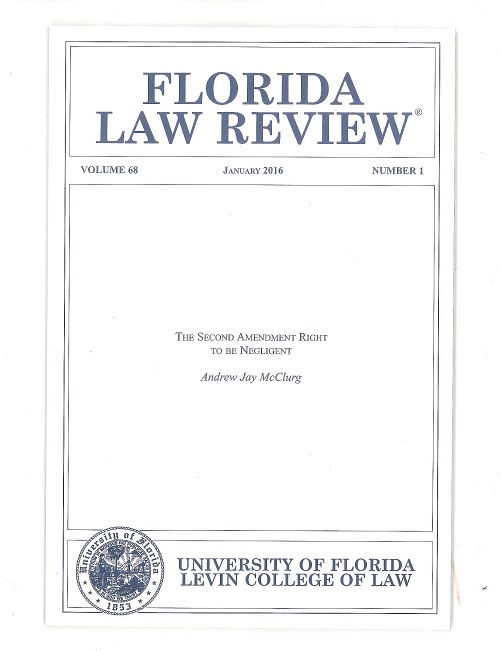
Florida Law Review Right to be NegligentAndrew Jay McClurg, The Second Amendment Right to be Negligent, 68 Florida Law Review 1 (2016).

Only two constitutional rights — the First and Second Amendments — have the capacity, through judicial interpretation or legislative action or inaction, to confer a “right to be negligent” on private citizens; that is, a right to engage in objectively unreasonable risk-creating conduct without legal consequences. In the First Amendment context, for example, the Supreme Court, in New York Times v. Sullivan and its progeny, expressly embraced a right to be negligent in defaming public officials and public figures to protect speech. This Article asserts that through both common and statutory law the United States has enshrined a de facto Second Amendment right to be negligent in many aspects of making, distributing, and possessing firearms, the only legal product designed to inflict what the tort system is designed to prevent.

Explaining that it is a microcosm of a much larger issue, the Article focuses on one area: allowing access to guns by criminals through theft. Hundreds of thousands of guns are stolen each year from individuals and commercial sellers. By definition, they all go directly to criminals. A substantial percentage of guns used in crime were previously stolen. Nevertheless, the common law has conferred near complete immunity on gun owners and sellers who fail to secure guns from theft when they are subsequently used to cause harm. This occurs despite frequent judicial pronouncements that the risk of firearms demands the highest degree of care in their use and keeping. To accomplish this result, courts ignore or mischaracterize fundamental scope of liability principles, rarely even reaching the question of whether reasonable care was exercised.

On the statutory front, not only have Congress and most states failed to mandate firearms security measures, Congress has — in the name of the Second Amendment — given express protection of the right to be negligent, most prominently in the form of the Protection of Lawful Commerce in Arms Act. The Act immunizes manufacturers and sellers of guns from most tort claims, including claims against commercial firearms licensees for negligent security leading to theft.

The Article argues that this government-endorsed lack of responsibility results in the under-deterrence of risky conduct that, with reasonable alterations, could avoid substantial intentional and accidental injury costs.

New Guns and the Law Casebook

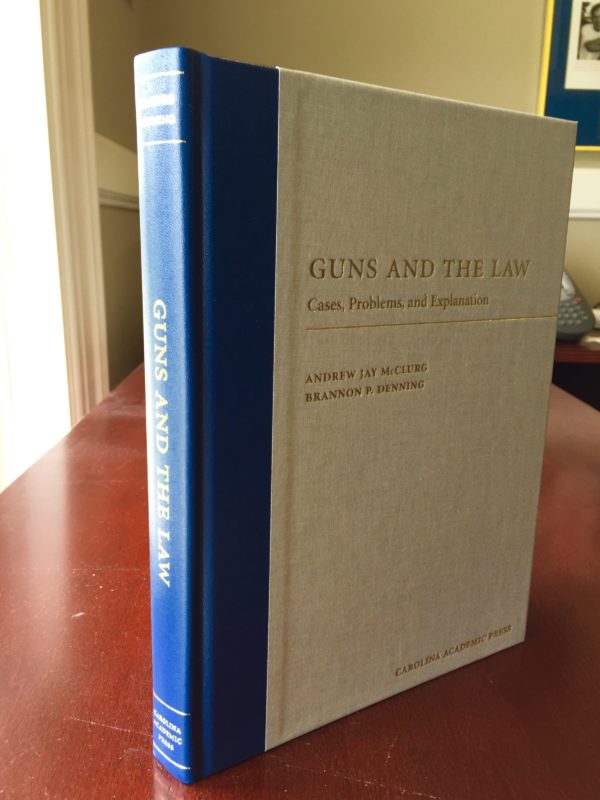
Gun Book CoverMy new casebook–Guns and the Law: Cases, Problems, and Explanation–composed with Professor Brannon Denning, just came out.  Featuring cases, problems, and explanation, it offers a balanced treatment of gun law and policy in the United States, which is hard to find in this highly charged area.

Here’s the catalog description from Carolina Academic Press:

McClurg (pro-reasonable regulation) and Denning (pro-gun-rights) apply their decades of experience studying firearms policy and gun violence in this balanced, reader-friendly casebook addressing the contentious issues of guns in America. Through cases, problems, and provocative notes and questions, the book explores current federal and state gun laws, major constitutional cases, post-Heller Second Amendment litigation, modern self-defense rules such as Stand Your Ground laws, civil liability, gun laws in other countries, legal solutions to gun violence, and issues of guns and race, alienage, culture, and gender.

We designed the book to be accessible not only to law professors and law students, but to undergraduate and other graduate school professors.  Professors interested in teaching a course in the area can obtain a complimentary copy from the publisher.

“Grit and Grind” Your Way to Law School Success

The Grindfather
The Grindfather

If you’re getting ready to start law school and are worried because you have a below-average LSAT score, you need to read my new ABA blog post.  In it, I explain data about the correlation between LSAT scores and first-year grades, which is weaker than most people realize.

While LSAT scores correlate with success for some students, they do not reliably predict success or lack of it for any individual student because the LSAT does not take into consideration many key ingredients to success, including “grit.”

Look at the Memphis Grizzlies. They’ve made the NBA playoffs for six straight years without any superstars. Their motto, coined by Grindfather Tony Allen, is “grit and grind.” Now, Professor Angela Duckworth has authored a bestselling explaining her research that shows “grit”–perseverance and single-minded determination–is at least as important as native intelligence in predicting success.

Check out over at ABAforLawStudents.com.

You Are About to Enter the Sex Worker Zone

Prostitution Sign in ZurichA Zurich friend sent along this sign in Kleinbasler in Basel, intended to alert sex workers of new “tolerance zones,” designed to impose more control over prostitution, which is legal in Switzerland.

According an article (link no longer available), “there has been a high turnover of prostitutes recently, mainly from EU countries in Eastern Europe, who are increasing competition, creating price falls and making it hard to convey the rules.”

The competition led to demands by locals for more restrictions. There are currently 800 sex workers in Basel. Police made 120 arrests last year for working outside of designated zones.

Thanks to Pat Crowell.

Don’t Store Explosives Next to Your Space Heater

Don't point space heaters at cans of gasoline five inches away.
Don’t point space heaters at cans of gasoline five inches away.

Well, it’s not quite that bad, but this warning in a package of instructions for a small space heater (maybe 10 by 12 inches)seems almost as obvious.  Not faulting the manufacturer. No doubt fires, probably a lot of them, have started because consumers unwisely placed heaters next to each of the listed flammable materials, probably including cans of gasoline.

U.S. products liability law does not require warnings against “obvious dangers.” But what’s obvious?  If people regularly suffer harm using a product in a dangerous way is it because the danger isn’t obvious or because product users frequently willfully or negligently overlook known dangers.

Manufacturers often get sued for failing to warn of obvious dangers. They don’t usually lose the lawsuits, but you can’t blame them for erring on the side of over-warning.  An unintended cost is the “dilution effect” of too many warnings. When instruction booklets are dominated by warnings, which they are, many of them repeated, it’s less likely consumers will read the warnings at all, or pay attention to the ones they really need to know.

But in this case, I’d agree the danger is both obvious and should be warned about because of the foreseeable grave risk.

Smoke Detector Warning Under Fire

Smoke Detector Fire AdviceNot surprisingly, the product warnings accompanying smoke detectors are extensive.  Smoke detector manufacturers have been held liable in lawsuits when the detector failed to work properly and harm resulted to residents.

I bought a replacement smoke detector last week at Home Depot and, as always, enjoyed reading the product warnings and instructions.

They provided a lot of good advice, but surely the first item of “WHAT TO DO WHEN THE ALARM SOUNDS” could have been worded better:

Alert small children in the home.

Maybe I’m quibbling, but I have three issues with this instruction.

First, the word “Alert” seems too unemphatic.  “Hey kids, the house is on fire.  Just wanted to let you know.”

Second, why alert only small children?  Don’t all children deserve to be alerted that the house may be on fire?

Third, why limit the alerting to children at all?  I picture the homeowner whispering: “Kids, the house is on fire.  Shhh.  Don’t wake Grandma.”

I suggest the following substitute:

WHAT TO DO WHEN THE ALARM SOUNDS  

• Scream “Everyone run for your lives!”

Just kidding.  Here’s my free, serious expert products liability/linguistics legal suggestion:

Immediately inform all persons in the house.