Practical Global Tort Litigation

Practical Global Tort Litigation

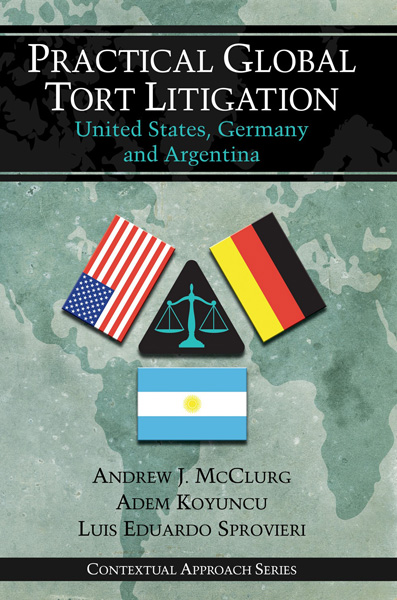
Practical Global Tort Litigation: United States, Germany and Argentina (Carolina Academic Press 2007) (with Adem Koyuncu and Luis Sprovieri)

Amazon.com listing

Publisher’s listing

Practical Global Tort Litigation is the first entry in The Contextual Approach Series to comparative law, which McClurg conceived while a professor at Florida International University College of Law. The series, for which McClurg serves as editor, is intended to show how the law “really works” in different nations by following hypothetical cases in different subject areas from beginning to completion. The books are designed to “show” instead of just “tell.”

Practical Global Tort Litigation takes readers on a journey through a products liability case in the United States, Germany, and Argentina. Using a shattering glass food container as the vehicle, the book compares how a prototypical products liability case would be handled in the U.S. common law system and representative civil law nations in Europe and Latin America. The book analyzes from a real world perspective issues such as fact gathering and presentation, expert witnesses, burdens of proof, theories of recovery and defenses, and damages and attorneys’ fees.

Review Excerpts:

“McClurg, Koyuncu, and Sprovieri have produced the blueprint for academics interested in examining comparative approaches to the law.” — Ediberto Román, Professor of Law, Florida International University

“It is impossible to conceive of a more creative, effective, or engaging way to get one’s arms around the fascinating if unwieldy issues of comparative law than to examine through separate lenses how a particular lawsuit would be handled under such disparate legal systems, reflecting such differing cultural traditions.” — David G. Owen, Carolina Distinguished Professor of Law, University of South Carolina

“The unique focus on a single case permits three different legal systems to be compared effectively and efficiently. The brisk and accessible style makes it perfect for classroom use, although lawyers outside of the academy will find it worth reading for the sheer intrinsic pleasure of learning about how familiar concepts are handled elsewhere.” — Anthony J. Sebok, Centennial Professor of Law, Brooklyn Law School

Federal Appellate Judge Makes Soap Opera of Ordinance Dispute

strange judicial opinion detergent brands
A washing machine laughing hysterically at Judge Brown's opinion.

In 1973, the Fifth Circuit struck down a Dade County detergent labeling ordinance, finding that the ordinance, intended to reduce pollution from ingredients found in household detergents, was preempted by the Federal Hazardous Substance Labeling Act.

Chief Judge John Brown concurred, managing to work in the brand names of just about every detergent product available, becoming a humorous opinion-writing path-breaker.

Let us know if we’re wrong, but Judge Brown’s opinion–published in 1973–may be the first overtly intentional effort by a federal court of appeals judge to write a clever and funny opinion.  It’s a lot easier for a state judge to get away with being amusing than a federal judge, certainly a court of appeals judge.

So, while the opinion isn’t particularly hilarious, Judge Brown’s boldness and innovation gets this case into the Strange Judicial Opinions Hall of Fame.

Here’s a taste of his detergent-filled ruling (italics inserted):

As Proctor of this dispute … the Court holds that Congress has specifically preempted regulatory action by Dade County. Clearly, the decision represents a Gamble since we risk a Cascade of criticism from an increasing Tide of ecology-minded citizens. Yet, a contrary decision would most likely have precipitated a Niagara of complaints from an industry which justifiably seeks uniformity in the laws with which it must comply. Inspired by the legendary valor of Ajax, who withstood Hector’s lance, we have Boldly chosen the course of uniformity in reversing the lower Court’s decision upholding Dade County’s local labeling laws. And, having done so, we are Cheered by the thought that striking down the regulation by the local jurisdiction does not create a void which is detrimental to consumers ….

And so we hold. This is all that need be said. It is as plain as Mr. Clean the proper Action is that the Dade County Ordinance must be superseded, as All comes out in the wash.

Chem. Specialties Mfrs. Ass’n v. Clark, 482 F.2d 325, 328–29 (5th Cir. 1973) (Brown, C.J., concurring). Thanks to Craig A. Wilson.

Amicus Humoriae

Amicus Humoriae
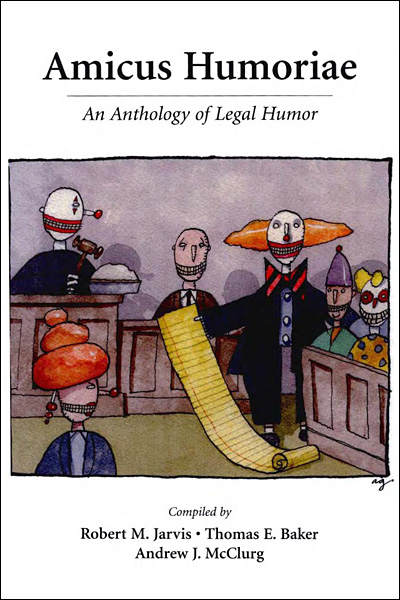
Amicus Humoriae (Carolina Academic Press 2003)

Amazon.com listing

The co-editors–law professors Robert M. Jarvis, Thomas E. Baker, and Andrew J. McClurg– collect twenty-five of the funniest law review articles from the past fifty years, arranged in five categories: law students, law professors, lawyers, judges, and legal scholarship. Who says law journal articles have to be stuffy and boring? An “intelligent gift” for lawyers, filled with outstanding writing and sophsticated wit.

Review Excepts

“A collect[ion] of rare gems.” — The Green Bag

“A very funny romp through legal life.” — The National Law Journal

“Definitely a good read.” — The National Jurist

“[S]plendid examples of the seriously underdeveloped genre of law review humor writing.” — Legal Times

Better Contempt of Court than Scratching Where You Itch

Most “funny” judicial opinions aren’t ha-ha funny. They’re merely amusing or interesting. But Lawhaha.com’s scientific focus group tests showed that the colloquy below between the chastised lawyer and the judge makes people laugh out loud. For that, it’s in the SJO Hall of Fame.

In Ahmed v. Reiss Steamship Co., a federal judge held the plaintiff’s lawyer in contempt of court for failure to appear for trial. Judge Ann Aldrich (N.D. Ohio) was disturbed that the lawyer had “told two different federal district court judges that he was appearing before the other,” sort of the legal version of the old childhood stratagem for a night out in which each kid tells his parents he’s spending the night at the other’s house.

Things turned bizarre when the lawyer finally decided to explain his absence, in a way the court found to be “lacking taste and any respect for courtroom decorum”:

MR. JAQUES: I wasn’t here because I couldn’t be here. I was not here, Judge, because I had the screaming itches in the crotch. I was so badly in need of medical care that I had been in communication with my physician a lot. Judge, I wasn’t here because I would have been scratching my testicles constantly if I had been here. Judge–

THE COURT: Mr. Jaques–

MR. JAQUES: Judge, do you understand that?

THE COURT: You don’t have to be so graphic. You could have simply let the Court know that for medical reasons you were not going to be here and you could have–

MR. JAQUES: Judge, it was not a medical reason that I would have been able to frame earlier. That’s one thing.

THE COURT: It doesn’t seem awfully difficult to me. Is there anything else?

The lawyer submitted a letter from his doctor to bolster his claim:

It has been recommendation (sic) … that because of the nature, location and symptoms of this ailment he should avoid to be in public places and mainly court appearances all of which could jeopardize his professional appearance …

While the judge did not “question the intensity of [the lawyer’s] discomfort,” she held him in contempt for not notifying the court of the problem and for representing that he couldn’t attend trial because he was appearing before another judge.

Ahmed v. Reiss S.S. Co., 580 F. Supp. 737, 742 (N.D. Ohio 1984). Thanks to Michael Slodov.

Patent: “Semen Taste-Enhancement Dietary Supplement”

Ever think being a “taste-tester” might be a good way to pick up a few extra bucks? Better read the fine print before signing up.

U.S. Patent No. 6,485,773 is a patent for an invention for a “semen taste-enhancement dietary supplement.”

This invention allegedly results in a “significant improvement to the taste of the male ejaculate by reducing its generally salty and/or bitter taste while also adding a pleasant flavor that is considered by 98.5% of all customers as very enjoyable.”

Marketing testing started with 27 couples of various lifestyles, all of who reported “significant semen-taste improvement.”

The secret ingredients include freeze-dried pineapple juice, broccoli powder, celery powder, strawberry powder and banana powder.

They’re not called Legal Oddities for nothing.

— U.S. Patent No. 6,485,773, Nov. 26, 2002. Thanks to David Barman.

Fixing the Broken Windows of Online Privacy: A Facebook Application

Andrew Jay McClurg, Fixing the Broken Windows of Online Privacy Through Private Ordering: A Facebook Application, 1 Wake Forest Law Review Online 74 (2011).

Building on a growing body of contract-based privacy scholarship, Professor Patricia Sánchez Abril has advanced a creative, concededly ambitious proposal for people to privately order their online interpersonal privacy: a system of standardized click-wrap-type confidentiality agreements in which social network users would be required to accept a content provider’s personal privacy preferences to access their online information.

The contracts would be legally binding, enforceable through traditional means, although Abril suggests that most breaches would be minor and could be addressed by a self-policed online complaint and perhaps eBay-type rating system administered by the social network host.

This reply to Abril’s article imagines how her proposal might function, or be adapted to function, in a real-world context, using Facebook as an example. Abril’s proposal is not limited to Facebook, but it is focused on online social networks.

The omnipresent force that is Facebook comes readily to mind when reading her article. With more than 500 million members as of 2010, Facebook is the undisputed heavyweight world champion of personal information-sharing. If any single entity holds the power to change the context of online social network privacy, it’s Facebook. Thinking about how Abril’s proposal might work with Facebook highlights some obstacles to it, but also illustrates the great potential of her ideas.

In the end, using Abril’s idea, the author suggests that Facebook could significantly alter the context of online privacy even without binding contracts, through a system of simple non-binding user-privacy preference icons (linked to short descriptions) that would run with all posted content.

The Encyclopedic Footnote of Pop Culture (Kozinski)

U.S. Ninth Court of Appeals Judge Alex Kozinski is well known for sprinkling pop culture references throughout his opinions, particularly in the famous Syufy opinion, which wove in the titles of more than 200 movies. (See “Coming Soon to a Footnote Near You”)

A less noticed, but just as fun pop culture-laden opinion was his dissent to an order denying rehearing en banc in White v. Samsung Electronics America, Inc., a case where the Ninth Circuit upheld a “right of publicity” claim by former game show hostess Vanna White against Samsung for using a robot resembling her game show persona in a television commercial.

Complaining that, “[u]nder the majority’s opinion, it’s now a tort for advertisers to remind the public of a celebrity,” Kozinski excoriated the court for over-extending intellectual property rights in an opinion jammed full of pop culture references.

(That’s one thing to love about Kozinski’s writing: he can be pithy, insightful, and amusing in less than twenty words.)

Pop culture ran amuck in a single footnote (footnote 6) that includes references to (in order): grunge rocker Tad Doyle, the Hell’s Angels, Marvel Comics, Breakfast at Tiffany’s, Breakfast of Champions, The Electric Kool-Aid Acid Test, Looking for Mr. Goodbar, The Coca-Cola Kid, The Kentucky Fried Movie, Harley Davidson and the Marlboro Man, The Wonder Years, Wonder Bread, Joseph and the Amazing Technicolor Dream Coat, Janis Joplin, Paul Simon, Leonard Cohen, Bruce Springsteen, Prince, dada, Monty Python, Roy Clark, Mel Tillis, the Talking Heads, Andy Warhol, REO Speedwagon, 38 Special, Jello Biafra and the Dead Kennedys.

White v. Samsung Elec. Am., Inc., 989 F.2d 1512, 1512 n.6, 1514 (9th Cir. 1993) (Kozinski, J., dissenting from order denying rehearing en banc). Thanks to Katherine Shipman.

The Never-Ending Story of Bill Clinton’s Sex Life (Kozinski)

Where do scandals go when they die? They travel upwards, of course … to a U.S. Court of Appeals. At least if they’re scandals involving the saga of President Bill Clinton’s sexcapades.

U.S. Ninth Circuit Court of Appeals Judge Alex Kozinski faced an appeal in a defamation suit filed by former lounge-singer Gennifer Flowers against Hillary Rodham Clinton, James Carville and George Stephanopoulos. With that cast of characters (including Judge K), you know it’s going to be an interesting opinion.

This is an opinion to be admired as much for its lucidity as its colorful take on the events. Here’s a taste from the opening paragraphs (some paragraph breaks inserted):

Long after the public spotlight has moved on in search of fresh intrigue, the lawyers remain. And so we find ourselves adjudicating a decade-old dispute between Gennifer Flowers and what she affectionately refers to as the “Clinton smear machine”: James Carville, George Stephanopoulos and Hillary Clinton. Flowers charges that said machine destroyed her reputation by painting her as a fraud and a liar after she dis-closed her affair with Bill Clinton. We decide whether Flowers’s claims are timely and, if so, whether they survive a motion to dismiss.

Background and Proceedings Below

In the heat of the 1992 presidential primary campaign, the Star—that ubiquitous supermarket source for celebrity scandal—ran a story claiming that Bill Clinton had carried on an affair with an Arkansas woman named Gennifer Flowers. Clinton and Flowers both denied it at first, but a few days later Flowers (doubtless realizing that honesty is the best policy after all) sold her story to the Star.

Clinton continued vigorously denying the allegations and appeared on 60 Minutes with his wife to say they weren’t true. The following day, Flowers responded by holding a press conference where she played recordings of intimate phone calls from Clinton that she’d secretly taped. Later news reports suggested that the tapes may have been selectively edited.

According to Flowers, Hillary Clinton and her two “henchmen,” George Stephanopoulos and James Carville, conspired to protect Bill Clinton’s presidential candidacy from Flowers’s damaging revelations. Flowers claims that during the 1992 campaign and in later political memoirs and interviews, Carville and Stephanopoulos defamed her and painted her in a false light by claiming that she had lied in her story to the Star and “doctored” the tape-recorded phone calls.

Hillary Clinton, the alleged mastermind of the conspiracy, not only orchestrated the defamatory exploits, but also exposed private information about Flowers and organized break-ins of her residence. Flowers claims that, as a result of all this schemery, her reputation has wilted and her blossoming career as a Las Vegas lounge singer has been nipped in the bud.

It’s like the beginning of an intriguing political spy novel you want to keep reading. In the not-as-exciting climax, the Ninth Circuit panel felt compelled under the law to reverse the district court, which had dismissed all of Flowers’ claims.

Meanwhile, Kozinski gave us another Syufy-type mystery (see “Coming Soon to a Footnote Near You!”) by burying an amusing reference in one of the citations. I won’t spoil the mystery. See if you can find it.

Flowers v. Carville, 310 F.3d 1118, 1122 (9th Cir. 2002) (Kozinski, J.). Thanks to Elise Hendrick .

That’s Entertainment! (Gardner)

Seems as though colorful California Court of Appeals Judge Robert Gardner, a Lawhaha.com Hall-of-Famer, had to deal with more than his fair share of bawdy subjects. But to resolve them, he consistently applied his excellent writing with good old common sense, leaving memorable opinions for the rest of us to enjoy.

In People v. Sarong Gals, the owners of “Sarong Gals,” a bar featuring live nude dancers, appealed an injunction entered against them under California’s Red Light Abatement law, a 1913 statute declaring to be a public nuisance any place used for the purpose of lewdness, assignation or prostitution.

Defendant’s primary argument was that the Red Light Abatement statute can not be lawfully applied to “entertainment.”

Judge Gardner disagreed. He began his opinion with a long list of what he called “hilarious highlights” of the “entertainment” observed at Sarong Gals through police surveillance. The judge’s descriptions of these highlights are a bit too graphic for Lawhaha.com, but one of them had something to do with a customer’s sunglasses. Use your imagination or go look up the opinion for details.

With regard to defendant’s argument that the statute could not be constitutionally applied to restrict “entertainment,” Judge Gardner opined that just about any activity, including people getting devoured by lions, appeals to the “entertainment” wishes of some audience somewhere:

Lewdness is lewdness and covering it with a patina of “free expression” is a fiction which the law will not tolerate. Masturbating on stage, causing customers to openly masturbate, allowing patrons to peer into females’ innards, simulating sexual intercourse and in other ways titillating the customers sexually amounts to lewdness—even though it may be entertaining.

Presumably, the Romans of the First Century derived entertainment from witnessing Christians being devoured by lions. Given the right audience, the spectacle of a man committing an act of sodomy on another man would provide entertainment value. However, neither this spectacle nor the activities described in the instant case are invested with constitutionally protected values merely because they entertain viewers.

People v. Sarong Gals, 27 Cal. App. 3d 46, 50–51 (1972). (Thanks to Frank Zotter.)

Kozinkski in Judge Gardner’s Fan Club

Judge Robert Gardner
Lawhaha.com Hall of Fame Judge Robert Gardner

U.S. Court of Appeals Judge Alex Kozinski, a Lawhaha.com Strange Judicial Opinions Hall-of-Famer, took time to send in his praise for another judge who dared to be different: California Court of Appeals Judge Robert Gardner.

Judge K said Gardner is one of his heroes, and included his favorite Gardner quote, from People v. Benton. Although it involves profanity, as Judge Kozinski said, it’s for a good cause:

Mrs. Barnhill and her daughter, Sainna Okeson, were seated at the kitchen table in Mrs. Barnhill’s apartment on Keel Street in Anaheim on the evening of August 2, 1976. Around midnight, a … man entered. With pistol in hand, he said, “Don’t say a word, don’t say a mother-f****** word.” [Fn.1]

[Fn.1] It is a sad commentary on contemporary culture to compare “Don’t say a word, don’t say a mother-f****** word” with “Stand and deliver,” the famous salutation of Dick Turpin and other early English highwaymen. It is true that both salutations lead to robbery. However, there is a certain rich style to “Stand and deliver.” On the other hand, “Don’t say a word, don’t say a mother-f****** word” conveys only dismal vulgarity.

The speech of the contemporary criminal culture has always been a rich source of color and vitality to any language. Yet, when one compares the “bawds,” “strumpets,” “trulls,” “cut-purses,” “knaves,” and “rascals” of Fielding and Smollett to the “hookers,” “pimps,” “Narcs,” “junkies,” and “snitches” of today’s criminal argot, one wonders just which direction we are traveling civilization’s ladder. “Hooker,” at least, has traceable historical antecedents—although the descendants of General “Fighting Joe” Hooker would probably prefer that their famous ancestor be remembered for something other than his army’s camp followers—such as the slaughter at Chancellorsville.

Judge Gardner used the full term without the asterisks, making it viscerally funnier, but Lawhaha.com tries to stay family friendly.

People v. Benton, 77 Cal. App. 3d 322, 324 & n.1 (1978).