Breaking News: Marbury v. Madison Causing Consitutional Crisis

marbury unconstitutional
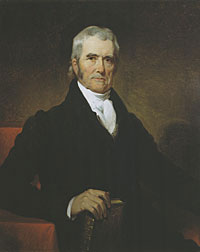
Chief Justice John Marshall, author of Marbury v. Madison.

In a 2005 opinion, an Alabama Supreme Court justice (that well-known jurisprudential heavyweight “Tom Parker”), without a trace of irony, called the U.S. Supreme Court “presumptuous” while declaring Marbury v. Madison and its progeny to be “unconstitutional.”

For non-legal types, Marbury is the landmark 1803 Supreme Court case authored by the great Chief Justice John Marshall that established the power of “judicial review”; i.e., that the Supreme Court gets the last word in disputes with the legislative and executive branches of government.

The Alabama case involved a challenge to the constitutionality of certain statutes affecting taxation and the funding of the Birmingham, Alabama civic center authority. Justice Parker included this footnote in his concurrence (italics added.):

21. . . . Despite everything in the text of the Constitution, its history, and the expressed intent of the Framers being completely contrary to the notion of judicial supremacy, the United States Supreme Court has presumptuously arrogated such a position for itself simply by declaring it so.

In Cooper v. Aaron . . . the United States Supreme Court stated: “[Marbury v. Madison, 5 U.S. (1 Cranch) 137, 2 L.Ed. 60 (1803)] declared the basic principle that the federal judiciary is supreme in the exposition of the law of the Constitution and that principle has ever since been respected by this Court and the Country as a permanent and indispensable feature of our constitutional system.” Tellingly, this proclamation of judicial supremacy was made without citation to the Constitution or any other authority. The result of this unconstitutional doctrine of judicial supremacy has been an increasing shift of the balance of powers from the elected executive and legislative branches of the federal government to the unelected judiciary, thereby emboldening federal courts to rule upon constitutional questions based upon foreign law or perceived changes in public opinion instead of the Constitution and its history. . . .

The turning away from our national compact by federal courts now threatens our country with a constitutional crisis.

There’s a constitutional crisis over Marbury?

Birmingham-Jefferson Civic Ctr. Auth. v. City of Birmingham, 912 So.2d 204, 223 n.21 (Ala. 2005) (Parker, J., concurring). Thanks to Brian Brock.

Judge Removed Over Cell-Phone Freakout

strange judicial opinions cell phone freakout
A single ringing phone sent 46 people to jail.

Calling it “an egregious and unprecedented abuse of judicial power,” the New York State Commission on Judicial Conduct ordered the removal of Niagra Falls City Court Judge Robert M. Restaino for an incident in which he freaked out when a cell phone rang in his court. He ended up ordering 46 defendants into police custody when he couldn’t find who had the ringing phone.

It all started when a cell phone went off in the back of a crowded domestic violence courtroom in which 46 defendants were about to be released on their own recognizance. In addition to the defendants, lawyers, court personnel, and others were present—about 70 people total. The judge responded to the offending ring stating:

Now, whoever owns the instrument that is ringing, bring it to me now or everybody could take a week in jail and please don’t tell me I’m the only one that heard that …

Everyone is going to jail; every single person is going to jail in this courtroom unless I get that instrument now … You are all going.

Instead of realizing his mistake and backing off, he proceeded to threaten and badger the poor defendants for two hours to find out whose phone it was. (He didn’t question the lawyers, but, of course, lawyers NEVER have ringing cell phones.)

He berated the group repeatedly about their selfishness:

As I have indicated, this troubles me more than any of you people can understand. Because what I am really, really having a hard time with, that someone in this courtroom who is so self-absorbed, so concerned only for their own well-being, they kind of figure they’re going to be able to establish the bail and it won’t matter so screw all of the rest of you people.

The disciplinary court saw the irony in this diatribe:

It is also ironic that in repeatedly berating the “selfish” and “self-absorbed” individual who “put their interests above everybody else’s” and “[doesn’t] care what happens to anybody,” respondent failed to recognize that he was describing himself.

I feel kind of sorry for Judge Restaino. Apparently, this was the only blemish on his record. Commissioner Raoul Felder dissented as to the sanction of removal because the incident was a “total aberration from his character and demeanor as a judge for eleven years.”  Personally, I feel everyone should be entitled to at least one free unwarranted outburst in public life, sort of like the “one free bite” rule pertaining to dogbites.  Maybe we could call it the “one free oopsy sound-bite” rule.

Restaino’s initial reaction no doubt would have been forgiven. What did him in was his decision to persist for two grinding, painful hours despite repeated pleas to reconsider.

Matter of Restaino, Determination of the New York State Commission on Judicial Conduct, Nov. 29, 2007. Thanks to Daniel Green.

Divinity Student Has Bone to Pick with A Yale Dog

strange judicial opinions dog puns
It's a dog-eat-divinity student world.

A dog-bite case against the dean of the Yale Divinity School by a divinity student gave U.S. District Judge Gerard Goettel a chance to “let the dogs out” in an opinion leaving no possible wordplay on dogs unpenned or unpunned.

The main issue was whether the Yale Divinity School could be held strictly liable under the Connecticut dog-bite statute as a “keeper” of the dean’s offending canine, Rocky, a Labrador, because the dog was permitted to roam free in common areas of the divinity school residences and chapel.

The court held the dean strictly liable, but let the school off because it didn’t “control” the dog’s activities.

Here’s a compendium of Judge Goettel’s fun canine puns:

“In this dog eat dog world, anything is fair game for litigation in the federal courts.”

“As compensation for her injuries, plaintiff seeks to take a bite out of the defendants’ pocketbooks.”

“[The plaintiff], now an Episcopal priest with her own ministry, obviously has a bone to pick as her injuries required substantial medical care, and Rocky is clearly in the doghouse.”

“In dogged pursuit of damages for her trauma, she filed this suit ….”

“Hounded by Connecticut’s [dog-bite statute] ….”

“The [individual defendants] do not deny that they were keeping Rocky who apparently was not licensed to anyone but had a nose for trouble.”

 “Plaintiff’s analysis is essentially the tail wagging the dog.”

“Rocky’s having access to common areas, without more evidence indicating an intent to give refuge to the dog or to control the dog’s activities on the part of the School is not a sufficient basis to collar the Divinity School.”

As for Rocky, we don’t know his fate, but the judge did offer a weak defense for the nice face-biting doggie in a footnote:

1. There is no indication that Rocky, like the dog in Oliver Goldsmith’s Elegy on the Death of a Mad Dog, “to gain some private ends, went mad and bit the [wo]man.”

Post v. Annand, 798 F. Supp. 189, 190–91 & n.1, 192 (S.D.N.Y. 1992). Thanks to Lillian Gustilo.

Judge is New York Pizza Snob

new york pizzaGeoff Petis sent along this interesting case. I’ll let him tell you about it:

New York Judge Philip S. Straniere penned an opinion about “shrinkwrap” agreements—contracts that may or may not become valid upon the opening of the package. The agreements go by different names (shrinkwrap, clickwrap, etc.), but the rose still smells as sweet. Evidently, Judge Straniere—who apparently takes his pizza as seriously as his contracts — did not agree:

Before deciding the merits of this case the court must address a troubling issue. The computer industry and other courts have adopted the term “pizza box” to describe the package in which the document containing the terms and conditions of the agreement is shipped. As a matter of law in the State of New York, such a container is not a “pizza box.” No self-respecting New York pizza would be caught soggy in such a box. The container may pass as a “pizza box” in those parts of the world that think food from Domino’s, Little Caesars, Pizza Hut, and Papa John’s is pizza. In this court’s opinion such a classification cannot be recognized east of the Hudson River.

Judge Straniere, having fun with this case, goes on to quote Ira Gershwin, Mandy Patinkin, and Marie Antoinette, among others.

Licitra v. Gateway, Inc., 734 N.Y.S.2d 389, 391 (N.Y. Civ. Ct. 2001). Thanks to Geoff Petis.

Happily, It’s Still a MAD, MAD World

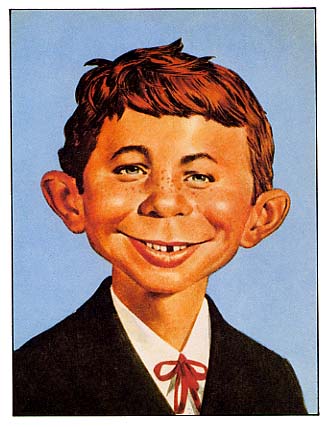
Alfred E. NeumanAs a kid, I couldn’t wait to get my hands on each new issue of MAD Magazine. Alfred E. Neuman and company had a lot to do with shaping (warping) my sense of humor. One of my favorite features, and the first thing I looked at every month, was the folding back covers, which showed one picture unfolded but ingeniously formed a different, wacky picture when folded.

I’m glad to see that MAD has not been forgotten, even in the hallowed halls of justice, as shown by Cabiness v. Town of James Island, South Carolina Supreme Court case.

The case involved a third failed attempt by the Town of James Island to incorporate itself. The complicated facts aren’t important for our purposes. Suffice it to say that one of the biggest issues was the “contiguity” of certain property.

In considering this issue, the court said the most convincing evidence were the courtroom exhibits of maps, which apparently, resembling MAD fold-in back covers, showed the all-important contiguity of certain properties at issue in the case:

Perhaps the most convincing exhibits illustrated the “but for” concept of contiguity in a “MAD Magazine” style back-page folding manner, where a map of two areas alleged to be contiguous was folded in such a manner as to eliminate the previously-annexed publicly-owned property.

Perhaps worried, as I am, that this great literary device is being forgotten, Justice Hearn, in a footnote, directed readers “not familiar with this reference” to a New York Times interractive compilation of MAD Magazine fold-in covers.

Cabiness v. Town of James Island, Opinion No. 26989, S.C. Sup. Ct, June 20, 2011. Thanks to Jim Bogle.

Defamatory in England to Call Someone Ugly

Steven Berkoff
Won a defamation judgment for being called ugly.

A 1996 English libel case reminds me of the old Rodney Dangerfield joke: “My psychiatrist told me I’m going crazy. I told him, ‘Doc, if you don’t mind I’d like a second opinion.’ He said, ‘Alright, you’re ugly too.’”

In Berkoff v. Burchill, an English court of appeals held that describing a person as ugly can constitute actionable defamation. No wonder people are flocking to England to take advantage of the country’s plaintiff-friendly libel laws. It’s highly doubtful calling someone ugly would be actionable defamation under U.S. law.

(By the way, this practice, known as “libel tourism,” resulted in enactment of a 2010 U.S. law that prohibits U.S. courts from enforcing foreign defamation judgments if they were rendered under legal protections less protective of speech than U.S. standards. Berkoff’s suit, against an English newspaper, was not a case of libel tourism.)

The English case arose from a Sunday Times article in which defendant Burchill reviewed the movie The Age of Innocence. Burchill described the film director, Steven Berkoff, as “hideous-looking.”

Nine months later, Burchill once again called Berkoff’s pulchritude into question, this time in a review of the movie Frankenstein. Describing “the Creature,” Burchill said: “It’s a very new look for the Creature—no bolts in the neck or flat-tap hairdo—and I think it works; it’s a lot like Stephen Berkoff, only marginally better-looking.”

Berkoff sued for defamation. The issue was whether calling someone hideous-looking is a defamatory statement capable of injuring a person’s reputation. The appellate court answered affirmatively.

The court said a jury could “conclude that in the context the remarks about Mr. Berkoff gave the impression that he was not merely physically unattractive but actually repulsive” and that this could injure Berkoff’s ability to make a living by “lowering his standing in the estimation of the public … [by] making him an object of ridicule.”

Is truth a defense? He looks okay in this picture (photo by Getty, borrowed from The Telegraph).

Berkoff v. Burchill, [1996] 4 All E.R. 1008 (Ct. App. 1996). Thanks to Heiner O. Mommsen.

Was Judge Too Late in Slamming Lawyers for Trial Misconduct?

U.S. District Judge Richard P. Matsch awarded attorneys’ fees and costs in a patent infringement case against a pair of high-echelon lawyers and their clients for trial misconduct “reflecting an attitude of ‘what can I get away with?’” and a “winning is all that is important approach” to litigation. A media report estimated the fees and costs could run several million dollars. Judge Matsch had previously thrown out the plaintiffs’ $51 million verdict in the case based on the same conduct.

The case raises interesting questions about the extent of a judge’s obligation to control attorney conduct it finds objectionable during the course of a trial.

The facts are complicated and readers interested in the full story should consult the judge’s order. But basically, the judge was ticked off that the plaintiffs’ lawyers pursued a trial strategy that the judge considered legally untenable, including attempting to establish a patent infringement by showing substantial similarity between the plaintiffs’ product and the defendants’ product.

Judge Matsch opined (paragraph breaks inserted):

Upon reflection, this Court finds and concludes that the rulings on the claims construction issues adjudicated the fairly debatable issues in this case and that the manner in which plaintiffs’ counsel continued the prosecution of the claims through trial was in disregard of their obligations as officers of the court.

The fairness of the adversary system of adjudication depends upon the assumption that trial lawyers will temper zealous advocacy of their client’s cause with an objective assessment of its merit and be candid in presenting it to the court and to opposing counsel.

When that assumption has been contradicted by a trial record of conduct reflecting a winning is all that is important approach to the trial process, the court has a duty to redress this resulting harm to the opposing party.

Judge Matsch essentially took the position that the plaintiffs’ claims were frivolous. However, he had previously denied the defendants’ motion for summary judgment and the jury returned a verdict in the plaintiffs’ favor. Defendants argued that these events showed the claims had merit, but the judge disagreed.

Perhaps most interesting was the defendants’ argument that if the judge found the trial conduct to be objectionable, he should have done something about it during the trial. In the judge’s words, the plaintiff’s lawyers “argue that they should not be held responsible for what they were able to get away with during the trial presentation.”

The argument does carry some persuasive force, particularly since the judge apparently denied objections by defendants’ counsel to some of the misconduct.

But Judge Matsch took the position that counsel were already aware of the court’s admonitions regarding the trial strategy, so he didn’t have any obligation to restrain it during the trial.

Medtronic Navigation, Inc. v. Brainlab Medizinische Computersystems GMBH, No. 98-cv-01072-RPM, 2008 WL 410413 (D. Colo. 2008).

Dr. Seuss Poet Laureate to Federal Judiciary?

Dr. Seuss
Dr. Seuss - Most emulated poet of the American judiciary.

For reasons unexplained, a pro se inmate litigant apparently included a hard-boiled egg as part of his request for a preliminary injunction.

U.S. Magistrate James Muirhead ordered the egg destroyed. He did it in the style of Dr. Seuss, who may be on his way to being named poet laureate for the federal judiciary (see “Dr. Seuss on Bankruptcy Law” in which a federal bankruptcy judge also engages in Seussian rhyming):

No fan I am

Of the egg at hand.

Just like no ham

On the kosher plan.

This egg will rot

I kid you not.

And stink it can

This egg at hand.

There will be no eggs at court

To prove a clog in your aort.

There will be no eggs accepted.

Objections all will be rejected.

From this day forth

This court will ban

hard-boiled eggs of any brand.

And if you should not understand

The meaning of the ban at hand

Then you should contact either Dan,

the Deputy Clerk, or my clerk Jan.

I do not like eggs in the file.

I do not like them in any style.

I will not take them fried or boiled.

I will not take them poached or broiled.

I will not take them soft or scrambled

Despite an argument well-rambled.

No fan I am

Of the egg at hand.

Destroy that egg!

Today! Today!

Today I say! Without delay!

SO ORDERED (with apologies to Dr. Seuss).

Cute, although the “court”-“aort” rhyme seems a bit of a stretch.

Wolff v. New Hampshire Dep’t of Corrections, Civil No. 06-cv-321-PB, 2007 WL 2788610 (D.N.H. Sept. 18, 2007). Thanks to everyone who sent this in.

Gun Control and Gun Rights

Gun Control and Gun RightsGun Control and Gun Rights (N.Y.U. Press 2002) (with David B. Kopel & Brannon P. Denning)

Amazon.com listing

Most firearms policy discourse falls firmly on one side of the debate or the other. Showcasing viewpoints from all sides of the gun control debate, Gun Control and Gun Rights offers the first (and still the only) balanced firearms law and policy book. Anyone looking for a fair, even-handed account of the gun issue will find it in this book.

Review Excerpts: 

“Most academic literature regarding firearms policy is one-sided advocacy scholarship. … This book seeks to create … a balance.” — Future Survey 

“For the most part, the gun-policy debate in the United States could be well summed up by Yeats’ words: The best lack all conviction, while the worst are full of passionate intensity. Truly honest scholarship … has been sorely lacking. … No one, it seems, has come forward to frame the questions that the debate ought to be seeking to answer.  Andrew McClurg, David Kopel, and Brannon Denning have done just that.” — Amazon.com Customer Review 

“[Any book by Brannon Denning,] Andrew McClurg, and David Kopel is bound to be a major—and more importantly an honest and balanced—contribution to the great American gun debate. Both Kopel and McClurg are fastidious scholars who are able to bring to this work the best of both sides.” — Barnes & Nobel.com Customer Review

The Law School Trip

The Law School Trip
The Law School Trip: The Insider’s Guide to Law School (Trafford 2001)

Amazon.com listing

The Law School Trip, a satire of legal education, gives the complete inside story on:  The LSAT® and Other Registered Trademarks, How to Survive the Socratic Method with Treatable Injuries, Learning to Love Mrs. Palsgraf, Fun, Fun, Fun and the Rule Against Perpetuities, Strange Creatures from Outer Space and Other Law Professors, Law’s Greatest Hits: Best First-Year Cases, and more.

Review excerpts:

“Laughter is what McClurg’s book provides. Lots of laughter. Heaps and mounds of undulating and ululating laughter. … McClurg makes the law school experience sparkle and shine. He has the unique ability among satirists to make us laugh with each other, but never at each other.” — The Law Teacher

“[T]he quintessential book on the three years oftorment and tribulation known as law school. … [H]owlingly, gut-wrenchingly, turn purple and blow food out your nose funny! … [S]hould be required reading for every law student and lawyer.” — The Bimonthly Review of Law Books

”McClurg has the ability to take excruciating situations,  turn them around, and make them funny. He laughs at everything, including himself, but retains a reverence for the legal profession that is poignant. It is a gut-busting good time that leaves you proud of your chosen profession and makes your sides ache at the same time.” — The Opinion

“Dispense[s] buckets of advice without ever removing tongue from cheek. … a ‘loving parody’ from the eyes of one who knows.” — The National Jurist, The Magazine for Law Students

“Professor McClurg may be the next Dave Barry. … McClurg’s unique outlook on law school life is guaranteed to make you to make you laugh out loud. Five stars and two thumbs up!” — WorldJustice.com

“[T]akes the sting right out of the high-handed pomposity, the double-talk, and officious seriousness of our legal training institutions … [A] barrel of screwy fun … [A] one of a kind piece of work that you don’t have to be a lawyer or law student to love.” — Text-Book.com

“If your smart bone is connected to your funny bone, there’s only one book for you: Andrew McClurg’s The Law School Trip. It left me holding my sides while thinking: wait! I never thought about that before! This is serious! This book gave me more pure pleasure than anything I’ve read in months.” — Professor Marianne Wesson, bestselling author of Render Up the Body and A Suggestion of Death

“A wonderful, twisted tour through legal education that had me laughing all the way. … [T]he perfect antidote for legal education … [A] must read for law students, professors and lawyers.” — Professor Gerry Hess, Gonzaga University

“Hard to find words to describe it. Spectabulous? Fanacular? McClurg brings legal humor to new heights. … Very, very funny!” — Professor Myron Moskovitz, Golden Gate University

What a ‘Trip’! Hilariously poking fun at law students, professors, judges, and the law itself, Andrew McClurg’s The Law School Trip is truly a classic of legal humor.” — Professor David G. Owen

“A delicious read from beginning to end.” — Grif Stockley, bestselling author of Probable Cause and Religious Conviction

“You’ll howl with delight … chortle uncontrollably … your funny bone will ache.” — Professor Timothy R. Zinnecker

“There is no doubt that this creative and amusing masterpiece will be a classic. You will feel the need to share excerpts with friends, then they will borrow the book and never return it!” — Amazon.com customer review (Cherish L. Cronmiller)

“There was not a single page of this book that didn’t make me laugh out loud.” — Amazon.com customer review (Jacquie Brennan)