Lawyer Flunks History in Closing Argument

strange judicial opinions history lesson
Don't know much about history.

In a convoluted libel case, the defendant, a lawyer, argued on appeal that the plaintiff’s counsel delivered a prejudicial, inflammatory closing argument.

But the bigger problem was that his historically based closing argument—which invoked Jesus Christ, Julius Caesar, the Philistines and Mennonites—was off on the facts. Here’s an excerpt:

You may remember when Christ was preaching the gospel, in the Holy Roman Empire that Julius Caesar was Emperor of Rome. As Christ was making his way toward Rome, the Mennonites and the Philistines stopped him in the road and they sought to entrap him. They asked Christ: ‘Shall we continue to pay tribute unto Caesar?’ And you will remember, in the Book of St. Matthew it is written that Christ said: ‘Render ye unto Caesar the things that are Caesar’s and unto God the things that are God’s.

Inspiring perhaps, but the lawyer made a few teensy-weensy historical errors. His timeline, for example, was a off a little. Okay, a lot. Six to eight centuries. The court pointed out the faux pas:

The Holy Roman Empire did not come into existence until about 800 years after Christ. Julius Caesar, who was never Emperor of Rome, was dead before Christ was born. Christ was never on His way to Rome and the Philistines had disappeared from Palestine before the birth of Christ. The Mennonites are a devout Protestant sect that arose in the Sixteenth Century A.D.

Some good news for the lawyer though. The judge was impressed he could cram so much misinformation into one short excerpt.  As the judge said it, the argument excerpt “is noteworthy only because of the ease with which the speaker crowded into one short paragraph such an abundance of misinformation.”

Give him credit for that. If the lawyering thing doesn’t work out, he could go to work for a cable news network.

Hall v. Brookshire, 285 S.W.2d 60, 66–67 (Mo. Ct. App. 1955). Thanks to Judge James Barlow.

Annoyed Federal Judge Remains Model of Judicial Temperament

A federal judge in Oklahoma, annoyed by delays in carrying out his order to commit a defendant to a medical facility, managed to maintain a perfect judicial temperament and sense of humor on hearing the news that the parties had worked out everything out on their own–without bothering to tell the judge. His “on the one hand, but on the other hand” order is a masterpiece of balance and even-handedness.

“On the one hand,” the court was grateful that the government and the defendant were able to cooperate in setting a date for the defendant to report.

“On the other hand,” the court said, “the court might be somewhat justified in experiencing annoyance at being left out of the loop in making a decision that is vested in its sound discretion. ‘Oh right, somebody better remember to tell the judge…’”

“On the one hand,” the court wanted to give due consideration to the fact that the defendant was 80 years old and was receiving treatment for a heart condition by a neurosurgeon.

“On the other hand,” the court asked, “how long may a defendant avoid imposition of justifiable court orders merely because of his age and medical condition? Where does it end? Anarchy? Dogs and cats living together?”

In the end, the court threw in the towel and agreed to let the defendant report on the date agreed to by the government. Or as the court put it: “[T]he court will be content to let imposition of its orders be held hostage by the vagaries of the schedule of some neurosurgeon in Oklahoma City.”

— Order, United States v. Stipe, Case No. 07-TP-001-RAW (E.D. Okla., May 5, 2008). Thanks to Debra Schwartz.

Texas Federal Judge Orders Lawyers to “Get a Life”

Strange Judicial Opinions Judge Sam Sparks
U.S. District Judge Sam Sparks does not enjoy lawyers he perceives as having kindergarten skill-sets.

In 2011, U.S. District Judge Sam Sparks, Western District of Texas, got in trouble with his bosses at the Fifth Circuit Court of Appeals for ordering the lawyers in a case to attend a kindergarten party.  It wasn’t the first time Judge Sparks used kindergarten references to berate lawyers.

In a 2004 case called Klein-Becker, LLC v. Stanley, Judge Sparks expressed his “disgust” with squabbling among the lawyers in a barrage that began with his expressing doubt as to whether the lawyers had ever attended kindergarten and ended by telling him them to “get a life” (some paragraph breaks inserted):

When the undersigned accepted the appointment from the President of the United States of the position now held, he was read to face the daily practice of law in federal courts with presumably competent lawyers. No one warned the undersigned that in many instances his responsibility would be the same as a person who supervised kindergarten.

Frankly, the undersigned would guess the lawyers in this case did not attend kindergarten as they never learned how to get along well with others. Notwithstanding the history of filings and antagonistic motions full of personal insults and requiring multiple discovery hearings, earning the disgust of the this Court, the lawyers continue ad infinitum.

[Court recounts current dispute in which, despite the court’s order allowing a pleading to be filed on July 23, 2004, defendants’ counsel filed a motion for reconsideration, claiming the pleading should have been filed July 19.]

The Court simply wants to scream to these lawyers, “Get a life” or “Do you have any other cases?” or “When is the last time you registered for anger management classes?”

Neither the world’s problems nor this case will be determined by a … [pleading] which is four days later, even with the approval of the presiding judge.

If the lawyers in this case do not change, immediately, their manner of practice and start conducting themselves as competent to practice in the federal court, the Court will contemplate and may enter an order requiring the parties to obtain new counsel.

Judge Sparks wrapped up by saying that if it wasn’t already clear from the tone of the order, the motion for reconsideration was denied. Hmm, I think he was pretty clear.

Klein-Becker, LLC v. Stanley, Case No. A-03-CA-871-SS, 2004 U.S. Dist. LEXIS 19107, at *4–6 (W.D. Tex. July 21, 2004). Thanks to Michael Barclay.

Sex and the Reasonable Person

lawsuit over fractured penis
Family friendly depiction of the injury.

Doe v. Moe, a May 2005 Massachusetts appellate case, gives a whole new meaning to the idea of safe sex. A guy sued his long-time girlfriend (ex-girlfriend?) for negligence when an ill-advised change in position during consensual intercourse resulted in him suffering a fractured penis. (The opinion gives details about how the accident occurred.)

In a case of first impression, the court struggled to arrive at an appropriate and workable standard of care to apply to private consensual sexual conduct. The court noted:

There are no comprehensive legal rules to regulate consensual sexual behavior, and there are not commonly accepted customs or values that determine parameters for the intensely private and widely diverse forms of such behavior.

Accordingly, the court concluded that the general negligence standard of reasonable care under the circumstances was inappropriate for consensual sex-physical injury cases.

Instead, the court said the plaintiff needed to show conduct rising to the level of “wanton or reckless.” The court opined that while the trial record might support a finding that the defendant’s conduct exposed plaintiff to a risk of harm, it did not support a finding of wanton or reckless conduct.

The case does raise an interesting legal issue. With so many different preferences and positions and idiosyncratic fantasies and fetishes, is there such a thing as a standard of “ordinary and reasonable care” for sex?

Doe v. Moe, 827 N.E.2d 240, 245 (Mass. Ct. App. 2005). Thanks to David Keller and Professor Howard Wasserman.

Dr. Seuss on Bankruptcy Law

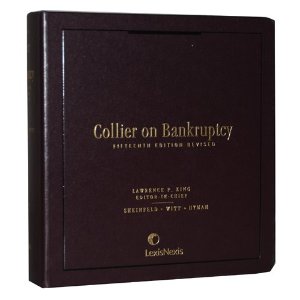
Collier on Bankruptcy
No, not this bankruptcy expert. The other one.

Bankruptcy Judge A. Jay Cristol (S.D. Fla.) was vexed by a bankruptcy statute saying that if an individual debtor in a voluntary chapter 7 or 13 case fails to file certain information within 45 days of filing his petition, the case shall be “automatically dismissed” on the 46th day.

Judge Cristol struggled with the statutory riddle of how a case could be automatically dismissed without court action or even a docket entry.

He decided to analyze the question in the style of one of the foremost experts in bankruptcy. Nope, not Collier.

I do not like dismissal automatic,

It seems to me to be traumatic

I do not like it in this case,

I do not like it any place.

As a judge I am most keen

To understand, What does it mean?

How can any person know

what the docket does not show?

What is the clue on the 46th day?

Is the case still here, or gone away?

It goes on for several more verses. Rumor has it the Cat in the Hat appeared pro hac vice on behalf of the debtor.

In re Riddle, 344 B.R. 702, 703 (Bankr. S.D. Fla. 2006). Thanks to Kevin McDowell.

Gee, I Wonder How this Case Will End

As Paul Scott wrote when he sent in a federal district court opinion involving an excessive force claim against a Georgia police officer, it’s not too hard to figure out which side’s going to win the case when the court’s decision starts out by measuring the plaintiff’s sprained-wrist claim against “the rights of those thousands of American soldiers” who fought and died on D-Day in World War II:

This case demonstrates the proclivity of American citizens today to search for legal causes of action to redress every imaginable wrong. As we commemorate the 60th anniversary of the Allied’s invasion of Normandy during World War II, the Court must decide in this case whether the rights those thousands of American soldiers fought and died for on the beaches of France include legal recourse for a sprained wrist suffered by someone who was arrested for, and subsequently convicted of, the obstruction of a law enforcement officer.

Surprise! The plaintiff lost (the court granted defendant’s motion for summary judgment).

— Mladek v. Day, 320 F. Supp. 2d 1373, 1374 (M.D. Ga. 2004). Thanks to Paul Scott.

Judge Enters “Order Denying Motion for Incomprehensibility”

Several grounds exist for a judge denying a lawyer’s motion.  Now we have a new one: incomprehensibility.

Displeased with a lawyer’s inartful motion-drafting, U.S. Bankruptcy Judge Leif M. Clark (W.D. Tex.) entered an order captioned “Order Denying Motion for Incomprehensibility.” The judge couldn’t figure out what the heck the defendant was requesting in a motion titled, “Defendant’s Motion to Discharge Response to Plaintiff’s Response to Defendant’s Response Opposing Objection to Discharge.”

Judge Clark said: “The court cannot determine the substance, in any, of the Defendant’s legal argument, nor can the court even ascertain the relief that the Defendant is requesting. The Defendant’s motion is accordingly denied for being incomprehensible.”

Perhaps worried that the defendant might miss his point, Judge Clark appended a footnote in which he invoked the following quotation from the Adam Sandler movie, Billy Madison:

Mr. Madison [Sandler’s character], what you’ve just said is one of the most insanely idiotic things I’ve ever heard. At no point in your rambling, incoherent response was there anything that could even be considered a rational thought. Everyone in this room is now dumber for having listened to it. I award you no point, and may God have mercy on your soul.

Order Denying Motion for Incomprehensibility, In re King, Case No. 05-56485-C, Feb. 21, 2006. Thanks to Sharee Moser.

Let’s Do Lunch—The Court So Orders

judge orders lawyers to do lunchIn an Arizona case, the plaintiff’s lawyer asked the defendant’s lawyer to go to lunch to discuss some pending issues. Defense counsel refused, so the plaintiff did what anyone would do when they get rejected for a lunch date: file a “Motion to Compel Acceptance of Lunch Invitation.”

Here’s what Judge Pendelton Gaines, Superior Court of Maricopa County, Arizona, had to say in granting the unusual motion:

Conversation has been called “the socializing instrument par excellence” (Jose Ortega y Gasset, Invertebrate Spain) and “one of the greatest pleasures in life” (Somerset Maugham, The Moon and Sixpence). John Dryden referred to “Sweet discourse, the banquet of the mind” (The Flower and the Leaf).

Plaintiff’s counsel extended a lunch invitation to Defendant’s counsel “to have a discussion regarding discovery and other matters.” Plaintiff’s counsel offered to “pay for lunch.” Defendant’s counsel failed to respond until the motion was filed.

Defendant’s counsel distrusts Plaintiff’s counsel’s motives and fears that Plaintiff’s counsel’s purpose is to persuade Defendant’s counsel of the lack of merit in the defense case. The Court has no doubt of Defendant’s counsel’s ability to withstand Plaintiff’s counsel’s blandishments and to respond sally for sally and barb for barb. Defendant’s counsel now makes what may be an illusory acceptance of Plaintiff’s counsel’s invitation by saying, “We would love to have lunch at Ruth’s Chris with/on . . .” Plaintiff’s counsel.[fn1]

[fn1] Everyone knows that Ruth’s Chris, while open for dinner, is not open for lunch. This is a matter of which the Court may take judicial notice.

Plaintiff’s counsel replies somewhat petulantly, criticizing Defendant’s counsel’s acceptance of the lunch invitation on the grounds that Defendant’s counsel is “now attempting to choose the location” and saying that he “will oblige,” but Defendant’s counsel “will pay for its own meal.”

There are a number of fine restaurants within easy driving distance of both counsel’s offices, e.g., [court lists fine restaurants in the Phoenix area]. Counsel may select their own venue or, if unable to agree, shall select from this list in order.

Each side may be represented by no more than two (2) lawyers of its own choosing, but the principal counsel on the pending motions must personally appear.

The cost of the lunch will be paid as follows: Total cost will be calculated by the amount of the bill including appetizers, salads, entrees and one non-alcoholic beverage per participant.[fn3]

[fn3] Alcoholic beverages may be consumed, but at the personal expense of the consumer.

[McClurg note: Alcohol and feuding lawyers? Bad idea, judge.]

A twenty percent (20%) tip will be added to the bill (which will include tax). Each side will pay its pro rata share according to number of participants. The Court may reapportion the cost on application for good cause or may treat it as a taxable cost under ARS § 12-331(5).

During lunch, counsel will confer regarding [various matters in the case]. [fn4]

[fn4] The Court suggests that serious discussion occur after counsel have eaten. The temperaments of the Court’s children always improved after a meal.

Then the judge gave the parties something to chew on by proceeding in the same order to strike the plaintiff’s proposed amended complaint.

— Rulings on Pending Motions, Physicians Choice of Arizona, Inc. v. Miller, Case No. CV2003-020242 (Ariz. Super. Ct. July 21, 2006). Thanks to Robert Greer.

Trial Judge Woes: No Submissions, No Tears, No Wigs

You don’t have to be a famous judge or blessed with a crazy case to write a Hall of Fame Strange Judicial Opinion. Here we have a low-level New Zealand trial judge trying to educate his appellate court masters about life down in the “real world” trial court-trenches, and a good-humored, self-effacing reply from the appellate court.

In New Zealand, an appeal over a $100 fine for failure to register “a handsome German Shepherd named Ben” apparently irritated the overworked trial judge. In a memorandum, the judge sought to educate the high court about the process for administering justice in his humble court at the bottom of the judicial hierarchy:

Your honour may not be familiar with the manner in which “Minor Offences” are dealt with in this Court. Notices of Prosecution . . . are surreptitiously placed in the Judge’s “In Tray” at frequent and irritating intervals, usually in his or her absence. They come in stacks and bundles … [The trial judge proceeds to describe the variety of matters crying out for his daily attention, including applications for Massage Parlor licenses, truancy notices, underage drinking citations, etc.]

The Judge peruses the mountain of files with great care and then imposes whatever he or she deems appropriate. No hearing is held. No defendant or counsel are present. No submissions are made. No tears are shed. No howls of derision are heard from the gallery. … No anxious mother suckles a fretful child. There are no sideways glances or rolling back of eyes from counsel’s table and certainly no titters are heard to run around the Court.

The Judge sits alone in his chambers and affixes his facsimile signature to the Information Sheet perhaps muttering silent curses to himself as he does so. …

I hope this short memorandum may assist Your Honour in dealing with this appeal.

High Court Justice Grant Hammond (pretty sure this is him–please correct if wrong), chragined, contrasted the trial judge’s mundane existence with the grandeur of his much more regal appellate court, describing how on the day of the hearing over the hundred-dollar appeal, “[i]n full High Court regalia we processed bewigged and black-robed through several levels” of the court building.

It was clear Justice Hammond felt awkward  about “tinkering” with the trial judge’s work. He quoted political philosopher Jeremy Bentham’s description of court systems as “a fathomless and boundless chaos, made up of fiction, tautology, technicality and inconsistency, and the administration of it a system of exquisitely contrived chicanery which maximises delay and the denial of justice.”

In the end, Hammond’s court reduced the fine to $20 because the appellant didn’t have the money to pay the higher fine.

Lowe v. Auckland City Council (High Court, Auckland, AP44/93, 12 May 1993, Hammond, J.). Thanks to Lina Lim.

Alaska Judge a Parrot Head

strange judicial opinions volcano moves trialChanging venue because of a volcano? Sure, it sounds far-fetched, but don’t blow your stack.

It really happened in U.S. v. McDonald, a 1990 federal bribery prosecution in Alaska. Fearful that an unpredictable volcano named Mt. Redoubt would act up and disrupt the trial, Judge James M. Burns granted a motion to change venue for the trial from Fairbanks, Alaska to Tacoma, Washington.

Judge Burns noted he could find “no precedent for changing venue because of an earthquake, hurricane, tornado, flood, volcanic eruption, or other natural disaster,” but said Mt. Redoubt was “entitled to a modicum of judicial respect.”

Judge Burns might be a Jimmy Buffett fan. Usually, when you think of Buffett, you think frozen margaritas, not frozen tundra, but footnote 17 quotes the entire lyrics of the Jimmy Buffett song “Volcano,” observing that Buffett’s lyrics express feelings apropos to the circumstances of the case.

Buffett sang, “I don’t know, I don’t know where I’m a-gonna go when the volcano blow.”

Here they knew. The judge sent everyone to Tacoma.

United States v. McDonald, 740 F. Supp. 757, 764 nn.17 & 18 (D. Alaska 1990) (Burns, J.). Thanks to Tom Gaylord.