Facebook’s computer algorithms do an amazing–if scary–job of connecting the dots by ferreting out people relevant to one’s life and recommending them as friends. A Washington man and his wife, er, wives, recently learned there are no degrees of separation in a Facebook-dominated world.
The man’s current wife found out he was still married to someone else when she clicked on a Facebook friend suggestion and saw a picture of her husband at his wedding to her new potential Facebook buddy. This led to felony bigamy charges against the husband. Wild stuff.
(Justia had the story, but the link is now broken.)
Dang, should have trademarked, “Spot the Tort,” the family friendly game of risk reduction. A former student at the Florida International University College of Law sent along this amusing law firm advertisement. (Click to expand.)
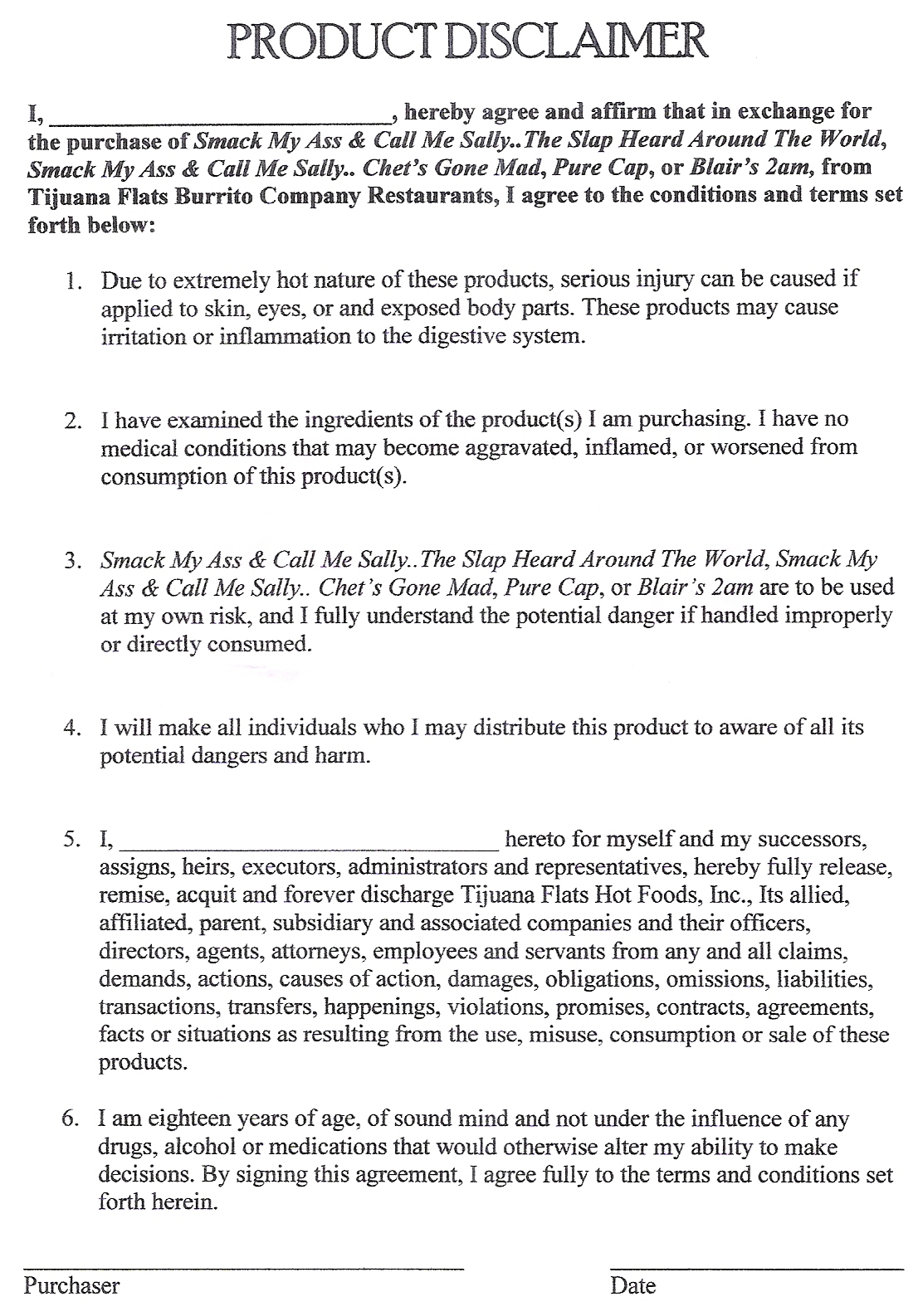
What kind of a consumer would voluntarily ingest a hot sauce so dangerous they must first sign a disclaimer/waiver acknowledging “serious injury can be caused if applied to skin, eyes or and exposed body parts,” and waiving their legal rights in the event of injury, while also certifying they are not under the influence of drugs or alcohol at the time of signing? (Click on thumbnail to expand.)
Answer: The only answers coming readily to mind are an unreasonable consumer or one with an asbestos-lined stomach. If this product–a hot sauce manufactured by a burrito company and called, among other names, Smack My Ass and Call Me Sally–is dangerous enough to require a disclaimer before consumption, should it be marketed at all?
The sauce is reportedly 700 times hotter than tobasco sauce and 300 times hotter than a jalapeno. Looking forward to trying it before my next emergency colon surgery.
But believe it or not, there are much hotter sauces available! The heat of hot sauces is measured in Scoville units. Smack My Ass and Call Me Sally rates at 1.5 million Scoville units. The hottest sauce, according to a site that tracks these things, is Blair’s 16 Million Reserve, which rates 16 million Scoville units, or 3200 times hotter than a jalapeno.
Is there any other consumable product for which buyers must sign a disclaimer/waiver?
The waiver of rights may or may not be valid depending on the accuracy of the risk information in the disclaimer. If hot sauces of this nature were determined to be “unreasonably dangerous,” the waiver would not be upheld. Every product carries a warranty of merchantability that the product is fit for the ordinary purposes for which such products are used; here, human consumption.
But since several different brands of super-hot sauces exist, maybe they really aren’t dangerous. Maybe the disclaimer is even part of a marketing plan, since boasting the hottest of hot sauces appears to be a selling point.
Thanks to French artist, Cassou, for introducing herself to Lawhaha.com and sending along a sample of one of her paintings.
She said the world of justice inspired her to “create a judicial series of humorous paintings with tender irony” that she exhibits in courthouses throughout Europe, including, recently, in Antwerp, Bruges, Ghent, Breda, Middelburg, and Maastricht. This year her work will be displayed at courthouses of The Hague and in Amsterdam.
The pictured painting is called “le juge, un singe?” (the judge, a monkey?). She explains it this way: “The ape has the reputation of being a caricature of human being, a buffoon. The painting expresses the fear of a citizen that the judge be airy, unconcerned, carefree, thoughtless. But, after all, the ape symbolises wisdom and agility as well.”
She adds that she is always looking for new hospitable courthouses and would be delighted to exhibit her work in America. So if you’re a judge or otherwise work in a courthouse that might be interested in exhibiting her art, as we say in the South, give her a holler.
Congratulations to the new parents. The Court so orders.
In a Kansas federal district court, the defendants’ lawyer asked for a trial continuance because it conflicted with the date on which his wife was having a baby.
The plaintiffs’ lawyers opposed the continuance, which “surprised” the judge. “Irritated” is probably more accurate. Judge Eric Melgren not only granted the motion for continuance, but chastised the objecting lawyers while ordering that the new parents be congratulated:
Defendants seek a brief continuance, noting that one of their counsel …, along with his wife, is expecting their first child due on July 3. Given the proposed length of trial and the famous disregard that newborns (especially first-borns) have for such schedules, and given that the trial is scheduled in Kansas City while the new [baby’s] arrival is scheduled in Dallas, Defendants move this Court for a continuance.
This in itself would not be remarkable, but in reviewing the motion the Court was more than somewhat surprised to read that “Plaintiffs have refused to agree to continue the trial setting and have indicated that they intend to oppose this Motion.”
Well, every party is entitled to file an opposition to a motion, and hoping that perhaps Defendants’ had mis-characterized the vigor of Plaintiffs’ opposition, we have eagerly awaited Plaintiffs’ defense of its opposition. The Memorandum in Opposition arrived yesterday, and it was, sadly, as advertised.
First, Plaintiffs make a lengthy and spirited argument about when Defendants should have known this would happen, even citing a pretrial conference occurring in early November as a time when [Plantiffs’ lawyer] “most certainly” would have known of the due date of his child, and even more astonishingly arguing that “utilizing simple math, the due date for [the] child’s birth would have been known on approximately Oct. 3, or shortly thereafter.”
For reasons of good taste which should be (though, apparently, are not) too obvious to explain, the Court declines to accept Plaintiffs’ invitation to speculate on the time of conception of the … child.
[The plaintiffs also argued that the defendants had five lawyers, presumably implying they could continue with the trial without soon-to-be dad. The court pointedly noted that the plaintiffs also had five lawyers.]
Finally, Plaintiffs argue that surely [Plaintiffs’ lawyer] will have sufficient time to make it from the Kansas City trial to the Dallas birth, even helpfully pointing out the number of daily, non-stop flights between the two cities; and in any event complain of the inconvenience of this late requested continuance.
Certainly this judge is convinced of the importance of federal court, but he has always tried not to confuse what he does with who he is, nor to distort the priorities of his day job with his life’s role. Counsel are encouraged to order their priorities similarly.
Defendants’ Motion is GRANTED. The Ermans are CONGRATULATED.
IT IS SO ORDERED.
Did the judge come down too hard on the plaintiffs’ lawyers for objecting to the continuance? Not knowing the parties or the history of the case, it’s difficult to assess the appropriateness of the judge’s order, but trials involve substantial planning and scheduling. Changing them on short notice can not only delay justice, but be very expensive for the parties.
On the other hand, life does go on outside of cases and having a baby is a pretty big deal. His personal advice that lawyers strive to reach a proper work-life balance is unchallengeable, but easier said than done for practicing litigators.
—Order on Motion to Continue, Jayhawk Capital Management, LLC v. LSB Industries, Inc., Case No. 08-2561-EFM (U.S. Dist. Ct., E.D. Kan., Apr. 12, 2011). Thanks to a judge-friend who prefers anonymity.
A first-year University of Memphis law student sent along this picture from the parking garage where most students park. The picture came as a follow-up to our class discussion in Torts II of the use of exculpatory clauses by, among others, parking garages.
Exculpatory clauses–which invariably appear on the back of tickets customers receive when they enter a parking garage–operate to relieve negligent actors of liability. Exculpatory clauses generally will be upheld if clearly written, so long as they do not pertain to an essential public service, such as medical care or education. Courts are split on whether parking garages qualify as essential public service within this rule.
Here the student pointed to two large holes in the concrete on one of the upper-levels where someone has attached, with small fasteners, thin sheets of metal as covers (that’s light shining from the floor below). She noted that “part of the one hole is still exposed where someone’s foot could fall through,” but said it made her even more nervous to think that large cars were depending on the thin sheets for support.
–Law School Story from Tony Arseneault, Université Laval’s Faculty of Law (Quebec, Canada), Date of event: 2011
In 2011, I was at my first session at Université Laval’s Faculty of Law, when I had the pleasure to meet the teacher that changed my perception of constitutional law forever: Patrick Taillon.
I come from the province of Quebec, Canada. As you may or may not know, Quebec is a civil law (French law) province when it comes to private law, and common law (English law) when it comes to public law. Essentially, all subjects like Contracts, Civil Liability or Property Law are in the realm of civil law, with everything that entails.
Since these classes are based around the mastery of the Civil Code, there is really no place for the Socratic method. Classes are taught for the most part with long lectures and minimal student intervention. This way of teaching law, common in purely civilist countries, bleeds over to the teaching of common law subjects. That means there is also no Socratic method in our common law classes, like Constitutional Law.
Thus, since teachers can’t entertain themselves at our expense through Socratic dialogues, and since teaching law in the civilist manner is, frankly, pretty boring, some of them choose to go the other way around: they entertain us.
Mr. Taillon has a pretty … unique way to do that for such a learned legal scholar. He laced his classes with sexual references to drive home points in a memorable way.
Two examples:
—Trying to teach us about the separation of powers (which is much less defined in Canada than it is in the United States) and checks and balances, his explanation went like this: “Essentially, the three branches are brothers and sisters and they have an incestuous triangle going on. They screw each other all the time.”
—Teaching us about article 56.1 of the Canada Elections Act, a disposition that removes the power from the Governor General to choose the date of the elections while saying that nothing in the article removes power from the GG: “This is like a rapist yelling ‘THIS IS NOT A RAPE’ while he’s doing it.”
All the while, he kept telling us what a “crappy country” we live in, because a huge part of the Constitution is unwritten and how our constitutional system is “done very badly” and “makes no sense.”
To this day, I only have to remember the sexual innuendo of the class to access everything he taught in class, filed neatly in a mental drawer. His enthusiasm for the subject is contagious. He always gave us a ton of laughs in a subject that really isn’t straightforward. He made me decide to focus more on Constitutional Law in the future.
What is it about Texas federal district court judges named “Sam” that makes them so ornery? First, we had the notorious U.S. District Judge Samuel Kent from San Antonio (see here, here, here, and here). Now U.S. District Judge Samuel Sparks from Austin (see here and here) comes along to fill the void.
Regrettably, while most law schools do a good job screening and training students, some students manage to graduate from and pass state bar exams who lack competent skills. Not knowing the actors, we have no basis for arguing with Judge Sparks’ evaluation of the lawyer named (we left him unnamed) in the order below, but bludgeoning him so harshly in a permanent public record seems over the top (some paragraph breaks inserted):
The Court has already turned down two extremely tempting offers to transform this case from a boring old federal lawsuit into an exciting, politically-charged media circus. As any competent attorney could have predicted, the Court declines the latest invitation as well.
However, the Court is forced to conclude [name omitted], the attorney whose signature appears on this motion, is anything but competent. A competent attorney would not have filed this motion in the first place; if he did, he certainly would not have attached exhibits that are both highly prejudicial and legally irrelevant; and if he foolishly did both things, he surely would not be so unprofessional as to file such exhibits unsealed.
A competent attorney who did those things would be deliberately disrespecting this Court and knowingly shirking his professional responsibilities, offenses for which he would be lucky to retain his bar card, much less an intact bank balance.
For [name omitted]’s sake, and because the Court has no time to hold a sanctions hearing—in part because it must take time out of deciding the actual legal issues in this case to address the self-serving entreaties of attention-seekers like [name omitted]—the Court assumes [name omitted] is as incompetent as he appears. Rather than sanction him, the Court simply does what [name omitted] would have done if he was a competent professional, and seals attachment 7 to his motion.
I have no problem with judges dressing down lawyers in a very direct way when they deserve it. In fact, I wish more judges would do it. But putting such a personal attack in a written order that will last forever may not be the best way to go.
–Order, Texas Medical Providers Performing Abortion Services v. Lakey, Case No. A-11-Ca-486-S (W.D. Tex., Aug. 22, 2011). Thanks to Gaspar Forteza.
A former student sent along the complaint below, which a friend of his suggested might be “the new Palsgraf for our generation.” Hmm, this might not be a good generational sign given the allegations.
For non-legals, Palsgraf v. Long Island Railroad is a famous tort law case all law students read involving a bizarre accident at a train station, where the court ruled that a tort defendant owes a legal duty to act with reasonable care to another only if the other is a reasonably foreseeable victim of the defendant’s conduct. More Lawhaha.com posts involving Palsgraf are here, here, here, and here.
A national Greek fraternity, Alpha Tau Omega, apparently held a “house party” at their frat house at a West Virginia university. The complaint alleges that many of the participants consumed intoxicating beverages. No surprise so far. But one of the guests surprised at least one person (the plaintiff, allegedly) when he decided to light up–literally–the party by shooting bottle rockets from … er, I’d rather let the Complaint explain it:
Warning: Allegations are Disgusting
8. Defendant Hughes was highly intoxicated on this date and time, and decided in his drunken stupor that it would be a good idea to shoot bottle rockets out of his anus on the ATO deck, located on the back of the ATO house.
9. Upon information and belief, there were several other ATO fraternity members on the deck at the time of this incident, including one or more officers of the fraternity. Plaintiff and his girlfriend were also present on the ATO deck.
10. Defendant Hughes placed a bottle rocket in his anus, ignited the fuse, but instead of launching, the bottle rocket blew up in Defendant’s rectum, and this startled plaintiff and caused him to jump back, at which time he fell off of the ATO deck, and he became lodged between the deck and an air conditioner unit adjacent to the deck.
11. There was no railing on said deck at the time of the incident. Upon information and belief, the lack of a railing had existed for at least several months, if not years, before the incident. Upon further information and belief, the deck never had a railing when it was installed, or any time thereafter. The subject deck was approximately 3-4 feet high.
12. The subject deck was in the exclusive custody, maintenance and control of the ATO fraternity at all times relevant hereto.
Here’s your Palsgraf test: Was the plaintiff within the zone of foreseeable danger of the bottle rocket-defendant’s alleged conduct? Probably, although perhaps with some contributory negligence thrown in. Assuming the plaintiff was standing close by he could have been injured in any number of ways from someone setting off fireworks in such a dangerous, uncontrolled manner.
The more interesting question is the fraterity’s liability. Was it foreseeable to the fraternity that an intoxicated fraternity member would ignite fireworks in such a bizarre manner and cause a startled bystander to fall off the deck? Probably not, but it is foreseeable that during social or other gatherings on a deck with no railing (which the complaint alleges violated building codes, likely making it negligence per se) someone would fall off it. Generally speaking, the precise manner in which the harm occurred need not be foreseeable so long as the same general kind of harm was foreseeable. The injury that occurred–falling off the deck-is the risk that makes it negligent to not have a railing on a raised deck.
Just an off-the-cuff analysis of the facts as alleged. As always, it will come down to the facts as proved–or, more likely, to a settlement.
—Complaint, Helmburg v. Alpha Tau Omega Fraternity, Case No. 12-C-57, Circuit Ct., Cabell County, West Va., filed Jan. 23, 2012.