Spot the Tort: Suspect Steps Make for Treacherous Dining

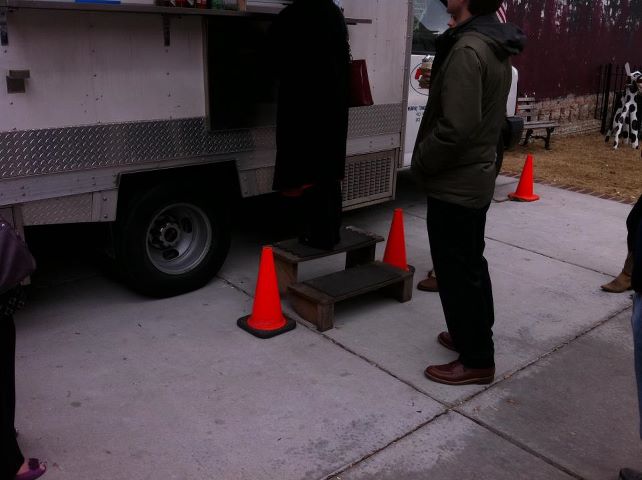
spot the tort shaky stepsA student snapped this photo of a food vending truck in Memphis, where a customer is perched precariously on some portable steps placing an order. The steps should be both longer and wider for stability and to avoid missteps and missed steps. On the other hand, give the vendor credit for the safety cones.

Handwritten Divorce Petition Shows Fine Line Between Love and Hate

A judge friend sent me this handwritten Texas divorce petition, apparently filed back in 1985 by a Texas lawyer proceeding pro se.  It’s one of those hand-scrawled pleadings that, at first blush, looks like it was written by an inmate or perhaps a crazy person; however, closer examination shows the writing to be quite clever and amusing in places.  And the drawings are priceless.

The petitioner seems uncertain of where his heart lies, as he alternates between insulting the wife and telling the court how much he loves her.

Read the original to appreciate it, but here are some re-typed uncorrected highlights (the respondent’s name and petitioner’s address are redacted on both the copy of the original pleading and below):

I.

            This suit is brought by PAUL FRANK HENSLER, Petitioner who is Forty Six (46) years of age and who resides at XXXX.

             Respondent, XXXX, is a “Transient Person,” having her residence in a 1970 Chrysler. …

IV.

             These parties were joined together in Holy Matrimony by the Very Honorable Frances Porter, JUSTICE OF THE PEACE in Lampasus, Lampasas County, Texas on the 29th Day of March, in the year of our Lord, A.D. 1983.  They ceased living together as husband and wife on Monday January 21, 1984, when she got pissed off and hauled ass with the car, the Mastercard, $365.00 cash, her FEDERAL CIVIL RIGHTS NINE YEAR OLD EMPLOYMENT DISCRIMINATION CASE …, to which she is WELCOME, having BORED ME STIFF for 2 years about just how everybody picks on XXXX.

IV.

            This marriage has become very insupportable because of, ho-hum, conflict of personalities  between Petitioner and Respondent, but chiefly because of conflict of personalities between Respondent and Respondent that destroyed the legitimate ends of the marriage (good sex!) and prevents any reasonable expectation of reconciliation (unless she consents to having her mouth surgically closed).

 V.

             There is no child born or adopted of this marriage although Petitioner swears on oath that he did everything he could to KNOCK HER UP, but she isn’t pregnant and won’t have another CHILD, although Petitioner LOVES HER DEARLY and wants her to have his children, but she is LIBERATED now and “Feminists” don’t have children by “male chauvinist pig lawyers,” she so swears.

VI.

             Petitioner requests the Court to divide the estate of the parties by awarding their property to the party having POSSESION (in a legal sense, not the kind of “possession” by spirits you see in movies, although XXXX could pass muster for a stand-in for “Syble” or the girl in “The Exorcist.”)

VII.

             Petitioner, Paul Frank Hensler prays that CITATION and NOTICE issue as required by LAW and that the Court GRANT A DIVORCE and decree such other and further relief as requested herein, including changing Respondent’s name to BELLA ABZUG, JR. for costs of suit and for (see drawings of trumpet and drum roll).

             Stand back, its almost here – Ed McMahon on stage now — HEEEER’ES General Relief (see drawing of Rolaids man).

–Petition for Divorce, Hensler v. [Name redacted], Case No. 85-04521, Dist. Ct., Harris Cty, TX, Jan. 23, 1985.

Warning: Do Not Use iTunes to Run Nuclear Facility

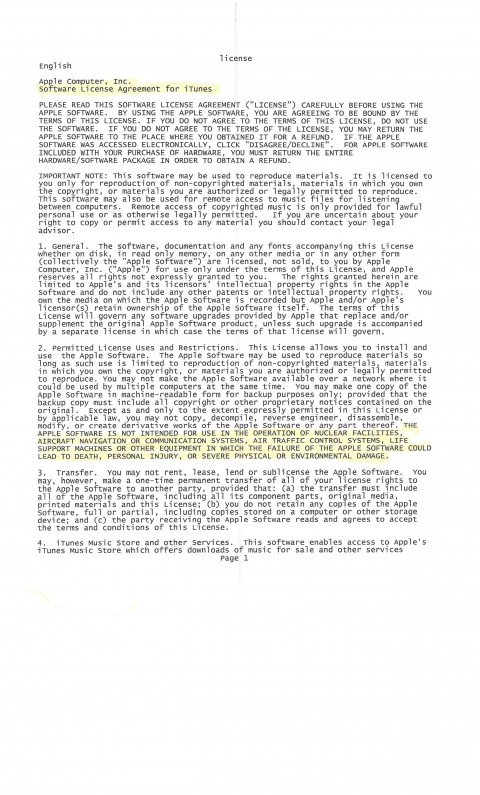
Apple iTunes software warningiTunes software is good stuff for downloading the latest crappola that the recording industry is outputting (editorial comment courtesy of a music lover still stuck in the 60s and 70s), but just remember that iTunes software is:

[N]ot intended for use in the operation of nuclear facilities, aircraft navigation or communication systems, air traffic control systems, life support machines or other equipment in which the failure of the Apple software system could lead to death, personal injury, or severe physical or environmental damage.

Warning: Don’t Put Anything in the Toilet You Haven’t Eaten

Toilet WarningHere’s an interesting warning, from a former student at Florida International University College of Law.

The warning is on the outside of a toilet compartment on a recreational boat.  I think I know what it means, but surely they could have worded it better.

Tomatos are Vegetables as a Matter of Law, So Says the U.S. Supreme Court

Tomato
It's official. Tomatos are vegetables according to the Supreme Court.

The next time someone raises the age-old debate as to whether a tomato is a fruit or a vegetable, show off your legal acuity (or nerdiness) by informing them you have it on good authority that tomatos are vegetables. No, in fact, make that great authority. Who? The U.S. Supreme Court.

More than 100 years ago, in Nix v. Hedden, Justice Horace Gray, speaking on behalf of a unanimous Supreme Court, ruled that a tomato is a vegetable as a matter of law.

The Tariff Act of 1883 declared a 10 percent duty on all vegetables entering the country, but allowed fruit to enter duty-free. The New York Customs Collector saw an opportunity to increase revenue and declared the tomato to be a vegetable.

Angry importers sued and their case reached the Supreme Court, where Justice Gray said: “[A]lthough botanists consider the tomato a fruit, tomatoes are eaten as a principal part of a meal, like squash or peas, (and all grow on vines), so it is the court’s decision that the tomato is a vegetable.”

Nix v. Hedden, 149 U.S. 304 (1893). Thanks to Lihwei Lin.

Judge has Ex Parte Conversation with a Talking Cat

Blackie the talking cat
“Excuse me, I’d like to have a few words with you about the litter box issue.”

Miles v. City Council of Augusta, GA—starring “Blackie the Talking Cat”—is our kind of case: completely WEIRD, so weird that it qualifies for Lawhaha.com’s Strange Judicial Opinions Hall of Fame.

The plaintiffs, Carl and Elaine Mills, were an unemployed, married couple who owned Blackie, a cat who could allegedly speak English. The plaintiffs were entrepreneurs in the true American mold, making their entire living marketing Blackie’s unique vocal abilities to the public. Although the closest Blackie ever came to making the big time was a $500 appearance on “That’s Incredible” in 1980, he generated steady income for Carl and Elaine by talking to strangers on the street in return for contributions.

After receiving complaints, the Augusta Police Department warned Carl and Elaine that they needed to obtain a business license to continue peddling Blackie’s talents on the streets of Augusta. Plaintiffs sued the city, alleging the occupational license tax was unconstitutional.

The whole opinion is interesting, but the craziest part was the trial judge’s disclosure in a footnote of an ex parte street encounter with Blackie (some paragraph breaks inserted):

In ruling on the motions for summary judgment, the Court has considered only the evidence in the file. However, it should be disclosed that I have seen and heard a demonstration of Blackie’s abilities.

The point in time of the Court’s view was late summer, 1982, well after the events contended in this lawsuit. One afternoon when crossing Greene Street in an automobile, I spotted in the median a man accompanied by a cat and a woman. The black cat was draped over his shoulder. Knowing the matter to be in litigation, and suspecting the cat was Blackie, I thought twice before stopping. Observing, however, that counsel for neither side was present and that any citizen on the street could have happened by chance upon this scene, I spoke, and the man with the cat eagerly responded to my greeting.

I asked him if his cat could talk. He said he could, and if I would pull over on the side street he would show me. I did, and he did. The cat was wearing a collar, two harnesses and a leash. Held and stroked by the man Blackie said “I love you” and “I want my Mama.”

The man then explained that the cat was the sole source of income for him and his wife and requested a donation which was provided. I felt that my dollar was well spent …

I never understood why a cat that could talk didn’t become more famous.

Miles v. City Council of Augusta, Ga., 551 F. Supp. 349, 350 n.1 (S.D. Ga. 1982). Thanks to Richard McKewen.

“Hello, My Name Is … Oh, Never Mind”

A pro se litigant in Arkansas appealed a trial court decision granting custody of her child to the biological father and ordering that the child’s birth name be changed. The trial court granted the custody change and ordered the child’s name be changed to “Samuel Charles.” Not a bad name, but why order a change? Personally, I liked the original name: “Weather’By Dot Com Chanel Fourcast.”

For making us laugh out loud, this order gets into the Strange Judicial Opinions Hall of Fame.

Here’s the colloquy in which the perplexed trial judge asked the mother to explain the child’s birth name:

The Court: I simply do not understand why you named this child — his legal name is Weather’By Dot Com Chanel Fourcast Sheppard. Now, before you answer that, Mr. – the plaintiff in this action is a weatherman for a local television station?

Sheppard: Yes.

The Court: Okay. Is that why you named this child the name that you gave the child?

Sheppard: It – it stems from a lot of things.

The Court: Okay. Tell me what they are.

Sheppard: Weather’by — I’ve always heard of Weatherby as a last name and never a first name, so I thought Weatherby would be — and I’m sure you could spell it b-e-e or b-e-a or b-y. Anyway, Weatherby.

The Court: Where did you get the “Dot Com”?

Sheppard: Well, when I worked at NBC, I worked on a Teleprompter computer.

The Court: All right.

Sheppard: All right, and so that’s where the Dot Com [came from]. I just thought it was kind of cute, Dot Com, and then instead of — I really didn’t have a whole lot of names because I had nothing to work with. I don’t know family names. I don’t know any names of the Speir family, and I really had nothing to work with, and I thought “Chanel”? …

The Court: Well, where did you get “Fourcast”?

Sheppard: Fourcast? Instead of F-o-r-e, like your future forecast or your weather forecast, F-o-u, as in my fourth son, my fourth child, Fourcast. It was —

The Court: So his name is Fourcast, F-o-u-r-c-a-s-t?

Sheppard: Yes.

The Court: All right. Now, do you have some objection to him being renamed Samuel Charles?

Sheppard: Yes.

The Court: Why? You think it’s better for his name to be Weather’by Dot Com Chanel —

Sheppard: Well, the —

The Court: Just a minute for the record.

Sheppard: Sorry.

The Court: Chanel Fourcast, spelled F-o-u-r-c-a-s-t? And in response to that question, I want you to think about what he’s going to be — what his life is going to be like when he enters the first grade and has to fill out all [the] paperwork where you fill out — this little kid fills out his last name and his first name and his middle name, okay? So I just want – if your answer to that is yes, you think his name is better today than it would be with Samuel Charles, as his father would like to name him and why. Go ahead.

Sheppard: Yes, I think it’s better this way.

The Court: The way he is now?

Sheppard: Yes. He doesn’t have to use “Dot Com.” I mean, as a grown man, he can use whatever he wants.

The Court: As a grown man, what is his middle name? Dot Com Chanel Fourcast?

Sheppard: He can use Chanel, he can use the letter “C.”

The Court: And when he gives his Birth Certificate — is it on his birth certificate as you’ve stated to the Court? Does his Birth — does this child’s Birth Certificate read “Weather’by Dot com” —

Sheppard: That’s how I filled out the paperwork for his —

The Court: — Chanel Fourcast?

Sheppard: Yes, and for his Social Security card, I filled it out as Weather’by F. Sheppard.

The Court: All right.

The Arkansas court of appeals upheld the trial judge’s ruling based largely on its finding that the birth name could subject the child to embarrassment.

Sheppard v. Speir, 157 S.W.3d 583, 587–88 (Ark. Ct. App. 2004). Thanks to David Eanes.

Warning: Go to Walmart for the Perfect Date

Law student and boyfriend holding hands on romantic date night reading product warning labels at Walmart.

Covering products liability in Torts and made a point of explaining what utter fun reading product warning labels can be, saying:

“In fact, if you’re looking for a really great night out, take your date to Walmart.  Hold hands and spend the evening strolling the aisles reading product warning labels.  It’s a guaranteed good time!”

One student and her boyfriend took me up on the idea.  She sent along this great PowerPoint presentation of their romantic Walmart Product Warning Label Date.

Facebook Friend Suggestion Results in Bigamy Charges

Facebook’s computer algorithms do an amazing–if scary–job of connecting the dots by ferreting out people relevant to one’s life and recommending them as friends. A Washington man and his wife, er, wives, recently learned there are no degrees of separation in a Facebook-dominated world.

The man’s current wife found out he was still married to someone else when she clicked on a Facebook friend suggestion and saw a picture of her husband at his wedding to her new potential Facebook buddy.  This led to felony bigamy charges against the husband.  Wild stuff.

(Justia had the story, but the link is now broken.)

Spot the Tort: Florida Law Firm Plays It

spot the tortDang, should have trademarked, “Spot the Tort,” the family friendly game of risk reduction.  A former student at the Florida International University College of Law sent along this amusing law firm advertisement. (Click to expand.)