2012 Spot the Tort Contest: Another Safety Cone Fix

2012 Spot the Tort Contest2012 “Spot the Tort” Contest with my 1Ls at the University of Memphis law school:

Just before school started the city public works department came to my house to replace a clay sewer pipe under the street.  I took these photos a few minutes ago.  I wonder how many more times I need to call them; I’m sure they could use the orange cone elsewhere! — Rick McCabe

2012 Spot the Tort Contest: Loose Pool Table

2012 Spot the Tort Contest2012 “Spot the Tort” Contest with my 1Ls at the University of Memphis law school:

Possible tort spotted this morning on Walnut Grove in front of Baptist East Hospital.  The picture is a bit blurry, but the pool table in the back of this tailgate-less truck was secured to the truck bed by nothing other than gravity. The truck also did not have functional brake lights, as we were all at a complete stop at the red light when I took the photo. — Melissa Harris

Gilligan’s Island Tale Helps Federal Judge Sort Out Shipwreck Dispute

judge invokes gilligans island
Betting the professor was this federal judge’s favorite Gilligan’s Island character.

In an opinion that is part period-piece shipwreck thriller and part Gilligan’s Island pop-culture fun, Chief U.S. District Judge William Steele (S.D. Ala.) attempted to unravel a dispute over the ownership rights to an unidentified shipwreck off the coast of Alabama. The wreck is believed to be either the Clipper Ship ROBERT H. DIXEY or the British barque AMSTEL.

Several parties, including the United States and Alabama, claimed title to the wreck. Unfortunately, whichever ship it was, it sank more than 150 years ago, leaving Judge Steele to observe in a footnote that historical scholars were better-suited than a federal judge to determine the ship’s identity:

FN4. This procedural posture is highly unusual. For starters, the proper identity of Shipwreck # 1 is a matter better suited for spirited scholarly discourse than black-letter judicial construction. Yet the parties have submitted their dispute to a federal judge, not a 19th century maritime historian. Furthermore, while both sides agree that 100% certainty as to the vessel’s identity is not possible, resolution of this factual issue does not turn on the sort of credibility determinations for which an evidentiary hearing would be appropriate. The underlying events having taken place a century and a half ago, there are no live witnesses to recount the circumstances under which the DIXEY and the AMSTEL sank. Nor are there dueling expert witnesses whose theories might be poked and prodded via cross-examination. Instead, as the DIXEY Claimants succinctly state, “[t]here is what there is.”

But Judge Steele did a pretty good scholarly job himself in recounting the interesting history of both ships, starting with the DIXEY, where he invoked the 1960s sitcom, Gilligan’s Island, for a unifying thread (Gilligan’s Island references have been bolded):

Just sit right back and you’ll hear a tale, a tale of a fateful trip. It did not start in a tropic port, nor aboard a tiny ship. On August 15, 1860, the Clipper Ship ROBERT H. DIXEY set sail that day from New York to Mobile, carrying a cargo described only as “miscellaneous hardware.” The DIXEY reached an anchorage in Mobile Bay on the evening of September 14, 1860. By inopportune coincidence, the DIXEY arrived at the Bay just hours ahead of a Category 1 hurricane. Wary of the approaching storm, Captain Dixey (by all accounts a skipper brave and sure) put out “double anchors and all chain” at 10 p.m., and took “all measures to ride out a storm.”

The hurricane struck at approximately 2:00 a.m. on September 15, 1860. The DIXEY actually weathered the first few hours of the storm well. With the winds out of the south, the DIXEY was sheltered by the buffering presence of Dauphin Island (to the vessel’s south) from the worst of the rough seas, at least initially. After 8:00 a.m., however, the eye of the hurricane passed, and fierce winds shifted to the north. The weather started getting rough, and the mighty ship was tossed. In its anchored position, the DIXEY was exposed to approximately 17 miles of open shallow water stretching all the way to Mobile. As a result, the DIXEY was pounded by the punishing winds and roiling seas. The first anchor’s chain broke at around 10:00 a.m. The DIXEY’s crew began working feverishly to cut away its masts and sails, thereby lightening the ship and reducing its wind exposure, even as the DIXEY took on water for over an hour. If not for the courage of the fearless crew, the DIXEY would have been lost. Alas, the gale continued to worsen and the other anchor chain snapped, causing the DIXEY to be buffeted by the hurricane, tossed around in the shallow water like a child’s toy. The wind and seas pushed the helpless DIXEY south down the shipping channel of Mobile Bay for some 12 miles. [The DIXIE ultimately was pounded to pieces by the storm.]

Judge Steele also recounted the AMSTEL’s fate, another interesting story, but left out any pop culture references. Aw, come on, Judge. As Sammy Hagar sang with Van Halen, you gotta finish what you started. Maybe he ran dry on Gilligan’s Island’s references, but he always could have switched to a Wreck of the Edmund Fitzgerald theme.

In the end, the judge ruled that the ship was the AMSTEL, but ordered the parties to continue gathering evidence and let him know if he got it wrong.

From the scholarly bent of this opinion–setting aside the Gilligan’s Island references–I’m guessing “The Professor” was Judge Steele’s favorite Gilligan’s Island character.

Fathom Exploration, L.L.C. v. The Unidentified Shipwrecked Vessel or Vessels, etc., in rem, Civil Action No. 04-0685-S-M. (S.D. Ala., Mar. 12, 2012).

Spot the Tort: The Balcony Doors to Nowhere

dangerous balcony“I am just a nowhere man, falling into nowhere land, stepping through the balcony doors to nowhere.”

With apologies to the Beatles, that’s the tune that came to mind on receiving this picture of a second floor balcony with nowhere to go but down at a resort at Pickwick Lake in Tennessee.

The submitter said the doors open inward. While the railing no doubt helps, the open space at the bottom is still a tort waiting to happen.

Suit Against T-Mobile Results in a True Pot-Boiler

stolen phones T-Mobile suitIn this class action against T-Mobile for allegedly reactivating stolen phones after they were reported stolen, the plaintiffs invoked a recipe metaphor from another case, but the U.S. Court of Appeals for the Eleventh Circuit turned it around on them. The court opined the closest the plaintiffs came to explaining the trial court’s alleged error

is when they quote (in their reply brief) a metaphor from an opinion in another case: “Just as one bad ingredient can spoil a stew, one error of law can spoil an order.” Gray v. Bostic, 625 F.3d 692, 697 (11th Cir. 2010) … [Explaining Gray as a case where the error was blended in the trial court’s decision and distinguishing it from the instant case where the trial court, in the court’s opinion, stated independent valid grounds for its ruling against plaintiffs.] That was why the error spoiled the stew in Gray. Here, the district court’s decision was not contained in a single pot with blended ingredients but instead was contained in a number of pots containing different ingredients. If a bad ingredient went into some of the pots, that would not spoil what was dished out of a pot that was free of the ingredient.

The Eleventh Circuit upheld the district court’s denial of class certification.  Meanwhile, I have a bone to pick with, er, or stir into, the merits of this suit. The federal district court denied class certification on the basis that the value of stolen phones can’t be uniformly determined. Accordingly, common questions of fact did not predominate, as required for the plaintiffs to obtain class certification under the Federal Rules of Civil Procedure. Here is the district court’s take on the absolutely insurmountable problem of valuing stolen phones:

Here, Plaintiffs contend that “in this era of Ebay and other public online sites selling used phones by the millions, determining a particular model phone’s value is a relatively simple matter of online research.” However, they certainly offer no concrete proposal or methodology about how to effectively and accurately manage such online research on a nationwide basis. For example, when conducting online research, would 2011 be the year to use for establishing the value for a used phone of a certain model or would the year in which the phone was misplaced or stolen be the more appropriate time frame? Plaintiffs also ignore how individualized issues relating to the age of the phone, what contents or applications were previously on the phone, and whether the original owner was a heavy or light user of the phone, might affect the value of the used phone. Additionally, Plaintiffs do not address whether loss of use of the phone should be compensable and, if so, suggest how it might be reduced to a formula-type calculation.

If courts aren’t willing to ballpark something as simple as the value of stolen phones, consumer and other class actions are in big trouble, which, of course, they already are under a growing body of legislative restrictions at both the federal and state levels. Assuming the truth of the plaintiffs’ allegations, the effect of the court’s ruling is that every person who had their phone stolen and reactivated after reporting the theft would have to bring a separate lawsuit to get relief, which, of course, isn’t going to happen because pursuing litigation is cost and time prohibitive to all but the most querulous of consumers. The threat of individual consumer lawsuits in cases that, like this one, involve small amounts of damages isn’t a realistic deterrence to corporate misconduct.

But no worries. There won’t be any individual lawsuits anyway because T-Mobile, like most corporations, requires customers to sign or click-through an agreement in which they give up their legal rights to sue in a court of law in favor of binding non-judicial arbitration. (Whether T-Mobile had waived the arbitration clause was another issue in the litigation.)

—Little v. T-Mobile, Case No. 12-10170, U.S. Court of Appeals for the Eleventh Circuit, August 22, 2012. Thanks to Paul Scott.

A First: A Comic-Strip Brief

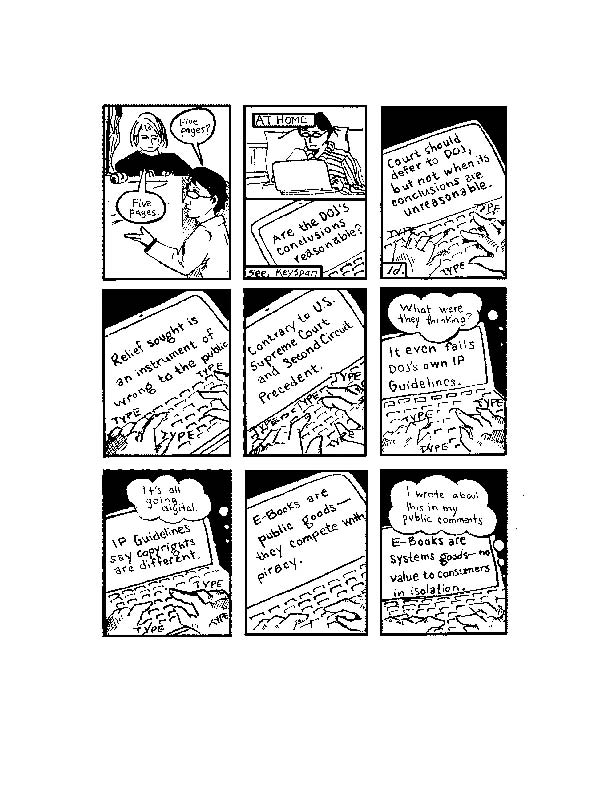
Comic Strip BriefThanks to Lawahaha.com friend Bob Van Voris of Bloomberg News for sending along a true first: an amicus brief filed in a complex intellectual property dispute in the U.S. District Court for the Southern District of New York comprising only comic strip panels.

(You can get a taste by clicking on the expandable thumbnail, but this gem deserves to be read in full.)

Limited by the court to filing a brief of five pages, Bob Kohn took out his frustration by deciding to simplify the complex arguments in comic book form.

The brief is made up largely of a cartoon-bubble conversation between a man and woman (Kohn and his daughter, according to other sources) in which the man starts out struggling “to explain why supply & demand does not operate normally in the pricing of e-books.” Fortunately–because remember he only has five pages–the woman catches on very quickly, becoming an instant expert in federal antitrust law.

Even so, and despite Kohn’s valiant, creative efforts, his principal concern proved accurate: it’s hard to articulate complex antitrust arguments such as horizontal, predatory and marginal pricing in five pages, regardless of the expression-medium. Maybe he should have just borrowed from Charles Schulz and expressed a simple “Good grief!”

The comic book/federal appellate brief ends with this colloquy:

“You should have been a lawyer,” says the male character.

“Nope. Not for me.”

“Why not?”

“I’m a novelist and it’s impossible to tell a complex story in only five pages.”

Excellent try though. Even if Kohn’s side loses, not all is lost. Maybe Marvel Comics will pick up the tale and create a new series, “Amici Man.”

More details about the underlying case and Kohn’s motivations can be found in this ABA Journal article.

Brief of Bob Kohn as Amicus Curiae, U.S. v. Apple, Inc., Civ. Action No. 12-CV-2826 (DLC), S.D.N.Y., Sept. 4, 2012. Thanks to Bob Van Voris.

Book Review: Life Without Lawyers

Book review of Life Without LawyersAndrew Jay McClurg, Book review: Philip K. Howard, Life Without Lawyers: Restoring Responsibility in America, 52 American Journal of Legal History 387 (2012).

Contrary to the title, Philip K. Howard’s Life Without Lawyers is not an anti-lawyer screed. It does not argue for a society without lawyers and suggests only in passing that America has too many lawyers. A more apt title would be “Life Without Rules” or maybe “Life Without Law.”

Howard argues that America’s enormous inventory of laws and bureaucratic rules is crippling society by making it impossible for people and institutions to do their jobs effectively. His opinion is that the primary reason is because they live in fear of potential legal consequences, making a case that the rights-explosion of the 1960s has led to a rights-obsessed, risk-averse culture that overvalues individual rights to the detriment of broader communitarian interests.

His principal solution is to grant judges and administrators more discretion to make decisions without the necessity of having a legally supportable record to back up their decisions.

This review contains some critique, but agrees with most of Howard’s general observations and concludes the book is a powerful one worth reading.

Fight Club: Doctors vs. Lawyers

Fight Club: Doctors v. LawyersFight Club: Doctors v. Lawyers, Chicago Medicine, June 2012, at 8 (cover story).

This article, a shorter version of an article first published in the Temple Law Review, argues that doctors and lawyers have strong shared self-interests that should motivate them to improve their bitter relations, while offering several specific examples of ways to accomplish that goal.

Among other things, the article traces the history of medical malpractice litigation in the U.S. Did you know that the first reported medical malpractice case occurred in 1794 and that lawyers were first called sharks by doctors in 1878? Here’s an excerpt:

Relations between doctors and lawyers got off to a rocky start in the first reported U.S. medical malpractice case, Cross v. Guthery, decided by a Connecticut court in 1794.  The defendant operated on the plaintiff’s wife to remove a breast.  She died three hours after the surgery because, according to the court, the defendant “performed said operation in the most unskillful, ignorant and cruel manner.”

The jury awarded the plaintiff £40.  One can imagine relations got frosty in the litigation when the defendant doctor asserted that the plaintiff wasn’t entitled to damages because he allegedly had agreed to settle the case for £15—which the doctor claimed the plaintiff owed him “for doctoring his wife.”  The court rejected the defense and ruled for the plaintiff.

Medical malpractice lawsuits were rare when Cross was decided.  Early on, some physicians actually embraced malpractice litigation as a way to cleanse their ranks of quacks and charlatans.  At the time of the American Revolution, only 5 percent of the nation’s 3,500 medical practitioners had any type of medical degree.  Relations soured, however, with a surge of lawsuits filed between 1840-50, a period denoted by James Mohr as the nation’s first “medical malpractice crisis.”

By 1860, a book review of an early treatise about medico-legal jurisprudence opined that “law and medicine had evolved into mutually incompatible professions.”  Less restrained assessments of the relationship were abundant.  As Mohr noted, “[i]t would be easy to fill several hundred pages full of vituperative, anti-legal rhetoric from medical journals after mid-century.”

The first reported unflattering comparison by doctors of lawyers to a certain ocean predator appeared around this time.  In 1878 physician Eugene Sanger wrote that medical malpractice lawyers “follow us as the shark does the emigrant ship.”  The epithet has enjoyed impressive staying power.  A hundred years later, the president of the Association of American Medical Colleges told a graduating medical school class, “We’re swimming in shark-infested waters where the sharks are lawyers.”

The article argues that the two professions have a stronger self-interest in building up professions generally than in continuing to tear each other down.

Spot the Tort: Looks Like a Hogwarts Tort

hogwarts tort dangerous staircaseFrom a University of Memphis law student comes this photo of a treacherous, spiral staircase that looks like it would be a perfect set piece for a low-budget version of a Harry Potter movie. The student said the whole staircase, not just the railing, “wobbles all the way down.”

Spooky. And dangerous.

Seriously. Stairs, like ladders and any other place a person can fall from height, can be extremely perilous. One recent study found that 931,886 children under five were treated in emergency rooms for stair-related injuries from 1999 through 2008, averaging 93,189 injuries per year.

Speaking of Hogwarts Torts

Eleventh Circuit Relies on Jim Croce in Dismissing Section 1983 Claim

Judge invokes Jim Croce
Court of Appeals used this guy’s tunes to find humor in alleged gun assault.

One rule of thumb regarding amusing judicial opinions is that the higher up the judicial hierarchy one climbs, the fewer such opinions one encounters. But here we have the distinguished U.S. Circuit Court of Appeals for the Eleventh Circuit, per Judge Ed Carnes, having fun with a case that probably wasn’t amusing from the plaintiff’s point of view, assuming the allegations of his complaint are true.

As alleged: A mother, a state corrections officer, came home in uniform to find her daughter and plaintiff engaging in intimate relations. The complaint alleges she pulled her gun on the naked plaintiff, threatened to shoot him, forced him to his knees, handcuffed him, tried to have him arrested, and further assaulted and threatened him. He was ultimately released unharmed physically.

The young man sued the mother and the county sheriff, her employer, in a Section 1983 action. The claim against the sheriff was based on the allegation the mother acted under color of state law (in an official capacity) when she allegedly assaulted the plaintiff.

The Eleventh Circuit rejected that claim, endorsing the district court’s position that the mother was no more than “an angry parent who happened to be in uniform, have handcuffs, and a firearm, which she used for the private ends of assaulting and scaring a young man she caught in bed with her daughter.”

Judge Carnes had a great time with the opinion, starting and ending with references to Jim Croce songs. Okay, this is just a wild guess, but I’m thinking Judge Carnes has never been forced naked to his knees, handcuffed, at gunpoint, by someone threatening to shoot him. Here are some excerpts (I substituted “plaintiff, “defendant,” and “defendant’s daughter” for the actors’ names):

In one of his ballads, Jim Croce warned that there are four things that you just don’t do: “You don’t tug on Superman’s cape/ You don’t spit into the wind/ You don’t pull the mask off that old Lone Ranger/ And you don’t mess around with Jim.” He could have added a fifth warning to that list: “And you don’t let a pistol-packing mother catch you naked in her daughter’s closet.”

It all started with a phone call. Nineteen-year-old defendant’s daughter called plaintiff, who was of a similar age, and invited him to her house.  Plaintiff responded to the invitation the way most young men over the age of consent would have—he went. …

Then they consented to do what young couples alone in a house have been consenting to do since the memory of man (and woman) runneth not to the contrary. The record does not disclose how long these two young people had known each other in the dictionary sense, but that afternoon in … the bedroom they also knew each other in the biblical sense.

That’s when the mother came home. Discovering plaintiff with her daughter, she allegedly pulled her firearm on him. She apparently asserted that she believed the plaintiff was attacking her daughter.

She told plaintiff that if he moved or did not follow her commands, she would shoot him.

Plaintiff tried to explain that her daughter had invited him to the house, but defendant insisted that he must have broken in. She had the still-naked plaintiff turn around, she handcuffed him, and she made him get down on his knees. After staying there “for a prolonged period,”  plaintiff pleaded with defendant that he could not maintain that position any longer. Defendant responded by telling him to bend over or she would shoot him. She “made numerous threats against plaintiff, telling him that she would ‘kill him’ if he did not obey her commands.”

The amended complaint and plaintiff’s briefs leave no doubt that he feels mistreated, and with what appears to be some justification. If the allegations are true, defendant’s treatment of plaintiff was badder than old King Kong and meaner than a junkyard dog. She might even have acted like the meanest hunk of woman anybody had ever seen. Still, the fact that the mistreatment was mean does not mean that the mistreatment was under color of law.

Glad at least someone involved in the case had fun, Judge.

–Butler v. Sheriff of Palm Beach County, Case No. 11-13933 (11th Cir., July 6, 2012). Thanks to Paul Scott.