From a University of Memphis law student comes this photo of a treacherous, spiral staircase that looks like it would be a perfect set piece for a low-budget version of a Harry Potter movie. The student said the whole staircase, not just the railing, “wobbles all the way down.”
Spooky. And dangerous.
Seriously. Stairs, like ladders and any other place a person can fall from height, can be extremely perilous. One recent study found that 931,886 children under five were treated in emergency rooms for stair-related injuries from 1999 through 2008, averaging 93,189 injuries per year.
Court of Appeals used this guy’s tunes to find humor in alleged gun assault.
One rule of thumb regarding amusing judicial opinions is that the higher up the judicial hierarchy one climbs, the fewer such opinions one encounters. But here we have the distinguished U.S. Circuit Court of Appeals for the Eleventh Circuit, per Judge Ed Carnes, having fun with a case that probably wasn’t amusing from the plaintiff’s point of view, assuming the allegations of his complaint are true.
As alleged: A mother, a state corrections officer, came home in uniform to find her daughter and plaintiff engaging in intimate relations. The complaint alleges she pulled her gun on the naked plaintiff, threatened to shoot him, forced him to his knees, handcuffed him, tried to have him arrested, and further assaulted and threatened him. He was ultimately released unharmed physically.
The young man sued the mother and the county sheriff, her employer, in a Section 1983 action. The claim against the sheriff was based on the allegation the mother acted under color of state law (in an official capacity) when she allegedly assaulted the plaintiff.
The Eleventh Circuit rejected that claim, endorsing the district court’s position that the mother was no more than “an angry parent who happened to be in uniform, have handcuffs, and a firearm, which she used for the private ends of assaulting and scaring a young man she caught in bed with her daughter.”
Judge Carnes had a great time with the opinion, starting and ending with references to Jim Croce songs. Okay, this is just a wild guess, but I’m thinking Judge Carnes has never been forced naked to his knees, handcuffed, at gunpoint, by someone threatening to shoot him. Here are some excerpts (I substituted “plaintiff, “defendant,” and “defendant’s daughter” for the actors’ names):
In one of his ballads, Jim Croce warned that there are four things that you just don’t do: “You don’t tug on Superman’s cape/ You don’t spit into the wind/ You don’t pull the mask off that old Lone Ranger/ And you don’t mess around with Jim.” He could have added a fifth warning to that list: “And you don’t let a pistol-packing mother catch you naked in her daughter’s closet.”
It all started with a phone call. Nineteen-year-old defendant’s daughter called plaintiff, who was of a similar age, and invited him to her house. Plaintiff responded to the invitation the way most young men over the age of consent would have—he went. …
Then they consented to do what young couples alone in a house have been consenting to do since the memory of man (and woman) runneth not to the contrary. The record does not disclose how long these two young people had known each other in the dictionary sense, but that afternoon in … the bedroom they also knew each other in the biblical sense.
That’s when the mother came home. Discovering plaintiff with her daughter, she allegedly pulled her firearm on him. She apparently asserted that she believed the plaintiff was attacking her daughter.
She told plaintiff that if he moved or did not follow her commands, she would shoot him.
Plaintiff tried to explain that her daughter had invited him to the house, but defendant insisted that he must have broken in. She had the still-naked plaintiff turn around, she handcuffed him, and she made him get down on his knees. After staying there “for a prolonged period,” plaintiff pleaded with defendant that he could not maintain that position any longer. Defendant responded by telling him to bend over or she would shoot him. She “made numerous threats against plaintiff, telling him that she would ‘kill him’ if he did not obey her commands.”
…
The amended complaint and plaintiff’s briefs leave no doubt that he feels mistreated, and with what appears to be some justification. If the allegations are true, defendant’s treatment of plaintiff was badder than old King Kong and meaner than a junkyard dog. She might even have acted like the meanest hunk of woman anybody had ever seen. Still, the fact that the mistreatment was mean does not mean that the mistreatment was under color of law.
Glad at least someone involved in the case had fun, Judge.
–Butler v. Sheriff of Palm Beach County, Case No. 11-13933 (11th Cir., July 6, 2012). Thanks to Paul Scott.
[Judge Terence T. Evans, U.S. Court of Appeals for the Seventh Circuit, passed away in 2011. Here’s a nice tribute to him on the Marquette law school (where he attended law school) faculty blog.]
In an opinion involving controversy over “Chief Illiniwek,” mascot of the University of Illinois since 1926, Judge Terence Evans of the U.S. Court of Appeals for the Seventh Circuit once again showed his dominance as the nation’s premiere judicial sports buff.
A group of students and faculty who believed the mascot degraded Native Americans brought suit against the university chancellor, seeking a declaratory judgment that the chancellor’s order banning all speech directed toward prospective student athletes without prior permission violated their First Amendment rights. The students and faculty wanted to contact prospective student athletes regarding the controversy.
The court found the policy violated the plaintiffs’ rights, but before getting to the merits, Judge Evans took a substantial detour into sports mascot trivia:
In the Seventh Circuit, some large schools–Wisconsin (Badgers), Purdue (Boilermakers), Indiana (Hoosiers), Notre Dame (The Fighting Irish), DePaul (the Blue Demons), the University of Evansville (Purple Aces), and Southern Illinois (Salukis)–have nicknames that would make any list of ones that are pretty cool. And small schools in this circuit are no slouches in the cool nickname department. One would have a hard time beating the Hustlin’ Quakers of Earlham College (Richmond, Indiana), the Little Giants of Wabash College (Crawfordsville, Indiana), the Mastodons of Indiana University-Purdue University-Fort Wayne (Fort Wayne, Indiana), and the Scarlet Hawks of the Illinois Institute of Technology.
But most schools have mundane nicknames. How can one feel unique when your school’s nickname is Tigers (43 different colleges or universities), Bulldogs (40 schools), Wildcats (33), Lions (32), Pioneers (31), Panthers or Cougars (30 each), Crusaders (28), or Knights (25)? Or how about Eagles (56 schools)? The mascots for these schools, who we assume do their best to fire up the home crowd, are pretty generic–and pretty boring.
“Some schools adorn their nicknames with adjectives–like “Golden,” for instance. Thus, we see Golden Bears, Golden Bobcats, Golden Buffaloes, Golden Bulls, Golden Eagles (15 of them alone!), Golden Flashes, Golden Flyers, Golden Gophers, Golden Griffins, Golden Grizzlies, Golden Gusties, Golden Hurricanes, Golden Knights, Golden Lions, Golden Panthers, Golden Rams, Golden Seals, Golden Suns, Golden Tigers, and Golden Tornados cheering on their teams.
All this makes it quite obvious that, when considering college nicknames, one must kiss a lot of frogs to get a prince. But there are a few princes. For major universities, one would be hard pressed to beat gems like The Crimson Tide (Alabama), Razorbacks (Arkansas), Billikens [Fn.2]
[Fn.2] What in the world is a “Billiken”?
(St.Louis), Horned Frogs (TCU), and Tarheels (North Carolina). But as we see it, some small schools take the cake when it comes to nickname ingenuity. Can anyone top the Anteaters of the University of California-Irvine; the Hardrockers of the South Dakota School of Mines and Technology in Rapid City; the Humpback Whales of the University of Alaska-Southeast; the Judges (we are particularly partial to this one) of Brandeis University; the Poets of Whittier College; the Stormy Petrels of Oglethorpe University in Atlanta; the Zips of the University of Akron; or the Vixens (will this nickname be changed if the school goes coed?) of Sweet Briar College in Virginia? As wonderful as all these are, however, we give the best college nickname nod to the University of California-Santa Cruz. Imagine the fear in the hearts of opponents who travel there to face the imaginatively named “Banana Slugs”?
From this brief overview of school nicknames, we can see that they cover a lot of territory, from the very clever to the rather unimaginative. But one thing is fairly clear–although most are not at all controversial, some are. Even the Banana Slug was born out of controversy. For many years, a banana slug (ariolomax dolichophalus to the work of science) was only the unofficial mascot at UC-Santa Cruz. In 1981, the chancellor named the “Sea Lion” as the school’s official mascot. But some students would have none of that. Arguing that the slug represented some of the strongest elements of the campus, like flexibility and nonagressiveness, the students pushed for and funded a referendum which resulted in a landslide win for the Banana Slug over the Sea Lion. And so it became the official mascot.
Not all mascot controversies are “fought” out as simply as was the dispute over the Banana Slug. Which brings us to the University of Illinois where its nickname is the “Fighting Illini,” a reference to a loose confederation of Algonquin Indian Tribes that inhabited the upper Mississippi Valley area when French explorers first journeyed there from Canada in the early seventeenth century. The university’s mascot, to mirror its nickname–or to some its symbol–is “Chief Illiniwek.” Chief Illiniwek is controversial. And the controversy remains unresolved today. …”
Even if you’re not a sports fan, you have to appreciate a federal appellate judge who uses phrases like “pretty cool” and “pretty boring” in his opinions. I wonder if he talked like that during oral arguments. “Counselor, that was a pretty cool motion you filed the other day, but it was pretty boring.”
R.I.P. Judge Evans. You are missed.
— Crue v. Aiken, 370 F.3d 668, 671–72 & n.2 (7th Cir. 2004). Thanks to Professor Howard Wasserman, a decent sports trivia buff in his own right.
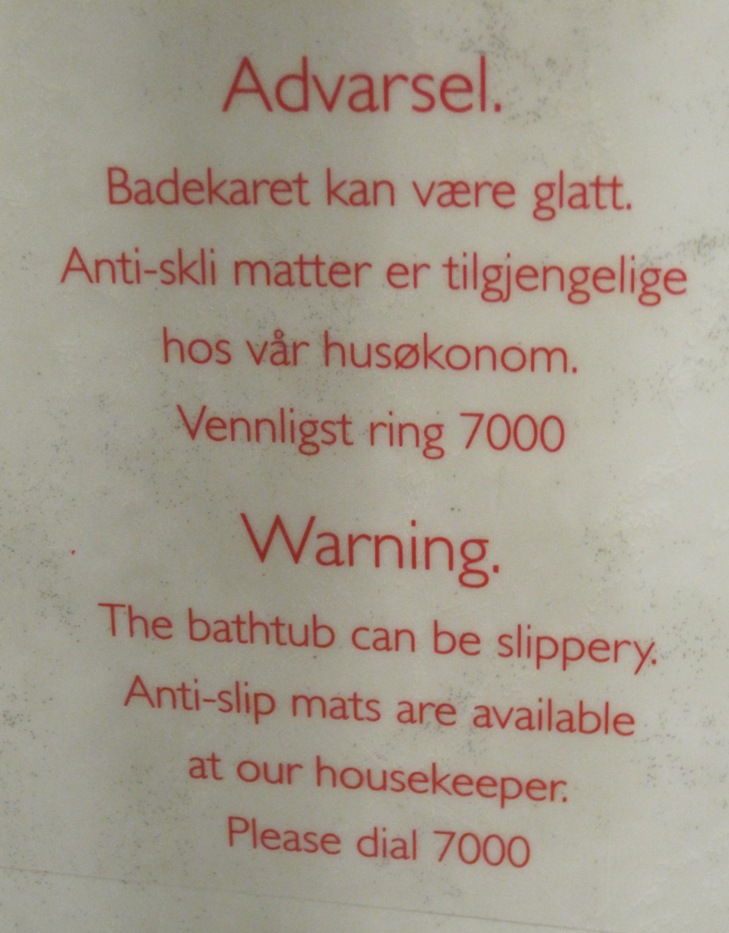
One of my colleagues was amused and bemused by this warning sticker inside the shower stall of her hotel room during a vacation to Norway:
Warning.
The bathtub can be slippery. Anti-slip mats are available at our housekeeper.
Please dial 7000.
Hmm, if the bathtubs are slippery, shouldn’t they already have mats in them? And isn’t it a bit too late to be dialing up the housekeeper for a mat once you’re already in the bath?
Remember “Golden Guides”? They were sort of the original “Dummies” series for kids, explaining a variety of scientific, geographic, and nature topics in succinct terms understandable even by 10 year olds.
Zim v. Western Pub. Co. arose out of a dispute between the guy who wrote or co-wrote many of these masterpieces—Dr. Herbert Zim—and the Golden Guides publisher, Western Publishing. Zim penned such classics as Rocks and Minerals, Reptiles and Amphibians, Trees, and my personal fav, Fishes.
Judge Goldberg of the U.S. Court of Appeals for the Fifth Circuit apparently also thinks highly of Zim, elevating him to biblical proportions:
In the beginning, Zim [Fn.1] created the concept of the Golden Guides. For the earth was dark and ignorance filled the void. And Zim said, let there be enlightenment and there was enlightenment. In the Golden Guides, Zim created the heavens (STARS) (SKY OBSERVER’S GUIDE) and the earth. (MINERALS) (ROCKS and MINERALS) (GEOLOGY).
[Fn.1] Dr. Zim is a noted science educator with a Ph.D. in science education from Columbia University. His special expertise is in the presentation of scientific subjects to popular audiences. The major focus of his efforts has been the development of a multivolume series of books on scientific subjects, the “Golden Guides.” …
And together with his publisher, Western, he brought forth in the Golden Guides knowledge of all manner of living things that spring from the earth, grass, herbs yielding seed, fruit-trees yielding fruits after their kind, (PLANT KINGDOM) (NON-FLOWERED PLANTS) (FLOWERS) (ORCHIDS) (TREES), and Zim saw that it was good. And they brought forth in the Golden Guides knowledge of all the living moving creatures that dwell in the waters, (FISHES) (MARINE MOLLUSKS) (POND LIFE), and fowl that may fly above the earth. (BIRDS) (BIRDS OF NORTH AMERICA) (GAMEBIRDS). And Zim saw that it was good. And they brought forth knowledge in the Golden Guides of the creatures that dwell on dry land, cattle, and creeping things, (INSECTS) (INSECT PESTS) (SPIDERS), and beasts of the earth after their kind. (ANIMAL KINGDOM). And Zim saw that it was very good.[Fn.4]
[Fn.4] According to Zim’s brief before this court, well over 100 million of the Golden Guide books have been printed under Zim’s name, earning him “millions of dollars” in royalties.
Then there rose up in Western a new Vice-President who knew not Zim. And there was strife and discord, anger and frustration, between them for the Golden Guides were not being published or revised in their appointed seasons. And it came to pass that Zim and Western covenanted a new covenant, calling it a Settlement Agreement. But there was no peace in the land. Verily, they came with their counselors of law into the district court for judgment and sued there upon their covenants.
And they put upon the district judge hard tasks. And the district judge listened to long testimony and received hundreds of exhibits. So Zim did cry unto the district judge that he might remember the promises of the Settlement Agreement. And the district judge heard Zim’s cry, but gave judgment for Western. Yea, the district judge gave judgment to Western on a counterclaim as well. Therefore, Zim went up out of the court of the district judge.
And Zim spake unto the Court of Appeals saying, make a sacrifice of the judgment below. And the judges, three in number, convened in orderly fashion to recount the story of the covenants and to discuss and answer the four questions which Zim brought before them …
Maybe it’s just because I loved Golden Guides, but this one goes in the Strange Judicial Opinions Hall of Fame.
— Zim v. Western Pub. Co., 573 F.2d 1318, 1320–21 (5th Cir. 1978). Thanks to Professor Ken Swift.
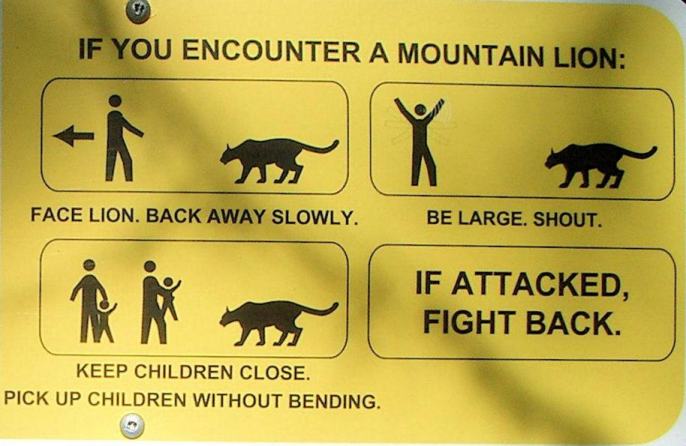
Courtesy of a rising 2L at the University of Memphis law school, we have another failed attempt at conveying warnings and instructions via pictorial symbols.
In evaluating pictorial warnings, remember that the principal purpose of pictorial warnings is to convey warnings to people who can’t read or read in a different language. If people could read the warnings, we wouldn’t need the pictures.
Thus, interpreting only the pictures, here’s what a non-English speaking park visitor might take away from these four frames of a sign warning about how to handle mountain lion attacks:
1. Top left: “After lion has bitten off your right hand, run AWAY from the lion. Follow the arrow. Never run toward a mountain lion.”
2. Top right: “Once you realize you can’t outrun a mountain lion and are handless, say the hell with it and give up.”
3. Bottom left: “If accompanied by children, offer them to the lion.”
4. Bottom right: “Don’t know. Can’t read it. That’s why I needed the pictures!”
Judge Alex Kozinski, of the U.S. Court of Appeals for the Ninth Circuit, was well-known for his sparkling prose in writing opinions, but his most classic opinion was U.S. v. Syufy Enterprises, in which he weaved in more than 200 movie titles.
In Syufy, the federal government sued Las Vegas movie-chain owner Syufy for antitrust violations. In affirming the trial court’s dismissal of the antitrust charges, rumor had it that Judge Kozinski wove more than 200 movie titles into the text of his fourteen-page opinion.
But did it really happen? Was it urban legend? Bourbon legend?
It really happened. Daniel Solzman of the Tarlton Library at the University of Texas law school assembled the entire list of movies Kozinski managed to cram into Syufy as part of its Law in Popular Culture Collection. Here are the movie titles in the order they appeared:
M, Suspect, Giant, Nevada, Illegal, Monkey Business, Platoon, David, 8 1/2, The Power, The Competition, Greatest Hurdle, Gone are the Days, Popcorn, Something for Everyone, Manpower, The Producers, Formula, Splash, Shame, Stir, Titanic, Easy Money, No Holds Barred, Upper Hand, Rivals, Rocky, Until September, September, Midway, The Big Picture, Do the Right Thing, Brass Knuckles, The Accused, Humongous, Little Big Man, Chances, Vice Versa, Always, Nuts, The Seven-Ups, Big, Ordinary People, Possessed, Foul Play, The Survivors, Personal Services, Time after Time, Challenge, Testimony, Riding High, Captured, Utopia, Dark Horse, Invitation, Major League, Against all Odds, Fighting Fire with Fire, Trading Places, The End, Country, Losing Ground, Short Circuit, Lock Up, Dead Heat, Personal Best, Absolute Beginners, Staying Alive, Big Business, Network, Shopworm, Witness, High Tide, The Law, Wisdom, The Hand, Guilty, Illicit, Satisfaction, The Victim, Raw Deal, The Evil, Above the Law, Down by Law, Off Limits, The Enforcer, Fear, The Villain, The Weapon, Champion, The Natural, Deliverance, The Disappearance, The Challenge, Running, The Other, Top Gun, Players, The Trial, Paid, Head, The Squeeze, Seven Days, Cold Feet, Gambit Backfire, Contract, Cold Turkey, Lost, Plenty, After Hours, The Judge, The Trap, Leviathan, Stick, Tough Enough, Making It, Risky Business, Squeeze Play, Sitting Ducks, Boomerang, Big Trouble, The Principal, House of Cards, Tribute, America, Target, Paper Tiger, Distance, Local Hero, Being There, Fire Sale, Abandoned, The Lawyer, You and Me, Avalanche, Surrender, The First Time, Hard Choices, Showdown, Fail-Safe, The Great Race, Relentless, The Fountainhead, Out, House, Volunteers, October, 1984, Over the Top, Ran, Trapped, The Gate, Hard Times, Partners, California, Barrier, Five, Colors, Exposed, Switching Channels, Checking Out, Fame, Great Expectations, Without a Trace, Perfect, Out of Bounds, Offbeat, Critic’s Choice, The Longshot, The Sure Thing, Misunderstood, Boom Town, Static, Alien, Things Change, High Hopes, The Jackpot, Drive-in, Performance, New Faces, The Thing, The Crucible, Violated, All the Right Moves, The Creator, Interiors, Clue, Fashion, Winner Take All, Any Number Can Play, Insignificance, The Harder They Fell, Missing, Shakedown, Ruthless Predator, Dangerous, Critical Condition.
Kozinski never confirmed or denied the rumors about intentionally loading up Syufy with movie titles.
— United States v. Syufy Enterprises, Inc., 903 F.2d 659 (9th Cir. 1990); see alsoThe Syufy Rosetta Stone, 1992 BYU L. Rev. 457 (1992).
Legal research shows no Lannister has ever filed for bankruptcy.
Good legal news if you’re a fan of HBO’s Game of Thrones series, adapted from George R.R. Martin’s medieval fantasy novel series, A Song of Ice and Fire. The series centers around the struggles of several noble families, including the Lannisters, whose unoffical motto is that “A Lannister always pays his debts.”
Now comes breaking news out of South Florida. A former student at the Florida International College of Law, a really smart one named Michael Hirschkowitz, has, through painstaking legal research, confirmed the apparent truth of the Lannister motto.
He reports: “There are 0 cases in the United States in which any individual or organization named ‘Lannister’ has undergone Chapter 11 or Chapter 7 bankruptcy. This is strong evidence that a Lannister does, in fact, ‘always pay his debts.'”
When manufacturers overwarn, it dilutes the impact of warnings that consumers really need to know about. Over-warning is a serious problem — not to be confused with global-warming, which is also really bad.
Given some of the silly and dangerous ways consumers misuse products, one can have sympathy for manufacturers that don’t want to take chances. I’ve done consulting work writing product warnings and instructions for manufacturers and confess that I advise erring on the side of giving too many warnings.
But to waste space and, more importantly, short consumer attention span on worthless warnings that lead with telling consumers to:
1. Read these instructions.
2. Keep these instructions.
3. Heed all warnings.
4. Follow all instructions
… is just stupid. The most important warnings should come first. Even diligent consumers are going to tune out quickly reading these warnings (which led to the headline, a reversal of the famous line from Jerry McGuire, “You had me at hello”). No manufacturer has been or ever will be held liable for failing to warn consumers to read and keep their warnings and instructions.
Meanwhile, the list of warnings for this apparently incredibly dangerous alarm clock went on much longer, but I cut it off.
Maybe there should be an opposite abbreviation to TMI such as NEI (not enough information).
In a case involving a challenge to nuclear waste fees at a site intended to replace the Yucca Mountain disposal site, brought to our attention by way of The BLT: The Blog of LegalTimes, the U.S. Court of Appeals for the District of Columbia admonished the lawyers – in the attention-stealing first footnote no less – for using too many acronyms:
1. We also remind the parties that our Handbook of Practice and Internal Procedures states that “parties are strongly urged to limit the use of acronyms” and “should avoid using acronyms that are not widely known.” Brief-writing, no less than “written English, is full of bad habits which spread by imitation and which can be avoided if one is willing to take the necessary trouble.” George Orwell, “Politics and the English Language,” 13 Horizon 76 (1946). Here, both parties abandoned any attempt to write in plain English, instead abbreviating every conceivable agency and statute involved, familiar or not, and littering their briefs with references to “SNF,” “HLW,” “NWF,” “NWPA,” and “BRC” – shorthand for “spent nuclear fuel,” “highlevel radioactive waste,” the “Nuclear Waste Fund,” the Nuclear Waste Policy Act,” and the “Blue Ribbon Commission.”
Who knew there was a written court rule against acronyms or that George Orwell gave legal-writing advice?
— Nat’l Ass’n of Regulatory Utility Commissioners v. U.S. Dep’t of Energy, Case No. 11-1066 (D.C. Cir., June 1, 2012)
 From a University of Memphis law student comes this photo of a treacherous, spiral staircase that looks like it would be a perfect set piece for a low-budget version of a Harry Potter movie. The student said the whole staircase, not just the railing, “wobbles all the way down.”