Warning: No Happy Children

No child labor pictorial announcement.If you come here often, you know we love pictorial product warnings. Pictorial warnings are intended to explain product dangers in a universal symbol or picture that can be universally understood even by people who cannot read or who speak and read a different language.

Here we have a pictorial product announcement on the back of a rug indicating the company uses no child labor. Very commendable.

The test for a pictorial symbol is whether it communicates its intended message without textual explanation.  So take away the “No Child Labor” words and what do you see?  A “No Happy Children” warning.

Not quite sure why the manufacturer felt it necessary to include a pictorial symbol in the first place, unless universal pictorial warnings have been transmuted into marketing tools–which will further dilute their already limited uility as product-risk warnings.

Or, maybe the manufacturer really is warning consumers not to use child labor. I can see some kid whose allowance includes vacuuming balking to mom and dad, “You’re violating this warning! I’m calling the labor department!”


Test Your Legal Trivia Knowledge: Who Rocked the Law?

Reprinted from The “Companion Text” to Law School: Understanding and Surviving Life with a Law Student (West 2012) with permission from Thomson Reuters.

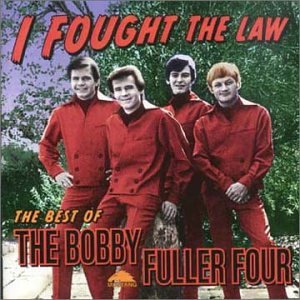
The Bobby Fuller Four
Quiz clue.

Question. While some people purport to “hate” lawyers, the public remains fascinated by them, as evidenced by all the attention the legal profession receives in the entertainment world.  Since the 1960s, more than fifty television series about lawyers have been produced.  Well over 100 “lawyer movies” have been brought to the big screen and lawyer novelists such as John Grisham sell hundreds of millions of books.  What about musical entertainment?  Which of the following is not a real song by a popular artist?

A.  I Fought the Law (and the Law Won)

B.  Lawyers in Love

C.  Sue Me, Sue You Blues

D.  My Lawyer Bit My Doctor

E.  Lawyers, Guns & Money

Answer: D.  “My Lawyer Bit My Doctor” is not a real song, although it sounds like it could be a hit.  The Bobby Fuller Four made I Fought the Law (and the Law Won) into a top 10 hit in 1964.  Sadly, Fuller was found dead in his car shortly after he tasted fame.  The death was ruled a suicide/accident, although some suspected Fuller was murdered.  John Mellencamp paid homage to Fuller in his song, R.O.C.K. in the U.S.A. (“There was Frankie Lymon, Bobby Fuller, Mitch Ryder (they were rockin’).”  Jackson Brown’s Lawyers in Love reached the Top 40 in 1983, while his album of the same name made it all the way to #8 in the charts.  The sardonic Sue Me, Sue You Blues appeared on former Beatle George Harrison’s second solo album, Living in the Material World, released in 1973.  Like many rock stars, Harrison had been embroiled in more than his fair share of litigation, including lawsuits over the breakup of the Beatles.  The song contained biting lyrics such as, “Bring your lawyer, and I’ll bring mine; get together and we could have a real bad time.”  Lawyers, Guns & Money was a typically over-the-top, hilarious tune from the late Warren Zevon that appeared on his 1978 album, Excitable Boy.  It includes the classic refrain line, “Send lawyers, guns, and money; the s*** has hit the fan.”

Warning: Hurry When You Cross This Street!

Crosswalk sign with energy drink.Okay, that’s probably not the original message of this crosswalk sign, found on the University of Florida campus, but a sense of urgency was added when someone doctored the sign by adding a can of Red Bull … and angel wings?

Warning: Canadian Coffee Seller Makes Fun of Hot Coffee Warnings

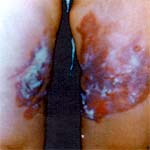
Liebeck coffee burn.
One of the milder pictures of  Stella Liebeck’s coffee burn injuries.

Any mention of lawsuits and hot coffee invariably invokes the grossly misunderstood “McDonald’s coffee spill” case of Stella Liebeck, a 79-old-woman who suffered third-degree burns after spilling a stryrofoam, takeout cup of McDonald’s coffee on her legs.

I apologize for the gruesome picture, but a large part of the misunderstanding of this case comes from people not appreciating that Ms. Liebeck suffered extremely severe injuries. There are much worse pictures of her injuries available on the internet. There is also a ton of information, and misinformation, out there about the McDonald’s case. Here (scroll down to “Public Perceptions: The McDonald’s Coffee Spill”) and here are a couple accounts of the facts. You might also want to check out the movie, Hot Coffee, which explores the McDonald’s case and, more generally, the tort reform movement.

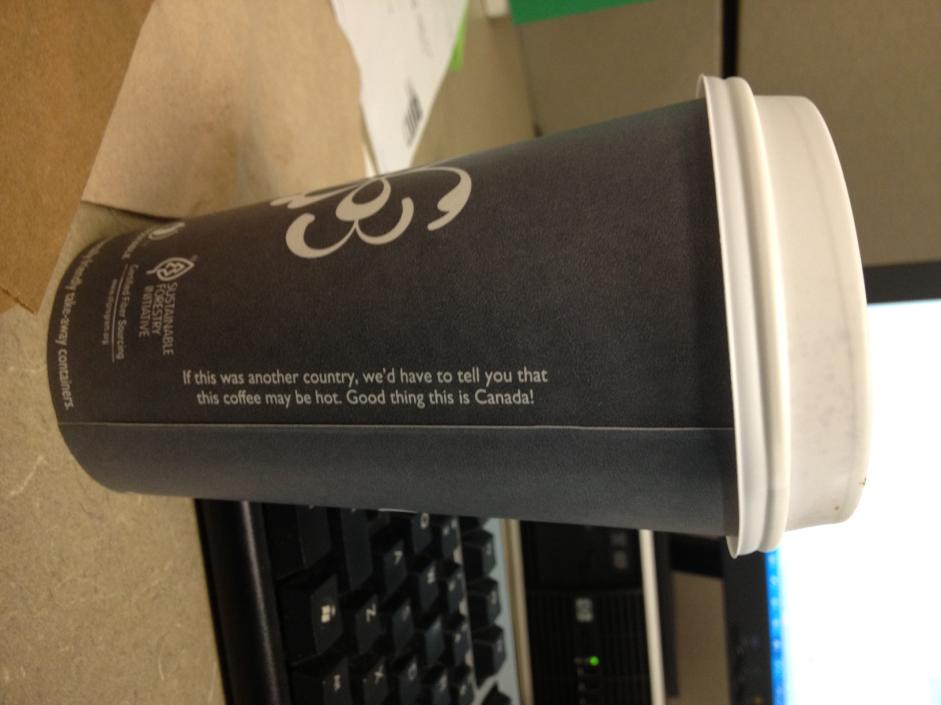
Canadian coffee cup warning
Sideways on purpose. Click to expand.

At least one Canadian coffee seller found the idea of warning consumers about hot coffee to be hilarious:

“If this was another country, we’d have to tell you this coffee may be hot. Good thing this is Canada!”

Spot the Tort: What a Tortious Web We Weave When First We Practice Technology

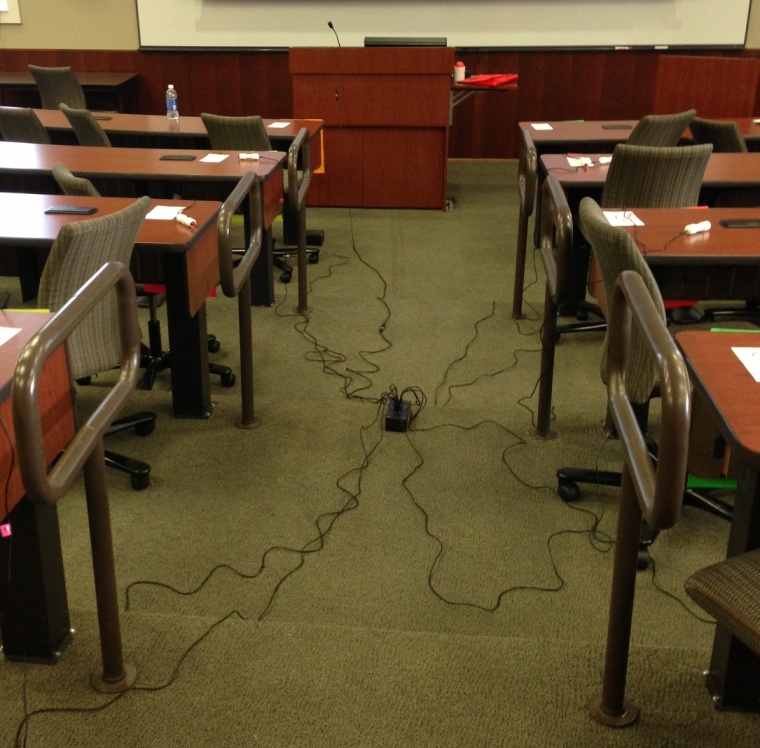
Torts in law schoolsLaw schools, filled as they are with lawyers and law students, are pretty safe places, but they sometimes present their own dangerous premises issues, as here in a University of Memphis classroom where students were trying out some new technology that has not reached the wireless stage. The result: a spider web of trip and fall possibilities. Thanks to Rachel Cade.

Warning: Sad Pumpkins Should Avoid Hair Rubberbands

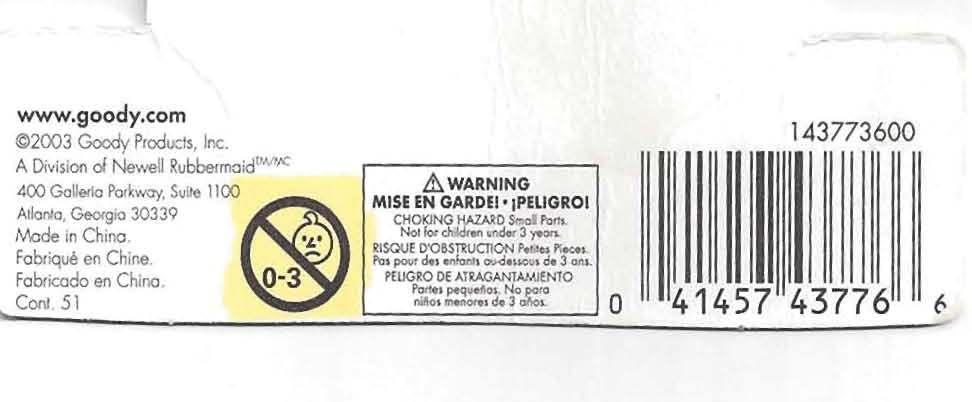
Goody hair bands pictorial warningPictorial warnings are intended to explain product dangers in a universal symbol or picture that can be universally understood even by people who cannot read or who speak and read a different language.

Unfortunately, coherently explaining product risks usually is hard to do in a single image. A picture may be worth a thousand words, but product warnings can be better explained in words (unfortunately, many litigation risk-averse product makers insist on using the full thousand or more, but that’s a different issue).

Here we have a pictorial warning about hair rubberbands. As the written part of the pictured warning shows (all thumbnails are expandable), they can present a choking hazard to young children. But what if one can’t read the printed warning?  That’s where the symbol warning against use by children under three comes in.

But wouldn’t it be easy to do and more effective to create a symbol that looked more like a child and less like a melancholy pumpkin?

Poltergeist Infestation Allows Buyer to Rescind Contract on Haunted House

haunted house buyer suesIn this Halloween-themed case, the plaintiff bought a house, only to learn that it had a reputation in the Village of Nyack, NY, for being possessed by poltergeists, a reputation built in large part on the seller’s previous efforts to promote the house as haunted, which were unknown to plaintiff. On learning of the alleged haunting, plaintiff sued for rescission of the sale contract.

The New York Supreme Court, Appellate Division, over one dissent, ruled for the plaintiff, going against the usual rule in New York of strict caveat emptor (let the buyer beware), which imposed no duty on house sellers to disclose even known defects. Based on the seller’s previous assertions that the house was haunted, the court said the seller was estopped from claiming otherwise and that the house was haunted “as a matter of law.”

So New York property owners take note: there is no duty to report collapsing roofs, faulty foundations, or termite infestations, but, after this opinion, suspected poltergeist infestations must be disclosed. (The case was decided in 1991; New York may have modified its caveat emptor rule since then.)

We’ll let the court–per Judge Rubin–unravel this hair-raiser. Turn the lights low, cuddle up, and prepare for the one and only judicial ghost story, a classic tale of a stranger arriving in a town where things aren’t quite what they seem. [Cue spooky music]:

The unusual facts of this case … clearly warrant a grant of equitable relief to the buyer who, as a resident of New York City, cannot be expected to have any familiarity with the folklore of the Village of Nyack. Not being a “local,” plaintiff could not readily learn that the home he had contracted to purchase is haunted.

Whether the source of the spectral apparitions seen by defendant seller are parapsychic or psychogenic, having reported their presence in both a national publication (“Readers’ Digest”) and the local press …, defendant is estopped to deny their existence and, as a matter of law, the house is haunted.

More to the point, however, no divination is required to conclude that it is defendant’s promotional efforts in publicizing her close encounters with these spirits which fostered the home’s reputation in the community.  In 1989, the house was included in a five-home walking tour of Nyack and described in a November 27th newspaper article as “a riverfront Victorian (with ghost).”  The impact of the reputation thus created goes to the very essence of the bargain between the parties, greatly impairing both the value of the property and its potential for resale. ….

While I agree… that the real estate broker, as agent for the seller, is under no duty to disclose to a potential buyer the phantasmal reputation of the premises and that, in his pursuit of a legal remedy for fraudulent misrepresentation against the seller, plaintiff hasn’t a ghost of a chance, I am nevertheless moved by the spirit of equity to allow the buyer to seek rescission of the contract of sale and recovery of his down payment.

New York law fails to recognize any remedy for damages incurred as a result of the seller’s mere silence, applying instead the strict rule of caveat emptor.   Therefore, the theoretical basis for granting relief, even under the extraordinary facts of this case, is elusive if not ephemeral.

“Pity me not but lend thy serious hearing to what I shall unfold” (William Shakespeare, Hamlet, Act I, Scene V [Ghost] ).

From the perspective of a person in the position of plaintiff herein, a very practical problem arises with respect to the discovery of a paranormal phenomenon:  “Who you gonna’ call?” as the title song to the movie “Ghostbusters” asks.  Applying the strict rule of caveat emptor to a contract involving a house possessed by poltergeists conjures up visions of a psychic or medium routinely accompanying the structural engineer and Terminix man on an inspection of every home subject to a contract of sale.

It portends that the prudent attorney will establish an escrow account lest the subject of the transaction come back to haunt him and his client–or pray that his malpractice insurance coverage extends to supernatural disasters.

In the interest of avoiding such untenable consequences, the notion that a haunting is a condition which can and should be ascertained upon reasonable inspection of the premises is a hobgoblin which should be exorcised from the body of legal precedent and laid quietly to rest.

The court detailed New York’s strict caveat emptor rule, but ultimately couldn’t stomach the fact that it was the defendant who, in effect, created the defect by broadcasting the house’s haunted status, thereby impairing its value:

In the case at bar, defendant seller deliberately fostered the public belief that her home was possessed. … Where, as here, the seller not only takes unfair advantage of the buyer’s ignorance but has created and perpetuated a condition about which he is unlikely to even inquire, enforcement of the contract (in whole or in part) is offensive to the court’s sense of equity. Application of the remedy of rescission, within the bounds of the narrow exception to the doctrine of caveat emptor set forth herein, is entirely appropriate to relieve the unwitting purchaser from the consequences of a most unnatural bargain.

The dissenting judge wanted to stick with the caveat emptor rule, stating that “if the doctrine of caveat emptor is to be discarded, it should be for a reason more substantive than a poltergeist.”

–Stambovsky v. Ackley,169 A.D.2d 254 (N.Y. Sup. Ct. 1991)
Warning: Halloween Grease Makeup Promises Tricks, Not Treats

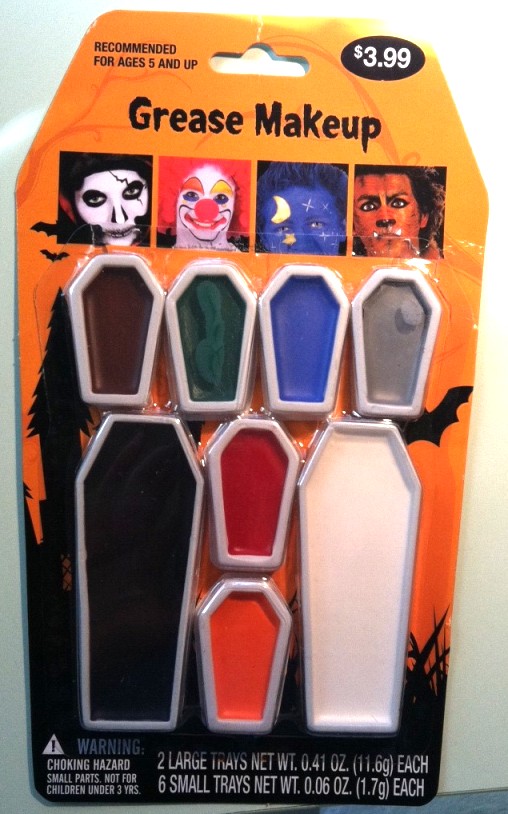
Grease paint product warnings.Getting in the Halloween spirit, I was in a drug store reading warning labels for Halloween products and came across this Grease Makeup. Looks like fun stuff, right?

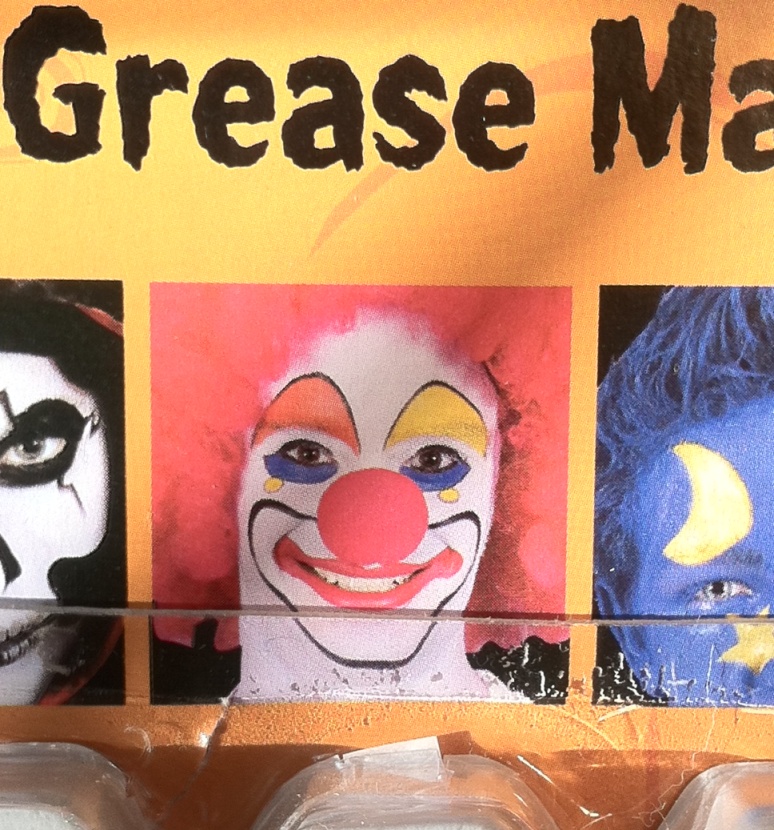
Not as fun as you might think. First, don’t expect to end up looking like this clown.Grease paint product warnings.


Why? Because–Bozo warning alert–the instructions on the back of this one quarter-inch thick transparent package clearly state: “COSTUMES AND ACCESSORIES SHOWN IN PHOTO NOT INCLUDED.”

Grease makeup product warnings.But things get worse. Ready to have some fun applying your grease makeup? Like the thought of sporting red or maybe yellow eyes at the costume party? Forget about it. How about pink or purple?  Scratch those too. Maybe green? Orange? No, No. All of those colors are banned from eye-area application. And don’t even think about going with blue, green or purple lips:

Grease makeup product warnings.Have a happy, complicated Halloween with your grease makeup!

2012 Spot the Tort Contest

2012 Spot the Tort ContestYou thought “Risk” was a good game? Spotting risk is even more fun, and definitely more educational. As law students learn in Torts, the world is a dangerous place where the worst that can happen often does.

My 1Ls at the University of Memphis have been participating in a “Spot the Tort” Contest. Check out their photo entries. This is just one sample of the “accidents waiting to happen” they’ve documented in and around Memphis.