Insurance Humor: “50 Ways to Leave No Cover”

meteor damage
Meteor damage: Coverage exclusion reason 51?

Insurance law expert Randy Maniloff shows that insurance law doesn’t have to be dry. His insurance coverage newsletter Coverage Opinions takes a light-hearted look at insurance, recently celebrating Valentine’s Day with a funny parody of a Paul Simon classic: “50 Ways To Leave No Cover,” an inventory of the many ways insurance companies manage to deny coverage. Here’s a taste:

There must be fifty ways

To leave no cover

Your notice was late Kate

And then you didn’t cooperate

That’s not an occurrence Terrence

It’s impaired property Lee

You furnished alcohol Paul

You intended that Matt

We’re just excess Bess

We reserved on Buss Gus

Your claim relates back Jack …

Randy’s a funny guy.  Check him out.

Here’s my take on insurance coverage:  Harmless Error, Insurance Deterrence, A.B.A. Journal, Mar. 2001. Still funny after all these years (Paul Simon joke).

Law School Makes Students Overly Analytical

A 1L at St. Thomas University School of Law in Miami wrote to say she enjoyed The “Companion Text” to Law School and especially connected to the chapter on the personality changes that occur in law students, specifically, becoming overly analytical. She gave a funny example:

I find it hard trying to switch gears back and forth from analytical law school mode to normal person mode.

We are trained to “think like lawyers” every waking moment of the day. But that doesn’t always work around our non-law student loved ones. It creates a kind of dissonance, I guess.

A lot of times when I try to explain law school things to friends and family and they just don’t get it, I either don’t have the energy to figure out how to communicate it accurately or the communication gap comes during a particularly stressful period—just before memos are due, for example—and I am afraid to open my mouth because I might erupt with irritable snaps or some other stream of emotion that isn’t really directed toward my loved ones but will likely end up coming out that way.

Here’s a story that could be in The “Companion Text” to Law School about the whole mental rewiring process law students go through as they work their way through law school and the confusion that ensues as family members try to figure out what the heck is going on. I called my grandpa and the conversation went like this:

Me: “What’cha doing?”

Grandpa: “Well, I just walked through the door.”

Me: “Oh. Which door?”

Grandpa: Silence…

Finally, after a long pause, he burst into laughter and said, “I just walked through the door to my house! I thought that was a given!” He laughed about it, but I could tell there was a little shock in his voice, like he thought I had lost my marbles.

I then had to explain to him that law students constantly clarify and ask questions because our brains have been trained think that way! Of course, it’s not that I lacked the common sense to assume he was implying he just got home and “walked through the door” of his house—but it’s like the law student in me had to ask just to be sure.

I have had other people make comments (half-jokingly, half seriously) about the fact that my “common sense” seems to have gone out the window since I became a law student. I’m sure I’m not the only one who experiences this—family members and friends don’t realize that lawyers and law students see factual assumptions as no-nos.

Being well-trained in critical-thinking skills–including knowing that the most accurate answer to most questions in law or life is “It depends on the facts”–is both a blessing and a curse to law students and lawyers. If you want a balanced, well-reasoned answer to a vexing question, ask a lawyer. On the other hand, law students and lawyers can drive people around them nuts by overanalyzing every word spoken.

Speaking of balanced “on the one hand, on the other hand”-thinking, here’s a judge who did it literally.
Spot the Tort: How About “Fix the Tort”?

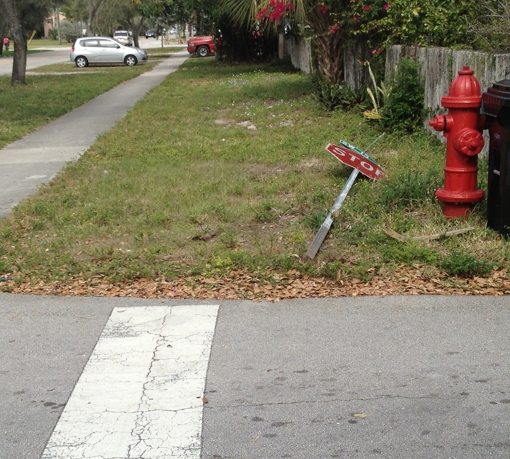
Downed stop signSpotting torts, as we like to do here at Lawhaha.com, has its benefits as a pastime, but maybe a new “Fix the Tort” category should be added to “Spot the Tort.”  After all, reducing risk, not just identifying it, should be the ultimate goal.

From sunny South Florida comes this picture of a downed stopped sign which, amazingly, the sender reported was fixed the same day it went down.  Good job, city workers.

Warning: Toasters Are Dangerous

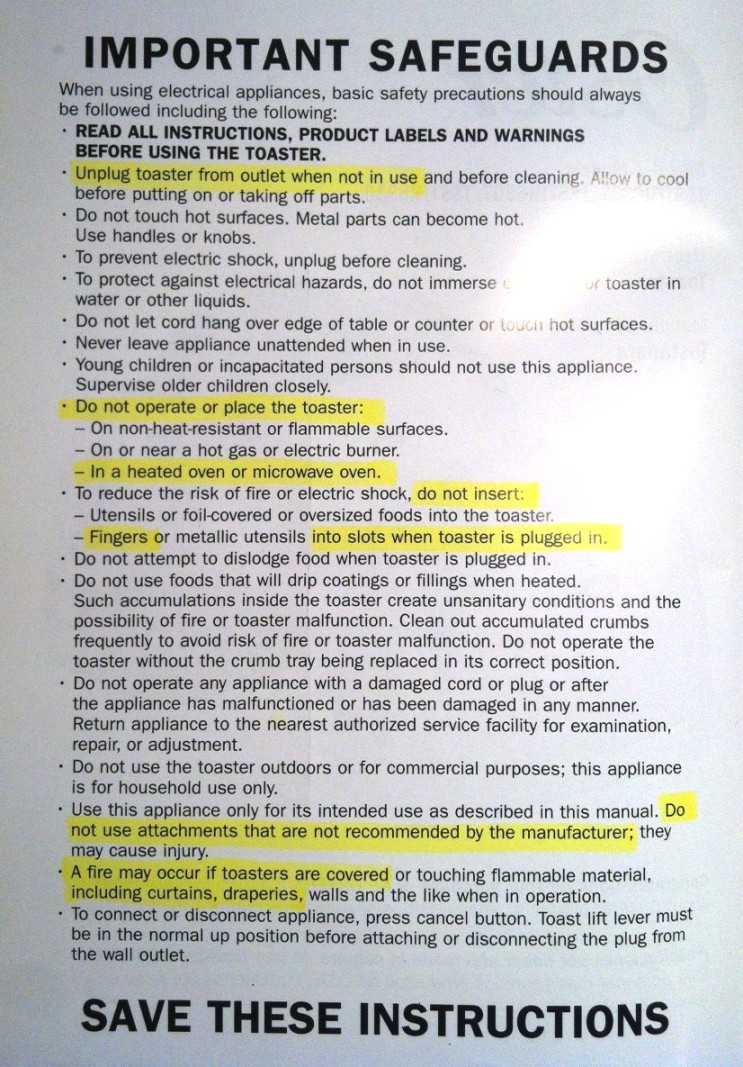
toaster warningsLike any heat-generating electrical device, toasters can be very dangerous.

Here’s the main warning page from a set of instructions for a new toaster (click pic to expand).

Most of these are good warnings, even if they sound silly. For example, “do not insert fingers … into slots when toaster is plugged in” sounds obvious, but how many toaster-users among us could swear under oath we haven’t fished stuff out of a plugged-in toaster with bare hands? One of the most common types of toaster injuries is burned fingers from trying to get Pop-Tarts out.

And on reading “Do not operate or place the toaster  … in a heated oven or microwave oven,” your first reaction might be to laugh, but this kind of warning is there because real live, or at least formerly so, consumers have engaged in exactly that activity.

So these are mostly good warnings, but two quibbles applicable to many product warnings:

–First, it’s annoying when product warnings direct consumers to do things the manufacturer knows 100 percent they are not going to do, such as “Unplug toaster from outlet when not in use.” Maybe I lead an overly risky life, but I do not unplug all electrical products (many of which include the same warning) between usage. Repeated plugging and unplugging strikes me as being potentially even more dangerous when it comes to toasters because water is frequently running nearby and fingers may be wet or slippery from various cooking ingredients.

–Second, it would be great if we could ditch the generic warnings that clearly do not apply to the particular product. They simply dilute the impact of (and already small likelihood consumers will actually read) the important warnings. Example here: “Do not use attachments that are not recommended by the manufacturer.” I have no doubt consumers misuse products in varied and imaginative ways, but I can’t picture what kinds of attachments they would use for a toaster.

Post script: An insurance defense lawyer-turned-judge friend wrote in response to this post:

Gulp.  Will you still be my friend if I confess that I  actually DO unplug the toaster between uses?  It’s the old insurance defense lawyer in me.  I don’t walk over grates in the sidewalk or manhole covers in the street.  I don’t talk on the phone or shower when there is lightning outside.  I inanely tell loved ones departing in cars:  “Drive safely!”  (In response, my former husband once told me, “Good thing you said that.  Had you not, I would have driven like a maniac.”) In my defense, experts actually do advise unplugging small appliances like toasters.

Two points. First, you can see what being immersed in tort law does to people’s psyches. We become very safe people. Second, I’m still not convinced. If electric appliances present a significant risk of physical harm to persons or property (other than harm to only the product) simply from being plugged in, I would argue that the failure to incorporate failsafe technology from electrical surges is a defective design.

Warning: Do Not Eat iPod Shuffle

Warning: Do not eat iPod shuffle.It’s hard to tell in this warning if Apple was serious or trying to be amusing in admonishing consumers “Do not eat iPod shuffle.”

It seems jokey, especially because it follows the jokey tone of the instructions above, where it says that syncing the device will be “a piece of cake. Cupcake, even.”

No doubt Apple has a galaxy of outstanding legal advisors, so it’s surprising no one pointed out: “Never, ever make jokes in product warnings.”

Let’s assume hypothetically that the product seriously injured someone in a different way that should have been, but wasn’t, warned about, say, because the battery could explode.  Picture the cross-examination:

“So you didn’t warn consumers about the danger of exploding batteries, is that true?”

“That’s correct.”

“But you did warn them not to eat their iPod shuffle, is that correct?”

“Yes, but we were just joking about that.”

“Sir, my client is blind in one eye because of your failure to warn. Does Apple  consider product warnings to be a joke?”

On the other hand, it’s possible that it is intended as a real warning to not eat iPod shuffles, which would be unnecessary.  Manufacturers do not have a legal duty to warn consumers not to eat electronic devices. The exception, of course, would be if the object was small enough to present a choking hazard to children.  That doesn’t appear to be the case with an iPod shuffle. But even if that is a risk, the warning should not say “Do not eat iPod shuffle,” but like, “Choking hazard–Keep away from small children.”

Career Shoes for Lawyers?

Career shoes for lawyersA first-year law student in Miami isn’t rushing out to buy these “career shoes.” As she explained in an email:

I am a member of a designer overstock/discount (and probably liquidation) club and was just browsing through today’s sales when I saw a heading that said “CAREER SHOES.” I clicked on it thinking I might find a pair of designer shoes suitable for pairing with a suit.

This photo shows their idea of career shoes for the modern woman. I do love a good pair of heels, but when I think of “career shoes,” I definitely don’t picture these styles … What’s the career they had in mind when they wrote the heading for this sale? Hooker?

–Thanks to Amy Holland.

Warning: No Blindfolded Kids Swinging Bats

no pinatasDuring a Torts class last semester, we were discussing various applications of Judge Learned Hand’s formula for negligence, when a student asked, “Why isn’t it negligent to hold pinata parties?” To which I replied, “It probably is!”

Judge Hand’s formula, explained in a famous case called United States v. Carroll Towing Co., is that if the burden of avoiding a risk is less than than probability of the risk resulting in harm multiplied by the potential severity of the harm, it is negligent to engage in the conduct.

As applied to pinata parties, the only burden to avoiding the risk is to choose a different, safer game to entertain kids at a party, compared to the risk that a blindfolded kid swinging a bat could whack some other kid in the head and cause serious injury.

Some students thought I was just being, as usual, overly cautious Tortman, but then I came across this sign at a picnic area while bike-riding in Shelby Farms. Vindicated.

But wait, what is up with that prohibition on metal detecting?

It’s No Tattoo, But A Torts-Lover Nonetheless

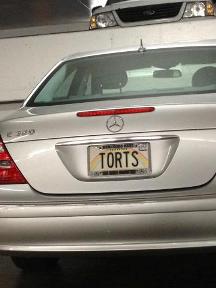
torts license plateA former student from Golden Gate law school who lives and practices in Hawaii sent this picture of a true torts-loving person’s car.

We will engage in outrageous speculation that it belongs to a plaintiffs’ personal injury lawyer.  If you think about it, who else would get a “TORTS” license plate? Maybe geeky law professors with nicknames like Tortman or pattisiers who can’t spell, but really no one else. Insurance defense lawyers wouldn’t do it because it would violate the industry position that torts do not actually exist.

The car owner  obviously loves tort law, but any challenger to the “Most Crazy in Love with Torts” still has to contend with the guy who got Judge Learned Hand tattooed on his arm.  On the other hand, that guy may have simply loved Judge Hand or even barges.

–Thanks to Laura Ozak.

The World’s Greatest Law Review Article

People sometimes (infrequently, slightly more often than “not ever”) ask how I got started writing legal humor.

It was a steaming summer afternoon back in 1995. I sat in my law school office sweating footnotes. Frustrated by the strictures of law review writing requiring that every sentence be documented in a–preferably lengthy–footnote, I snapped. Exiting the article, I dashed off The World’s Greatest Law Review Article, a heavily footnoted parody of real law review articles.

Not knowing what to do with it, I sent it to the American Bar Association Journal. They published it (Oct. 1995, pp. 84-85) and The World’s Greatest Law Review Article struck a chord. Someone spotted it posted on the wall of a law school in Hong Kong. A law review editor wrote to say, “Thank you for helping me make it through life.” A managing partner at the law firm  I worked at before joining academia wrote, “I never realized you were mentally ill.”

The parody led to Harmless Error, my monthly column in the A.B.A. Journal. 

Here’s how it all got started: The World’s Greatest Law Review Article (art by Wayne Slezak).

Test Your Legal Trivia Knowledge: Top Lawyer Movie Heroes

Reprinted from The “Companion Text” to Law School: Understanding and Surviving Life with a Law Student (West 2012) with permission of Thomson Reuters.

Top movie hero of all time.
Top movie hero, Atticus Finch.

Question.  In 2003, the American Film Institute (AFI) released its list of the top fifty heroes in movie history.  How many of those top fifty movie heroes were legal professionals (lawyers or lawmakers) or common citizens who used the law to achieve progressive objectives?

A.  1

B.  4

C.  8

D.  12

E.  15
Answer: C.  The eight legally inclined top fifty movie heroes include, in the number one spot, Atticus Finch (Gregory Peck), the Southern lawyer who fought for justice in a racially charged case in the screen adaptation of Harper Lee’s book, To Kill a Mockingbird.  Mahatma Gandhi, who was trained as a lawyer, came in #21 for Gandhi (Ben Kingsley).  Andrew Beckett (Tom Hanks), the AIDS-afflicted corporate lawyer from Philadelphia, made the list at #49.  Jefferson Smith (Jimmy Stewart)—the protagonist in the Frank Capra classic, Mr. Smith Goes to Washington—reached the #11 spot.  Stewart played a character appointed to fill a vacancy as a U.S. Senator, where he confronted and fought political corruption.  Erin Brockovich (Julia Roberts), a down-and-out paralegal whose sleuthing led to a class action against a toxic waste-dumping corporation in the movie of the same name, checked in at #31.  At #28 we have Juror #8 (Henry Fonda) from 12 Angry Men, the lone juror who refused to vote guilty in the trial of a teenager accused of murdering his father.  The final two characters were workers who became labor union activists fighting for fair, safer working conditions: Norma Rae Webster (Sally Field), from Norma Rae, at #15, and Karen Silkwood (Meryl Streep), from Silkwood, at #47.