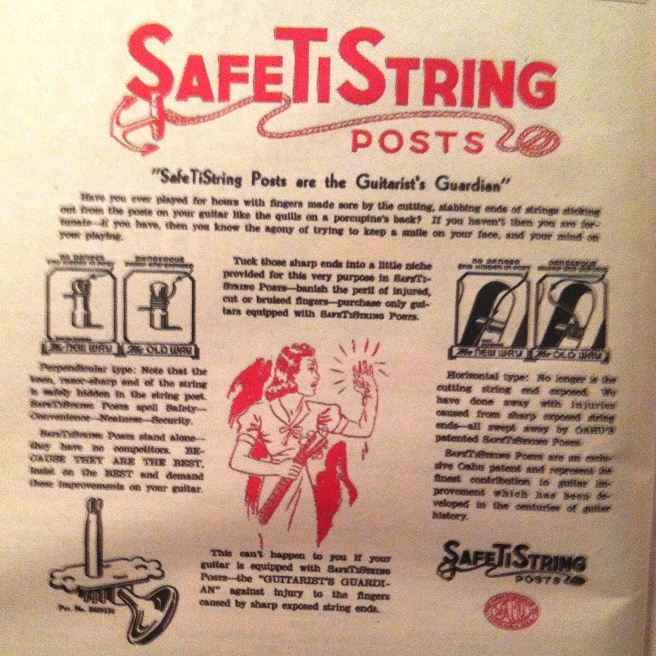
All guitar players have been painfully poked more than once by the sharp ends of the strings where they wrap around the tuners. In the 1930s, Kluson marketed “SafeTiString” tuner posts where the string ends could be neatly tucked away in a slot in the posts to “banish the peril of injured, cut or bruised fingers.”
Neat invention, but apparently too late to save the poor woman pictured in this advertisement reprinted in Vintage Guitar magazine in the Feb. 2013 issue. She appears to be bleeding to death.
Click to enlarge the thumbnail to appreciate her plight.
Lawhaha.com friend and South Florida resident Amy Holland is always on the look out to make the world a safer place. Here’s her latest effort:
Here’s a good spot-the-tort photo for you. We were at a liquor store, and as we were (separately) browsing the aisles, we each tripped over this object in the floor. Thankfully, neither of us was seriously injured, but tripping and stubbing a toe on this thing sure does hurt!
The object, which appears to be a doorstop, is made of heavy metal and anchored to the floor with concrete. I have no idea why someone would place a doorstop in the middle of the floor (as opposed to near the wall). The object is difficult to see given its small size, but the worst part is that it is located near the end of the aisle and centered between two shelves, one of which is full of glass bottles. Because of its location, when a customer (or an invitee, rather) comes around the corner to enter this aisle, he or she will likely trip over the object before it ever comes into his or her field of vision.
Of course, I alerted the manager about the risk, and told him that he should immediately put up a caution sign or hazard cone as a temporary solution, and then have the object removed. He said he would have it removed ASAP, so I went back to the little store last night just to see if anything had been done (okay, okay, so I wanted a glass of wine, too), and as soon as I walked in, the owner/manager said, “Watch out, the doorstop is still there! I am having it fixed, though, I swear!”
About two minutes later, a guy approached the manager as we were standing there chatting, and guess what—he was there to remove the doorstop! The owner/manager was obviously serious (and diligent) about fulfilling his promise, and I thought, good for him!
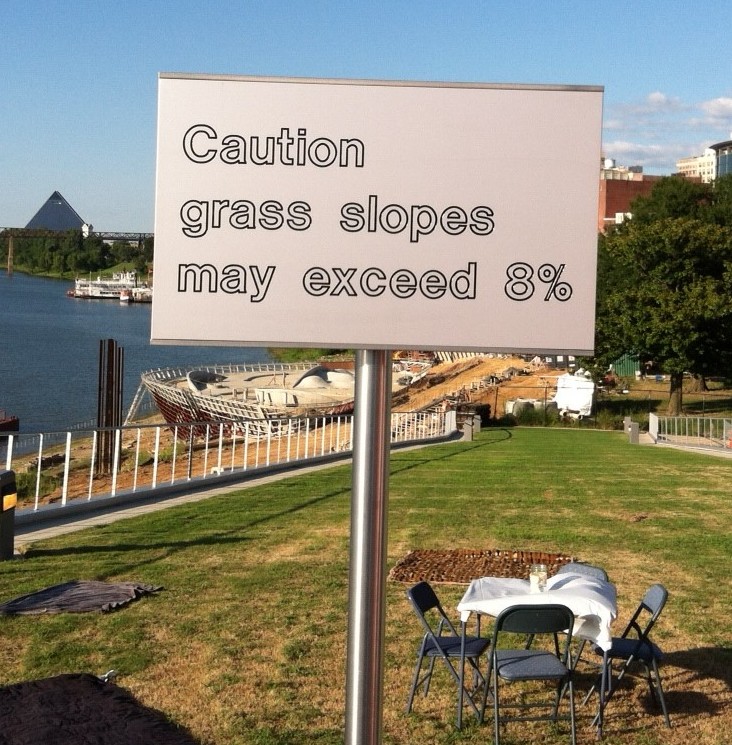
Contrary to Murphy’s Law, most things in life usually go right when it comes to risk and injury. Except in Tortland where the worst that can happen always does.
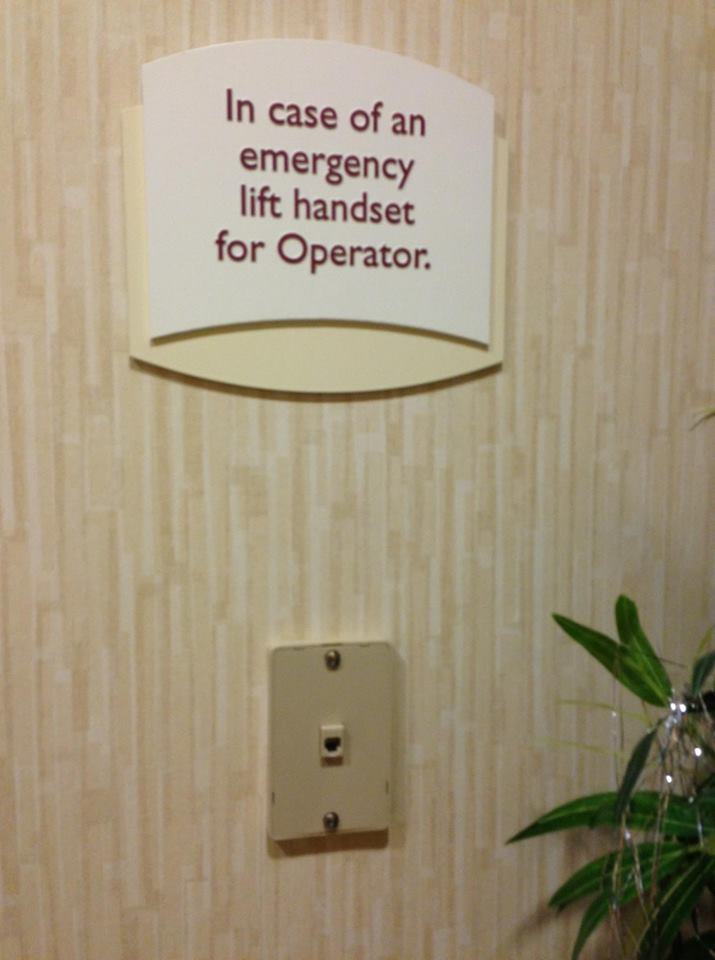
Picture a guest with an emergency, maybe a heart attack or a criminal attack. They reach for the emergency phone as instructed and … oops. No phone.
Easy fix: just take down the sign. No legal duty exists to provide an emergency phone in most situations, but one can assume a duty under tort law that would not otherwise exist by undertaking to render a service that people rely on and then performing it without reasonable care (i.e., negligently).
This story has made the rounds but is worth repeating here if for no reason other than many of my current and former law students at the University of Memphis claim an association with Franklin, Tennessee lawyer Drew Justice, aka Captain Justice.
In a criminal case in which Mr. Justice represents the defendant, the government filed a motion in limine to prohibit the defense from referring to the prosecution as “the government,” asserting it was prejudicial. Justice replied that such a ban would violate the first amendment, but went on to argue, that should the court agree with the government, er, the prosecution, what’s good for the goose should be good for the gander:
Should this Court disagree, and feel inclined to let the parties basically pick their own designations and ban words, then the defense has a few additional suggestions for amending the speech code. First, the Defendant no longer wants to be called “the Defendant.” This rather archaic term of art, obviously has a fairly negative connotation. It unfairly demeans, and dehumanizes Mr. Donald Powell. The word “defendant” should be banned. At trial, Mr. Powell hereby demands be addressed only by his full name, preceded by the title “Mister.” Alternatively, he may be called simply “the Citizen Accused.” This latter title sounds more respectable than the criminal “Defendant.” The designation “That innocent man” would also be acceptable.
Moreover, defense counsel does not wish to be referred to as a “lawyer,” or a “defense attorney.” Those terms are substantially more prejudicial than probative. See Tenn. R. Evid. 403. Rather, counsel for the Citizen Accused should be referred to primarily as the “Defender of the Innocent.” This title seems particularly appropriate, because every Citizen Accused is presumed innocent. Alternatively, counsel would also accept the designation “Guardian of the Realm.”
Further, the Citizen Accused humbly requests an appropriate military title for his own representative, to match that of the opposing counsel. Whenever addressed by name, the name “Captain Justice” will be appropriate. While less impressive than “General,” still, the more humble term seems suitable. After all, the Captain represents only a Citizen Accused, whereas the General represents an entire State.
Along these same lines, even the term “defense” does not sound very likeable. The whole idea of being defensive, comes across to most people as suspicious. So to prevent the jury from being unfairly misled by this ancient English terminology, the opposition to the Plaintiff hereby names itself “the Resistance.” Obviously, this terminology need only extend throughout the duration of the trial — not to any pre-trial motions. During its heroic struggle against the State, the Resistance goes on the attack, not just the defense.
WHEREFORE, Captain Justice, Guardian of the Realm and Leader of the Resistance, primarily asks that the Court deny the State’s motion, as lacking legal basis. Alternatively, the Citizen Accused moves for an order in limine modifying the speech code as aforementioned, and requiring any other euphemisms and feel-good terms as the Court finds appropriate.
Insurance expert, stand-up comic, and friend of Lawhaha.com, Randy Maniloff, penned an interesting article in his latest issue of Coverage Opinions about whether people who get frightened at Halloween haunted houses, with resulting injury, can sue.
He writes:
On any other evening, presenting a frightening or threatening visage might be a violation of a general duty not to scare others. But on Halloween at trick-or-treat time, that duty is modified. Our society encourages children to transform themselves into witches, demons, and ghosts, and play a game of threatening neighbors into giving them candy.” Bouton v. Allstate Ins. Co., 491 So. 2d 56 (La. Ct. App. 1986) (also noting that the Louisiana legislature has recognized Halloween as a special occasion by exempting it from the statute which prohibits the wearing of masks in public places).
But does this “Halloween rule” apply to haunted houses? All sorts of duties are imposed on property owners to maintain a safe premises. Do these same rules apply when the premises are advertised as having, as their only purpose, to scare visitors? Indeed, many visitors will leave a haunted house disappointed if they were not frightened while there. That being the case, can the visitor of a haunted house now turn around and sue for injuries sustained in the process of getting what he asked (and paid) for?
His research turned up five reported judicial decisions in which visitors of haunted houses sought recovery for injuries “sustained on account of being scared.” Notably, the plaintiffs lost every case based on assumption of the risk analysis and the social utility of keeping haunted houses scary and darkly lit. In one case, a startled plaintiff in a pitch-dark house turned to run and ran smack into a brick wall.
Hate to be a party-pooper, but I think there’s a duty to act reasonably to prevent highly foreseeable injuries at premises open to the public. The goal of a haunted house is to terrify, the expected result is that customers will be terrified, and the instinctive response to terror is to run. But no one can see! Give them helmets, maybe even put flashlights on them, or scare them outside where they can run into the cushy-walls of cornfield mazes.
“Eerily,” as Randy notes, all five cases are from Louisiana.
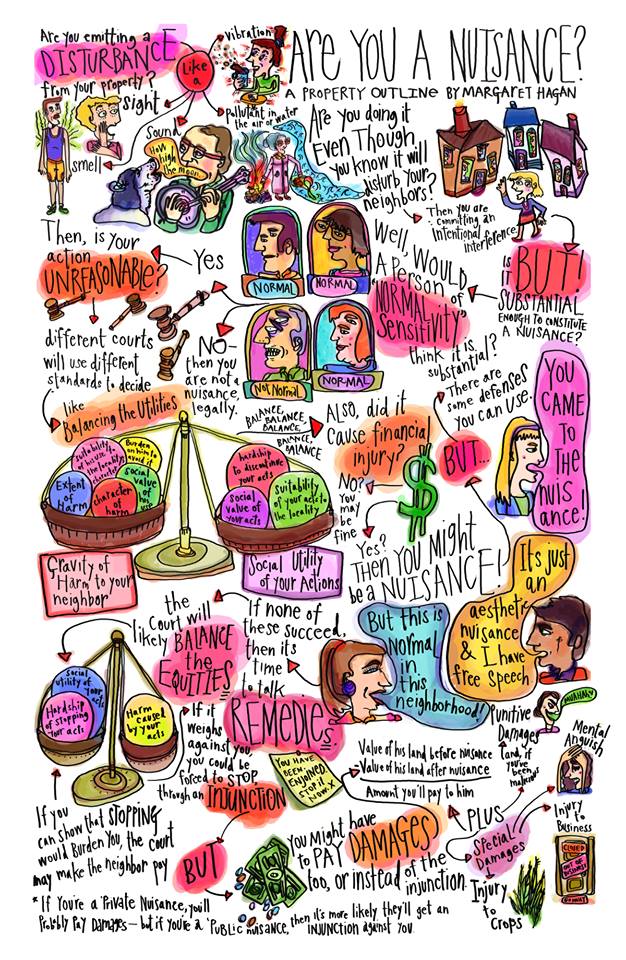
A student from my very first Torts course a million years ago sent me this brilliant flow chart for the tort of nuisance, which comprises substantial and unreasonable interferences with the use and enjoyment of one’s property. The most interesting thing about it is that it actually summarizes the law pretty well, assuming one has dropped acid before studying it. Credit on the chart attributes this work of art to one Margaret Hagen. Well done!
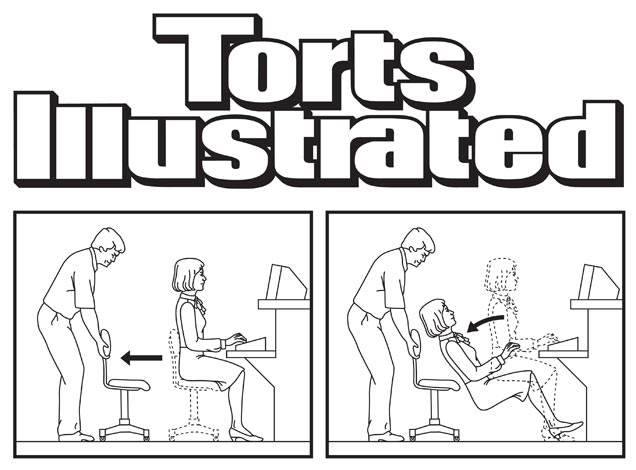
A 1L sent me this “Torts Illustrated” image, sort of a grown-up version of Garrett v. Daily, a famous case that all law students study in which a five-year-old was sued for pulling a chair out from under an elderly woman. If anyone knows the original source, please send it along so we can give proper credit.
In the meantime, one can only imagine what the swimsuit issue would look like.
Already widespread and with seventy-eight million baby boomers in or nearing retirement, elder financial exploitation has been labeled “The Crime of the 21st Century,” yet little is being done to address the problem. While states and the federal government have passed hundreds of laws protecting children based on the assumption they are vulnerable and unable to protect themselves, older at-risk adults have been comparatively ignored despite extensive research showing they too are vulnerable.
A substantial roadblock to prosecuting elder financial predators is the inability to prove the financial transfers at issue were the result of exploitation rather than legitimate transactions. By their nature, most elder exploitation cases do not involve taking property by force or even stealth. Many victims “voluntarily” part with their assets. To outsiders, the transfers may look like gifts or loans, when in fact they occur because of undue influence, psychological manipulation, and misrepresentation.
Arising from a Florida criminal case involving the financial exploitation of the author’s 93-year-old father, this Article proposes an aid to prosecuting elder exploitation in the form of state criminal statutes creating a permissive presumption of exploitation with regard to certain financial transfers from elders. The Article offers a specific statute and explains that it would be workable and constitutional. Preliminarily, the Article explores the scope of elder financial exploitation, discusses why it is grossly underreported and under-prosecuted, and analyzes practical, cognitive, and psychological reasons older adults are vulnerable, focusing on emerging research showing that even elders who lack obvious impairments are at risk.
[Update: In 2014, the Florida Legislature unanimously passed the elder exploitation presumption statute proposed in this article. This one’s for you, Dad.]
Here’s a trivia question for lawyers and law students.
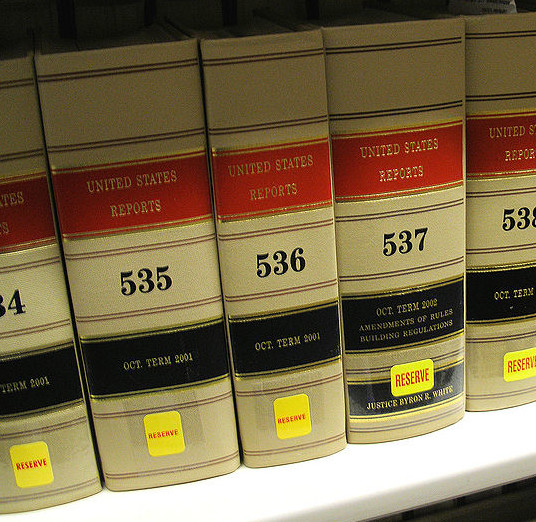
Question: What was the very first opinion issued in the U.S. Reports case reporter; that is, the opinion claiming that coveted number one slot of “1 U.S. 1” as a citation?
Answer: Well, it’s a bit of a letdown. You’d think they’d want to start with a bang, something Marbury-esque. But no, here’s the first case in the U.S. Reports:
The Lessee of Hyam and others
v.
Edwards
April Term, 1759.
1 U.S. 1, 1 Dall. 1, 1759 WL 20 (Pa.), 1 L.Ed. 11
Copy of a Deed inrolled in the King’s Bench in England, proved before the Lord Mayor of London to be a true one; allowed to be given in Evidence to a Jury to support a Title to Lands in this Province.*

 All guitar players have been painfully poked more than once by the sharp ends of the strings where they wrap around the tuners. In the 1930s, Kluson marketed “SafeTiString” tuner posts where the string ends could be neatly tucked away in a slot in the posts to “banish the peril of injured, cut or bruised fingers.”