The National Jurist interviewed me and a couple of other law school prep book authors in its September 2013 issue regarding happiness tips for new law students. Here’s the article:
A litigation strategy the judge thought went too boldly beyond …
In an order littered with Star Trek references, a litigation strategy involving obtaining the copyright to pornographic movies and then suing people for illegally downloading them irked U.S. District Judge Otis D. Wright (C.D. Cal.) to the extent that he levied hefty sanctions against those involved in various misdeeds.
According to Judge Wright, the plaintiffs had outmaneuvered the legal system:
They’ve discovered the nexus of antiquated copyright laws, paralyzing social stigma, and unaffordable defense costs. And they exploit this anomaly by accusing individuals of illegally downloading a single pornographic video. Then they offer to settle—for a sum calculated to be just below the cost of a bare-bones defense. For these individuals, resistance is futile; most reluctantly pay rather than have their names associated with illegally downloading porn. So now, copyright laws originally designed to compensate starving artists allow, starving attorneys in this electronic-media era to plunder the citizenry.
The following findings of fact flesh out the situation a bit more:
2. AF Holdings and Ingenuity 13 have no assets other than several copyrights to pornographic movies. There are no official owners or officers for these two offshore entities, but the Principals are the de facto owners and officers.
3. The Principals started their copyright-enforcement crusade in about 2010, through Prenda Law, which was also owned and controlled by the Principals. Their litigation strategy consisted of monitoring BitTorrent download activity of their copyrighted pornographic movies, recording IP addresses of the computers downloading the movies, filing suit in federal court to subpoena Internet Service Providers (“ISPs”) for the identity of the subscribers to these IP addresses, and sending cease-and-desist letters to the subscribers, offering to settle each copyright infringement claim for about $4,000.
4. This nationwide strategy was highly successful because of statutory copyright damages, the pornographic subject matter, and the high cost of litigation. Most defendants settled with the Principals, resulting in proceeds of millions of dollars due to the numerosity of defendants.
An apparent Star Trek fan, Judge Wright began his order imposing sanctions by quoting Spock from Star Trek II: The Wrath of Khan: “The needs of the many outweigh the needs of the few.”
Not sure of the exact relevance of this quotation. Was he referring to the needs of the many for illegally downloaded porn?
He continued mining the Star Trek vein at various parts of the order, stating, for example, that “though Plaintiffs boldly probe the outskirts of law, the only enterprise they resemble is RICO. The federal agency eleven decks up is familiar with their prime directive and will gladly refit them for their next voyage” and “[i]t was when the Court realized Plaintiffs engaged their cloak of shell companies and fraud that the Court went to battlestations.”
Order Issuing Sanctions, Ingenuity 13 LLC v. John Doe, Case No. 2:12-cv-8333-ODW(JCx), May 6, 2013, U.S. District Ct., Central District of California. Thanks to Michael Kong.
Insurance law expert and humorist in his own right, Randy Maniloff, did a nice interview with me in the latest issue of Coverage Opinions, his bi-weekly electronic newsletter reporting and commenting on new court decisions addressing insurance coverage disputes.
He asked a lot of great questions covering everything from the state of product warnings the state of legal education.
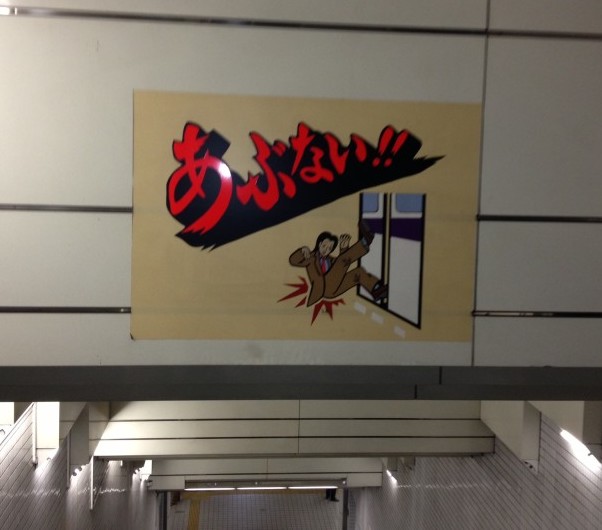
This very large sign in a Tennessee restaurant contends with the Tokyo Subway warning for The World’s Largest Warning, but it’s more interesting than that.
In the Southern United States, and perhaps in other parts of the country, it is popular for some restaurants to serve peanuts and encourage customers to throw the shells on the floor. Forget that it’s an unreasonable risk for a business invitor to have debris or other objects on the floor where customers are known to walk, or that slip and fall cases rank in the double digits percentage-wise among all tort lawsuits. It’s FUN to throw trash on the floor!
The fact that customers are on notice that peanut shells litter the floor– and it would be hard to content otherwise given this enormous sign, give them credit for that–probably is not sufficient to protect a business from liability if someone slips and gets injured. The fact that a danger is obvious is a defense only if the danger can be navigated safely with knowledge of the risk which, I would argue, is not true of a shell-strewn floor, which is probably dark and traveled on frequently by customers consuming alcohol.
As for the “Loud Music” warning, this could be an attempt at humor, as the entire sign could be, or it could be a legitimate warning that the music played in the establishment is loud enough to cause hearing damage. It raises an interesting question I have long wondered about: Is a music venue negligent if it plays music at a level that causes hearing damage or is that a risk music fans assume? Even though I sing and play in loud rock bands, I assert it is negligent to play music the venue owner reasonably knows or should know is above the decibel-level known to cause hearing damage.
One year when I was teaching at a law school in San Francisco, I was at a Fillmore show. I forget who the band was but the music was so loud that it felt literally deafening. My ears ached and I could see my clothes flatten with every bass note. I went to the soundman and tried to explain it was too loud. He couldn’t hear what I was saying, of course. I shouted louder and when he figured it out, he looked at me like I was crazy.
Persons and entities with a duty to warn of risks under tort law are often accused of hiding the warnings in the fine print or otherwise not making them sufficiently conspicuous. But the administrators of the Tokyo subway could never be accused of that, as shown in this mural-size slip and fall warning.
If there’s a Guinness Book of World Records entry for the largest risk warning, this one might contend. Good job, Tokyo subway.
Comparative Law Tangent: Many Americans think personal injury lawsuits are common only in the United States and attributable to far out U.S. tort law principles. Actually, basic tort law principles are remarkably similarly throughout much of the world. I learned this co-authoring Practical Global Tort Litigation: United States, Germany and Argentina with Adem Koyuncu and Luis Sprovieri.
Oversimplified, the principal tort law and litigation differences between the United States and many countries can be reduced to five:
1. Higher noneconomic damages (e.g., damages for intangible injuries such as physical and mental pain and suffering, disability and disfigurement) in the United States .
2. The fact that most developed countries have public health care with the result that injured tort victims do not have to sue to recover large medical expense obligations (lifetime medical expenses in the United States for catastrophic injury cases such as quadriplegia can exceed $20 million).
3. The availability of civil punitive damages in the United States to punish and deter particularly egregious wrongdoers, which are not available in most other countries (but other countries may be more willing to criminally prosecute and fine offenders who endanger public safety).
4. The “loser pays” rule that applies in most countries, but generally not in the United States. The loser pays rule requires the losing party to bear not only their own attorney fees and litigation costs, but their opponent’s. In the United States, each side generally bears its own legal fees, win or lose.
5. The wider availability of discovery in the United States. Discovery is a process by which each side gets access to the facts in the possession of the other side, with the goal that all relevant facts will be presented at trial and the case will be decided on those facts.
But I got carried away. The point of this post is that this is one huge warning!
Someone sent a message in response to the Warning: Playing Stairway to Heaven is Prohibited post asking if I was making up the part about playing in Memphis rock cover bands. It’s true. As dubious as the proposition sounds, law professors can actually rock (or at least we think we can).
Below is a sample from our most recently disbanded band, The Vynals, having fun playing surf music at a festival outside of Memphis (a medley of Surfin’ USA by the Beach Boys and Wipeout by the Safaris). Wait, it gets even more incredulous. Now we’re forming The World’s Oldest Punk Band. (Similar to The World’s Greatest Law Review Article, but with fewer footnotes.)
Federal judge a fan of this venerable exotic dancer.
Chief U.S. District Court Judge Fred Biery, W.D. Tex, had a great time writing a preliminary injunction order in a case in which the City of San Antonio passed an ordinance regulating topless dancers, including requiring them to wear more clothes. How much fun did he have? The title of the order gives a good clue:
“The Case of the Itsy Bitsy Teeny Weeny Bikini Top v. The (More) Itsy Bitsy Teeny Weeny Pastie,” with a footnote to—you guessed it—the novelty hit, Itsy Bitsy Teeny Weeny Yellow Polka Dot Bikini (Knapp Records 1960). The order is a combination of lame sexually oriented wordplay and thoughtful analysis. Here are two sample paragraphs of the former (underline added):
An ordinance dealing with semi-nude dancers has once again fallen on the Court’s lap. The City of San Antonio (“City”) wants exotic dancers employed by Plaintiffs to wear larger pieces of fabric to cover more of the female breast. Thus, the age old question before the Court, now with constitutional implications, is: Does size matter?
The Court infers Plaintiffs fear enforcement of the ordinance would strip them of their Profits, adversely impacting their bottom line. Conversely, the City asserts these businesses contribute to reduced property values, violent crime, increased drug sales, prostitution and other sex crimes, and therefore need to be girdled more tightly. Plaintiffs, and by extension their customers, seek an erection of a constitutional wall separating themselves from the regulatory power of City government.
The order then veers into hyper-weirdland, explaining that while no amicus curiae briefs had been filed, the court had the benefit of input from volunteer “curious amigos” who performed on-site inspections. Judge Biery advises the volunteers “they would have enjoyed far more the sight of Miss Wiggles, truly an exotic artist of physical self expression even into her eighties, when she performed fully clothed in the 1960s at San Antonio’s Eastwood Country Club.” He even includes a picture of Miss Wiggles. Er, thanks for that, Judge.
Things settle down at that point with an analysis of the request for preliminary injunction by the plaintiff club owners, pitting the government’s interests in reducing crime and protecting property values against the First Amendment. Under the law, the club owners can get a license and let their dancers wear pasties or operate without a license and make them wear bikini tops.
Judge Biery wasn’t convinced female breasts were the cause of the government’s asserted ills, saying he “doubts several square inches of fabric will stanch the flow of violence and other secondary effects emanating from these businesses” and speculating that “[a]lcohol, drugs, testosterone, guns and knives are more likely the causative agents.”
But he denied the preliminary injunction because the law does not require the government to prove causation in this instance, ending with more provocative wordplay (“Should the parties choose to string this case out to trial on the merits, the court encourages reasonable discovery intercourse as they navigate the peaks and valleys of litigation, perhaps to reach a happy ending.”)
(Postscript: A student sent me this, but many other sources have publicized this order, including Above the Law and the ABA Journal.)
—35 Bar and Grille v San Antonio, 35 Bar & Grille, LLC, et al. v. City of San Antonio, Civil Action No. SA-13-CA34-FB (W.D. Tex., Apr. 29, 2013) (Biery, J.)
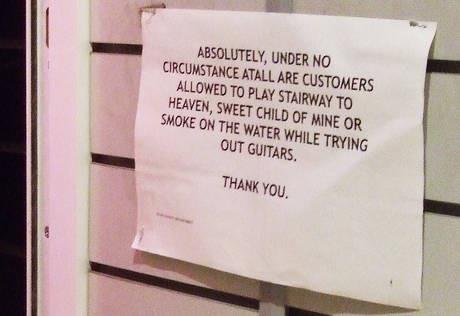
As a hobby, I sing and play in Memphis rock cover bands. At the Young Avenue Deli in the Cooper-Young neighborhood of Memphis, the sound guy has a sign posted warning bands: “$20 Fine for Playing Brown-Eyed Girl or Mustang Sally.”
If you’re a music fan, you might be thinking, “Why? Those are both great songs.” They definitely are, which is why 90 percent of cover bands play them, which in turn is why sound guys hate them.
We encounter a similar phenomenon with guitar players. Every guitar player learns or tries to learn certain fundmental songs and riffs, including Stairway to Heaven (first song I ever learned back in college), Smoke On the Water, and Sweet Child O’ Mine.
In response we get this admonishment from a music store that:
ABSOLUTELY, UNDER NO CIRCUMSTANCE AT ALL ARE CUSTOMERS ALLOWED TO PLAY STAIRWAY TO HEAVEN, SWEET CHILD OF MINE OR SMOKE ON THE WATER WHILE TRYING OUT GUITARS. THANK YOU.
–Thanks to my bandmate Ron Lefkowitz for this one.

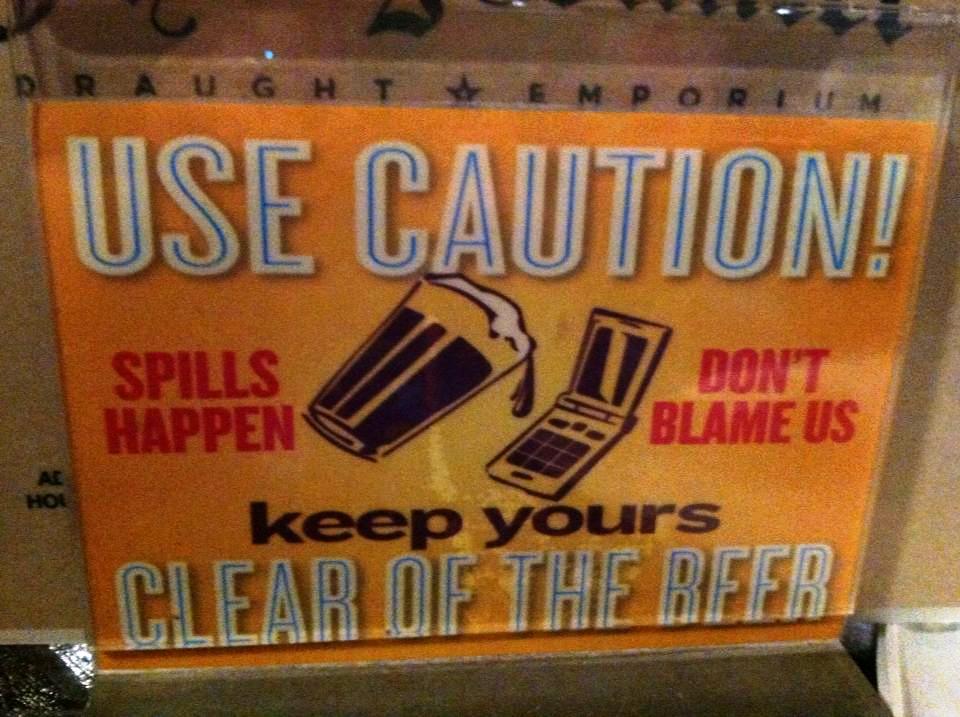 A recent graduate sent me this warning from a bar: “USE CAUTION! SPILLS HAPPEN … DON’T BLAME US … keep yours [your phone] CLEAR OF THE BEER.”