Nice Shout-Out to The “Companion Text” to Law School

The "Companion Text" to Law SchoolMy law school prep book, 1L of a Ride, gets a lot more attention, but my book written for the loved ones of law students–The “Companion Text” to Law School: Understanding and Surviving Life with a Law Student (West 2012)–got a nice shout-out on Paul Caron’s popular TaxProf blog.

Thanks to Al Sturgeon, Dean of Students at Pepperdine Law, for  his insightful take on my chapter called Eight Things to NEVER Say to a Law Student, which include:

  1. “Don’t Worry, You’ll Do Fine”
  2. “Maybe You Weren’t Meant to Be in Law School”
  3. “Remember, It’s Only a Test”
  4. “Is That the Best You Could Do?”
  5. “Do You Really Have to Work on That Tonight?”
  6. “What Kind of Lawyer Do You Want to Be?”
  7. “Do You Have a Job Yet?”
  8. “Have You Heard the One About the Lawyer, the Shark, and the Pornographer?”

If you’re attending or planning to attend law school and want your loved ones to understand your crazy, stressful journey, check out The “Companion Text” to Law School.  Here’s the Table of Contents.

Great-Grandma Unhappy About Being in Court

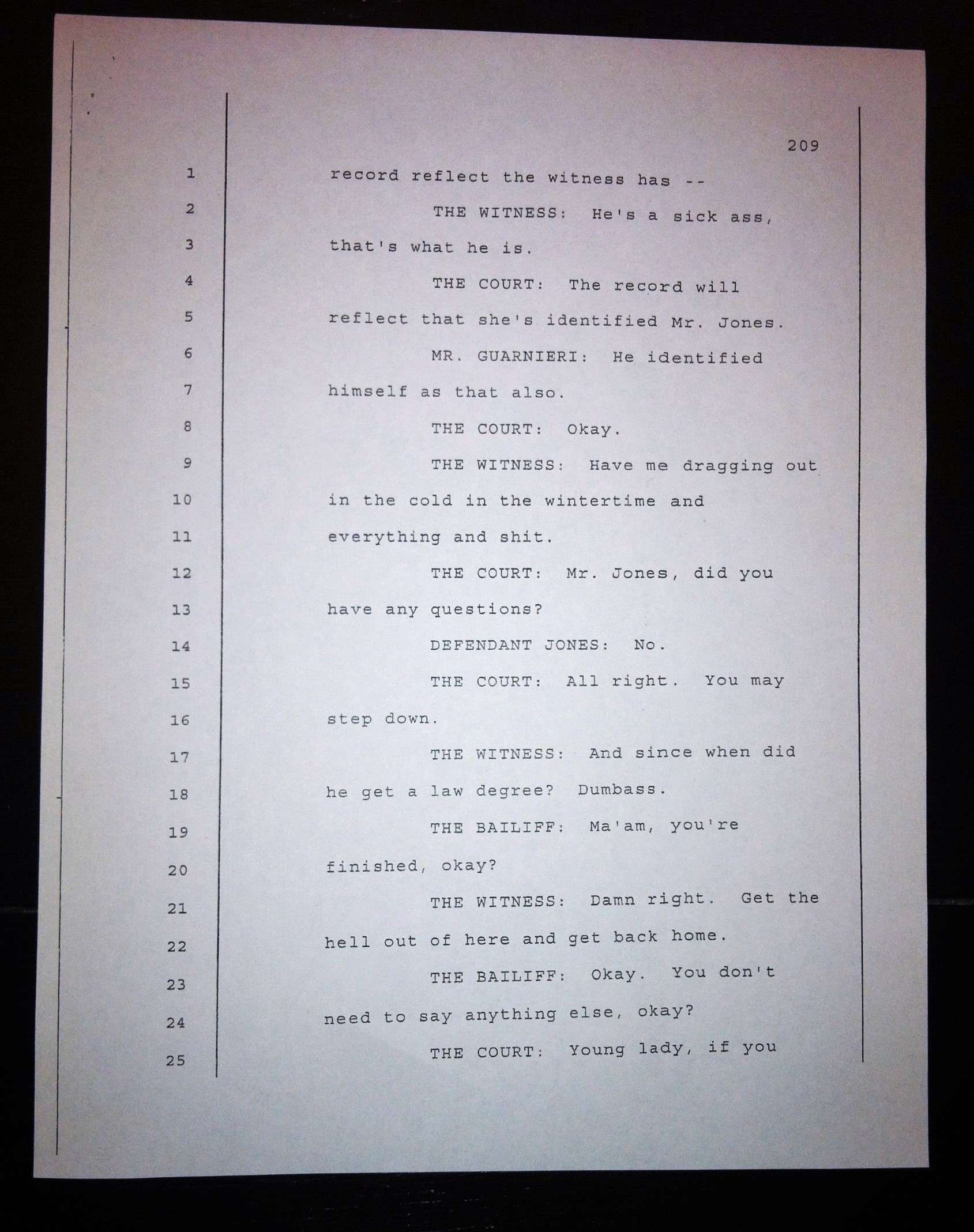
Great-granny unhappy with court appearance.A fleeing bank robber made the mistake of seeking refuge in his 94-year-old great-grandmother’s home with pursuers hot on his trail. When the police arrived, the only ones present were the accused and great-grandma. At trial, the defendant, Mr. Jones, elected to represent himself, never a good idea.

The prosecution called his great-grandma as a witness. To say she wasn’t happy about the proceedings and, in particular, the conduct of her great-grandson would understate her disenchantment with sitting in the witness box.

We’ll let her explain. Here’s the text of page 209 of the trial transcript shown in the photo, where she concludes her testimony:

 THE WITNESS: He’s a sick ass, that’s what he is.

 THE COURT: The record will reflect that she’s identified Mr. Jones.

 …

 THE WITNESS: Have me dragging out in the cold in the wintertime and everything and shit.

 THE COURT: Mr. Jones, did you have any questions?

 DEFENDANT JONES (the great-grandson): No.

 THE COURT: All right. You may step down.

 THE WITNESS: And since when did he get a law degree? Dumbass.

 THE BAILIFF: Ma’am, you’re finished, okay?

 THE WITNESS: Damn right. Get the hell out of here and get back home.

 THE BAILIFF: Okay, you don’t need to say anything else, okay?

Law degree or not, give the great-grandson credit for the smart strategy decision not to cross-examine.  Small wonder the prosecutor described the great-grandmother as “one of the most entertaining witnesses this writer has ever encountered” in the state’s appellate brief.

— Trial Transcript, State of Ohio v. Jones, Case No. 2014CA-00051, at 209 (Ohio 5th Ct. App.).  Thanks to Laura Ozak.

Death Certificate Shows Man Died from Slipping on Banana Peel

Poor guy died from slipping on a banana peel.

Slipping on a banana peel is, of course, a classic clichéd accident depicted in cartoons.  As my 1Ls get ready to tackle the famous trilogy of banana peel slip and fall cases in the Prosser, Wade & Schwartz Torts casebook next week, the nagging question that lingers is: do people really slip on banana peels?

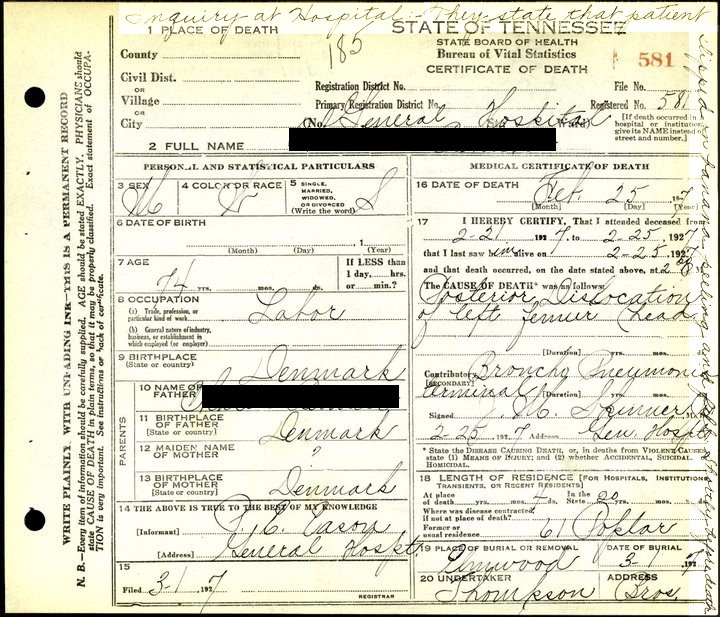
A previous post discussed this issue, but check this out.  It’s a 1927 Tennessee death certificate for a 74-year-old hospitalized man.  A bit hard to read, but the highlighted note written across the top and going down the right side says:

Inquiry at Hospital: They state that patient slipped on banana peeling and fell shortly before death.

Warning: Figure Out These Pictorial Warnings

Dehumidifier Warning - Let's Dance
“Let’s Dance”

We love pictorial warnings at Lawhaha.com, as shown by the samples here, here, herehere, and here.  These are supposedly universal warnings designed to be understood by everyone.  As in these warnings on the outside of a dehumidifier box, they are often accompanied by written warnings.  But not everyone can read the written warnings, either because of language barriers or simply an inability to read.

So how do these pictorial warnings rate?  When I look at the first one, all I can think of is the David Bowie song, “Let’s Dance.”  What is it trying to convey?  That you need two people to pick the thing up.  I think that one probably works, assuming for the sake of argument that people need a warning not to pick up large heavy objects without assistance.

Dehumidifier Warnings Part 2These next three warnings on the same box are a mixed bag.  No idea what “4” stands for.  Assuming it’s something on a scale, but “4” out of what?  And what is it measuring?  Please send word.  The second one might be a warning to not put your wine glass on the dehumidifier, but, on the outside packaging, it’s probably a warning that the contents are breakable.  The third one?  Who knows?  Don’t stomp on it?  Don’t kick it?  Hmm, maybe don’t stand on it, which I could see, but if that’s the case, shouldn’t they have a box under the boot?

We like to have fun with these, but let’s face it, the real problem is that it’s almost impossible to meaningfully convey most product warnings via a symbol.

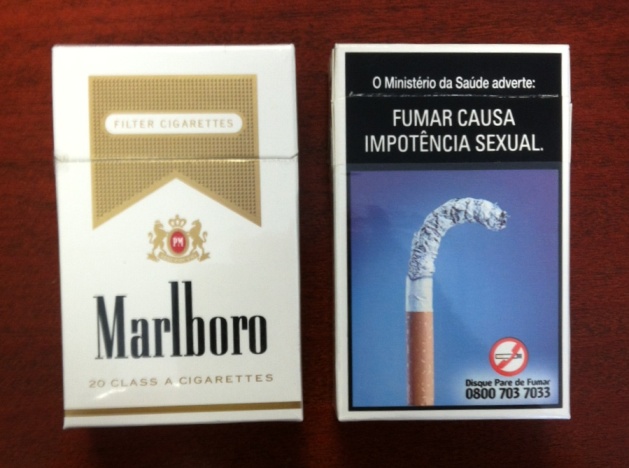
Warning: Smoking Causes Impotence

Graphic cigarette warnings

And a whole lot of other undesirable results.

The World Health Organization (WHO) directs, in Article 11 of the WHO Framework Convention on Tobacco Control, that parties to the convention “implement large, rotating health warnings on all tobacco product packaging and labelling.”

The WHO website shows twenty countries (and their mandated warnings) currently participating, including Brazil, which is where the Florida International University law student who gave me this pack of Marlboros purchased it.

Some of the warnings are much more graphic.

Other countries mandate pictorial warnings without belonging to the WHO convention.  In the United States, graphic pictorial warnings on cigarette packages were torpedoed by a lawsuit in which the tobacco industry successfully argued before the U.S. Circuit Court of Appeals for the D.C. Circuit in R.J. Reynolds Tobacco Co. v. FDA that requiring them to put pictorial warnings on “the top 50 percent of the front and rear panels of cigarette packages and 20 percent of the area of each cigarette advertisement” violated their First Amendment rights.

The warnings were authorized by the Family Smoking Prevention and Tobacco Control Act of 1989, which directed the U.S. Dep’t of Health and Human Services to adopt regulations requiring cigarettes to bear “color graphics depicting the negative health consequences of smoking.”

The Obama Administration backed away from the requirements after the decision.

The data is mixed as to whether pictorial cigarette warnings change smoking behavior.  A study of 4000 smokers in Malaysia and Thailand found the warnings had an effect in Thailand, but not Malaysia.

Best Case Name Contest

A former student of mine at the Florida International University College of Law sent this along, his entry for “Best Case Name of the Month.”

This month’s contestant is Wise v. Strong, 341 S.W.2d 633, 634 (Mo. Ct. App. 1960).

Spoiler alert: Strong wins.  Strong always wins.  *Tear.

Send along any entries you come up with!

–Thanks to Michael Hirschkowitz.

Suzy Spikes — America’s Favorite Little Litigator

“We live in a hideously unjust society where the only thing anyone cares about is oppressing precious, innocent children.” — Suzanne Marie Spikes

So proclaimed 11-year-old Suzy Spikes immediately before her parents imposed sentence in Spikes v. Spikes, Case No. 1,094,908, in which Suzy was charged with 48 counts of Bad Attitude with Intent to Act Like a Teenager. Just another day in the life of poor Suzy Spikes.

Check out Suzy’s world by clicking on the links below (or just scroll down). Make sure you’re well-insured and keep your lawyer’s number handy:

Sentencing Suzy ★ ★ ★ ★ (1998 Drama) Litigious adolescent defends herself against battery charges involving misplaced Monopoly game piece.

Suzy Assumes the Risk ★ ★ ★ ★ (1998 Action) Litigious adolescent engages in hijinks on the soccer field while coaches seek to avoid tort liability.

Suzy’s Re-dress ★ ★ ★ ★ (1999 Noir) Litigious adolescent crusades against school dress code on behalf of garment-oppressed youth.

Suzy’s Breach ★ ★ ★ ★ (2000 Comedy) Litigious adolescent fights for free speech against media conglomerate bent on making her pay for magazine subscription.

Suzy’s Soulmate ★ ★ ★ ★ (2001 Romance) Litigious adolescent struggles to find love, only to lose it over a contract dispute.

Suzy Spikes appeared in five Harmless Error columns, all of which found her using the law to fight for childhood freedom from tyranny wherever it raised its ugly head, which basically was anywhere Suzy went. Suzy, modeled after my own strong-willed daughter, was the ultimate champion of children’s rights, especially her own.

A sitcom pitch for the “The Legal Life of Suzy Spikes” impressed a certain well-known executive producer of a popular cable network devoted to the younger set, but did not materialize. Perhaps the fear of Suzy coming to life and suing everyone for misappropriating her celebrity right of publicity scared off the honchos. (Note to entertainment execs: Multimillion dollar television and movie deals can be easily negotiated on Lawhaha.com simply by using the Contact link found at the top of every page.)

Law Review Articles CAN Have An Impact

Preying on the Graying coverOne doesn’t have to look far to find criticism of law professors for spending such a large portion of their time writing long, heavily foonoted, sleep-inducing law review articles.  We even poke fun at ourselves for it, Exhibit A being The World’s Greatest Law Review Article.

But law review articles can and do have an impact.  Have to share the good news that my proposal for a statutory presumption of elder financial exploitation in my recent Hastings Law Journal article, Preying on the Graying: A Statutory Presumption to Prosecute Elder Financial Exploitation, was signed into law by Florida Governor Rick Scott on June 20.  The proposal passed unanimously through every legislative committee and both the Florida House of Representatives and Florida Senate, showing that at least some bipartisan issues still exist.

Don McClurg, USS JeffersThe article arose from a cruel financial exploitation incident involving our remarkable dad shortly before he passed away last year.  He’s shown here during WWII.

On October 1, 2014, when the law takes effect, prosecutors in Florida will have several more tools at their disposal.  In addition to my presumption statute, the new law (HB 409/Offenses Against Vulnerable Persons) creates the nation’s only elder hearsay exception and eliminates the requirement of proving deception or intimidation in elder exploitation cases.

Elder financial exploitation is a problem of enormous scope and growing rapidly as baby boomers age.  The crimes are notoriously underreported and under-prosecuted, often due to the same factors that make older adults vulnerable to exploitation in the first place.  If you care about this issue and know a legislator in your state, contact them and let them know they can help by supporting legislation similar to Florida’s.

In the meantime, watch after your own elders.  Don’t make the mistake of assuming they are immune to exploitation.  We would have voted our father to be the World’s Most Unlikely Victim.