Exercise your First and Second Amendment rights in the same place.
Former student Ben Wilkins took a trip to Somerville, Tennessee to search through deeds from decades past. Now that’s genuine, old-fashioned lawyering.
While there, he snapped this picture, astutely noting that he’d found a place where one can exercise their First and Second Amendment rights at the same time.
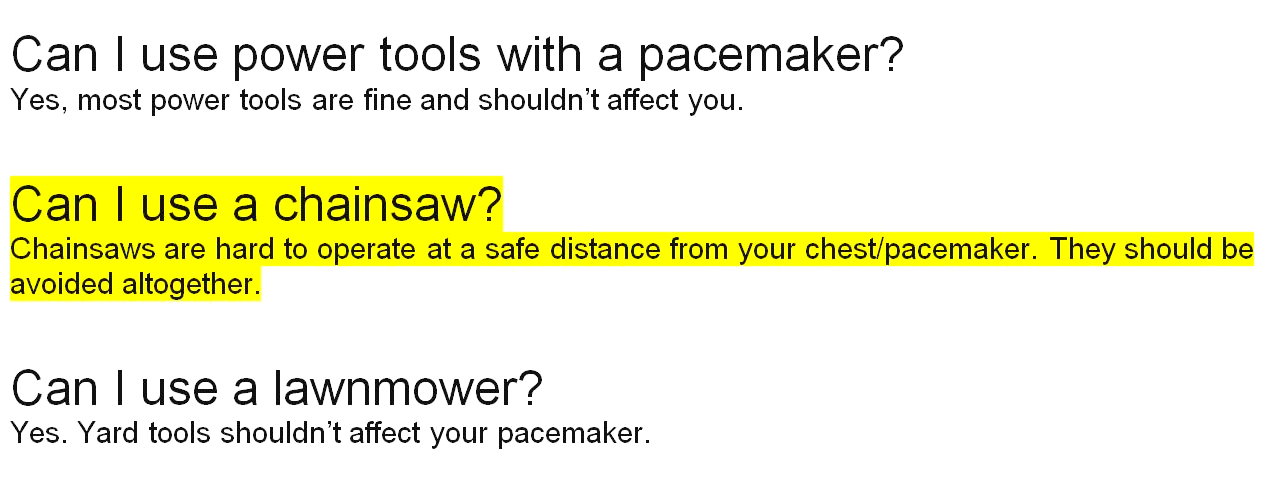
The highlighted warning in this image sounds like a joke, but it’s part of a real set of FAQs on a pacemaker information site.
Overall, it’s good news. You can use a lawn mower and other power tools with a pacemaker, but not chainsaws:
Can I use a chainsaw?
Chainsaws are hard to operate at a safe distance from your chest pacemaker. They should be avoided altogether.
Hard to argue with the factual assertion. The user would either: (1) have to rip the pacemaker out of his chest and leave it in the house; (2) set the chainsaw up in the backyard, start it, and run like hell; or (3) tap in to Rubber Man’s secret.
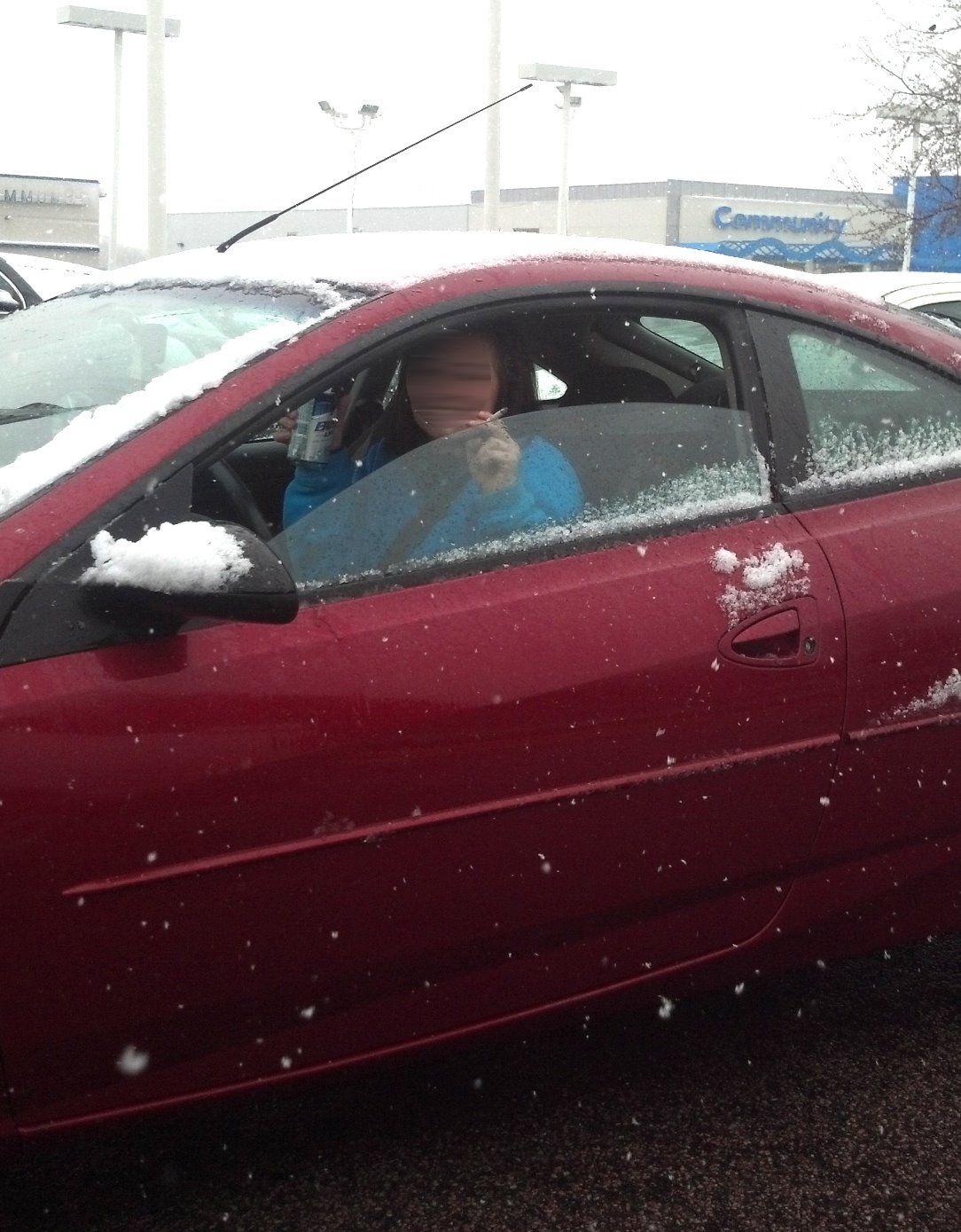
Courtesy of a law student at St. Thomas law school in Minneapolis comes this drinking, phone-talking, smoking driver and proud tortfeasor. As the student explained:
Here’s a potential tort for you. I’m a law student at University of St. Thomas (Minneapolis). While driving through Iowa, I spotted a girl drinking a beer, smoking a cigarette and talking on the phone. When she saw me taking a picture, she even posed for me.
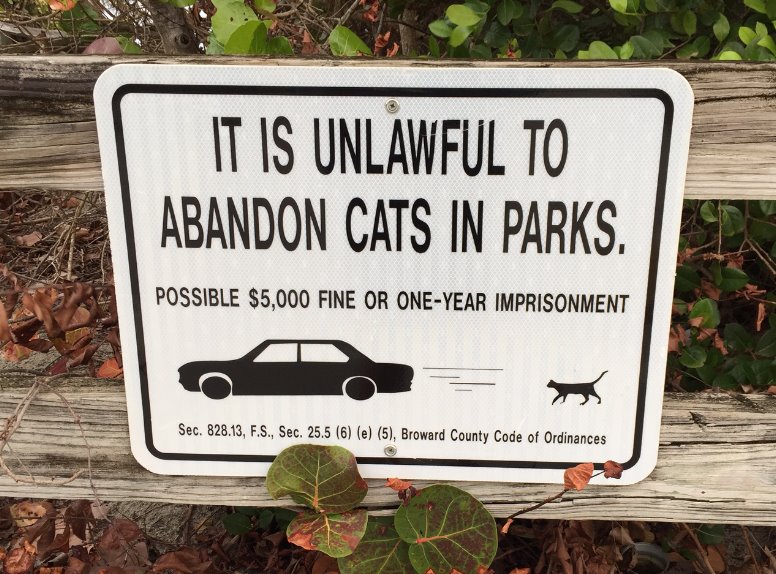
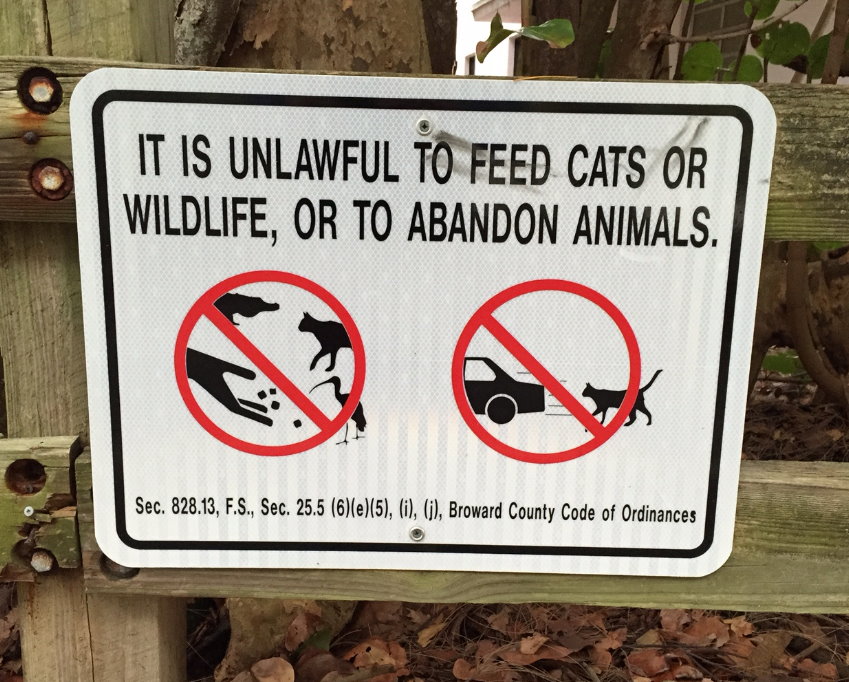
So I’m taking a pleasant walk along a Florida beachfront park and encounter this sign warning that it is a crime, punishable by up to one year in prison, to abandon cats in the park. I’m thinking, “That’s weird.”
Then I get to a second sign warning it is unlawful to feed or abandon cats or other animals. Unlawful to feed a cat? Wait a minute.
At this point, I’m thinking, “Aren’t we engaging in some serious overkill on the cat issue?”
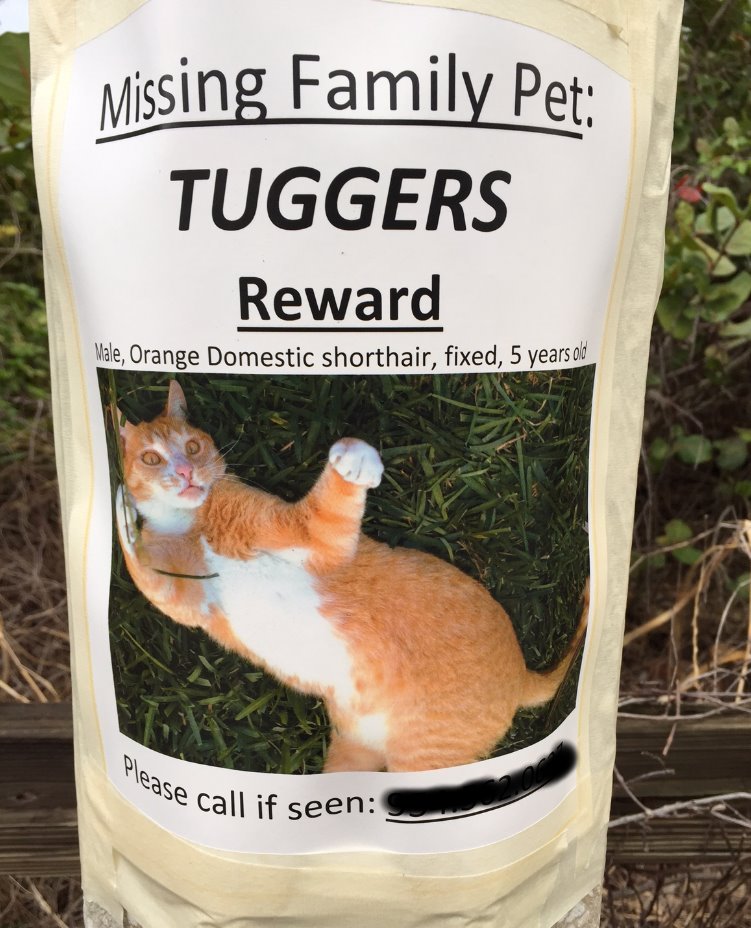
But then I come to a third sign and go, “Uh-oh.” Did Tuggers run away to join the other cats?
Poor Tuggers. Hope he is found. In the meantime, if you are at the beach and come across an Orange Domestic Shorthair sunbathing or shell collecting, be felonious (or it is feline-ious) and feed the poor thing.
Meanwhile, anyone who would abandon a cat deserves a bad fate.
Don’t think for a minute that Canadian judges can’t keep up with American judges when it comes to Strange Judicial Opinions. Wild and crazy judicial happenings in Canada are here, here and here.
Now comes a new hit TV series, I mean, an order in a divorce case, entered by Superior Court Justice Pazaratz, where the court analogized the parties’ ugly divorce to the hit television show, Breaking Bad. Excerpts from the order include:
1. Breaking Bad, meet Breaking Bad Parents.
2. The former is an acclaimed fictional TV show whose title needed a bit of explaining: “BREAKING BAD: A southern U.S. expression for when a good person suddenly loses their moral compass and starts doing bad things”.
3. The latter is a sad reality show playing out in family courts across the country. “BREAKING BAD PARENTS: When smart, loving, caring, sensible mothers and fathers suddenly lose their parental judgment and embark on relentless, nasty litigation; oblivious to the impact on their children”.
4. SPOILER ALERT: The main characters in both of these tragedies end up pretty much the same: Miserable. Financially ruined. And worst of all, hurting the children they claimed they were protecting.
5. To prolong the tortured metaphor only slightly, the “urgent” motion before me might be regarded as this family’s pilot episode. Will these parents sign up for the permanent cast of Breaking Bad Parents? Will they become regulars in our family court building, recognizable by face and disposition? Or will they come to their senses; salvage their lives, dignity (and finances); and give their children the truly priceless gifts of maturity and permission to love.
6. Stay tuned.
[The court proceeds to recount the parties’ inability to work together, accusations and counter-accusations, and their deadlock in trying to reach a custody sharing arrangement. The Court decides on a reasonable arrangement before wrapping things up.]
36. One final comment:
37. I hope I didn’t offend the parties with my Breaking Bad Parents analogy. They’re not bad parents. Yet.
38. Mainly, I was trying to give both parties a sobering warning: Stop!
39. Stop being nasty.
40. Stop jockeying for position.
41. Stop playing hardball.
42. Stop acting like you hate your ex more than you love your children.
All good advice, Justice Pazaratz, but you’ve just ruined the potential for the TV series.
–Coe v. Tope, Case No. 2839/14, Ontario Superior Court of Justice (July 3, 2014). Thanks to whoever sent this along. We lost track of the original email. Let us hear from you!
It’s the season to reprise those two holiday favorites from the Harmless Error vault:
Santa Suit — The children of the world file a class action lawsuit seeking redress for perceived grievances against the man in the red suit. (Caroline Kennedy selected this column for inclusion in her A Family Christmas anthology.)
Santa Strikes Back — Turns out the jolly one has his own issues about his Christmas job. Mightily ticked off, he files his own lawsuit.
Thanks to legal humorist extraordinaire Randy Maniloff for a nice shout-out to Lawhaha.com as part of his recent article exploring cartoon accident clichés that found their way to the courthouse.
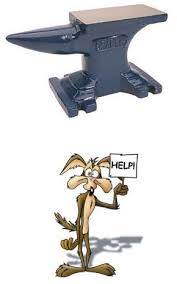
Exploding cigars, falling anvils, you name it. Turns out the experiences of Wile E. Coyote and Tom and Jerry also happen to ordinary people, and Randy cites the cases to prove it.
That’s one of the things we most appreciate about him. Like Lawhaha.com (and unlike so many purveyors of legal humor), Randy doesn’t circulate undocumented anecdotes that may or may not have really happened. He researches and provides citations to everything.
Ryan A. Malphurs conducted an interesting study of laughter in proceedings before the U.S. Supreme Court, following up on the work of Jerry Wexler for the New York Times. His entire article is must-reading for fans of legal humor, but this attention-grabbing opening excerpt from an oral argument in Safford Unified School District v. Redding certainly stands out:
Justice Breyer: In my experience when I was 8 or 10 or 12 years old, we did take our clothes off once a day, we changed for gym, okay? And in my experience, too, people did sometime stick things in my underwear–
(Laughter.)
Justice Breyer: Or not my underwear. Whatever. Whatever. I was the one who did it? I don’t know.
Studying all notations of “(Laughter)” appearing in the Court’s oral argument transcripts during the 2006-2007 term, Malphurs found 131 instances of ha-ha outbursts.
–Ryan A. Malphurs, “People Did Sometimes Stick Things in my Underwear”: The Function of Laughter at the U.S. Supreme Court, 10 Communication L. Rev. 48 (2010).
A Word Cloud reveals the stress and anxiety of 1Ls.
This is Part II of an exploration of psychological distress in law students. Part I explored empirical research showing the extent to which law students suffer from psychological dysfunction such as anxiety and depression. This part highlights a couple of non-scientific indicators of the problem.
Mid-semester, I asked a class of first-year Torts students to list their three top emotions about law school. Then I dumped all their answers into a Word Cloud program, which depicts entries by size according to how often the words are repeated. The results, as you can see from the picture, are not a pretty sight.
I also asked them to play Ernest Hemingway. You may have heard the legend that Hemingway once made a bet that he could write a complete story in six-words, and proceeded to write on a napkin, “For Sale: Baby shoes, never worn.” I assigned, as some other professors have done, my 1Ls to write a six-word story about law school. The majority of their stories reflected stress and anxiety. Here are some samples:
• Accepted application. Law school. Emotional wreck.
• Started school. Constant briefing. Now crying.
• Socrates meets Bentham under Sisyphus’ boulder.
If you’re a law student who is struggling, seek help. Talk to your professors about it. Visit the university counseling center. Do not accept depression or severe anxiety as normal consequences of law school. There is no shame in suffering these conditions. I was a wreck during my first year. You can read about it in my 1L story for the University of Missouri-Kansas City Law Review: Neurotic, Paranoid Wimps—Nothing Has Changed.
I talk to my students about these issues and each time I do, at least a couple of students contact me afterwards to say thanks and share their own experiences. In many cases, they take me up on my advice to seek help at the counseling center. When they do, invariably, they report back that they are doing much better.
On the Sunny Side. If you’re considering law school, do not let these posts scare you away. Law school isn’t all gloom and doom. The research just makes it look that way. No one has ever studied the positive aspects of law school, of which there are many. Here’s a happy statistic the might surprise you in light of what you’ve read in these posts: 83 percent of the 33,000 students who responded to the 2011 Law School Survey of Student Engagement reported that they found their law school experience to be either good or excellent.
Sure, law school is a challenge, but it’s supposed to be. It obviously is doable though, or we wouldn’t have 1.1 million lawyers in America. I love this comment from a student in response to a question asking whether her first year was better or worse than expected:
I love law school. I love the material, the professors, my classmates, and especially those few close friends I’ve connected with and grown close to. Law school is definitely more challenging in so many ways than I ever could have anticipated, but that’s what makes it great. If it was easy, I can say in all honesty that I would be disappointed. It’s supposed to be hard because it means something. The challenges are what help us grow and learn and open our minds and I wouldn’t have it any other way.
Hang in there! First-semester exams will be over before you know it.


 It’s the season to reprise those two holiday favorites from the Harmless Error vault: