Thanks to Professor Laura Heymann, College of William & Mary-Marshall-Wythe School of Law, for sending along her funny parody of intellectual property law in the form of a cease and desist letter sent from one neighbor to another complaining about infringement of the offended neighbor’s parenting directive to “Eat your frisee salad.”
Facebook’s computer algorithms do an amazing–if scary–job of connecting the dots by ferreting out people relevant to one’s life and recommending them as friends. A Washington man and his wife, er, wives, recently learned there are no degrees of separation in a Facebook-dominated world.
The man’s current wife found out he was still married to someone else when she clicked on a Facebook friend suggestion and saw a picture of her husband at his wedding to her new potential Facebook buddy. This led to felony bigamy charges against the husband. Wild stuff.
(Justia had the story, but the link is now broken.)
Thanks to French artist, Cassou, for introducing herself to Lawhaha.com and sending along a sample of one of her paintings.
She said the world of justice inspired her to “create a judicial series of humorous paintings with tender irony” that she exhibits in courthouses throughout Europe, including, recently, in Antwerp, Bruges, Ghent, Breda, Middelburg, and Maastricht. This year her work will be displayed at courthouses of The Hague and in Amsterdam.
The pictured painting is called “le juge, un singe?” (the judge, a monkey?). She explains it this way: “The ape has the reputation of being a caricature of human being, a buffoon. The painting expresses the fear of a citizen that the judge be airy, unconcerned, carefree, thoughtless. But, after all, the ape symbolises wisdom and agility as well.”
She adds that she is always looking for new hospitable courthouses and would be delighted to exhibit her work in America. So if you’re a judge or otherwise work in a courthouse that might be interested in exhibiting her art, as we say in the South, give her a holler.
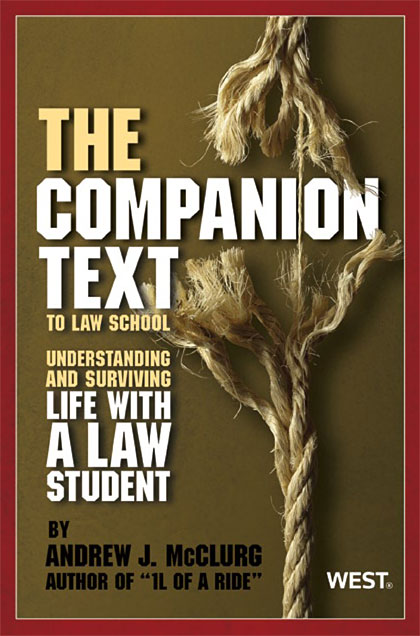
As every lawyer and law student knows, law school is an adventure for the entire family. It’s a life-changing experience that affects everyone involved.
Dozens of books have been written to prepare students for law school, but what about all those other suffering souls–the relatives and friends who support and struggle right alongside the student on their wild and crazy journey toward a Juris Doctor degree? Who’s preparing them?
Named one of Amazon Editors’ Favorite Books of 2014.
The “Companion Text” to Law School is designed to equip loved ones of law students—parents, partners, and other friends and relatives—with all the information and tools needed to understand both law school and their stressed out, rapidly transforming student.
Highlights
• Written by an award-winning professor with wide experience teaching thousands of law students at six law schools.
• Explains all the essentials of legal education, including the first-year curriculum, the Socratic Method of teaching, and the dreaded single-exam format.
• Explores the psyches of law students, including what they love to talk about, things you should never say to them, their sources of stress, and how law school can change their personalities.
• Addresses the impact of law school on outside relationships—and vice versa—and gives tips for navigating relationships with law students.
• Includes dozens of comments, anecdotes, and insights from real law students and their loved ones.
• Extras include a chapter on the types of jobs available to new law graduates, fun “legal” questions you can use to stump your student, a sample case, and a glossary.
• Backed up throughout by academic research.
• Written in a lively, reader-friendly voice, bolstered by humor.
This article from Time Newsfeed about how some governments make certain baby names illegal is reminiscent of one of our Hall of Fame Strange Judicial Opinions: “Hello, My Name Is … Oh, Never Mind.”
Meanwhile, the article warns that the following baby names have been declared illegal in New Zealand:
“Yeah Detroit”
Twins named “89”
“Sex Fruit”
Good news though! New Zealand will still allow boys to be named “Number 16 Bus Shelter.”
Nathan Koppel of the Wall Street Journal wrote an interesting front-page article about judges who use humor in their opinions, quoting McClurg and citing to Lawhaha.com.
Koppel explored the ongoing debate of whether and to what extent judges should use their written products as avenues for amusement.
What do you think?
Meanwhile, in the article, U.S. Ninth Circuit Court of Appeals Judge Alex Kozinski, a Lawhaha.com Hall of Famer, opined that Canadian judges are too boring and staid. Koppel quoted Kozinski saying: “I like my Canadian colleagues, but, boy, when it comes to reading their opinions, it’s like wading through molasses.”
But that’s not always true. Koppel cited one example of Canadian judicial humor and we have a couple other good ones here and here.
Two of the most popular Harmless Error columns, Santa Suit (Children of the world sue Santa Claus) and Santa Strikes Back (Santa files his own suit), are featured here for your holiday pleasure.
Caroline Kennedy selected Santa Suit for inclusion in her anthology, A Family Christmas, where it appears alongside works by the likes of Mark Twain, Robert Frost, and Shakespeare.
Originally appeared in the October 1997 issue of the ABA Journal.
On Shelley’s Case
BY ANDREW J. McCLURG
The Rule in Murray’s Case. The Rule in Rolanda’s Case. Who remembers those? Probably just Murray and Rolanda, their lawyers and a few close friends. But everyone remembers the Rule in Shelley’s Case. This is because the rule is vitally important to every lawyer until five minutes after completing the bar exam.
Who was Shelley and what made her so special? Next month, top property lawyers from around the world will gather in Hawaii to tackle this ancient riddle at the First International Conference on The Rule in Shelley’s Case and Jet-Ski Championships. For three days, these experts will present scholarly papers, engage in profound debate and do cannonballs off the highdive board.
You may qualify as such an expert. Take the following classic essay exam to find out:
A conveys Whiteacre to “B for life, then to C for life, then to B’s heirs” (Practice tip: The Rule in Shelley’s Case applies only to property called Whiteacre or Blackacre.) B, the life estate grantee and remainderwoman, is involved with C, an aging rock star who turns out to be a fertile octogenarian.
B gets pregnant and gives birth to little D, a delightful toddler when he is sedated. (C, the artist formerly known as Q, was a cad who already had nine children: H, I, J, K, L, M, N, O and P.)
You may be asking yourself, “Where does Shelley fit into all this?” It’s a good question, but questions aren’t allowed during a test.
A gets jealous and enfeoffs C with a backhoe. C is rushed to the ER by EMTs, gets CPR from and RN and an IV from an MD, but it’s too late. C is DOA.
If things weren’t bad enough, C’s HMO refuses to pay for his MRI. A, guilt-ridden, turns to drugs (you guessed it: LSD) and shoots himself with a BB gun. B, unable to find suitable daycare for little D, loses her scholarship at UCLA, flunks her LSAT and is hounded by her CD club.
C was last spotted by CNN hiding somewhere in the mountains of the former USSR.
Analyze D’s rights to Whiteacre. Don’t look at the answer until you have fully worked through the problem.
Answer: What did we just say about looking?
Real Answer: Under the Rule in Shelley’s Case, D gets nothing because if a life estate is conveyed to a grantee and a remainder to the grantee’s heirs, both the present estate and remainder are taken by the grantee (or maybe it’s the grantor, we always get those messed up).
If you’re still wondering about Shelley, you’ll have to attend the conference. Don’t forget to bring lots of legal pads and sunscreen.
Originally appeared in the November 1997 issue of the ABA Journal.
100 % Guarantee
BY ANDREW J. McCLURG
Warranty law has always been fraught with pitfalls for the unwary lawyer. Drafting warranties for modern consumers presents special problems because of their higher expectations. Follow these tips and sample warranty provisions to avoid legal tangles:
1. Marketing studies show today’s purchasers like warranties that are “consumer-friendly.” Use this proven opener:
Hello Smart Shopper! My, you’re looking good today. How are the little ones? Feeling blue because your new product turned out to be a piece of junk? Call to speak to one of our Customer Account Therapists. And remember, we love you.
2. Consumers appreciate honesty. When attempting to limit warranty coverage, be sure to use plain language:
Very Limited Warranty. This product is of extremely low quality. We made it that way on purpose so we could sell it really cheap. Our Only Warranty In the Universe: If the product malfunctions in any way, return it to our service center and we’ll chunk it for you. Be sure to include $19.95 for shipping and handling.
3. Modern consumers like to feel a close connection with the corporations they buy from. Offering a convenient telephone “help-line” bolsters consumer confidence:
Questions? Complaints? We encourage you to call our toll-free number any time we’re not here. We offer you a variety of choices because we care about your business: weekdays after 5:00 pm, weekends and holidays. Listen to the menu, use the phone buttons to enter your complaint, ATM code and the lyrics to Boogie Fever, hit the # sign, hang up and we’ll call you back on the expiration date of your product warranty.
4. Health-conscious consumers are highly concerned about the fat content in their diet. This presents a dilemma for food sellers because of the exact correlation between flavor and cubic yards of fat. Present unfavorable nutritional information in the best light possible:
Fat content. In tests, one teaspoon of this product was found to burst the hearts of laboratory rats. However, our researchers believe these rats were already at risk due to a diet high in dairy content (primarily cheese) and probable hypertension from a daily routine of running for their lives.
WARRANTY: Humor writer does not guarantee laughs. Individual chuckling may vary. Consult physician before guffawing. Busting a gut is not recommended.
Originally appeared in the December 1997 issue of the ABA Journal.
Please, Mr. Postman
BY ANDREW J. McCLURG
The “mailbox rule” is an elementary principle of contract law which holds that a contract acceptance is valid upon dispatch in the United States mail.
Some assert that the conveniences of modern technology may soon render the mailbox rule obsolete. For example, already under the emerging “cell phone rule” a contract may be offered, accepted, breached and the offeror verbally abused without ever having to leave one’s car.
Others argue persuasively that the legal profession will never allow the mailbox rule to die because it is one of the only rules lawyers remember from law school. Thus, familiarity with strategies for avoiding this harsh rule is essential.
Once a contract acceptance is deposited in the mail, the sole means of withdrawing it is to actually physically retrieve the letter. Fortunately, several creative options exist for accomplishing this:
1. The Official Method. The only method approved by the U.S. Postal Service for retrieving a letter once it has made it into the hands of a postal worker is begging. This ancient form of pleading, known in Latin as Si placet, Bone Vir Tabellarius, is believed to have originated in 398 B.C. although it did not gain widespread judicial favor until the Marvelettes made it into a hit single in 1961.
2. The Magic Trick Method. Tell the postal worker you are going to perform a magic trick. Reach into her mailbag and pull out a rabbit. If there’s no rabbit inside, pull out a coupon book, an electric bill, anything you can get your hands on. Whatever comes out, pretend it’s a rabbit. While the postal worker is dialing 911, retrieve the acceptance letter from the mailbag.
3. The Career Change Method. Intercept the letter by rapidly taking the civil service exam and actually becoming a postal worker. The risk of this approach is that, because postal workers earn more than many lawyers and get to drive around in those cool little trucks, you may lose interest in contract law and forget about retrieving the letter.