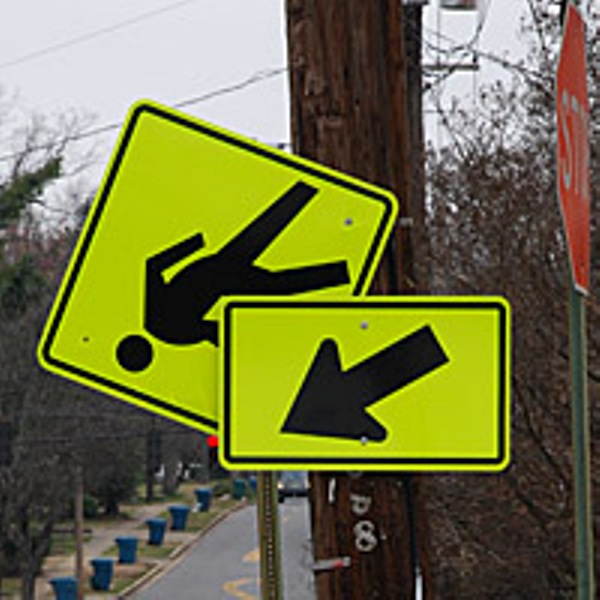
 … at least that’s what these two signs seem to be indicating.
–Thanks to Gary Golden.
… at least that’s what these two signs seem to be indicating.
–Thanks to Gary Golden.
 If you’re contemplating or applying to law school, boost your ability to maximize success with the highest-rated law school prep book, 1L of a Ride: A Well-Traveled Professor’s Roadmap to Success in the First Year of Law School. Read the Amazon Customer Reviews.
And don’t forget the loved ones. They’re in for an adventure too. The “Companion Text” to Law School: Understanding and Surviving Life with a Law Student is the only book written just for them. Named one of Amazon Editors’ Favorite Books of 2014.
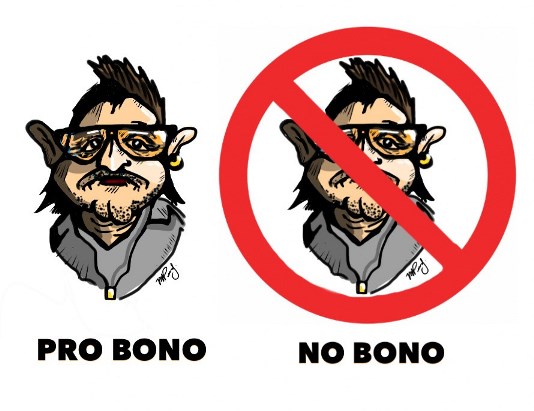 Friend of Lawhaha.com and legal cartoonist Mark Purdy has penned a cartoon raising an intriguing question that has long puzzled lawyers and rock music lovers alike. It’s purdy funny (ouch, sorry). So what’s your answer, are you “Pro Bono” or “No Bono”?
Pro bono legal work are services rendered by lawyers without charge to low income clients or otherwise in furtherance of the public good. (Pro bono comes from the Latin phrase pro bono publico, which means “for the public good.”)
Lawyers get a bad rap, but most non-lawyers probably do not realize that lawyers donate literally millions of hours of free legal services annually in the United States. Name another profession whose members donate so much of their time. (Click here for a comprehensive 2008 study of pro bono service conducted by the American Bar Association.)

Insurance expert, stand-up comic, and friend of Lawhaha.com, Randy Maniloff, penned an interesting article in his latest issue of Coverage Opinions about whether people who get frightened at Halloween haunted houses, with resulting injury, can sue.
He writes:
On any other evening, presenting a frightening or threatening visage might be a violation of a general duty not to scare others. But on Halloween at trick-or-treat time, that duty is modified. Our society encourages children to transform themselves into witches, demons, and ghosts, and play a game of threatening neighbors into giving them candy.” Bouton v. Allstate Ins. Co., 491 So. 2d 56 (La. Ct. App. 1986) (also noting that the Louisiana legislature has recognized Halloween as a special occasion by exempting it from the statute which prohibits the wearing of masks in public places).
But does this “Halloween rule” apply to haunted houses? All sorts of duties are imposed on property owners to maintain a safe premises. Do these same rules apply when the premises are advertised as having, as their only purpose, to scare visitors? Indeed, many visitors will leave a haunted house disappointed if they were not frightened while there. That being the case, can the visitor of a haunted house now turn around and sue for injuries sustained in the process of getting what he asked (and paid) for?
His research turned up five reported judicial decisions in which visitors of haunted houses sought recovery for injuries “sustained on account of being scared.” Notably, the plaintiffs lost every case based on assumption of the risk analysis and the social utility of keeping haunted houses scary and darkly lit. In one case, a startled plaintiff in a pitch-dark house turned to run and ran smack into a brick wall.
Hate to be a party-pooper, but I think there’s a duty to act reasonably to prevent highly foreseeable injuries at premises open to the public. The goal of a haunted house is to terrify, the expected result is that customers will be terrified, and the instinctive response to terror is to run. But no one can see! Give them helmets, maybe even put flashlights on them, or scare them outside where they can run into the cushy-walls of cornfield mazes.
“Eerily,” as Randy notes, all five cases are from Louisiana.
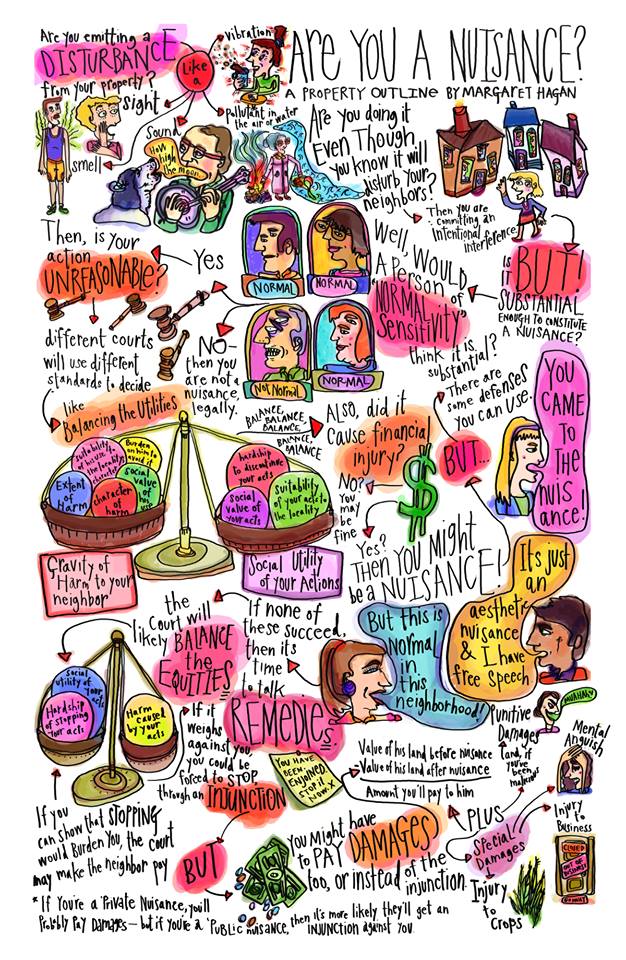 A student from my very first Torts course a million years ago sent me this brilliant flow chart for the tort of nuisance, which comprises substantial and unreasonable interferences with the use and enjoyment of one’s property. The most interesting thing about it is that it actually summarizes the law pretty well, assuming one has dropped acid before studying it. Credit on the chart attributes this work of art to one Margaret Hagen. Well done!
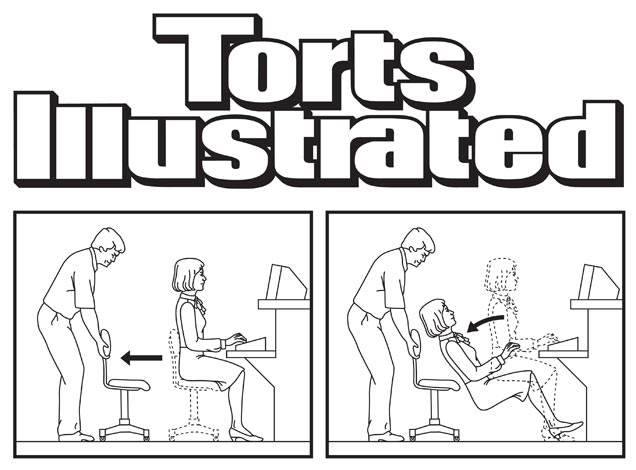 A 1L sent me this “Torts Illustrated” image, sort of a grown-up version of Garrett v. Daily, a famous case that all law students study in which a five-year-old was sued for pulling a chair out from under an elderly woman. If anyone knows the original source, please send it along so we can give proper credit.
In the meantime, one can only imagine what the swimsuit issue would look like.
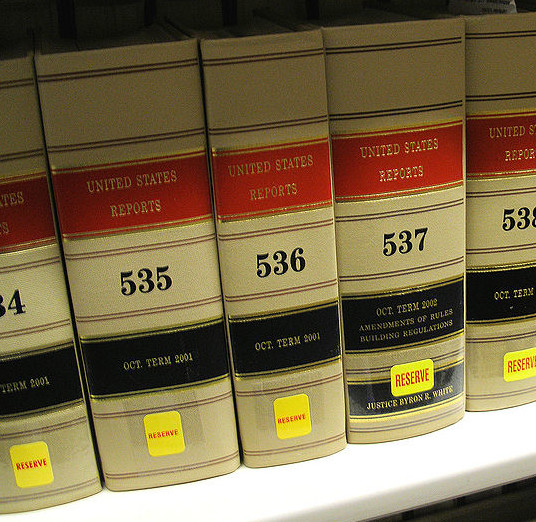 Here’s a trivia question for lawyers and law students.
Question: What was the very first opinion issued in the U.S. Reports case reporter; that is, the opinion claiming that coveted number one slot of “1 U.S. 1” as a citation?
Answer: Well, it’s a bit of a letdown. You’d think they’d want to start with a bang, something Marbury-esque. But no, here’s the first case in the U.S. Reports:
The Lessee of Hyam and others
v.
Edwards
April Term, 1759.
1 U.S. 1, 1 Dall. 1, 1759 WL 20 (Pa.), 1 L.Ed. 11
Copy of a Deed inrolled in the King’s Bench in England, proved before the Lord Mayor of London to be a true one; allowed to be given in Evidence to a Jury to support a Title to Lands in this Province.*
*11 mod. 2 c. 2.
Well, at least it had a footnote.
The National Jurist interviewed me and a couple of other law school prep book authors in its September 2013 issue regarding happiness tips for new law students. Here’s the article:
The National Jurist – Sept 2013 McClurg Interview
Insurance law expert and humorist in his own right, Randy Maniloff, did a nice interview with me in the latest issue of Coverage Opinions, his bi-weekly electronic newsletter reporting and commenting on new court decisions addressing insurance coverage disputes.
He asked a lot of great questions covering everything from the state of product warnings the state of legal education.
Read it here: Coverage Opinions Interview July 24, 2013.
Someone sent a message in response to the Warning: Playing Stairway to Heaven is Prohibited post asking if I was making up the part about playing in Memphis rock cover bands. It’s true. As dubious as the proposition sounds, law professors can actually rock (or at least we think we can).
Below is a sample from our most recently disbanded band, The Vynals, having fun playing surf music at a festival outside of Memphis (a medley of Surfin’ USA by the Beach Boys and Wipeout by the Safaris). Wait, it gets even more incredulous. Now we’re forming The World’s Oldest Punk Band. (Similar to The World’s Greatest Law Review Article, but with fewer footnotes.)