Two drink minimum; No packages wrapped in newspaper.
A student of mine posted this pic on Facebook of “Cardozo’s Pub” in Chicago. Is “Andrews’ Billiard Hall” next door by any chance?
For non-legals, Judge Benjamin Cardozo is one of the most famous American jurists. He authored several judicial opinions read by law students, including the majority opinion in Palsgraf v. Long Island Railroad. Judge William Andrews wrote a famous dissent in the same case.
Palsgraf, studied by every first-year law student, is the improbable tale of a set of scales allegedly knocked on top of the plaintiff, Mrs. Helen Palsgraf, as a result of an explosion that occurred when a man running to catch a train dropped a package of fireworks while being helped onto the train by railroad employees.
For the completely true fake inside story behind these opinions, check out Palsgraf Uncovered). Other posts related to the famous case are here, here, and here.
No known connection exists between this Chicago pub and the real Judge Cardozo.
The start of another academic year is closing in quickly. If you’re going to be a new law student, you’re not the only one who needs to get ready for a wild ride.
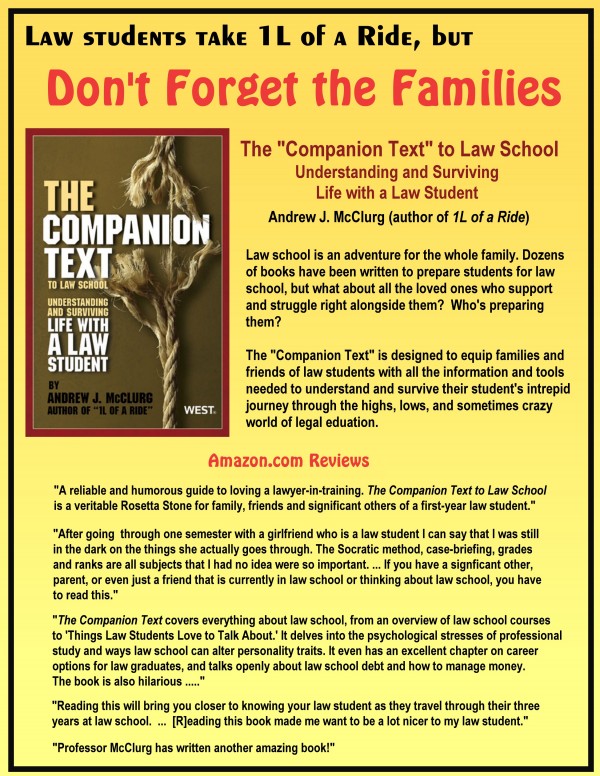
Dozens of books have been written to prepare students for law school, but The “Companion Text” to Law School is the only book ever written to prepare the families and friends of law students for what to expect and how to deal with it.
Back in 2003, in McConnell v. Federal Election Committee, the U.S. Supreme Court cleared up a major legal dispute over campaign financing. Er, well, maybe not completely cleared up.
The basic question was whether the McCain-Feingold Act, a federal statute that imposed restrictions on political contributions, violated the First Amendment free speech rights of potential contributors. A challenging issue no doubt, but certainly not too tough for the mighty U.S. Supreme Court to resolve, right?
With nine justices voting, the result could have been as simple as 8-1, 7-2, 6-3, or 5-4 in favor of one side or the other. The nine wise ones chose a slightly more complicated path. Here is the Court’s actual voting lineup straight out of the case:
STEVENS and O.CONNOR, JJ., delivered the opinion of the Court with respect to BCRA Titles I and II, in which SOUTER, GINSBURG, and BREYER, JJ., joined. REHNQUIST, C. J., delivered the opinion of the Court with respect to BCRA Titles III and IV, in which O.CONNOR, SCALIA, KENNEDY, and SOUTER, JJ., joined, in which STEVENS, GINSBURG, and BREYER, JJ., joined except with respect to BCRA § 305, and in which THOMAS, J., joined with respect to BCRA §§ 304, 305, 307, 316, 319, and 403(b). BREYER, J., delivered the opinion of the Court with respect to BCRA Title V, in which STEVENS, O.CONNOR, SOUTER, and GINSBURG, JJ., joined. SCALIA, J., filed an opinion concurring with respect to BCRA Titles III and IV, dissenting with respect to BCRA Titles I and V, and concurring in the judgment in part and dissenting in part with respect to BCRA Title II. THOMAS, J., filed an opinion concurring with respect to BCRA Titles III and IV, except for BCRA §§ 311 and 318, concurring in the result with respect to BCRA § 318, concurring in the judgment in part and dissenting in part with respect to BCRA Title II, and dissenting with respect to BCRA Titles I, V, and § 311, in which opinion SCALIA, J., joined as to Parts I, II.A, and II.B. KENNEDY, J., filed an opinion concurring in the judgment in part and dissenting in part with respect to BCRA Titles I and II, in which REHNQUIST, C. J.,joined, in which SCALIA, J., joined except to the extent the opinion upholds new FECA § 323(e) and BCRA § 202, and in which THOMAS, J., joined with respect to BCRA §213. REHNQUIST, C. J., filed an opinion dissenting with respect to BCRA Titles I and V, in which SCALIA and KENNEDY, JJ., joined. STEVENS, J., filed an opinion dissenting with respect to BCRA § 305, in which GINSBURG and BREYER, JJ., joined.
Who won? I have no idea.
For embodying in a single voting lineup the reason why the most accurate answer to most legal questions is “It depends,” this case gets into the Strange Judicial Opinions Hall of Fame. If members of the world’s most powerful tribunal are unable to agree on what the law means, how could one expect poor law students to do so?
— McConnell v. Federal Election Comm’n, 540 U.S. 93 (2003). Thanks to Elise Hendricks.
Law student and boyfriend holding hands on romantic date night reading product warning labels at Walmart.
Covering products liability in Torts and made a point of explaining what utter fun reading product warning labels can be, saying:
“In fact, if you’re looking for a really great night out, take your date to Walmart. Hold hands and spend the evening strolling the aisles reading product warning labels. It’s a guaranteed good time!”
One student and her boyfriend took me up on the idea. She sent along this great PowerPoint presentation of their romantic Walmart Product Warning Label Date.
As every lawyer and law student knows, law school is an adventure for the entire family. It’s a life-changing experience that affects everyone involved.
Dozens of books have been written to prepare students for law school, but what about all those other suffering souls–the relatives and friends who support and struggle right alongside the student on their wild and crazy journey toward a Juris Doctor degree? Who’s preparing them?
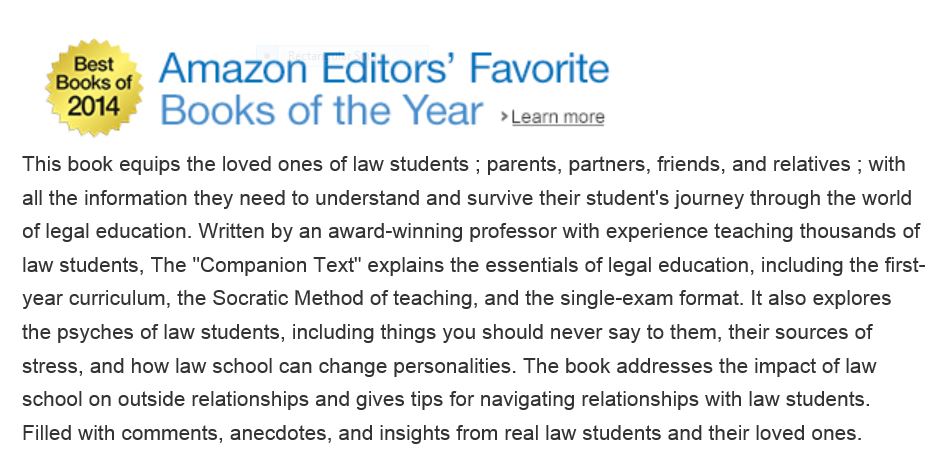
Named one of Amazon Editors’ Favorite Books of 2014.
The “Companion Text” to Law School is designed to equip loved ones of law students—parents, partners, and other friends and relatives—with all the information and tools needed to understand both law school and their stressed out, rapidly transforming student.
Highlights
• Written by an award-winning professor with wide experience teaching thousands of law students at six law schools.
• Explains all the essentials of legal education, including the first-year curriculum, the Socratic Method of teaching, and the dreaded single-exam format.
• Explores the psyches of law students, including what they love to talk about, things you should never say to them, their sources of stress, and how law school can change their personalities.
• Addresses the impact of law school on outside relationships—and vice versa—and gives tips for navigating relationships with law students.
• Includes dozens of comments, anecdotes, and insights from real law students and their loved ones.
• Extras include a chapter on the types of jobs available to new law graduates, fun “legal” questions you can use to stump your student, a sample case, and a glossary.
• Backed up throughout by academic research.
• Written in a lively, reader-friendly voice, bolstered by humor.
A judicial friend from Florida sent along a case of first impression involving a parental rights determination between a birth mother and a biological mother that she calls “a law professor’s dream case.” It does sound a bit like a law school exam question—a very difficult one.
The case involved two women in a committed relationship who wanted to have a child. Ova from one of the women were removed, fertilized by donated sperm, and implanted in the other woman, who then gave birth to the child. Thus, one woman was the biological mother and one was the birth mother, an unusual situation to be sure.
Only the birth mother’s name appeared on the child’s birth certificate. For years, the two women reared their child together but, when the relationship failed, the birth mother, without telling the biological mother, fled to Australia with the child.
The trial court reluctantly ruled that only the birth mother was the legal mother but invited appeal of his decision. The Florida Fifth District Court of Appeal reversed, ruling that both women had parental rights to the child.
My judicial friend pointed out that this is a case begging, and no doubt destined, for scholarly attention by law professors and law students, although Judge Thomas D. Sawaya, writing for the majority, might shiver at the thought.
Judge Sawaya was not impressed that the only authority for the birth mother’s position that only gestational mothers have maternal rights were: law review articles and a Tennessee case that relied solely on a law review article.
Regarding law review articles relied on by the birth mother, the judge commented: “We do not believe that law review articles written by students and professors establish the common law.”
About the Tennessee case, Sawaya said: “The common law does not come from law students and professors who write law review articles, and we hardly think it comes from a decision rendered by a Tennessee court that does nothing more than cite a law review article as the source.”
Hmm, I guess that depends on how one defines “the common law.” The Tennessee case is part of the body of judicial precedent that forms the common law. It might not be persuasive precedent, but isn’t it still part of the common law? And simply because a judicial opinion relies on a law review article doesn’t remove the opinion from the realm of common law.
Courts cite law review articles frequently, including the U.S. Supreme Court, and there are innumerable instances of law review articles–including some written by students–that have turned the tide of the common law. As just one example, the products liability doctrine of market-share liability, first articulated by the California Supreme Court in Sindell v. Abbott Laboratories, was conceived from a student-written Note in the Fordham Law Review.
As an aside, my judge-friend was troubled that the majority’s analysis seemed to treat the child as a piece of property, giving no consideration to the best interests of the child, an issue the concurring opinion also focused on.
—T.M.H. v. D.M.T. , Case No. 5D09-3559 (Fla. 5th DCA, Dec. 23, 2011)
David Cheifetz, Lawhaha’s friend from the north, sent in this Canadian court opinion about the judicial pecking order. David wrote:
Here is the pithiest and funniest summary of “stare decisis” ever written. Judge Cardozo’s explanation in “The Nature of the Judicial Process” may be the best justification and explanation, but it doesn’t hold a candle to what you’re about to read for wit and succinctness. The below summary comes from a decision by a Master of the Queens Bench of Alberta, Canada. A Master is a judge in all but name whose role is deciding preliminary motions in civil matters. The Master involved, Master Funduk, is noted for his witty judgments. The Queens Bench is the trial division of Alberta’s highest court. In the Canadian system, the highest court of any province is always the province’s Court of Appeal, even if the highest provincial trial court is called the Superior or the Supreme Court of the province. Here’s how Master Funduk summed up his role (some paragraph breaks inserted):
Any legal system which has a judicial appeals process inherently creates a pecking order for the judiciary regarding where judicial decisions stand on the legal ladder.
I am bound by decisions of Queen’s Bench judges, by decisions of the Alberta Court of Appeal and by decisions of the Supreme Court of Canada.
Very simply, Masters in Chambers of a superior trial court occupy the bottom rung of the superior courts’ judicial ladder. I do not overrule decisions of a judge of this Court.
The judicial pecking order does not permit little peckers to overrule big peckers. It is the other way around.
— South Side Woodwork (1979) Ltd. v. R.C. Contracting Ltd., [1989] A.J. No. 111, 95 A.R. 161 at 166–67 (Alta. Q.B.). Thanks to David Cheifetz.
Legalese embraces redundancy. Legalese embraces redundancy. Legalese … sorry, just getting in the spirit. In a convoluted dispute regarding a real estate conveyance, Judge Mark P. Painter, Ohio Court of Appeals, First District, offered his common sense take on the phrase “free and clear title” and other legal redundancies:
Free and clear mean the same thing. Using both is an unnecessary lawyerism. Free is English; clear is from the French clere. After the Norman Conquest, English courts were held in French. The Normans were originally Vikings, but after they conquered the region of Normandy, they became French; then they took over England. But most people in England, surprisingly enough, still spoke English. So lawyers started using two words for one and forgot to stop for the last nine hundred years.
So free and clear do not mean separate things; they mean, and were always meant to mean, exactly the same thing. Just as null and void and due and payable mean the same thing. All of these couplets are redundant and irritating lawyerisms. And they invite just what has happened here—an assertion that they somehow have different meanings.
The Norman Conquest was in 1066. We can safely eliminate the couplets now.
What’s your favorite legal redundancy?
— Kohlbrand v. Ranieri, 823 N.E.2d 76, 78 (Ohio Ct. App. 2005).
Originally appeared in the December 1997 issue of the ABA Journal.
Please, Mr. Postman
BY ANDREW J. McCLURG
The “mailbox rule” is an elementary principle of contract law which holds that a contract acceptance is valid upon dispatch in the United States mail.
Some assert that the conveniences of modern technology may soon render the mailbox rule obsolete. For example, already under the emerging “cell phone rule” a contract may be offered, accepted, breached and the offeror verbally abused without ever having to leave one’s car.
Others argue persuasively that the legal profession will never allow the mailbox rule to die because it is one of the only rules lawyers remember from law school. Thus, familiarity with strategies for avoiding this harsh rule is essential.
Once a contract acceptance is deposited in the mail, the sole means of withdrawing it is to actually physically retrieve the letter. Fortunately, several creative options exist for accomplishing this:
1. The Official Method. The only method approved by the U.S. Postal Service for retrieving a letter once it has made it into the hands of a postal worker is begging. This ancient form of pleading, known in Latin as Si placet, Bone Vir Tabellarius, is believed to have originated in 398 B.C. although it did not gain widespread judicial favor until the Marvelettes made it into a hit single in 1961.
2. The Magic Trick Method. Tell the postal worker you are going to perform a magic trick. Reach into her mailbag and pull out a rabbit. If there’s no rabbit inside, pull out a coupon book, an electric bill, anything you can get your hands on. Whatever comes out, pretend it’s a rabbit. While the postal worker is dialing 911, retrieve the acceptance letter from the mailbag.
3. The Career Change Method. Intercept the letter by rapidly taking the civil service exam and actually becoming a postal worker. The risk of this approach is that, because postal workers earn more than many lawyers and get to drive around in those cool little trucks, you may lose interest in contract law and forget about retrieving the letter.