Best Law Review Article Title

It’s publish or perish in the law professor business, and most of that publishing occurs in law review articles.

Law professors strive mightily to make their law review articles stand out by coming up with clever titles for them. The trick is coming up with a title that is attention-getting, but also descriptive.  This, of course, requires use of the ubiquitous colon, which appears in the vast majority of law review titles. Some law professors look down on colons in law review titles (yes, this is part of the important stuff we actually spend time thinking and talking about) and eschew them, but the result is often a title that doesn’t give a clue what the article is about.

Here’s a top candidate for the best law review article title:

Erik S. Jaffe, “She’s Got Bette Davis[‘s] Eyes”: Assessing the Nonconsensual Removal of Cadaver Organs Under the Takings and Due Process Clauses, 90 Columbia Law Review 528 (1990).

Oldsters will recall that “She’s Got Bette Davis Eyes” was a smash hit for Kim Carnes in 1981. Originally written by Jackie DeShannon and Donna Weiss in 1974, Carnes took the song to number one on the Billboard charts where it held the top spot for nine weeks.

— Erik S. Jaffe, “She’s Got Bette Davis[‘s] Eyes”: Assessing the Nonconsensual Removal of Cadaver Organs Under the Takings and Due Process Clauses, 90 Columbia Law Review 528 (1990)
Warning: Law Students Are Careful

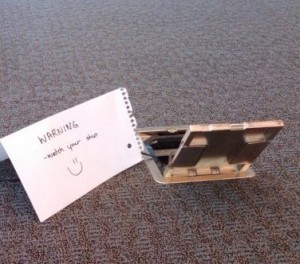
funny warning labelLaw students learn to avoid risk, in part because of what is known as the “availability heuristic”–a mental shortcut people use to unreliably evaluate the probability of risks based on whether they can remember the event ever happening before.

Law students and lawyers tend to over-estimate risk because they can always imagine a situation (an availability) in every context of life where things went wrong. In all the cases they read, things went wrong, which is why they became cases. Their constant exposure to Murphy’s Law causes them to become very adept at (even obsessive about) spotting and avoiding risks in their own lives.

Here a careful student of mine studying in the law library with her laptop took the extra-prudent precaution of posting a warning sign near to the cord and plug to avoid a tripping injury risk.

Breaking News: Marbury v. Madison Causing Consitutional Crisis

marbury unconstitutional
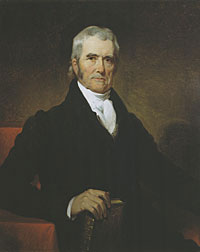
Chief Justice John Marshall, author of Marbury v. Madison.

In a 2005 opinion, an Alabama Supreme Court justice (that well-known jurisprudential heavyweight “Tom Parker”), without a trace of irony, called the U.S. Supreme Court “presumptuous” while declaring Marbury v. Madison and its progeny to be “unconstitutional.”

For non-legal types, Marbury is the landmark 1803 Supreme Court case authored by the great Chief Justice John Marshall that established the power of “judicial review”; i.e., that the Supreme Court gets the last word in disputes with the legislative and executive branches of government.

The Alabama case involved a challenge to the constitutionality of certain statutes affecting taxation and the funding of the Birmingham, Alabama civic center authority. Justice Parker included this footnote in his concurrence (italics added.):

21. . . . Despite everything in the text of the Constitution, its history, and the expressed intent of the Framers being completely contrary to the notion of judicial supremacy, the United States Supreme Court has presumptuously arrogated such a position for itself simply by declaring it so.

In Cooper v. Aaron . . . the United States Supreme Court stated: “[Marbury v. Madison, 5 U.S. (1 Cranch) 137, 2 L.Ed. 60 (1803)] declared the basic principle that the federal judiciary is supreme in the exposition of the law of the Constitution and that principle has ever since been respected by this Court and the Country as a permanent and indispensable feature of our constitutional system.” Tellingly, this proclamation of judicial supremacy was made without citation to the Constitution or any other authority. The result of this unconstitutional doctrine of judicial supremacy has been an increasing shift of the balance of powers from the elected executive and legislative branches of the federal government to the unelected judiciary, thereby emboldening federal courts to rule upon constitutional questions based upon foreign law or perceived changes in public opinion instead of the Constitution and its history. . . .

The turning away from our national compact by federal courts now threatens our country with a constitutional crisis.

There’s a constitutional crisis over Marbury?

Birmingham-Jefferson Civic Ctr. Auth. v. City of Birmingham, 912 So.2d 204, 223 n.21 (Ala. 2005) (Parker, J., concurring). Thanks to Brian Brock.

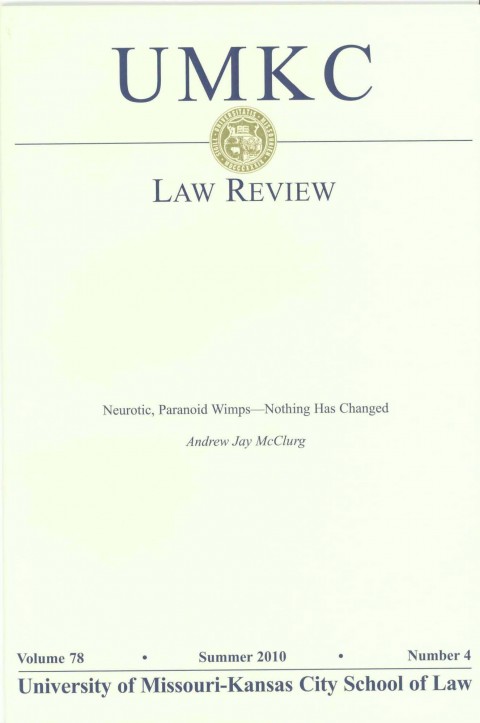
Neurotic, Paranoid Wimps―Nothing has Changed

1L storiesAndrew Jay McClurg, Neurotic, Paranoid Wimps―Nothing has Changed, 78 University of Missouri-Kansas City Law Review 1049-61 (2010).

In an issue of the UMKC Law Review devoted to “1L Stories” and intended as a tribute to Scott Turow’s classic book, One L, the author recounts his own first-year tales of neurotic, paranoid wimpism (descriptors from Amazon.com reviews of Turow’s book). Turow wrote the foreword for the issue.

The author’s narrative asserts that a dominant theme of One L, the story of Turow’s first year at Harvard Law School, was negative affect. Turow talked of anxiety, fear, stress, panic, vulnerability, self-doubt, shame and grief, wounded self-esteem, unhappiness, paranoia, embarrassment, oppression, and insanity.

The author describes his similar experiences and asserts that, contrary to popular belief, things have not changed that much in legal education since his and Turow’s day.

Law Professor Exposes Phony Tort Cases

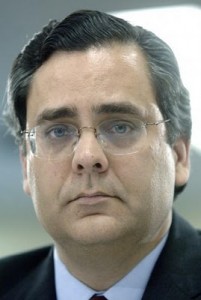
Jonathan Turley
Professor Jonathan Turley exposed phony outlandish tort cases.

Although several years old, Professor Jonathan Turley’s USA Today article exposing phony tort cases remains must-reading for anyone concerned about the tort reform movement. Why? Because people are still circulating these tall tales.

You know those crazy tort lawsuits you read about, the ones that make people indignant about the tort sytem, the ones politicians and tort reformers use to build public support for the movement, the ones that get endlessly forwarded to email inboxes?

They’re crazy, to be sure. But, one problem. A lot of the most notorious cases are fabricated, as Turley explored in his article.

The notorious–but apparently fictitious winning-plaintiffs–and their outlandish “cases” include:

• Kathleen Robertson, a woman who–imagine this–received a $780,000 jury award against a furniture store after she tripped over her own son.

• Carl Truman, who won a $74,000 judgment after his hand was run over by a neighbor. The neighbor could not see Truman because he was kneeling down while in the process of stealing the neighbor’s hubcaps.

• Terrence Dickson of Bristol, Pa., a man who received a $500,000 award against a garage-door manufacturer after he almost starved while trapped in the garage of a house he was burglarizing while the family was on vacation.

• And my personal favorite, a Mr. Grazinski, who won more than $1,750,000 against Winnebago when the RV he was driving went off the road after he put it on cruise control at 70 mph to go into the back to fix a cup of coffee.

Turley was unable to track down records showing that any of these, or several other notorious crazy lawsuits, actually existed.

It should be more than a little troubling to people that state legislatures have passed thousands of tort reform statutes throwing out 200 years of carefully considered common law (judge-made law) in part based on sound-bite reporting of cases that never happened.

— Jonathan Turley, Legal Myths: Hardly the Whole Truth, USA Today, Jan. 30, 2005.

Palsgraf Curse?

Palsgraf curse
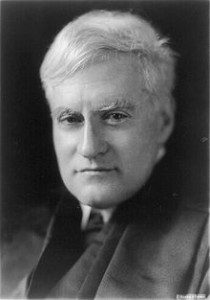
Cardozo wrote the famous majority opinion in Palsgraf.

Several lawhaha visitors sent in Mark Fass’s article in the New York Law Journal about an alleged curse on the family of Helen Palsgraf, the most famous torts plaintiff in history. Every lawyer remembers Mrs. P from law school. To test this theory, visit an elderly, dying lawyer in a coma and shout “Palsgraf!” Immediately, he will recite: “A man carrying a box wrapped in newspaper boarded a train at the Long Island Railroad Station … cough, cough … ack.”

The box contained fireworks. When it was dislodged by employees of the Long Island Railroad trying to help the man on the train, the fireworks exploded, allegedly knocking a scale onto Mrs. P. Mrs. P’s saga led to the legendary, and incredibly confusing, opinions by Judge Benjamin Cardozo (that’s Cardozo in the picture–handsome fellow he was) and Judge William Andrews studied by students year in and year out at law schools great and small.

Now Fass reports that Mrs. P’s accident began a curse on the Palsgraf family, at least that’s what some of her descendants believe. One descendant fell off a ladder in 1965 and sued the manufacturer, but never made it to trial because the ladder was stolen. Another lost her thumb when a ping-pong table collapsed. A lawsuit led to a small settlement. Another descendent tripped while jogging over a broken curb, but was discouraged by lawyers from filing suit.

The most intriguing Palsfraf mishap reported by Fass involves a descendant who lost control of his truck on an icy hill in 1968. The truck slid towards the edge of cliff. Guess what saved the life of Mrs. P’s closest living relative? The truck’s wheels got caught on a track of … you guessed it, the Long Island Railroad. (Cue Twilight Zone theme.)

— Mark Fass, Palsgraf Railroad Injury Proximate Cause of Family Curse?, New York Law Journal, Dec. 10, 2004.

Mrs. Palsgraf is Alive, in the U.S. Supreme Court

PalsgrafAs a Torts prof, I loved this tidbit sent in by Elise Hendrick. Good old Mrs. Palsgraf. You can try, but you can’t keep her down.

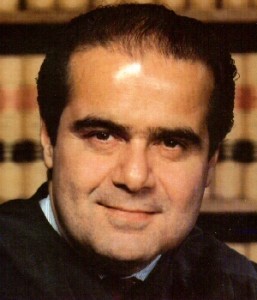
Elise was listening to oral arguments before the U.S. Supreme Court in Exxon Co. USA v. Sofec, 116 S.Ct. 1813 (1996), and came across the following exchange between George Playdon, counsel for Sofec, and Justice Scalia. The two were engaged in a colloquy about the maritime supervening cause doctrine:

Scalia: I’m not sure that you need a “doctrine of supervening cause.” Is a doctrine of supervening cause anything other than Palsgraf? When you say, you know, that the negligence … the causality … had long since terminated. Once you say you’re out of the scope of the risk, what do you need a doctrine of supervening cause for? And isn’t that basically your case?

Playdon (chuckling): I smile—I never envisioned thirty years ago that I’d have the opportunity …

Scalia: Of arguing Palsgraf!

Playdon (stammering, laughing): Obviously, Palsgraf is a foreseeability doctrine, just like Hadley v. Baxendale is a foreseeability problem.

Elise speculates that this may have been the first time the implausible case of Mrs. P has been mentioned in court since Palsgraf was decided in 1928.

— Thanks to Elise Hendrick.

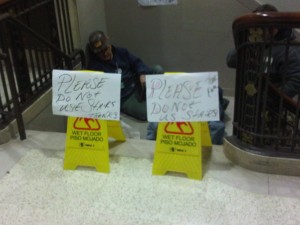
Warning: Do Not Even Think About Using the Stairs

Warning on stairsJust one question: Is it okay to use the stairs?

Not surprisingly, since they are full of law professors and law students, law schools are pretty safe places.  Be hard to overlook these warnings at the University of Memphis law school.

Wait, what is that in the background? Looks like a dead body. Maybe just a tired 1L.