“Rhetorical Flourishes” in Opinion Come Back to Bite Court

Bush sued by whales
George W. Bush -- Sued by whales.

Lawhaha.com obviously has great fondness for judges who liven up their opinions with humor and other writing spice, but a case from the U.S. Court of Appeals for the Ninth Circuit shows why judges need to exercise care in stirring in these ingredients.

In a suit brought against George W. Bush and Donald Rumsfeld on behalf of all whales, dolphins, and porpoises, the Ninth Circuit had to decide whether animals have standing to sue on their own behalf under the Endangered Species Act and other federal statutes.

The plaintiff was “the Cetacean Community,” a name chosen by the Cetaceans’ self-appointed attorney for all of the world’s whales, porpoises, and dolphins. The Cetaceans challenged the U.S. Navy’s use of low frequency sonar used to detect enemy submarines because the sonar harms marine life.

Bush and Rumsfeld moved to dismiss on the ground that the animals lacked standing to bring suit. The district court agreed and dismissed the action.

The animals appealed, relying on a statement made in a previous environmental case—Palila v. Hawaii Dep’t of Land and Natural Resources—in which the Ninth Circuit had indicated that an endangered member of the honeycreeper family, the Hawaiian Palila bird, had standing to sue on its own behalf. The specific language was that the bird “has legal status and wings its way into federal court as a plaintiff in its own right.”

The court had to decide whether the Palila language was binding precedent or only loose dicta. It ruled it was the latter, calling the statements “little more than rhetorical flourishes.”

With respect to the substantive issue, the court added that “It is obvious that an animal cannot function as a plaintiff in the same manner as a juridically competent human being.” Hmm, perfect entry for making a political joke about one of the defendants, but we try to stay apolitical.

The fact that courts have held monkeys, whales, and assumely all other non-human species (along with their human champions) lack standing to seek protection from the judicial system raises a troubling question: Who’s left to look out for them?

Cetacean Cmty. v. Bush, 386 F.3d 1169 (9th Cir. 2004). Thanks to Daniel Green.

What Do Enya, Celine Dion, and a Grisly Murder Trial Have in Common?

Celine Dion
Prosecutor used Celine Dion's and Enya's music to soften up jury.

Salazar v. Texas was a grisly murder case involving a victim and alleged dope dealer named Jonathon. Jonathon’s cohorts turned on him and killed him by beating him with baseball bats and strangling him with wire.

At the punishment phase of the trial, over the objection of defense counsel, the state played a professionally edited video montage of Jonathon’s life, complete with music by Enya and Celine Dion!

The defendant appealed on the ground that the videotape was prejudicial. Here’s how the appellate court described the videotape (paragraph breaks inserted):

This video is an extraordinarily moving tribute to Jonathon Bishop’s life. It consists of approximately 140 still photographs, arranged in a chronological montage. Music accompanies the entire seventeen-minute video and includes such selections as “Storms in Africa” and “River” by Enya, and concludes with Celine Dion singing, “My Heart Will Go On,” from the movie Titanic.

Almost half of the approximately 140 photographs depict the victim’s infancy and early childhood. The pictures show an angelic baby, surrounded by loving parents, grandparents, unidentified relatives, and other small children. Later photographs show Jonathon as a toddler, playing the piano, frolicking at the beach with other friends, happily riding on a carousel, laughing in a field of bluebonnets, and cuddling with a puppy.

The video also includes numerous annual school pictures showing Jonathon’s progression from a cheerful child to a equally cheerful young man. It catalogs his evident and early prowess as a young soccer player and eventually as a football player. There is a picture of him and his date, presumably going to their prom, and more candid shots of the victim and his teen-age buddies. The video includes many family reunion portraits showing Jonathon’s entire extended family.

Understandably, this professional and polished production portrays Jonathon in a very positive light and it is entirely appropriate for a memorial service. The music, too, is appropriately keyed to the various visuals, sometimes soft and soothing, then swelling to a crescendo chorus. In sum, it is a masterful portrait of a baby becoming a young man. It is also extraordinarily emotional.

The court held it was reversible error to admit the videtape into evidence on the ground that its relevance was outweighed by its prejudicial value, stating:

[The] prejudicial effect is enormous because the implicit suggestion is that the appellant murdered this angelic infant; he killed this laughing, light-hearted child; he snuffed out the life of the first-grade soccer player and of the young boy hugging his blond puppy dog.

Salazar v. State, 90 S.W.3d 330, 333–34, 337 (Tex. Crim. App. 2002). Thanks to Texas Senior Judge James Barlow.

Argument Unbound by Logic or Precedent Impresses Court, But Fails

Goshgarian v. George involved warring neighbors, one of whom continually dumped dirty water from his swimming pool onto the other’s property.

The water-dumping defendant came up with the imaginative, if not quite legally sound, argument that, since the County of Fresno had an easement on the property for the drainage and disposal of water, the individual defendant should have the same right.

The court was downright astonished by the creativity of the argument (paragraph breaks inserted):

Only a mind unburdened by the ephemeral shackles of legal training and gloriously free of the stultifying pomposities of precedent and stare decisis could have formulated the epiphanous principle that what the public may do as an entity, so may individual members of the public do, acting in their individual capacities.

Appellate counsel for cross-complainants, with an imagination dulled by years of legal training, evidently lacked the audacity to appreciate cross-defendants’ argument and misinterpreted (and diminished) it as a mundane attack upon the sufficiency of the evidence to support the jury’s finding of trespass.

Not so. Cross-defendant Mr. George is on the wave front of the expanding legal universe, Prometheus unbound by the strictures of logic and reason that constrain lawyers and judges in their quotidian professional functions.

 There is just one problem. The easement is for storm drain water, not mosquito infested swimming pool effluent.

Goshgarian v. George, 161 Cal. App. 3d 1214, 1222–23 (1984). Thanks to Eli Ben-Shmuel.

Judge Rules Breasts are Not “Private Parts”

Judge Mark Painter, a judge on the Ohio Court of Appeals, sent in a couple of his own funny opinions. The first one he wrote back when he was a municipal court judge. Lawhaha.com clings steadfastly to being a family friend site, but it’s not easy when a primary source of Strange Judicial Opinions is that haven for adult-oriented material known as the National Reporter System.

In State v. Parenteau, the defendant was charged with public indecency.  We’ll let Judge Painter explain what happened:

Defendant was part of a “lingerie fashion show” at a nightclub named “Scandals” in western Hamilton County. The charge arose from the modeling by defendant of a lace brassiere which was alleged by the officer to be “see-through,” in that the officer testified he could observe a nipple area through the lace fabric. Defendant was apprehended after she had retired to a back room to change her clothing. The officers asked Parenteau for the clothing she was wearing, which they confiscated.

The evidence produced in court included a lace brassiere, a pair of underpants, stockings, and a small square of pantyhose fabric. The panties and stockings were not relevant, considering that the charge was not based upon anything in connection with the defendant’s lower anatomy. Defendant testified that she wore the pantyhose fabric under the bra in order to be certain that it was not transparent in the area of the nipple. Defendant further stated that she was wearing two such squares, one on each breast, during the performance, but that only one was in evidence, since she had already removed her bra when she was arrested, and the other square had dropped out and was not recovered by the officers. An additional witness testified that she saw defendant cutting pantyhose to make the squares before she dressed. Much ado was made about whether one or two squares were worn, but in the court’s view of the law, the existence or nonexistence of the pantyhose material within one side of the brassiere is not controlling.

The question presented is whether the defendant can be convicted of public indecency … for wearing a lace brassiere which totally covered her breasts, but was partially transparent, or “see through.” If so, does the insertion of pantyhose material, rendering the brassiere less “see through,” change the result?

The result turned on the meaning of “private parts” as used in the public indecency statute. Judge Painter cited numerous sources supporting the proposition that “private parts,” as used in the law, refers to the genital area only. As such, he acquitted the defendant.

State v. Parenteau, 564 N.E.2d 505, 505 (Ohio Mun. 1990).

Creative Statutory Interpretation Put to Test

Ohio Court of Appeals Judge Mark Painter combined humor and common sense in Gibson v. Donahue, where the plaintiff was injured being thrown from her horse, which was spooked by two Irish Setters that the defendant allowed to run free in an area restricted to equestrian use.

Talk about creative lawyering. The defendant tried to escape liability by relying on an Ohio statute intended to provide tort immunity for riding stable owners and horse show operators for injuries resulting from the inherent risks of equine activity (a statute Painter said “is noteworthy mainly for using the word ‘farrier’ ten times”).

Judge Painter observed that the case was one of first impression, “probably because no one before has been audacious enough” to try to extend the statute to a situation like this one.

Defendant did have a slim statutory leg to stand on. The statute extends immunity to “an equine activity sponsor, equine activity participant, equine professional, veterinarian, farrier, or other person.” However, Judge Painter said that for defendant’s construction to prevail, the statute would have to be read as applying to “any other person in the whole world.” Construed as defendant argued, “[a] person who negligently crashes an airplane into the crowd at an equine event would thus be immune to liability.”

By the way, a farrier is a blacksmith. Remember that if you’re a law student in Ohio. It might be on the bar exam.

Gibson v. Donahue, 772 N.E. 2d 646, 648, 650 (Ohio Ct. App. 2002).

Negligence and “The Reasonable Dog”

Would a reasonably prudent dog batter a postal worker, negligently knock over a vase with a wagging tail or trespass on property to urinate or defecate?

Maybe we’ll find out, now that a court has held that a dog in a dog-bite case was to be judged by a “reasonable dog” standard.

In Kirkham v. Will, an Illinois intermediate appellate court held that, in deciding whether the defense of provocation applied in a dog-bite case, the appropriate test to apply was the “reasonable dog” standard; that is, how a reasonable dog would have reacted to the plaintiff’s presence under similar circumstances.

How a reasonably prudent person would have behaved under a given set of circumstances is one of the great imponderables of tort law that jurors, law students, lawyers, judges and law professors struggle with every day. Despite manifold attempts to define the standard, answers remain elusive.

We entrust the decision to jurors because they presumably know how reasonable people would act. Are they competent to determine how reasonable dogs would act? I can see it now, ads for expert witnesses in “Canine Behavior.”

Kirkham v. Will, 724 N.E.2d 1062, 1065 (Ill. App. Ct. 2000). Thanks to Darius Asly.

Admiralty Law According to Simon & Garfunkel

strange judicial opinions judge quotes simon and garfunkel
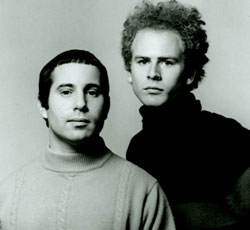
Simon and Garfunkel - Noted admiralty law experts.

In U.S. v. McPhee, the defendants were charged with conspiracy to import marijuana, after their boat, the Notty, was intercepted by Coast Guard cutters off the coast of Florida.

A key jurisdictional issue was whether the boat was intercepted within the territorial waters of the Bahamas. Defendants argued it was, on the basis that the interdiction occurred within 12 miles of Saint Vincent Rock, which defendants asserted is a Bahamian island. The government argued that Saint Vincent Rock is only a “rock” and does not qualify as an “island.”

The U.S. Court of Appeals for the Eleventh Circuit agreed with the government, although it conceded the question was not without its nuances, citing Simon & Garfunkel as authority (paragraph breaks inserted):

FN 9. The Government argued that the Notty was in international waters or on the “high seas” because “Saint Vincent Rock is a rock. If it was an island, it would be called Saint Vincent Island, not Saint Vincent Rock.” Ultimately, we must determine whether it is a rock or an island according to the statutory definitions provided by the Archipelagic Act.

We note in passing that for some purposes, the label is not altogether satisfying. Thus, for example, in the metaphysical sense, we can discern no reason why something could not be both a rock and an island at the same time.

See Paul Simon and Art Garfunkel, I am a Rock, on Sounds of Silence (Columbia 1966) (“A winter’s day, in a deep and dark December. I am alone, gazing from my window, to the streets below, on a freshly fallen silent shroud of snow. I am a rock, I am an island. I’ve built walls, a fortress deep and mighty, that none may penetrate. I have no need of friendship, friendship causes pain. It’s laughter and it’s loving I disdain. I am a rock, I am an island. Don’t talk of love. Well I’ve heard the word before. It’s sleeping in my memory. I won’t disturb the slumber of feelings that have died. If I never loved, I never would have cried. I am a rock, I am an island. I have my books and my poetry to protect me. I am shielded in my armor. Hiding in my room, safe within my womb, I touch no one and no one touches me. I am a rock, I am an island. And a rock feels no pain. And an island never cries.”).

The court did note, however, that “neither Simon nor Garfunkel has been identified as a nautical expert.”

Maybe the government could have bolstered its jurisdictional case by citing John Mellencamp and arguing that the “R.O.C.K. [was] in the U.S.A.”.

United States v. McPhee, 336 F.3d 1269, 1279 n.9 (11th Cir. 2003). Thanks to Michael Hirschkowitz.

See also United States v. Horn, 185 F. Supp. 2d 530, 551 n.37 (D. Md. 2002) (“She blinded me with science!”). Thanks to Kevin Cross for providing this Thomas Dolby-influenced citation in the same vein pop-music theme as McPhee, in proper Bluebook-form no less.

Sex and the Reasonable Person

lawsuit over fractured penis
Family friendly depiction of the injury.

Doe v. Moe, a May 2005 Massachusetts appellate case, gives a whole new meaning to the idea of safe sex. A guy sued his long-time girlfriend (ex-girlfriend?) for negligence when an ill-advised change in position during consensual intercourse resulted in him suffering a fractured penis. (The opinion gives details about how the accident occurred.)

In a case of first impression, the court struggled to arrive at an appropriate and workable standard of care to apply to private consensual sexual conduct. The court noted:

There are no comprehensive legal rules to regulate consensual sexual behavior, and there are not commonly accepted customs or values that determine parameters for the intensely private and widely diverse forms of such behavior.

Accordingly, the court concluded that the general negligence standard of reasonable care under the circumstances was inappropriate for consensual sex-physical injury cases.

Instead, the court said the plaintiff needed to show conduct rising to the level of “wanton or reckless.” The court opined that while the trial record might support a finding that the defendant’s conduct exposed plaintiff to a risk of harm, it did not support a finding of wanton or reckless conduct.

The case does raise an interesting legal issue. With so many different preferences and positions and idiosyncratic fantasies and fetishes, is there such a thing as a standard of “ordinary and reasonable care” for sex?

Doe v. Moe, 827 N.E.2d 240, 245 (Mass. Ct. App. 2005). Thanks to David Keller and Professor Howard Wasserman.

Breaking News: Marbury v. Madison Causing Consitutional Crisis

marbury unconstitutional
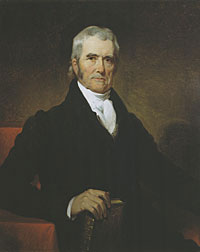
Chief Justice John Marshall, author of Marbury v. Madison.

In a 2005 opinion, an Alabama Supreme Court justice (that well-known jurisprudential heavyweight “Tom Parker”), without a trace of irony, called the U.S. Supreme Court “presumptuous” while declaring Marbury v. Madison and its progeny to be “unconstitutional.”

For non-legal types, Marbury is the landmark 1803 Supreme Court case authored by the great Chief Justice John Marshall that established the power of “judicial review”; i.e., that the Supreme Court gets the last word in disputes with the legislative and executive branches of government.

The Alabama case involved a challenge to the constitutionality of certain statutes affecting taxation and the funding of the Birmingham, Alabama civic center authority. Justice Parker included this footnote in his concurrence (italics added.):

21. . . . Despite everything in the text of the Constitution, its history, and the expressed intent of the Framers being completely contrary to the notion of judicial supremacy, the United States Supreme Court has presumptuously arrogated such a position for itself simply by declaring it so.

In Cooper v. Aaron . . . the United States Supreme Court stated: “[Marbury v. Madison, 5 U.S. (1 Cranch) 137, 2 L.Ed. 60 (1803)] declared the basic principle that the federal judiciary is supreme in the exposition of the law of the Constitution and that principle has ever since been respected by this Court and the Country as a permanent and indispensable feature of our constitutional system.” Tellingly, this proclamation of judicial supremacy was made without citation to the Constitution or any other authority. The result of this unconstitutional doctrine of judicial supremacy has been an increasing shift of the balance of powers from the elected executive and legislative branches of the federal government to the unelected judiciary, thereby emboldening federal courts to rule upon constitutional questions based upon foreign law or perceived changes in public opinion instead of the Constitution and its history. . . .

The turning away from our national compact by federal courts now threatens our country with a constitutional crisis.

There’s a constitutional crisis over Marbury?

Birmingham-Jefferson Civic Ctr. Auth. v. City of Birmingham, 912 So.2d 204, 223 n.21 (Ala. 2005) (Parker, J., concurring). Thanks to Brian Brock.

Judge is New York Pizza Snob

new york pizzaGeoff Petis sent along this interesting case. I’ll let him tell you about it:

New York Judge Philip S. Straniere penned an opinion about “shrinkwrap” agreements—contracts that may or may not become valid upon the opening of the package. The agreements go by different names (shrinkwrap, clickwrap, etc.), but the rose still smells as sweet. Evidently, Judge Straniere—who apparently takes his pizza as seriously as his contracts — did not agree:

Before deciding the merits of this case the court must address a troubling issue. The computer industry and other courts have adopted the term “pizza box” to describe the package in which the document containing the terms and conditions of the agreement is shipped. As a matter of law in the State of New York, such a container is not a “pizza box.” No self-respecting New York pizza would be caught soggy in such a box. The container may pass as a “pizza box” in those parts of the world that think food from Domino’s, Little Caesars, Pizza Hut, and Papa John’s is pizza. In this court’s opinion such a classification cannot be recognized east of the Hudson River.

Judge Straniere, having fun with this case, goes on to quote Ira Gershwin, Mandy Patinkin, and Marie Antoinette, among others.

Licitra v. Gateway, Inc., 734 N.Y.S.2d 389, 391 (N.Y. Civ. Ct. 2001). Thanks to Geoff Petis.