–From Julie Enloe, Marquette University Law School, Date of event: 1992
Like myself, my best friend during law school was a non-traditional student. However, she was much older than me and quite proud of the fact that she was a card-carrying member of the AARP.
During evidence class, we got into a discussion of “the ideal witness.” The professor posed some hypothetical examples, including a police officer who, at 55, was near retirement, as opposed to his much younger and rather inexperienced partner.
One young man in the second row was quite disgusted by the notion of an older witness. Such a person, he opined, could be easily cast as incompetent. “After all,” he said, “he’s going to die soon!”
No one laughed harder than my friend, who remarked that it was nice to know that she would graduate with one foot already in the grave.
(By the way, my friend is still very much alive and runs her own law practice!)
–From Jeremy Zeitlin, Columbia Law School, Date of event: 1984
Here’s a law school moment I’ll never forget: Columbia University, 1984 … It was a lecture conducted by some hot-shot VIP who refused to answer any questions following his hour-long rant on the politics of malpractice suits.
A woman in the back says, “Please sir, just answer my one, two-part question please?” So, thinking he was being very clever, the speaker says, “Okay, give me the second question first.”
A few chuckles followed, at which point the fast-thinking woman said, “If so, when?” Naturally, the place fell apart and she received an ovation.
–From Sylvia J. Feinman, Brooklyn Law School, Date of event: circa 1977.
We were in Domestic Relations class, focusing on annulment and the question of who can bring an action to annul a marriage. The problems became more and more esoteric. Who can bring an action to annul the marriage of a deceased person? Of an incompetent? Then one eager student went too far in his querying.
I closed my books decisively and said, “If I ever need to know who can bring an action to annul the marriage of a dead idiot, I’ll look it up.”
–From Carol Light, American University School of Law, Date of event: early 1970s
I went to night law school at American University in Washington, D.C. in the early 1970s. Our class was full of interesting people with demanding full-time jobs, so it’s not surprising that one of the, er, challenges, was literally staying awake in class. One night (and I’ve blessedly forgotten which class, which professor, and which student), one poor young man lost the battle, fell both asleep and off his chair onto the floor. The fall woke him, of course.
The professor, not missing a beat, said “Well, Mr. X, are we keeping you up?”
“Just barely,” the student replied, with alacrity and admirable accuracy.
–From name withheld by request, Loyola University (Chicago) School of Law, Date of event: circa 1991
I went to night school at Loyola University of Chicago School of Law and graduated in 1991. In my last year of law school, I took the intensive week-long Trial Advocacy class. For one practice exercise, we had to be videotaped making an argument to have a piece of evidence admitted over an objection and we had to dress as if we were in court. Since we were all just law students without jobs, some people had to purchase suits specifically for the exercise.
A woman, whose name I can’t remember, got up to give her argument, and it was impossible not to notice that she still had the anti-theft, “inventory control” tag attached prominently to the side of her suit jacket. She was extremely embarrassed and obviously concerned that everyone watching was going to think that she had stolen her suit, so she spent several minutes at the beginning of her argument explaining that the tag had been left on by the store and she didn’t discover it until she got home after the store had closed, etc.
Then she went into her actual argument, which didn’t last nearly as long as the tag explanation.
In Fisher v. Lowe, the plaintiff sued defendant for driving his automobile into plaintiff’s oak tree, damaging the tree. The Michigan trial court ruled in favor of the defendant and the Court of Appeals affirmed. Here is the court’s actual opinion:
We thought that we would never see
A suit to compensate a tree.
A suit whose claim in tort is prest
Upon a mangled tree’s behest;
A tree whose battered trunk was prest
Against a Chevy’s crumpled crest;
A tree that faces each new day
With bark and limb in disarray;
A tree that may forever bear
A lasting need for tender care.
Flora lovers though we three,
We must uphold the court’s decree.
Affirmed.
The court’s opinion prompted the usually staid headnote writers at West Publishing Co. to take their own poetic license. This one’s worth checking out in full.
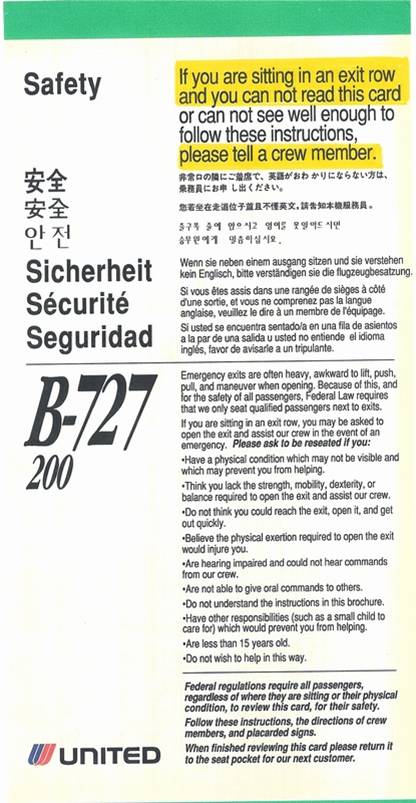
One of my favorite types of silly warnings is the kind that can’t possibly be followed. This is a great example, “borrowed” from the seat-back pocket of Boeing B-727 airliner:
If you are sitting in an exit row and you can not read this card, … please tell a crew member.
Alrighty.
Imagine what airlines would write if they really thought we couldn’t read any of it:
“Meanwhile, while you’re sitting there unable to read this card hoping we’ll come by with the drink cart before you pass out, let us tell you how much we enjoy treating you like cattle, bossing you around, losing your luggage, starving you into submission, and, when we can, smashing your heads against the overhead compartment, accidental like. Customer service? Ha, haa. That’s a good one. Too bad you can’t read this, SUCKERS!”
Much products liability litigation is directed at whether a product warning was reasonably clear in explaining the actual risk of the product. A subsidiary argument involves pictorial warnings. Pictorial warnings have the benefit of being understood by persons who read in different languages or who are illiterate. Their downside is that they often are unclear because it is difficult to capture most product warnings in a simple picture or symbol.
But I think everyone would agree that the graphic pictorial warning on this vehicle with a rotating-shaft device clearly indicates this is a risk a reasonable person would avoid.
This peek inside a real juror’s mind is hilarious. Below is a transcription of a handwritten letter from a juror to the judge during a civil trial (verified by seeing a scan of the handwritten letter). I deleted the juror’s name, left in typos, and inserted paragraph-spacing for reading convenience.
Your Honor
I am tired of spending day after day wasting my time listening to this bullcrap. This is cruel and unusual punishment. The plantif is an idiot. He has no case. Why are we here? I think my cat could better answer these questions . . . and he wouldn’t keep asking to see a document.
I’ve been patient. I’ve sat in these chairs for 7 days now. If I believed for a second this was going to end on Thursday I might not go crazy. This is going to last for another 4 weeks. I cannot take this. I hate these lawyers and prayed one would die so the case would end.
I shouldn’t be on this jury. I want to die. I want to die!! Well not die for real but that is how I feel sitting here. I am the judge, you’ve said that over and over, well I am not fair and balanced. I hate the plantif. His ignorance is driving me crazy. I know I’m writing this in vain but I have to do something . . . for my sanity. These jury chairs should come with a straight jacket.
An entire day today and we are still on the same witness. The defense hasn’t even started yet and we have 3 days left 3 days my ass. Not that the defense needs a turn considering the plantif and his lawyer (who looks like the Penquin) have no case!!!! Thanks for letting me get this off my chest. Please keep the disordelies nearby. I may need them.
Don't mistake Congressman Joe Walsh for Rock Star Joe Walsh, although life's been good to both of them so far.
A Los Angeles lawyer representing rocker Joe Walsh (James Gang, Eagles) sent a snide cease and desist letter to an Illinois Congressman of the same name for allegedly using the melody from Walsh’s classic song “Walk Away” to promote his campaign, retitled and with new lyrics. Here are some excerpts:
Dear Mr. Walsh:
We represent Joe Walsh—not you, but the musician who plays guitar with the Eagles. Joe wrote a song called “Walk Away.” A lot of people know this song. That’s why when they heard your campaign song, “Lead The Way,” they noticed it was the same song as “Walk Away,” but with peculiar lyrics.
As a candidate for Congress, you probably have a passing familiarity with many of the laws of this great country of ours. It’s possible, though, that laws governing intellectual property are a little too arcane and insufficiently populist for you to really have spent much time on. …
First, there’s the United States Copyright Act. It says a lot of things, but one of the things it says is that you can’t use someone else’s song for your political campaign promotions unless you get permission from the owner ….
Second, … you’re not allowed to take someone’s song and change the lyrics. … Now, I know why you used Joe’s music—it’s undoubtedly because it’s a lot better than any music you or your staff could have written. But that’s the point. Since Joe writes better songs than you do, the Copyright Act rewards him by letting him decide who gets to use the songs he writes.
You might also want to check out the trademark laws. They’re there to protect the public from being confused as to the source of goods or services or as to whether someone endorses particular goods or services. Given that your name is Joe Walsh, I’d think you’d want to be extra careful about using Joe’s music in case the public might think that Joe is endorsing your campaign or, God forbid, is you. …
I’m sure that when you take this letter to a lawyer with a passing knowledge of copyright and trademark law, he’ll give you some good lawyer words to put in a letter back to us – things like “First Amendment,” “fair use,” “parody” and “so’s your old man.” Having dealt with situations like this in past, we know that the first refuge of political scoundrels is the First Amendment. …
As a former Presidential candidate, Joe Walsh knows how tough it is to get elected. But he always played by the rules. And so should you. Therefore, we must insist that you discontinue using in your campaign any material that infringes the copyright in “Walk Away” (or any of Joe’s other songs).
We trust that you will promptly comply with this request so that we don’t have to go all Jackson Browne on you [referring to Jackson Browne suing John McCain for using his song “Running on Empty” during the 2008 campaign without permission]. …
Congressman Walsh responded in a letter asserting the song was performed as a parody, not for campaign promotion, and is protected under the fair use doctrine of U.S. copyright law.
— Letter from Peter T. Paterno to U.S. Rep. Joe Walsh (Ill.), 1/26/2010. Thanks to Professors Janet Richards and Jodi Wilson.