Law Review Humor – Ode to the Bluebook

As faculty advisor to a law review, I deliver opening remarks at the law review’s annual banquet.  Mostly these consist of giving thanks to the graduating law review members for their dedication and hard work.  They devote thousands of hours each year to painstakingly selecting, editing, formatting, proofing and–of course, cite-checking–scholarly articles.

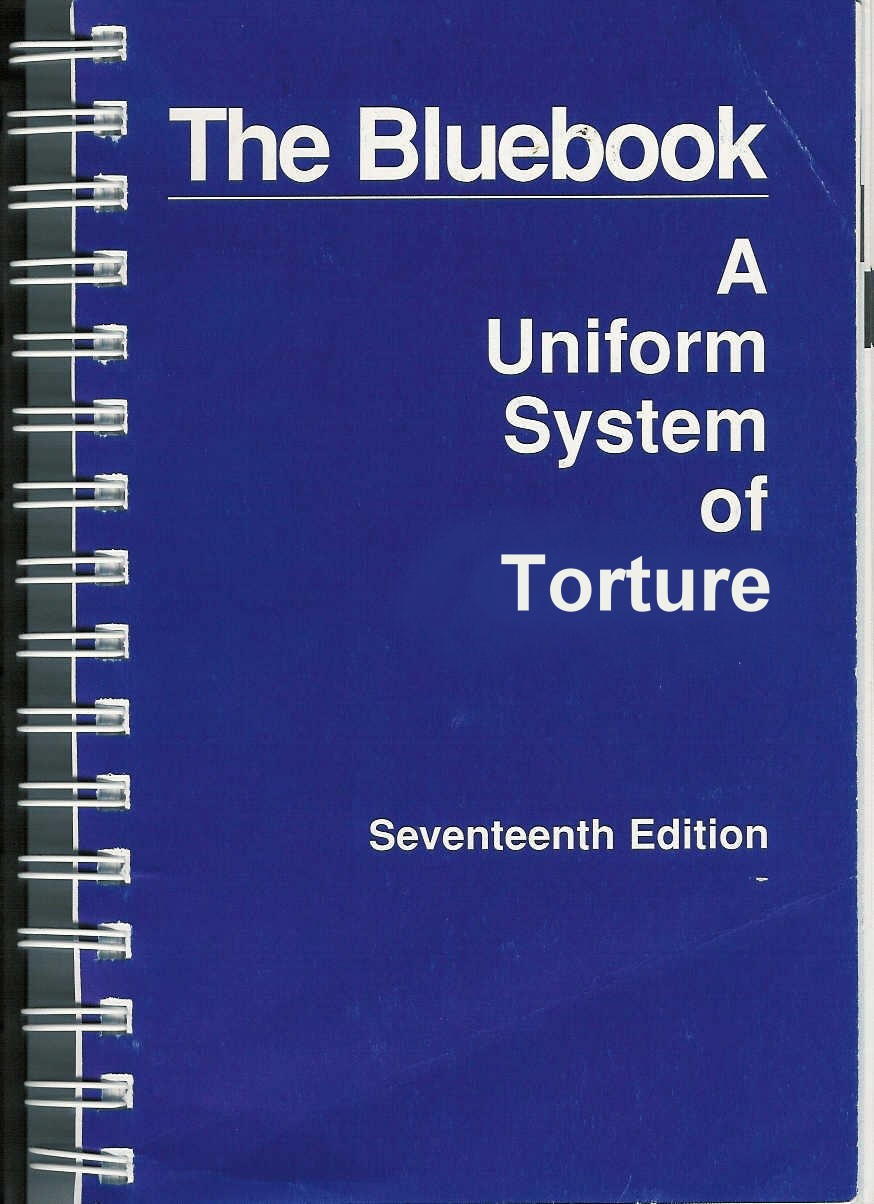
Cite-checking requires mastering The Bluebook: A Uniform System of Citation, a ridiculously-but-addictively complex 560-page manual of rules for referencing legal authorities.  (See The World’s Greatest Law Review Article.)

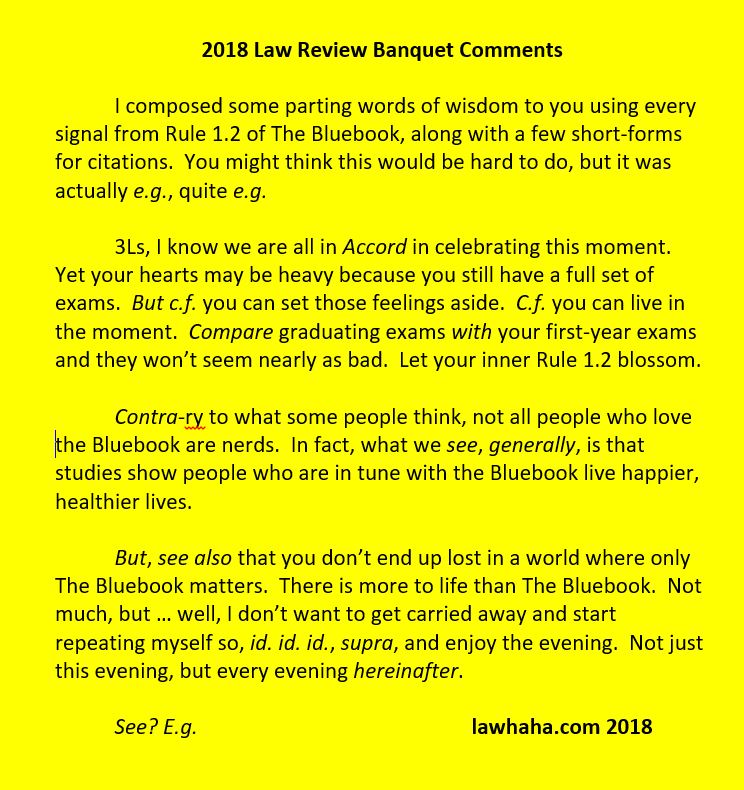
This year I tried to add levity to my remarks with some words of wisdom incorporating every “introductory signal” from Rule 1.2 of The Bluebook and throwing in a few “short-form” citation rules.  (If you are not a law review or Bluebook geek, this will make no sense at all.)

Corny, but it went over well, maybe because law review students are starved for frivolity.

Distinguishing Good from Bad Law School Advice

When new students arrive at law school, they receive a ton of advice from upper-level students.  2Ls and 3Ls love giving advice to new students.  If they can do it at an event where alcohol is being consumed, a state close to nirvana is achieved.  But how do incoming students distinguish between good advice and bad advice?  Here’s a tip I give in 1L of a Ride.  After mentioning that upper-level students sometimes give really good advice, I say:

But upper-level students also give some really bad advice, much of which involves ways to cut corners, so be wary of what they tell you. Although it will be socially awkward, if an upper-level student starts piling on the shortcut advice, ask the person about his or her GPA or class rank. You could phrase it like this: “Thanks for all the advice. Did it work for you?”

Last week I received an email from an incoming student at another law school.  She complimented the book and added a funny postscript referencing the above passage:

P.S.  Since your interest in humor is apparent, let me tell you a story from the second day of reading your book. I was with my parents before dinner and discussing the tips involved in your book.  My father is a practicing lawyer who went to Ole Miss Law School and graduated in 1961. I haven’t considered him much of a resource due to the changed role of technology in that intervening period.

I mentioned two conversations I’ve had with friends who are already in law programs across the country and clarified that they gave excellent advice. I repeated your recommendation that you ask any student giving bad advice or shortcuts about their GPA to help evaluate its validity.

Some time later my dad started a sentence, “What you need to know about law school is …”  When he finished I said, “Hey dad, that sounds like that really worked for you! May I ask what your GPA was?”

I’ll be listening to his fatherly advice, despite his C+/B- grade point average.  🙂  He’s more convinced than ever that repeating “You’ll go to law school and become a lawyer” beginning at the cradle was a good idea.

Love it.  Seriously, folks, I was just looking at a law school page where an incoming student was asking for advice on a specific topic.  The best answers came from the top students.  Most people will make it through law school.  If your goal is higher than that, carefully sift through all advice, from students, professors and, yes, even dads.
Third Edition of 1L of a Ride Released

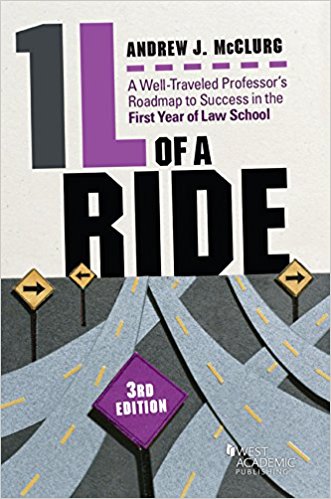
Excited to report that after two years of work, the shiny new third edition of 1L of a Ride: A Well-Traveled Professor’s Roadmap to Success in the First Year of Law School was just released by West Publishing Company.

It’s available here on Amazon.  Check out the 148 reviews for 1L of a Ride averaging 5-stars.  1L of a Ride is assigned as required or recommended reading at law schools throughout the country. [Note: Because it just came out, it’s listed temporarily out of stock on Amazon, but that should be fixed quickly.  In the meantime, you can always order it directly from the publisher here.]

Couldn’t have done it without the help my amazing research assistants at the University of Memphis Cecil C. Humphreys School of Law and good friends at West Academic Publishing.  Thank you all!


Top Five Habits of Successful Law Students — ABA Webinar on YouTube

The American Bar Association Law Student Division posted my webinar, The Top Five Habits of Successful Law Students, on YouTube. Check it out for some good advice.

[embedyt] https://www.youtube.com/watch?v=AmsCa-3JJJc[/embedyt]

Here’s the accompanying description:

In this webinar, Professor Andrew McClurg, author of the popular law school prep book, 1L of a Ride: A Well-Traveled Professor’s Roadmap to Success in the First Year of Law School, seeks to inspire new students to “Be Excited!” about their new adventure and get them on the right track from day one by explaining his C.R.E.D.O. for law school success: the top five habits of successful law students (Consistent, Rigorous, Efficient, Diligent, and Organized). Following the C.R.E.D.O. will boost any student’s ability to maximize their potential.

This special webinar includes a Q&A session with Professor McClurg.

1L of a Ride Video Course

1L of a Ride Video Course Marketing Video

The 1L of a Ride Video Course is based on McClurg’s bestselling law school prep book of the same name.  In addition to McClurg, the 13-part series features award-winning law professors Christine Coughlin (Wake Forest), Meredith Duncan (University of Houston), and Nancy Levit (University of Missouri-Kansas City).

Each video is a concise ten minutes, followed by a short self-assessment quiz. The videos include:

1. Introduction to the Video Course
2. Planning Ahead and Biggest Fears
3. Structure and Role of U.S. Courts
4. Socratic and Case Methods
5. Overview of First-Year Curriculum
6. First-Year Sample Course: Torts
7. How to Read and Brief a Case
8. The C.R.E.D.O.—Top Five Habits of Successful Law Students
9. Essential Study Techniques
10. Legal Research Basics
11. Legal Writing Basics
12. Managing Stress and Maintaining Well-Being
13. Professionalism

Research shows students gain not only from reading, but seeing and hearing, in part because video helps accommodate diverse learning styles. Use the videos to enhance comprehension and retention. Studies also show students prefer and benefit from one-on-one facetime with professors, which the videos, while no match for the real thing, can help simulate.

The video course is available as a standalone product or bundled with a print or e-copy of the book (recommended) at the West Academic Publishing Store.

The Second Amendment Right to Be Negligent

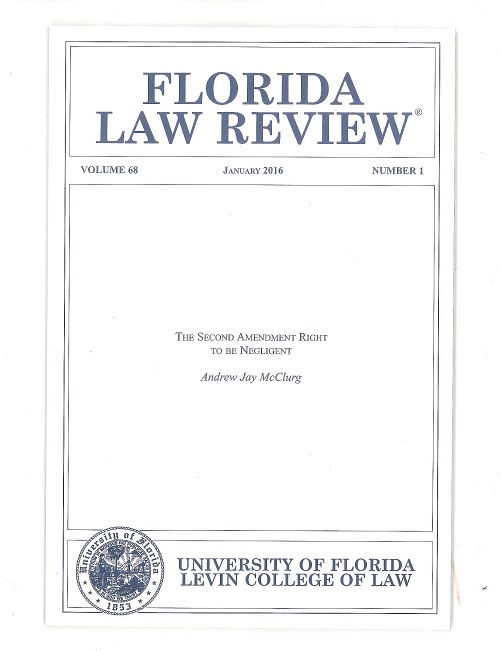
Florida Law Review Right to be NegligentAndrew Jay McClurg, The Second Amendment Right to be Negligent, 68 Florida Law Review 1 (2016).

Only two constitutional rights — the First and Second Amendments — have the capacity, through judicial interpretation or legislative action or inaction, to confer a “right to be negligent” on private citizens; that is, a right to engage in objectively unreasonable risk-creating conduct without legal consequences. In the First Amendment context, for example, the Supreme Court, in New York Times v. Sullivan and its progeny, expressly embraced a right to be negligent in defaming public officials and public figures to protect speech. This Article asserts that through both common and statutory law the United States has enshrined a de facto Second Amendment right to be negligent in many aspects of making, distributing, and possessing firearms, the only legal product designed to inflict what the tort system is designed to prevent.

Explaining that it is a microcosm of a much larger issue, the Article focuses on one area: allowing access to guns by criminals through theft. Hundreds of thousands of guns are stolen each year from individuals and commercial sellers. By definition, they all go directly to criminals. A substantial percentage of guns used in crime were previously stolen. Nevertheless, the common law has conferred near complete immunity on gun owners and sellers who fail to secure guns from theft when they are subsequently used to cause harm. This occurs despite frequent judicial pronouncements that the risk of firearms demands the highest degree of care in their use and keeping. To accomplish this result, courts ignore or mischaracterize fundamental scope of liability principles, rarely even reaching the question of whether reasonable care was exercised.

On the statutory front, not only have Congress and most states failed to mandate firearms security measures, Congress has — in the name of the Second Amendment — given express protection of the right to be negligent, most prominently in the form of the Protection of Lawful Commerce in Arms Act. The Act immunizes manufacturers and sellers of guns from most tort claims, including claims against commercial firearms licensees for negligent security leading to theft.

The Article argues that this government-endorsed lack of responsibility results in the under-deterrence of risky conduct that, with reasonable alterations, could avoid substantial intentional and accidental injury costs.

New Guns and the Law Casebook

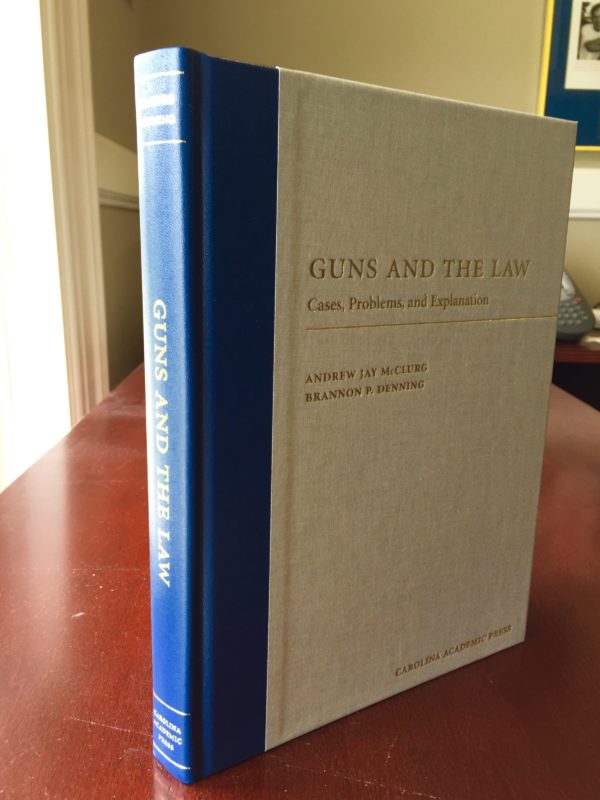
Gun Book CoverMy new casebook–Guns and the Law: Cases, Problems, and Explanation–composed with Professor Brannon Denning, just came out.  Featuring cases, problems, and explanation, it offers a balanced treatment of gun law and policy in the United States, which is hard to find in this highly charged area.

Here’s the catalog description from Carolina Academic Press:

McClurg (pro-reasonable regulation) and Denning (pro-gun-rights) apply their decades of experience studying firearms policy and gun violence in this balanced, reader-friendly casebook addressing the contentious issues of guns in America. Through cases, problems, and provocative notes and questions, the book explores current federal and state gun laws, major constitutional cases, post-Heller Second Amendment litigation, modern self-defense rules such as Stand Your Ground laws, civil liability, gun laws in other countries, legal solutions to gun violence, and issues of guns and race, alienage, culture, and gender.

We designed the book to be accessible not only to law professors and law students, but to undergraduate and other graduate school professors.  Professors interested in teaching a course in the area can obtain a complimentary copy from the publisher.

“Grit and Grind” Your Way to Law School Success

The Grindfather
The Grindfather

If you’re getting ready to start law school and are worried because you have a below-average LSAT score, you need to read my new ABA blog post.  In it, I explain data about the correlation between LSAT scores and first-year grades, which is weaker than most people realize.

While LSAT scores correlate with success for some students, they do not reliably predict success or lack of it for any individual student because the LSAT does not take into consideration many key ingredients to success, including “grit.”

Look at the Memphis Grizzlies. They’ve made the NBA playoffs for six straight years without any superstars. Their motto, coined by Grindfather Tony Allen, is “grit and grind.” Now, Professor Angela Duckworth has authored a bestselling explaining her research that shows “grit”–perseverance and single-minded determination–is at least as important as native intelligence in predicting success.

Check out over at ABAforLawStudents.com.

Supreme Court Emoji Challenge

Thinky EmojiInsurance law expert and all-around funny, clever guy Randy Maniloff has come up with a fun test for spelling out the names of 10 famous U.S. Supreme Court cases using only emoji.  How did this come about?  He explains in his latest issue of Coverage Opinions:

The other night I was out to dinner with my 9 year old daughter. As we waited for her mac & cheese to arrive I decided to give her a lesson on the Supreme Court. I figured I’d start with the basic operation of the federal judiciary. From there move on to some landmark Supreme Court cases. And by dessert we’d be discussing the Necessary and Proper Clause. But she wanted no part of it – begging me to stop.

So I took a different tack. I’d tell her about a case and then she would use my phone to find emojis to write out the case name. This idea she loved. While it didn’t last long, as dinner arrived, it gave me an idea: The Supreme Court “Emoji Challenge.”

For non-lawyers, the first takeaway from this is how geeky lawyers can be.  My own daughter grew up playing “Spot the Tort.”

I confess I fared poorly on the exam, but maybe it’s a generational issue.  Law students: Be sure to take the test. Rumor has it that several Constitutional Law professors (only at the higher-ranked schools) intend to use it on their upcoming Spring final exams.

The Golden Mean in the Gun Debate

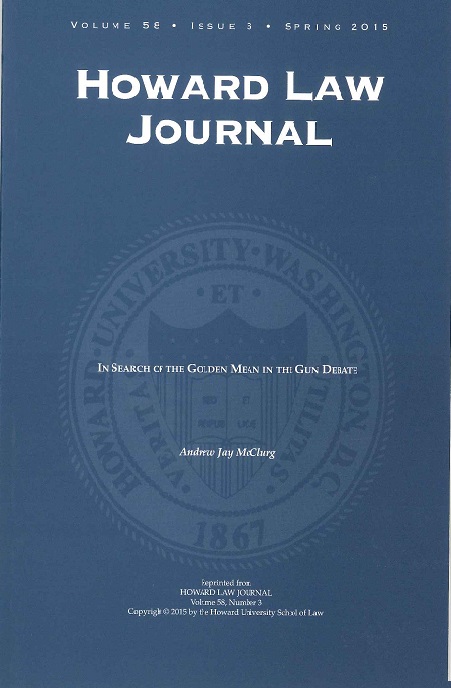
Howard Law Journal (002)Andrew Jay McClurg, In Search of the Golden Mean in the Gun Debate, 58 Howard Law Journal 779-809 (2015).

The American gun debate is stuck and has been for a long time. Both sides remain trapped by their own hyperbolic rhetoric and reasoning fallacies, with the result that partisans are being heard only by those who already agree with them. This essay asserts that there is such a thing as “reasonable middle ground” in the gun debate and seeks to prove it by analyzing five specific measures that have the potential to reduce gun violence without infringing legitimate Second Amendment rights:

(1) bolstering federal support for research into the causes and prevention of gun violence, which Congress has blocked since the 1990s;

(2) extending instant background checks, currently required only for sales by licensed firearms dealers, to all gun sales;

(3) requiring gun purchasers to demonstrate their knowledge of state gun laws and basic gun safety rules and also their ability to safely handle the gun they are purchasing;

(4) mandating security measures by retail gun sellers to prevent theft; and

(5) implementing microstamping technology that would enable law enforcement to trace crime guns and ammunition cartridges found at crime scenes, facilitating the apprehension and prosecution of violent criminals.

While more substantial measures would be more effective in combating gun deaths and injuries, this essay purposely selected limited measures with the hopeful goal of getting people to recognize that there may well be middle-ground or a “golden mean” in the gun debate.