
Sad, Weird Tale of an Executed One-Eyed Horse

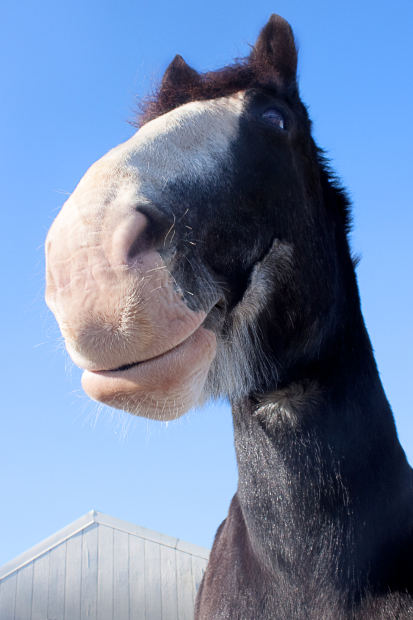
City of Canadian v. Guthrie is a sad, strange tale of a one-eyed horse ordered by the town mayor to be executed by one Panhandle Pete, who took the mare’s life “by shooting her between the bad eye and the one not so bad.”

In an opinion that makes you wonder whether someone dosed the town’s water supply with LSD (although it wasn’t yet invented), Chief Justice Hall explained “when Panhandle Pete’s pistol popped, she petered, for which the poundkeeper paid Pete a pair of Pesos.”

The owner of the horse sued for damages, claiming she was a prize mare. The court took issue with that assertion, describing the horse as follows:

From the record, we conclude that although she may not have had a skin you would particularly love to touch (though she had seen only fourteen joyous summers), yet she had a skin which clung like ivy to her rafters with a beautiful corrugated effect upon the sides of her lithe and spirituelle form.

The horse got in trouble for wandering onto neighboring property and eating the foilage, or as Justice Hall put it (paragraph breaks inserted):

The record shows that upon at least two occasions “When night drew her sable curtain down And pinned it with a star,” and “Silence like a gentle spirit Brooded o’er a still and pulseless world,” the time lock on her corral mysteriously went off and so did she, in search of tulips, dahlias, and gladioli in the neighboring lawns and flower beds …

Although she had only one eye, appellant contends she could find more edible shrubbery in a single night than an experienced landscape gardener could replant in thirty days. We may assume that in her midnight excursions she had been thrown with porch climbers, joy riders, orchard raiders, and other nocturnal prowlers, which may account for her waywardness and utter disregard for the property rights of other. …

It was not denied that she had “went hence” and was cut down in the heyday of her young and fitful life … [because the mayor] personally ordered her gentle soul sent to the great beyond and the remainder to the municipal dump ground.

The court finally dismissed the case for lack of jurisdiction.

City of Canadian v. Guthrie, 87 S.W.2d 316, 317–18 (Tex. Ct. App. 1932). Thanks to John R. Thomason.

No Degrees of Separation

Six degrees of separation? Forget about it.

In Wheat v. Fraker (Ga. App. 1963), there weren’t any. The plaintiff, Doug Fraker, sued the defendant, Judd Wheat, for damages arising from an automobile collision. The jury returned a verdict for plaintiff and the defendant appealed on the ground that (pay attention because this gets complicated) the wife of the foreman of the jury was the first cousin to the plaintiff’s wife. But wait, she was also the second cousin of the defendant! How could any judge pass up the opportunity to have fun with this family affair? Here are excerpts from the poetic opinion:

“Foul, foul play,” the defendant cried.

“That I by kinsman be not trammeled

Let the issue again be tried

Before another jury impanelled.”

“With juror mine adversary durst

Try the cause, whose wife is second cousin to my wife

And to plaintiff’s wife a first.

A new trial, sire, I demand to settle strife.”

“No foul play do I find or see,”

The judge replied. “Foreman’s wife to thine

And to plaintiff’s wife may kinsman be,

but to Doug and thee no kinship do I find.

“Thus, it doth not appear

For any cause or reason told

That the juror was not thy peer

The case to try and verdict mold.”

“Moreover, when kinships we sought to learn

It doth not appear that as best befits

One who would a kinsman spurn

Thou revealed that cousin did on the panel sit.”

Wheat v. Fraker, 130 S.E.2d 251, 252 (Ga. Ct. App. 1963). Thanks to Senior District Judge James Barlow, San Antonio, TX.

This Judicial Humor Resulted in Censure

The Kansas Supreme Court publicly censured a rhyming judge in a 1975 case for a tasteless piece of doggerel in which he publicly humiliated a woman arrested for prostitution. His poetic order was deemed to be in violation of the judicial ethical canon that “[a] judge should be patient, dignified, and courteous to litigants, jurors, witnesses, lawyers, and others with whom he deals in his official capacity.”

We won’t  perpetuate the misdeed by setting forth the offending rhyme here. Suffice it to say the judge repeatedly called the young woman a “whore” (in addition to showing bad judgment, he should be chastised for being a lousy poet; that’s what he came up with to rhyme with “1974” — the year of defendant’s arrest).

The most interesting aspect of the case was the Kansas Supreme Court’s commentary on judicial humor. In defense to the disciplinary proceeding, the censured jurist cited to several poetic judicial opinions and argued he should not be censured for following in this grand judicial tradition. The court observed:

Judges have long been enjoined from the use of humor at the expense of the litigants before them for reasons which should be apparent. Under the heading of “Ancient Precedents” in the canons of judicial ethics adopted in 1924 by the American Bar Association this appears:

“Judges ought to be more learned than witty; more reverend than plausible; and more advised than confident. Above all things, integrity is their portion and proper virtue ….”

“Patience and gravity of hearing is an essential part of justice; and an over speaking judge is no well-tuned cymbal ….” — Bacon’s Essay “of Judicature.” (198 Kan. xi.)

In 1967 a long time member of the supreme court of Arkansas in advising new judges on opinion writing had more to say on the subject. We quote:

“. . . Judicial humor is neither judicial nor humorous. A lawsuit is a serious matter to those concerned in it. For a judge to take advantage of his criticism-insulated, retaliation-proof position to display his wit is contemptible, like hitting a man when he’s down.” (Smith, A Primer of Opinion Writing, For Four New Judges, 21 Ark. L. Rev. 197, 210.)

Judges simply should not ‘wisecrack’ at the expense of anyone connected with a judicial proceeding who is not in a position to reply. … Nor should a judge do anything to exalt himself above anyone appearing as a litigant before him. Because of his unusual role a judge should be objective in his task and mindful that the damaging effect of his improprieties may be out of proportion to their actual seriousness. He is expected to act in a manner inspiring confidence that even-handed treatment is afforded to everyone coming into contact with the judicial system.

In re Rome, 542 P.2d 676, 685 (Kan. 1975). Thanks to Lihwei Lin.

I Thought that We Would Never See A Judge as Tolerant as Thee

With several rhyming judges having fun with people’s cases, one must wonder what the judges would do if the shoe was on the other foot–if lawyers submitted rhyming court documents in a case, perhaps a poetic brief. Now we know! Well, at least with regard to one tolerant judge.

In Mackensworth v. American Trading Transportation Co., a judge responded as a good sport to some poetic pleadings submitted by counsel. For reasons unknown, the plaintiff’s lawyer submitted a poetic reply brief, stirring defense counsel to reply poetically as well.

U.S. District Judge Edward R. Becker decided to be a good sport and join in the fun. Although not set out in this excerpt, the West headnote writers once again had a good rhyme time with the case. Here are some excerpts from Judge Becker’s order:

The motion now before us has stirred up a terrible fuss.

And what is considerably worse, it has spawned some preposterous doggerel verse.

The plaintiff, a man of the sea,

after paying his lawyer a fee,

filed a complaint of several pages to recover statutory wages.

The pleaded facts remind us of a tale that is endless.

A seaman whom for centuries the law has called “friendless”

is discharged from the ship before voyage’s end

and sues for lost wages, his finances to mend.

***


Plaintiff’s counsel, whose name is Harry Lore,

read defendant’s brief and found it a bore.

Instead of a reply brief, he acted pretty quick

and responded with a clever limerick:

“Admiralty process is hoary

With pleadings that tell a sad story

Of Libels in Rem-

The bane of sea-faring men

The moral:

Better personally served than be sorry.”


Not to be outdone, the defense took the time

to reply with their own clever rhyme.

The defense counsel team of Mahoney, Roberts, & Smith

drafted a poem cutting right to the pith:


“Admiralty lawyers like Harry

Both current and those known from lore

Be they straight types, mixed or fairy

Must learn how to sidestep our bore.

For Smith, not known for his mirth

With his knife out for Mackensworth

With Writs, papers or Motions to Quash

Knows that dear Harry’s position don’t wash.”


Overwhelmed by this outburst of pure creativity,

we determined to show an equal proclivity.

Hence this opinion in the form of verse,

even if not of the calibre of Saint-John Perse.

[Court proceeds to wax poetic about long arm jurisdiction, concluding with:]

Finding that service of process is bona fide,

the motion to dismiss is hereby denied.

So that this case can now get about its ways,

defendant shall file an answer within 21 days.

Mackensworth v. Am. Trading Transp. Co., 367 F. Supp. 373, 374–75, 377 (E.D. Pa. 1973). Thanks to Lihwei Lin.

The Haunting of Bankruptcy Law

It must have been a slow day in the bankruptcy courts of South Florida when Judge A. Jay Cristol took pen in hand to address the case of In re Love. The West headnote at the end is funny.  But first, Judge Cristol’s take on Edgar Allan Poe’s haunting poem, The Raven, as applied to bankruptcy law:

Once upon a midnight dreary, while I pondered weak and weary

Over many quaint and curious files of chapter seven lore

While I nodded nearly napping, suddenly there came a tapping

As of some one gently rapping, rapping at my chamber door,

“Tis some debtor” I muttered, “tapping at my chamber door—

Only this and nothing more.”

Ah distinctly I recall, it was in the early fall

And the file still was small

The Code provided I could use it

If someone tried to substantially abuse it

No party asked that it be heard.

“Sua sponte” whispered a small black bird.

The bird himself, my only maven, strongly looked to be a raven.

Upon the words the bird had uttered

I gazed at all the files cluttered

“Sua sponte,” I recall, had no meaning; none at all.

And the cluttered files sprawl, drove a thought into my brain.

Eagerly I wished the morrow—vainly I had sought to borrow

From BAFJA, surcease of sorrow—

and an order quick and plain

That this case would not remain

as a source of further pain.

The procedure, it seemed plain.

As the case grew older, I perceived I must be bolder.

And must sua sponte act, to determine every fact,

If primarily consumer debts, are faced,

Perhaps this case is wrongly placed.

This is a thought that I must face, perhaps

I should dismiss this case.

I moved sua sponte to dismiss it

for I knew I would not miss it

The Code said I could, I knew it.

But not exactly how to do it, or perhaps some day I’d rue it.

I leaped up and struck my gavel.

For the mystery to unravel

Could I? Should I? Sua sponte, grant my motion to dismiss? While it seemed the thing to do, suddenly I thought of this.

Looking, looking towards the future and to what there was to see

If my motion, it was granted and an appeal came to be,

Who would be the appellee?

Surely, it would not be me.

Who would file, but pray tell me,

a learned brief for the appellee

The District Judge would not do so

At least this much I do know.

Tell me raven, how to go.

As I with the ruling wrestled

In the statute I saw nestled

A presumption with a flavor clearly in the debtor’s favor.

No evidence had I taken

Sua sponte appeared foresaken.

Now my motion caused me terror

A dismissal would be error.

Upon consideration of § 707(b), in anguish, loud I cried

The court’s sua sponte motion to dismiss under 707(b) is denied.

Give credit to the headnote writers at West. The job must be pretty boring, but they never miss a chance to spice it up a bit. Here’s the West Reporter headnote for the case:

Bankruptcy 48

Sua sponte dismissal would be error,

Though authority in Code is there,

To eschew abuse of consumer debt,

As presumption for debtor must be met.

In re Love, 61 B.R. 558, 558–559 (Bankr. S.D. Fla. 1986). Thanks to Professor Glenn E. Pasvogel.

Rhymin’ Eakin

Pennsylvania Judge Mike Eakin is a poetic soul who specializes in opinions that rhyme.

In Zangrando v. Sipula, Zangrando was walking her miniature poodles, Angel and Autumn, when Sipula struck one of the dogs with his car. Zangrando sued Sipula for payment of the vet bills. Here’s a short excerpt from Judge Eakin’s rhyming decision, affirming the trial court’s award of damages:

The car was coming much too close, something inside told her; the next thing Mrs. Zangrando knew, a poodle flew over her shoulder.

To appellee this was nothing short of an unmitigated disaster; the wingless Angel’d taken flight and ascended quickly past her.

 In this brace of miniature poodles, neither one wide nor tall; one may have been named Autumn, but t’was Angel took the fall.

Don’t worry. Poor little Angel recovered from her injuries. A fundamental rule of writing rhyming judicial opinions—of which there are many in the annals of law—is that the injury be slight. The opinion wouldn’t be as amusing if it rhymed: “When the doggie got squashed under the SUV’s wheels; it put a quick end to his plaintive squeals.”

Zangrando v. Sipula, 756 A.2d 73, 75 (Pa. Super. Ct. 2000). Thanks to Professor Coleen Barger.

More Rhymin’ Eakin

Here are a couple more rhyming opinions from Pennsylvania Judge Mike Eakin:

In Busch v. Busch, he upheld a pre-nuptial agreement with the observation, “They wanted to marry, their lives to enhance, not for the dollars—it was for the romance. When they said, ‘I do,’ had their wedding day kiss, it was not about money—only marital bliss.”

In Liddle v. Scholze, he rejected a contract claim by a buyer of emus (Liddle) against the seller (Scholze) after the emus (Nicholas and Savannah) failed to propogate. He blamed the emus: “The fault’s the emus’, not that of Liddle, or Scholze, or the court placed in the middle. Fruitless in Pennsylvania and Louisiana, the blame’s on Nicholas and Savannah.”

Busch v. Busch, 732 A.2d 1274, 1278 (Pa. Super. Ct. 1999); Liddle v. Scholze, 768 A.2d 1183, 1186 (Pa. Super. Ct. 2001).

Proof Judges Can Do Anything They Want

In Fisher v. Lowe, the plaintiff sued defendant for driving his automobile into plaintiff’s oak tree, damaging the tree. The Michigan trial court ruled in favor of the defendant and the Court of Appeals affirmed. Here is the court’s actual opinion:

We thought that we would never see

A suit to compensate a tree.

A suit whose claim in tort is prest

Upon a mangled tree’s behest;

A tree whose battered trunk was prest

Against a Chevy’s crumpled crest;

A tree that faces each new day

With bark and limb in disarray;

A tree that may forever bear

A lasting need for tender care.

Flora lovers though we three,

We must uphold the court’s decree.

Affirmed.

The court’s opinion prompted the usually staid headnote writers at West Publishing Co. to take their own poetic license. This one’s worth checking out in full.

— Fisher v. Lowe, 333 N.W.2d 67, 67 (Mich. Ct. App. 1983).