Judge Enters “Order Denying Motion for Incomprehensibility”

Several grounds exist for a judge denying a lawyer’s motion.  Now we have a new one: incomprehensibility.

Displeased with a lawyer’s inartful motion-drafting, U.S. Bankruptcy Judge Leif M. Clark (W.D. Tex.) entered an order captioned “Order Denying Motion for Incomprehensibility.” The judge couldn’t figure out what the heck the defendant was requesting in a motion titled, “Defendant’s Motion to Discharge Response to Plaintiff’s Response to Defendant’s Response Opposing Objection to Discharge.”

Judge Clark said: “The court cannot determine the substance, in any, of the Defendant’s legal argument, nor can the court even ascertain the relief that the Defendant is requesting. The Defendant’s motion is accordingly denied for being incomprehensible.”

Perhaps worried that the defendant might miss his point, Judge Clark appended a footnote in which he invoked the following quotation from the Adam Sandler movie, Billy Madison:

Mr. Madison [Sandler’s character], what you’ve just said is one of the most insanely idiotic things I’ve ever heard. At no point in your rambling, incoherent response was there anything that could even be considered a rational thought. Everyone in this room is now dumber for having listened to it. I award you no point, and may God have mercy on your soul.

Order Denying Motion for Incomprehensibility, In re King, Case No. 05-56485-C, Feb. 21, 2006. Thanks to Sharee Moser.

Was Judge Too Late in Slamming Lawyers for Trial Misconduct?

U.S. District Judge Richard P. Matsch awarded attorneys’ fees and costs in a patent infringement case against a pair of high-echelon lawyers and their clients for trial misconduct “reflecting an attitude of ‘what can I get away with?’” and a “winning is all that is important approach” to litigation. A media report estimated the fees and costs could run several million dollars. Judge Matsch had previously thrown out the plaintiffs’ $51 million verdict in the case based on the same conduct.

The case raises interesting questions about the extent of a judge’s obligation to control attorney conduct it finds objectionable during the course of a trial.

The facts are complicated and readers interested in the full story should consult the judge’s order. But basically, the judge was ticked off that the plaintiffs’ lawyers pursued a trial strategy that the judge considered legally untenable, including attempting to establish a patent infringement by showing substantial similarity between the plaintiffs’ product and the defendants’ product.

Judge Matsch opined (paragraph breaks inserted):

Upon reflection, this Court finds and concludes that the rulings on the claims construction issues adjudicated the fairly debatable issues in this case and that the manner in which plaintiffs’ counsel continued the prosecution of the claims through trial was in disregard of their obligations as officers of the court.

The fairness of the adversary system of adjudication depends upon the assumption that trial lawyers will temper zealous advocacy of their client’s cause with an objective assessment of its merit and be candid in presenting it to the court and to opposing counsel.

When that assumption has been contradicted by a trial record of conduct reflecting a winning is all that is important approach to the trial process, the court has a duty to redress this resulting harm to the opposing party.

Judge Matsch essentially took the position that the plaintiffs’ claims were frivolous. However, he had previously denied the defendants’ motion for summary judgment and the jury returned a verdict in the plaintiffs’ favor. Defendants argued that these events showed the claims had merit, but the judge disagreed.

Perhaps most interesting was the defendants’ argument that if the judge found the trial conduct to be objectionable, he should have done something about it during the trial. In the judge’s words, the plaintiff’s lawyers “argue that they should not be held responsible for what they were able to get away with during the trial presentation.”

The argument does carry some persuasive force, particularly since the judge apparently denied objections by defendants’ counsel to some of the misconduct.

But Judge Matsch took the position that counsel were already aware of the court’s admonitions regarding the trial strategy, so he didn’t have any obligation to restrain it during the trial.

Medtronic Navigation, Inc. v. Brainlab Medizinische Computersystems GMBH, No. 98-cv-01072-RPM, 2008 WL 410413 (D. Colo. 2008).

Better Contempt of Court than Scratching Where You Itch

Most “funny” judicial opinions aren’t ha-ha funny. They’re merely amusing or interesting. But Lawhaha.com’s scientific focus group tests showed that the colloquy below between the chastised lawyer and the judge makes people laugh out loud. For that, it’s in the SJO Hall of Fame.

In Ahmed v. Reiss Steamship Co., a federal judge held the plaintiff’s lawyer in contempt of court for failure to appear for trial. Judge Ann Aldrich (N.D. Ohio) was disturbed that the lawyer had “told two different federal district court judges that he was appearing before the other,” sort of the legal version of the old childhood stratagem for a night out in which each kid tells his parents he’s spending the night at the other’s house.

Things turned bizarre when the lawyer finally decided to explain his absence, in a way the court found to be “lacking taste and any respect for courtroom decorum”:

MR. JAQUES: I wasn’t here because I couldn’t be here. I was not here, Judge, because I had the screaming itches in the crotch. I was so badly in need of medical care that I had been in communication with my physician a lot. Judge, I wasn’t here because I would have been scratching my testicles constantly if I had been here. Judge–

THE COURT: Mr. Jaques–

MR. JAQUES: Judge, do you understand that?

THE COURT: You don’t have to be so graphic. You could have simply let the Court know that for medical reasons you were not going to be here and you could have–

MR. JAQUES: Judge, it was not a medical reason that I would have been able to frame earlier. That’s one thing.

THE COURT: It doesn’t seem awfully difficult to me. Is there anything else?

The lawyer submitted a letter from his doctor to bolster his claim:

It has been recommendation (sic) … that because of the nature, location and symptoms of this ailment he should avoid to be in public places and mainly court appearances all of which could jeopardize his professional appearance …

While the judge did not “question the intensity of [the lawyer’s] discomfort,” she held him in contempt for not notifying the court of the problem and for representing that he couldn’t attend trial because he was appearing before another judge.

Ahmed v. Reiss S.S. Co., 580 F. Supp. 737, 742 (N.D. Ohio 1984). Thanks to Michael Slodov.

How to Get Disbarred in Five Easy Steps

It’s actually pretty hard to get disbarred as a lawyer, as opposed to reprimanded or suspended, maybe harder than it should be. But with enough effort, it can be done, as shown in a 2010 case where the Kansas Supreme Court disbarred a lawyer after what it called repeated episodes “of rude, disruptive, and at times criminal, misconduct.”

According to the court’s findings (the lawyer disputed the facts), these incidents included:

 1. Yelling at a court clerk to tell a prosecutor “to get his ‘ass’ in the courtroom,” telling the clerk he was smarter than anyone in the clerk’s office, and telling all the clerks present that they were “f****** b******.”

 2. Getting in a physical altercation with a Deputy Marshal at the federal courthouse after he refused to obey commands to return to the security entrance after setting off the magnetometer, for which the lawyer was subsequently indicted and convicted.

 3. Repeatedly talking loudly and abusively to the judge in a Missouri case, saying, among other things: “that the proceeding was a ‘joke’ and a ‘travesty’”; accusing the judge of “apparent reckless, bias, [and] prejudice”; telling the judge that the “proceeding was a joke”; accusing the court of “corrupting and stinking up the case” and “corrupting the system”; accusing the court of “being anything but impartial, justiciable, and anything but incompetent”; wadding up a copy of a pleading filed by opposing counsel, throwing it to the floor, and grinding it into the floor with his shoe; and stating to the court that “you’re going to sit up there with the audacity and the smugness of your holiness.” For these acts, he was held in contempt of court.

4. Changing a previously agreed on fee agreement from a $3,500 flat fee to an hourly rate of $3,500.

5. Getting into an argument with a court bailiff in another case, as a result of which he was held in contempt of court. Among other conduct, he accused the court of being a “kangaroo court” and said that “all you guys in Grandview [Missouri] are all snakes, that’s all you all are.” The bailiff reported that during this fracas, the lawyer’s client was overheard saying “That’s my attorney and I don’t want to have anything to do with him.”

In re Romious, 240 P.3d 945, 947 (Kan. 2010). Thanks to Doug Cressler.

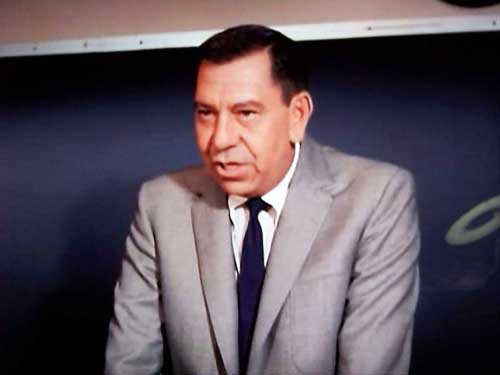
Ninth Circuit Annoyed When Drug Agents Talk Like Joe Friday

court condemns police talk
Appellate court doesn't like drug agents talking like this guy.

In suppressing evidence in a drug case, the U.S. Court of Appeals for the Ninth Circuit had some harsh words for the federal drug agents who were involved.  The Court also did not take kindly to the trial judge threatening to put one of the lawyers in jail for failing to answer phone calls from the court reporter about a disputed bill.

But first, the court’s indictment of Dragnet-ese. The court did not like the way the drug agents talked, as it explained in a footnote (paragraph breaks inserted):

1. The agents involved speak an almost impenetrable jargon. They do not get into their cars; they enter official government vehicles. They do not get out of or leave their cars, they exit them. They do not go somewhere; they proceed. They do not go to a particular place; they proceed to its vicinity. They do not watch or look; they surveille. They never see anything; they observe it. No one tells them anything; they are advised.

A person does not tell them his name; he identifies himself. A person does not say something; he indicates. They do not listen to a telephone conversation; they monitor it. People telephoning to each other do not say “hello;” they exchange greetings. An agent does not hand money to an informer to make a buy; he advances previously recorded official government funds.

To an agent, a list of serial numbers does not list serial numbers, it depicts Federal Reserve Notes. An agent does not say what an exhibit is; he says that it purports to be. The agents preface answers to simple and direct questions with “to my knowledge.” They cannot describe a conversation by saying “he said” and “I said;” they speak in conclusions. Sometimes it takes the combined efforts of counsel and the judge to get them to state who said what.

Under cross-examination, they seem unable to give a direct answer to a question; they either spout conclusions or do not understand. This often gives the prosecutor, under the guise of an objection, an opportunity to suggest an answer, which is then obligingly given.

As a side issue, the opinion contains a lengthy discussion of an incident in which the trial judge humiliated one of the defense lawyers in court and threatened to send him to jail for raising questions about the court reporter’s fee. The court reporter, who charged by the page, indented the text on each page so it began in the middle of the page, used only 25 lines of type per page instead of the standard 28, and used a font that was larger than normal. The lawyer tried to present an affidavit establishing that the transcript was twice as long as it needed to be, and thus twice as costly. The judge’s response? Here’s a snippet:

MR. LANGER (defense counsel): You say you spoke to me?

THE REPORTER: No. [TO JUDGE:] He wouldn’t even answer my phone calls.

MR. LANGER: Your Honor–

THE COURT: I know it. That is another thing. I ought to throw you in jail for not doing that, for not answering the phone calls of the reporter.

The Ninth Circuit disapproved of the trial judge’s conduct.

United States v. Marshall, 488 F.2d 1169, 1171 n.1, 1200 (9th Cir. 1973). Thanks to Frank Zotter.

Funny or Bully Pulpit? (Kent)

Before his flame-out, Judge Samuel Kent in Galveston, Texas, garnered a lot of attention for his abrasive writing style. Opinion was split in the legal community. Examples are here, here, here and here.

Some lawyers considered his sarcastic, often rude and insulting opinions hilarious. Some considered them very unjudicial and inappropriate. Probably many others viewed them as a combination of both.

Professor Steven Lubet of Northwestern University law school weighed in on the issue with a piece called “Bullying from the Bench,” in The Green Bag. Steve took issue with Kent’s humor, particularly his ad hominem attacks on lawyers. Here’s a brief excerpt:

Federal judges exercise enormous power over lawyers and their clients. Armed with life tenure and broad discretion, a judge can do great damage to an attorney’s reputation and career, while the lawyer has almost no recourse. So when Judge Kent decided to torment the hapless counsel in the Bradshaw case are identified by name in the published opinion—he was taking aim at people who could not defend themselves. …

In litigation, the judge is the maximum boss. Everyone else is a supplicant, compelled to engage in stylized demonstrations of obedience. We stand when the judge enters and leaves the room. Our “pleadings” are “respectfully submitted.” Before speaking, we make sure that it “pleases the court.” We obey the judge’s orders and we even say “thank you” for adverse rulings. …

By belittling the lawyers who appear before him, Judge Kent used his authority to humiliate people who—in the courtroom environment—are comparatively helpless. There is a name for that sort of behavior, and it isn’t adjudication. It’s bullying.

Steven got it right, of course. The relationship between judge and lawyers is about as one-sided as it gets.  The judge holds all the cards. Sometimes lawyers deserve to get chewed out, but Kent was over the top.

— Steven Lubet, Bullying from the Bench, 5 Green Bag 2d 11, 12 (2001).

“Could You Love Me a Little Less, Judge?” (Kent)

Another ad hominem-laced love letter to lawyers from former U.S. District Judge Samuel Kent, Galveston, TX. This one was a maritime personal injury case in which defense counsel moved for summary judgment on behalf of his client Phillips Petroleum.

Note that, in insulting the lawyers throughout, Judge Kent emphasized that the lawyers for both sides were “likeable” and that he had “affection” for them:

[Judge Kent begins the order by stating the case, then proceeds as follows.]

[T]he Court notes that this case involves two extremely likable lawyers, who have together delivered some of the most amateurish pleadings ever to cross the hallowed causeway into Galveston, an effort which leads the Court to surmise but one plausible explanation. Both attorneys have obviously entered into a secret pact—complete with hats, handshakes and cryptic words—to draft their pleadings entirely in crayon on the back sides of gravy-stained paper place mats, in the hope that the Court would be so charmed by their child-like efforts that their utter dearth of legal authorities in their briefing would go unnoticed.

Whatever actually occurred, the Court is now faced with the daunting task of deciphering their submissions. With Big Chief tablet readied, thick black pencil in hand, and a devil-may-care laugh in the face of death, life on the razor’s edge sense of exhilaration, the Court begins.

[The court discusses summary judgment law, followed by several caustic remarks about the quality of defense counsel’s (representing Phillips) filings, including the statement that “[a] more bumbling approach is difficult to conceive.” Then the court tears into plaintiff’s counsel.]

Plaintiff responds to this deft, yet minimalist analytical wizardry with an equally gossamer wisp of an argument, although Plaintiff does at least cite the federal limitations provision applicable to maritime tort claims. … Naturally, Plaintiff also neglects to provide any analysis whatsoever of why his claim versus Defendant Phillips is a maritime action. Instead, Plaintiff “cites” to a single case from the Fourth Circuit.

Plaintiff’s citation, however, points to a nonexistent Volume “1886” of the Federal Reporter Third Edition and neglects to provide a pinpoint citation for what, after being located, turned out to be a forty-page decision. Ultimately, to the Court’s dismay after reviewing the opinion, it stands simply for the bombshell proposition that torts committed on navigable waters … require the application of general maritime rather than state tort law … The Court cannot even begin to comprehend why this case was selected for reference. It is almost as if Plaintiff’s counsel chose the opinion by throwing long range darts at the Federal Reporter (remarkably enough hitting a nonexistent volume!). …

Despite the continued shortcomings of Plaintiff’s supplemental submission, the Court commends Plaintiff for his vastly improved choice of crayon—Brick Red is much easier on the eyes than Goldenrod, and stands out much better amidst the mustard splotched about Plaintiff’s briefing. But at the end of the day, even if you put a calico dress on it and call it Florence, a pig is still a pig. Now, alas, the Court must return to grownup land. [Court resolves issue on its own.] …

Take heed and be suitably awed, oh boys and girls—the Court was able to state the issue and its resolution in one paragraph … despite dozens of pages of gibberish from the parties to the contrary! …

After this remarkably long walk on a short legal pier, having received no useful guidance whatever from either party, the Court has endeavored, primarily based upon its affection for both counsel, but also out of its own sense of morbid curiosity, to resolve what it perceived to be the legal issue presented. Despite the waste of perfectly good crayon seen in both parties’ briefing … the Court believes it has satisfactorily resolved this matter. Defendant’s Motion for Summary Judgment is GRANTED …

Bradshaw v. Unity Marine Corp., 147 F. Supp. 2d 668, 670–72 (S.D. Tex. 2001). Thanks to Ira Rosenau.

More Judicial Distemper-ment (Kent)

Some believe the writings of impeached U.S. District Judge Samuel B. Kent, Southern District of Texas, are quite funny, but probably not many lawyers in Galveston were laughing after his June 2001 order on a motion to transfer for improper venue. Being Juge Kent, he couldn’t just deny the motion. He had to rip apart the lawyer who filed the motion:

[A]ny person with even a correspondence-course level understanding of federal practice and procedure would recognize that Defendant’s Motion is patently insipid, ludicrous and utterly unequivocally without any merit whatsoever. Worse, it is just plain blatantly wrong in light of the unambiguous language of a decades old federal statute and veritable mountains of case law addressing venue propriety.

Sound bad? It gets worse. Judge Kent went on to state that “Defendant’s obnoxiously ancient, boilerplate, inane Motion is emphatically DENIED.”

For the coup de grace, Judge Kent ended by disqualifying the lawyer from further appearing in the case “for submitting this asinine tripe.”

Labor Force, Inc. v. Jacintoport Corp., 144 F. Supp. 2d 740 (S.D. Tex. 2001) (opinion subsequently withdrawn from bound volume).