Santa Claus is Coming to Court

santa claus lawsuitA man named Warren J. Hayes somehow was able to obtain an official Ohio Identification Card in the name of “Santa Claus.” He also managed to get an official motor vehicle registration, AAA membership card, and checking account in Santa’s name, all of them listing his address as 1 Noel Drive, North Pole USA.

Hayes/Claus ran into trouble when he was involved in a minor car accident and produced his Santa Claus ID to a cop. He was charged under an Ohio statute prohibiting the use of “fictitious” names.

Perhaps in the Christmas spirit (although the case was decided in the heat of summer), Ohio Judge Thomas P. Gysegem let Mr. Hayes/Claus off the hook with this reasoning:

[T]he court’s dilemma is whether Santa’s act of displaying this identification card under these circumstances and with this history (noted above) violated the law, to wit, Was this identification card “fictitious”?

Webster’s Seventh New Collegiate Dictionary defines “fictitious.” Its analysis of the word includes a synonym comparison with “fabulous,” “legendary,” “mythical,” and “apocryphal”:

“Fabulous stresses the marvelous or incredible character of something without distinctly implying impossibility or actual nonexistence; Legendary suggests the elaboration of invented details and distortion of historical facts produced by popular tradition; Mythical implies a purely fanciful explanation of facts or the creation of beings and events out of the imagination; Apocryphal implies an unknown or dubious source or origin for an account circulated as true or genuine.  … Fictitious implies fabrication and suggests artificiality or contrivance more than deliberate falsification or deception.”

Had Santa been charged with being “fabulous, legendary, mythical or apocryphal,” he might well indeed be guilty facing up to 180 days in jail and a $1,000 fine. However, to sustain the burden of going forward, the state must make a showing that Santa knowingly displayed an identification card that was “fictitious.” This the state has not done. The fact that Santa had an ongoing relationship for 20 years with the BMV is not indicative of “artificiality or contrivance,” for, in fact, under the publicly held records of the Ohio Bureau of Motor Vehicles, Santa has been a “real person” since as early as 1982.

Never explained in the opinion is how the Ohio Bureau of Motor Vehicles allowed a person to obtain and renew official documents in the name of Santa Claus for twenty years.

State v. Hayes, 774 N.E.2d 807, 810 (Ohio Mun. Ct. 2002). Thanks to Mardee Sherman.

Barbie Gets Her Day In Court (And Loses) (Kozinski)

barbie lawsuit
Barbie, looking effervescent despite lawsuit loss.

In 1997, the Danish band “Aqua” released a parody of America’s favorite thin plastic girl, Mattel’s Barbie®, called “Barbie Girl.” Mattel sued for trademark infringement and dilution. The federal district court in California granted summary judgment against the plaintiff, ruling the song was protected parody.

The U.S. Court of Appeals for the Ninth Circuit affirmed in an opinion by Judge Alex Kozinski. Judge K opened by posing the case as an epic battle between free speech and intellectual property rights. In his words, “[i]f this were a sci-fi melodrama, it might be called Speech-Zilla meets Trademark Kong.”

In ruling against Mattel, Kozinski opined that Barbie is much more than a mere product in the American conscious. She also had a more colorful past than you might realize:

Barbie was born in Germany in the 1950s as an adult collector’s item. Over the years, Mattel transformed her from a doll that resembled a “German street walker,” as she originally appeared, into a glamorous, long-legged blonde. Barbie has been labeled both the ideal American woman and a bimbo. She has survived attacks both psychic (from feminists critical of her fictitious figure) and physical (more than 500 professional makeovers). She remains a symbol of American girlhood, a public figure who graces the aisles of toy stores throughout the country and beyond. With Barbie, Mattel created not just a toy but a cultural icon.

It’s true. Barbie is a myth, a legend, and, for better or worse, represents the dreams of little girls everywhere. My daughter used to own probably a dozen Barbies. At what point, if any, can a product image become part of the public domain because it has become woven into the fabric of culture itself?

As Kozinski said in discussing Mattel’s trademark-infringement claim:

The problem arises when trademarks transcend their identifying purpose. Some trademarks enter our public discourse and become an integral part of our vocabulary. How else do you say that something’s “the Rolls Royce of its class”? What else is a quick fix, but a Band–Aid? Does the average consumer know to ask for aspirin as “acetyl salicylic acid”? Trademarks often fill in gaps in our vocabulary and add a contemporary flavor to our expressions. Once imbued with such expressive value, the trademark becomes a word in our language and assumes a role outside the bounds of trademark law.

Don’t remember Aqua’s one-hit wonder novelty song? No worries. The court attached the lyrics as an appendix. Here’s the chorus to refresh your memory:

I’m a Barbie girl, in my Barbie world

Life in plastic, it’s fantastic

You can brush my hair, undress me everywhere

Imagination, life is your creation

Come on Barbie, let’s go party!

Here’s the Official YouTube video.

Mattel, this is more humor. Don’t sue.

Mattel, Inc. v. MCA Records, Inc., 296 F.3d 894, 898, 909 (9th Cir. 2002).

My Favorite Martian Sues CIA, President — Loses

An alleged alien from outer space—a Martian, to be precise—was outsmarted by good old terrestial law.

The plaintiff claimed to be a Martian. He filed three lawsuits in Canada against numerous defendants, including the CIA and then-President Bill Clinton, alleging the defendants had taken various steps that interfered with his ability to live freely as a Martian. He asserted the only reason he could not prove his Martian status was because the CIA tinkered with his DNA test. (This is actually starting to sound like a good action movie plot …)

Ironically, and perhaps unfairly, the essence of the plaintiff’s claim did him in. Judge Epstein explained:

Rule 1.03 defines plaintiff as “a person who commences an action”. The New Shorter Oxford English Dictionary defines person as “an individual human being”. Section 29 of the Interpretation Act provides that a person includes a corporation. It follows that if the plaintiff is not a person in that he is neither a human being nor a corporation, he cannot be a plaintiff as contemplated by the Rules of Civil Procedure. The entire basis of Mr. Joly’s actions is that he is a martian, not a human being. There is certainly no suggestion that he is a corporation. I conclude therefore, that Mr. Joly, on his pleading as drafted, has no status before the Court.

Judge Epstein also found the claims to be frivolous, vexatious and “patently ridiculous.” However, the court did not find plaintiff to be mentally incompetent. To the contrary, Judge Epstein wrote that Joly “presented himself as polite, articulate, intelligent and appeared to understand completely the issues before the Court and the consequences should I grant the relief sought.”

Joly v. Pelletier, [1999] O.J. No. 1728 (Ont. Super. Ct. 1999). Thanks to David Cheifetz, one of the lawyers involved in this interesting case.

Ninth Circuit Annoyed When Drug Agents Talk Like Joe Friday

court condemns police talk
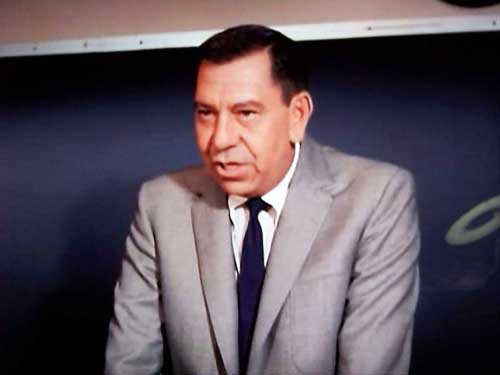
Appellate court doesn't like drug agents talking like this guy.

In suppressing evidence in a drug case, the U.S. Court of Appeals for the Ninth Circuit had some harsh words for the federal drug agents who were involved.  The Court also did not take kindly to the trial judge threatening to put one of the lawyers in jail for failing to answer phone calls from the court reporter about a disputed bill.

But first, the court’s indictment of Dragnet-ese. The court did not like the way the drug agents talked, as it explained in a footnote (paragraph breaks inserted):

1. The agents involved speak an almost impenetrable jargon. They do not get into their cars; they enter official government vehicles. They do not get out of or leave their cars, they exit them. They do not go somewhere; they proceed. They do not go to a particular place; they proceed to its vicinity. They do not watch or look; they surveille. They never see anything; they observe it. No one tells them anything; they are advised.

A person does not tell them his name; he identifies himself. A person does not say something; he indicates. They do not listen to a telephone conversation; they monitor it. People telephoning to each other do not say “hello;” they exchange greetings. An agent does not hand money to an informer to make a buy; he advances previously recorded official government funds.

To an agent, a list of serial numbers does not list serial numbers, it depicts Federal Reserve Notes. An agent does not say what an exhibit is; he says that it purports to be. The agents preface answers to simple and direct questions with “to my knowledge.” They cannot describe a conversation by saying “he said” and “I said;” they speak in conclusions. Sometimes it takes the combined efforts of counsel and the judge to get them to state who said what.

Under cross-examination, they seem unable to give a direct answer to a question; they either spout conclusions or do not understand. This often gives the prosecutor, under the guise of an objection, an opportunity to suggest an answer, which is then obligingly given.

As a side issue, the opinion contains a lengthy discussion of an incident in which the trial judge humiliated one of the defense lawyers in court and threatened to send him to jail for raising questions about the court reporter’s fee. The court reporter, who charged by the page, indented the text on each page so it began in the middle of the page, used only 25 lines of type per page instead of the standard 28, and used a font that was larger than normal. The lawyer tried to present an affidavit establishing that the transcript was twice as long as it needed to be, and thus twice as costly. The judge’s response? Here’s a snippet:

MR. LANGER (defense counsel): You say you spoke to me?

THE REPORTER: No. [TO JUDGE:] He wouldn’t even answer my phone calls.

MR. LANGER: Your Honor–

THE COURT: I know it. That is another thing. I ought to throw you in jail for not doing that, for not answering the phone calls of the reporter.

The Ninth Circuit disapproved of the trial judge’s conduct.

United States v. Marshall, 488 F.2d 1169, 1171 n.1, 1200 (9th Cir. 1973). Thanks to Frank Zotter.

Canada Has the Nicest Judges

There are plenty of cranky judges out there, but also some nice ones.

Have you ever noticed how nice people from Canada are? Well, it turns out that even the judges are super nice.

In National Leasing Group, Inc. v. Top West Ventures, the plaintiff sued to collect a debt and the defendant filed an intelligible counterclaim drafted by a friend consisting of 97 paragraphs and 26 pages.  As you’ll read below, the Supreme Court of British Columbia could argue just cause for launching into the guy, but Master Bolton, the writing judge, responded to the bizarre pleading with kindness and an abundance of decorum. Here’s a taste of the court’s opinion:

On the face of the document, I had difficulty discerning any cause of action while the matter was being spoken to in chambers, but in view of its length and complexity, I concluded that I should reserve my decision in order to consider it in more detail. The first paragraph reads:

1. For the [DE]FENDANT with the knowledge of the David-Wynn:Miller; Language-Procedures (http://www.dwmlawprocedures.com; http://brucestellar.tsx.org) is with the damage: damage by the utilization of the fictitious-language/scribble as the foundation for the authority for the action/claim against the DE[FENDANT] damage by the criminal-rate of the interest [section: 347: Criminal-Codeof the Canada]; damage by the false-statements [section: 397.1(a); Criminal-Codeof the Canada]; damage by the completion of a fraud: constructive or actual [section: 380.1 of the Criminal Code of the Canada]; damage by the completion of a mail-fraud [section: 381 of the Criminal-Code of the Canada; damage by the bad-faith; by the PLAINTIFF and DEFENDANT by the COUNTER-CLAIM.

What did the judge have to say about this gobbledygook? With a generosity of spirit unparalleled in recorded judicial history, he said: “This is not too bad.”

However, he added that, unfortunately, he could not recognize anything “in any of its remaining 96 paragraphs.”

Nat’l Leasing Group, Inc. v. Top West Ventures, 2001 BCSC 111 (Can.). Thanks to David Cheifetz.

25 Hidden Talking Heads References

Give credit to a sneaky law clerk to U.S. Circuit Judge Reynaldo Garza, who pulled off an adventurous Syufy-like prank all the way back in 1987. (U.S. v. Syufy is the opinion where Judge Alex Kozinski slipped in more than 200 movie titles. See “Coming Soon To A Footnote Near You.”

In United States v. Abner, a law clerk wove in twenty-five references to the names of albums and songs by the rock group Talking Heads, reportedly in an unsuccessful bid to win some concert tickets. The prank escaped the notice of Judge Garza according to a source.

United States v. Abner, 825 F.2d 835 (5th Cir. 1987).

Judicial Civility Spelled “S.C.H.M.U.C.K.”

Of all the judicial opinions that have been reviewed at lawhaha.com, People v. Arno takes the cake for the most over-the-top, unjudicial attack on a  colleague in a written opinion. For that reason, it qualifies for the Strange Judicial Opinions Hall of Fame.

Arno was a Fourth Amendment obscenity case in which the Second District California Court of Appeals suppressed evidence obtained by the police from peering in the windows of defendant’s office suite with ten-power binoculars.

One judge—we’ll leave names out to protect all the guilty judges involved—filed a strong dissent. Actually, it was more than strong. It was strident and no doubt irritating to the judge’s colleagues on the appellate panel.

But the attack launched by the majority judges against their dissenting brethren in footnote 2 is almost breathtaking in its inappropriateness.  You don’t bother to read the whole footnote. Just read the first letters of the seven numbered sentences. As Country Joe McDonald shouted at Woodstock: “What’s that spell? What’s that spell?”

2. We feel compelled by the nature of the attack in the dissenting opinion to spell out a response:

1. Some answer is required to the dissent’s charge.

2. Certainly we do not endorse “victimless crime.”

3. How that question is involved escapes us.

4. Moreover, the constitutional issue is significant.

5. Ultimately it must be addressed in light of precedent.

6. Certainly the course of precedent is clear.

7. Know that, our result is compelled.

How did the dissenter reply to this profane insult? Well, not surprisingly, with even more bizarre stridency. In his own footnote, he said:

I have heretofore eschewed responding to footnote 2 of the majority opinion in kind since it would be beneath the dignity of this office. Although I still will not respond in kind, … some comment is compelled.

 I decry the lack of propriety, collegiality and judicial temperament displayed in footnote 2. I abhor the loss of public respect for the legal profession and the judiciary footnote 2 engendered by reason of [a L.A. Times story about the footnote]. …

I construe the [footnote reference] as a personal affront to every California citizen and their duly elected representatives … who have deemed it a wise public policy to enact our criminal obscenity laws …. It is no wonder that California had the odious distinction of being the porno capital of the world.

Come on, judges. Play nice or we’ll take your robes away.

People v. Arno, 153 Cal. Rptr. 624, 628 n.2 (majority), 644 n.14 (dissent) (Cal. Ct. App. 1979).

Sad, Weird Tale of an Executed One-Eyed Horse

City of Canadian v. Guthrie is a sad, strange tale of a one-eyed horse ordered by the town mayor to be executed by one Panhandle Pete, who took the mare’s life “by shooting her between the bad eye and the one not so bad.”

In an opinion that makes you wonder whether someone dosed the town’s water supply with LSD (although it wasn’t yet invented), Chief Justice Hall explained “when Panhandle Pete’s pistol popped, she petered, for which the poundkeeper paid Pete a pair of Pesos.”

The owner of the horse sued for damages, claiming she was a prize mare. The court took issue with that assertion, describing the horse as follows:

From the record, we conclude that although she may not have had a skin you would particularly love to touch (though she had seen only fourteen joyous summers), yet she had a skin which clung like ivy to her rafters with a beautiful corrugated effect upon the sides of her lithe and spirituelle form.

The horse got in trouble for wandering onto neighboring property and eating the foilage, or as Justice Hall put it (paragraph breaks inserted):

The record shows that upon at least two occasions “When night drew her sable curtain down And pinned it with a star,” and “Silence like a gentle spirit Brooded o’er a still and pulseless world,” the time lock on her corral mysteriously went off and so did she, in search of tulips, dahlias, and gladioli in the neighboring lawns and flower beds …

Although she had only one eye, appellant contends she could find more edible shrubbery in a single night than an experienced landscape gardener could replant in thirty days. We may assume that in her midnight excursions she had been thrown with porch climbers, joy riders, orchard raiders, and other nocturnal prowlers, which may account for her waywardness and utter disregard for the property rights of other. …

It was not denied that she had “went hence” and was cut down in the heyday of her young and fitful life … [because the mayor] personally ordered her gentle soul sent to the great beyond and the remainder to the municipal dump ground.

The court finally dismissed the case for lack of jurisdiction.

City of Canadian v. Guthrie, 87 S.W.2d 316, 317–18 (Tex. Ct. App. 1932). Thanks to John R. Thomason.

Can’t Say this Plaintiff Didn’t Have a Prayer

A Utah resident upset with the fact that the Murray City, Utah, city council opened its meetings with a prayer, submitted a request to open the meeting with his own prayer, a free establishment protest prayer. Here are some excerpts:

OUR MOTHER, who art in heaven (if, indeed there is a heaven and if there is a god that takes a woman’s form) hallowed be thy name, we ask for thy blessing for and guidance of those that will participate in this meeting and for those mortals that govern the state of Utah;

We fervently ask that you guide the leaders of this city … so that they may see the wisdom of separating church and state and so that they will never again perform demeaning religious ceremonies as part of official government functions;

We pray that you prevent self-righteous politicians from mis-using the name of God in conducting government meetings; and, that you lead them away from the hypocritical and blasphemous deception of the public, attempting to make the people believe that bureaucrats’ decisions and actions have thy stamp of approval if prayers are offered at the beginning of government meetings …

Not surprisingly, his request was denied. He filed suit and the trial court granted summary judgment for the city, but the Utah Supreme Court reversed, holding that the city could not discriminate against the plaintiff’s prayer just because it didn’t like the content.

Snyder v. Murray City Corporation, 73 P.3d 325, 327 n.1 (Utah 2003). Thanks to Elise Hendrick.

Product Warning: Federal Supplement Contains Raunchy Adult Content

Federal Senior U.S. District Judge Kane of the District of Colorado offered curious readers of judicial opinions an excursion into the world of adult-oriented judicial opinions in Martin v. Cuny. In a case involving a copyright dispute over a photograph of a man and a woman engaging in oral sex, Judge Kane, in a footnote, provided a bibliography of judicial opinions that have titillated law students for decades:

Given its subject matter, this opinion may join certain cases with obscure citations found in well-thumbed volumes in law school libraries. These cases are favorites of second year law students imprisoned in libraries and seeking diversion from the boredom of yet another year of highly touted and low-yielding case method of instruction. Having known a law professor, now thankfully of emeritus status, who assigned students to locate these cases as an exercise in legal research, I list a few to bring them into the age of computers and political correctness through the back door.

[The list of citations is omitted. Some of the cases are gross, including the one my classmates and I all tracked down wa-aa-ay back when we were 2Ls.  Lawhaha.com is much more family friendly than the Federal Supplement. At the end of the citation list, the judge said:]

If you find each of these cases you are entitled to join the law review; if your law school library doesn’t have all of them, you should transfer at once.

A professor actually assigned these cases? No surprise he was an emeritus.

Martin v. Cuny, 887 F. Supp. 1390, 1392 n.1 (D. Colo. 1995). Thanks to Richard McKewen.