Another Ornery Texas Judge Named Sam

What is it about Texas federal district court judges named “Sam” that makes them so ornery? First, we had the notorious U.S. District Judge Samuel Kent from San Antonio (see here, here, here, and here). Now U.S. District Judge Samuel Sparks from Austin (see here and here) comes along to fill the void.

Regrettably, while most law schools do a good job screening and training students, some students manage to graduate from and pass state bar exams who lack competent skills. Not knowing the actors, we have no basis for arguing with Judge Sparks’ evaluation of the lawyer named (we left him unnamed) in the order below, but bludgeoning him so harshly in a permanent public record seems over the top (some paragraph breaks inserted):

The Court has already turned down two extremely tempting offers to transform this case from a boring old federal lawsuit into an exciting, politically-charged media circus. As any competent attorney could have predicted, the Court declines the latest invitation as well.

However, the Court is forced to conclude [name omitted], the attorney whose signature appears on this motion, is anything but competent. A competent attorney would not have filed this motion in the first place; if he did, he certainly would not have attached exhibits that are both highly prejudicial and legally irrelevant; and if he foolishly did both things, he surely would not be so unprofessional as to file such exhibits unsealed.

A competent attorney who did those things would be deliberately disrespecting this Court and knowingly shirking his professional responsibilities, offenses for which he would be lucky to retain his bar card, much less an intact bank balance.

For [name omitted]’s sake, and because the Court has no time to hold a sanctions hearing—in part because it must take time out of deciding the actual legal issues in this case to address the self-serving entreaties of attention-seekers like [name omitted]—the Court assumes [name omitted] is as incompetent as he appears.  Rather than sanction him, the Court simply does what [name omitted] would have done if he was a competent professional, and seals attachment 7 to his motion.

I have no problem with judges dressing down lawyers in a very direct way when they deserve it. In fact, I wish more judges would do it. But putting such a personal attack in a written order that will last forever may not be the best way to go.

–Order, Texas Medical Providers Performing Abortion Services v. Lakey, Case No. A-11-Ca-486-S (W.D. Tex., Aug. 22, 2011). Thanks to Gaspar Forteza.

Ill-Placed Bottle Rockets Create a “Palsgraf” for a New Generation

bottle rockets in anus lead to injuryA former student sent along the complaint below, which a friend of his suggested might be “the new Palsgraf for our generation.” Hmm, this might not be a good generational sign given the allegations.

For non-legals, Palsgraf v. Long Island Railroad is a famous tort law case all law students read involving a bizarre accident at a train station, where the court ruled that a tort defendant owes a legal duty to act with reasonable care to another only if the other is a reasonably foreseeable victim of the defendant’s conduct. More Lawhaha.com posts involving Palsgraf are here, here, here, and here.

A national Greek fraternity, Alpha Tau Omega, apparently held a “house party” at their frat house at a West Virginia university. The complaint alleges that many of the participants consumed intoxicating beverages. No surprise so far. But one of the guests  surprised at least one person (the plaintiff, allegedly) when he decided to light up–literally–the party by shooting bottle rockets from … er, I’d rather let the Complaint explain it:

Warning: Allegations are Disgusting

8. Defendant Hughes was highly intoxicated on this date and time, and decided in his drunken stupor that it would be a good idea to shoot bottle rockets out of his anus on the ATO deck, located on the back of the ATO house.

9. Upon information and belief, there were several other ATO fraternity members on the deck at the time of this incident, including one or more officers of the fraternity. Plaintiff and his girlfriend were also present on the ATO deck.

10. Defendant Hughes placed a bottle rocket in his anus, ignited the fuse, but instead of launching, the bottle rocket blew up in Defendant’s rectum, and this startled plaintiff and caused him to jump back, at which time he fell off of the ATO deck, and he became lodged between the deck and an air conditioner unit adjacent to the deck.

11. There was no railing on said deck at the time of the incident. Upon information and belief, the lack of a railing had existed for at least several months, if not years, before the incident. Upon further information and belief, the deck never had a railing when it was installed, or any time thereafter. The subject deck was approximately 3-4 feet high.

12. The subject deck was in the exclusive custody, maintenance and control of the ATO fraternity at all times relevant hereto.

Here’s your Palsgraf test: Was the plaintiff within the zone of foreseeable danger of the bottle rocket-defendant’s alleged conduct? Probably, although perhaps with some contributory negligence thrown in. Assuming the plaintiff was standing close by he could have been injured in any number of ways from someone setting off fireworks in such a dangerous, uncontrolled manner.

The more interesting question is the fraterity’s liability. Was it foreseeable to the fraternity that an intoxicated fraternity member would ignite fireworks in such a bizarre manner and cause a startled bystander to fall off the deck?  Probably not, but it is foreseeable that during social or other gatherings on a deck with no railing (which the complaint alleges violated building codes, likely making it negligence per se) someone would fall off it. Generally speaking, the precise manner in which the harm occurred need not be foreseeable so long as the same general kind of harm was foreseeable.  The injury that occurred–falling off the deck-is the risk that makes it negligent to not have a railing on a raised deck.

Just an off-the-cuff analysis of the facts as alleged.  As always, it will come down to the facts as proved–or, more likely, to a settlement.

—Complaint, Helmburg v. Alpha Tau Omega Fraternity, Case No. 12-C-57, Circuit Ct., Cabell County, West Va., filed Jan. 23, 2012.

The “Companion Text” to Law School, Understanding and Surviving Life with a Law Student

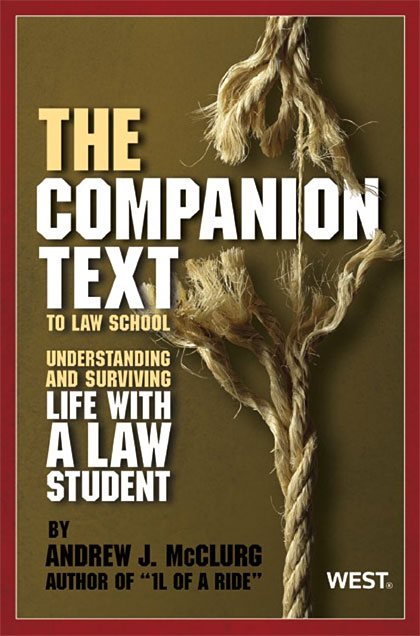
The Companion Text to Law SchoolThe “Companion Text” to Law School: Understanding and Surviving Life with a Law Student (West 2012)

Amazon.com listing

Table of Contents

As every lawyer and law student knows, law school is an adventure for the entire family. It’s a life-changing experience that affects everyone involved.

Dozens of books have been written to prepare students for law school, but what about all those other suffering souls–the relatives and friends who support and struggle right alongside the student on their wild and crazy journey toward a Juris Doctor degree? Who’s preparing them?

Named one of Amazon Editors’ Favorite Books of 2014.

Read interview with McClurg about the book on the Westlaw Insider Blog

The “Companion Text” to Law School is designed to equip loved ones of law students—parents, partners, and other friends and relatives—with all the information and tools needed to understand both law school and their stressed out, rapidly transforming student.

Highlights

• Written by an award-winning professor with wide experience teaching thousands of law students at six law schools.

• Explains all the essentials of legal education, including the first-year curriculum, the Socratic Method of teaching, and the dreaded single-exam format.

• Explores the psyches of law students, including what they love to talk about, things you should never say to them, their sources of stress, and how law school can change their personalities.

• Addresses the impact of law school on outside relationships—and vice versa—and gives tips for navigating relationships with law students.

• Includes dozens of comments, anecdotes, and insights from real law students and their loved ones.

• Extras include a chapter on the types of jobs available to new law graduates, fun “legal” questions you can use to stump your student, a sample case, and a glossary.

• Backed up throughout by academic research.

• Written in a lively, reader-friendly voice, bolstered by humor.

Spot the Tort: Why Waste Money on Concrete When You Have Spray Paint?

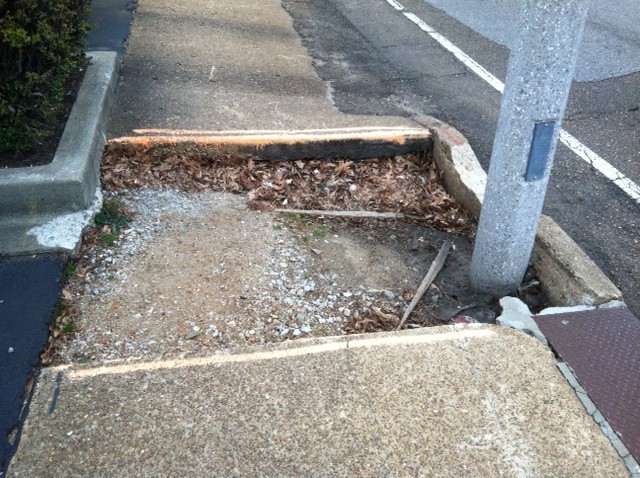
hole in sidewalk fixed by spray paintTaking a walk near my house in Memphis, I encountered this dangerous sidewalk condition.

Note that instead of filling in the chasm, the city apparently opted to leave it be and cure the problem instead by spray-painting a thin orange warning line around it.

Since the condition has been there for a quite a while (the orange paint is very faded), it appears this was considered to be an acceptable final fix.

Spot the Tort: Risky Stairway to Heaven

ladder riskOkay, not quite the stairway to heaven, but this long ladder could give the user a good head start. (All pics are expandable.) This picture from a University of Memphis law student makes me shudder.

Ladders are one of the most dangerous consumer products. A study published by the U.S. National Institutes of Health estimated that 2.2 million people received treatment in emergency rooms for ladder injuries during the 16-year-period from 1990-2005, an average of 136,000 cases a year.

Nearly 10% of injuries resulted in hospitalization, roughly twice that of consumer product-related injuries overall.

Other ladder injury data from the study included:

  • Men predominated over women in the percentage of injuries (76.5%).
  • Fractures were the most common type of injury (31.5%).
  • The number of ladder-related injuries increased by more than 50% from 1990 to 2005.
  • Of the cases for which locale of injury was recorded, 97.3% occurred in non-occupational settings, such as homes and farms.

Don’t underestimate the risks of ladders. Did you know that extension ladders need to be set up at a 75 and 1/2 degree angle (the “4 to 1 rule”) to minimize the risk of slipping?

Backfiring Joke in Corporations Leads to BFFs

–Law School Story from Thomas Walk, Wake Forest University School of Law, Date of event: fall 1979

Our Corporations professor had the annoying habit of ending a lot of his sentences with the phrase “All that jazz.”

Midway through the semester, my classmate who sat immediately to the left came to class with a notepad she bought at the mall. It had musical notes floating around the pages and the “All That Jazz” phrase.  She wandered to the front of the classroom before the prof arrived and put the pad on his rostrum.

The professor walked in, examined the pad with a confused look, and laid it to one side.

Later that day I was walking through the hall and saw the All That Jazz pad lying on a couch. I picked it up.

The next day of class my classmate found in her chair the pad with the following message I printed on the top sheet:

“Ms. Jones (named changed to protect the victim), please see me after class. Professor Telly.”

I let her suffer in fear for a few minutes before I confessed I was the culprit and that she had not been busted by our prof. To paraphrase Humphrey Bogart, that was the beginning of a beautiful friendship.

Some Baby Names May Be Illegal

This article from Time Newsfeed about how some governments make certain baby names illegal is reminiscent of one of our Hall of Fame Strange Judicial Opinions: “Hello, My Name Is … Oh, Never Mind.”

Meanwhile, the article warns that the following baby names have been declared illegal in New Zealand:

“Yeah Detroit”

Twins named “89”

“Sex Fruit”

Good news though! New Zealand will still allow boys to be named “Number 16 Bus Shelter.”

Warning: Stay Vigilant for Hogswarts Torts

Harry Potter warningProfessor and editor of the Torts Prof blog, Bill Childs, posted this picture of a warning sign at the new Harry Potter attraction at the Islands of Adventures theme park in Orlando.  He noted that he particularly enjoyed that even the warnings are themed, as this one comes from the “Department of Magical Transportation.”

See my ABA Journal column on Hogwarts Torts, suggesting that no student in the history of education has been subjected to as many torts as poor Harry Potter.

Melodramatic Memorandum Livens Up “Chinese Drywall” Litigation

It’s almost impossible to imagine a case that sounds more boring than “In re: Chinese-Manufactured Drywall Products Liability Litigation.” In this multidistrict potboiler, the judge stayed an insurance coverage action, apparently hoping to facilitate a global settlement.

Unfortunately, nothing was moving forward, prompting the Trust to ask the court to lift the stay to get things moving. Counsel didn’t take any chances that the court might miss her point, punching up her memorandum in support of the motion to lift the stay with a dramatic journalistic touch:

Since this Court stayed the insurance coverage action ten months ago last March, no global mediation of the insurance coverage action has been held.

There is no global mediation of the insurance coverage action scheduled.

There is no global mediation of the insurance coverage action being set up.

No date. No location. No notification of participants. No contact of all global insurance coverage participants. Silence.

Since the Court stayed this insurance coverage action, policyholders have been left in a purgatory in the insurance coverage action with no action advancing a global resolution of the insurance coverage action whatsoever.

I can’t wait to see how this litigation ends … er, if it ends.

—Chinese Drywall Litigation Memorandum, MDL 2047, E.D. La., Jan. 10, 2012. Thanks to Andrei Bogos.

Judge Dumps on Law Review Articles in Custody Fight Between a Birth Mother and Biological Mother

A judicial friend from Florida sent along a case of first impression involving a parental rights determination between a birth mother and a biological mother that she calls “a law professor’s dream case.” It does sound a bit like a law school exam question—a very difficult one.

The case involved two women in a committed relationship who wanted to have a child. Ova from one of the women were removed, fertilized by donated sperm, and implanted in the other woman, who then gave birth to the child. Thus, one woman was the biological mother and one was the birth mother, an unusual situation to be sure.

Only the birth mother’s name appeared on the child’s birth certificate. For years, the two women reared their child together but, when the relationship failed, the birth mother, without telling the biological mother, fled to Australia with the child.

The trial court reluctantly ruled that only the birth mother was the legal mother but invited appeal of his decision. The Florida Fifth District Court of Appeal reversed, ruling that both women had parental rights to the child.

My judicial friend pointed out that this is a case begging, and no doubt destined, for scholarly attention by law professors and law students, although Judge Thomas D. Sawaya, writing for the majority, might shiver at the thought.

Judge Sawaya was not impressed that the only authority for the birth mother’s position that only gestational mothers have maternal rights were: law review articles and a Tennessee case that relied solely on a law review article.

Regarding law review articles relied on by the birth mother, the judge commented: “We do not believe that law review articles written by students and professors establish the common law.”

About the Tennessee case, Sawaya said: “The common law does not come from law students and professors who write law review articles, and we hardly think it comes from a decision rendered by a Tennessee court that does nothing more than cite a law review article as the source.”

Hmm, I guess that depends on how one defines “the common law.” The Tennessee case is part of the body of judicial precedent that forms the common law. It might not be persuasive precedent, but isn’t it still part of the common law?  And simply because a judicial opinion relies on a law review article doesn’t remove the opinion from the realm of common law.

Courts cite law review articles frequently, including the U.S. Supreme Court, and there are innumerable instances of law review articles–including some written by students–that have turned the tide of the common law. As just one example, the products liability doctrine of market-share liability, first articulated by the California Supreme Court in Sindell v. Abbott Laboratories, was conceived from a student-written Note in the Fordham Law Review.

As an aside, my judge-friend was troubled that the majority’s analysis seemed to treat the child as a piece of property, giving no consideration to the best interests of the child, an issue the concurring opinion also focused on.

—T.M.H. v. D.M.T. , Case No. 5D09-3559 (Fla. 5th DCA, Dec. 23, 2011)