Warning: Clouds Cause Short Pants

The goal in crafting a pictorial product warning is to come up with a picture that can be universally understood, even by people who speak different languages or are illiterate. But it’s darned difficult to capture most warnings in the form of a simple drawing.

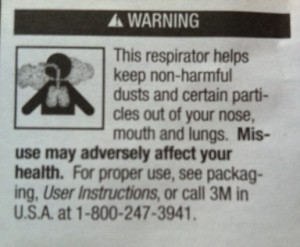
Case in point: this warning on a 3M paint-fumes mask.  You’ve seen or used these before. They are paper masks held to one’s face with rubber bands that go behind the head.

But what is this pictorial warning trying to say?  The accompanying text helps, but, again, the whole idea of pictorial warnings is that they are supposed to be understandable even by people who can’t read the written warning.

So just concentrate on the picture itself and ask, “What is it saying?

Here are possibilities that come to mind:

— “Smoking Area”

— “Help, My Lungs Recently Exploded”

— “Totally Awesome Bong”

— “Short Pants Are Caused By Clouds”

And what’s up with the limitation in the written warning that the respirator helps keep “non-harmful dusts and certain particles out of your nose, mouth and lungs”?  Isn’t the whole point of buying them to keep out harmful dust and particles?

Judge Evan’s “Rap” Sheet (Evans)

U.S. Seventh Circuit Court of Appeals Judge Terence T. Evans, who passed away in 2011, was well-known for his opinions jammed with sports trivia (see here and here).

But in a criminal case involving witness tampering and “too many Murphys” (the defendant, his son and the trial judge were all named Murphy), Judge Evans mined a different pop culture-vein in an opening footnote necessitated by a court reporting error in the trial transcript:

1. The trial transcript quotes Ms. Hayden as saying Murphy called her a snitch bitch “hoe.” A “hoe,” of course, is a tool used for weeding and gardening. We think the court reporter, unfamiliar with rap music (perhaps thankfully so), misunderstood Hayden’s response. We have taken the liberty of changing “hoe” to “ho,” a staple of rap music vernacular as, for example, when Ludacris raps “You doin’ ho activities with ho tendencies.”

Give credit to Ludacris. Cited as authority by the distinguished U.S. Court of Appeals for the Seventh Circuit. Maybe his next release will be a hornbook.

— United States v. Murphy, 406 F.3d 857, 859 n.1 (7th Cir. 2005). Thanks to the several folks who sent this opinion.

Spot the Tort: When Walkin’ in Memphis, Keep Feet 10 Feet Off of Beale

memphis street tort 1When Marc Cohn sang, “Walkin’ in Memphis, walkin’ with my feet ten feet off of Beale,” he may have been giving risk avoidance advice.

Good old Memphis, a streets-and-sidewalks tort mecca.

memphis street tort 2These photos were taken a couple blocks from Beale Street in downtown Memphis.

Walk a hundred steps, spot a tort.  Walk another hundred steps, spot a tort.  And so on.

Intellectual Property Parody: Don’t Copy My Parental Nagging!

Thanks to Professor Laura Heymann, College of William & Mary-Marshall-Wythe School of Law, for sending along her funny parody of intellectual property law in the form of a cease and desist letter sent from one neighbor to another complaining about infringement of the offended neighbor’s parenting directive to “Eat your frisee salad.”

Laura’s satirization of overly aggressive assertions of intellectual property rights–all too common these days–brought back memories of my Harmless Error column in the ABA Journal, The© Controversy, in which the heirs of a Homo erectus Peking Man cave dweller sought to compel me to cease and desist in using the word “the.”

Spot the Tort: Suspect Steps Make for Treacherous Dining

spot the tort shaky stepsA student snapped this photo of a food vending truck in Memphis, where a customer is perched precariously on some portable steps placing an order. The steps should be both longer and wider for stability and to avoid missteps and missed steps. On the other hand, give the vendor credit for the safety cones.

Handwritten Divorce Petition Shows Fine Line Between Love and Hate

A judge friend sent me this handwritten Texas divorce petition, apparently filed back in 1985 by a Texas lawyer proceeding pro se.  It’s one of those hand-scrawled pleadings that, at first blush, looks like it was written by an inmate or perhaps a crazy person; however, closer examination shows the writing to be quite clever and amusing in places.  And the drawings are priceless.

The petitioner seems uncertain of where his heart lies, as he alternates between insulting the wife and telling the court how much he loves her.

Read the original to appreciate it, but here are some re-typed uncorrected highlights (the respondent’s name and petitioner’s address are redacted on both the copy of the original pleading and below):

I.

            This suit is brought by PAUL FRANK HENSLER, Petitioner who is Forty Six (46) years of age and who resides at XXXX.

             Respondent, XXXX, is a “Transient Person,” having her residence in a 1970 Chrysler. …

IV.

             These parties were joined together in Holy Matrimony by the Very Honorable Frances Porter, JUSTICE OF THE PEACE in Lampasus, Lampasas County, Texas on the 29th Day of March, in the year of our Lord, A.D. 1983.  They ceased living together as husband and wife on Monday January 21, 1984, when she got pissed off and hauled ass with the car, the Mastercard, $365.00 cash, her FEDERAL CIVIL RIGHTS NINE YEAR OLD EMPLOYMENT DISCRIMINATION CASE …, to which she is WELCOME, having BORED ME STIFF for 2 years about just how everybody picks on XXXX.

IV.

            This marriage has become very insupportable because of, ho-hum, conflict of personalities  between Petitioner and Respondent, but chiefly because of conflict of personalities between Respondent and Respondent that destroyed the legitimate ends of the marriage (good sex!) and prevents any reasonable expectation of reconciliation (unless she consents to having her mouth surgically closed).

 V.

             There is no child born or adopted of this marriage although Petitioner swears on oath that he did everything he could to KNOCK HER UP, but she isn’t pregnant and won’t have another CHILD, although Petitioner LOVES HER DEARLY and wants her to have his children, but she is LIBERATED now and “Feminists” don’t have children by “male chauvinist pig lawyers,” she so swears.

VI.

             Petitioner requests the Court to divide the estate of the parties by awarding their property to the party having POSSESION (in a legal sense, not the kind of “possession” by spirits you see in movies, although XXXX could pass muster for a stand-in for “Syble” or the girl in “The Exorcist.”)

VII.

             Petitioner, Paul Frank Hensler prays that CITATION and NOTICE issue as required by LAW and that the Court GRANT A DIVORCE and decree such other and further relief as requested herein, including changing Respondent’s name to BELLA ABZUG, JR. for costs of suit and for (see drawings of trumpet and drum roll).

             Stand back, its almost here – Ed McMahon on stage now — HEEEER’ES General Relief (see drawing of Rolaids man).

–Petition for Divorce, Hensler v. [Name redacted], Case No. 85-04521, Dist. Ct., Harris Cty, TX, Jan. 23, 1985.

Warning: Do Not Use iTunes to Run Nuclear Facility

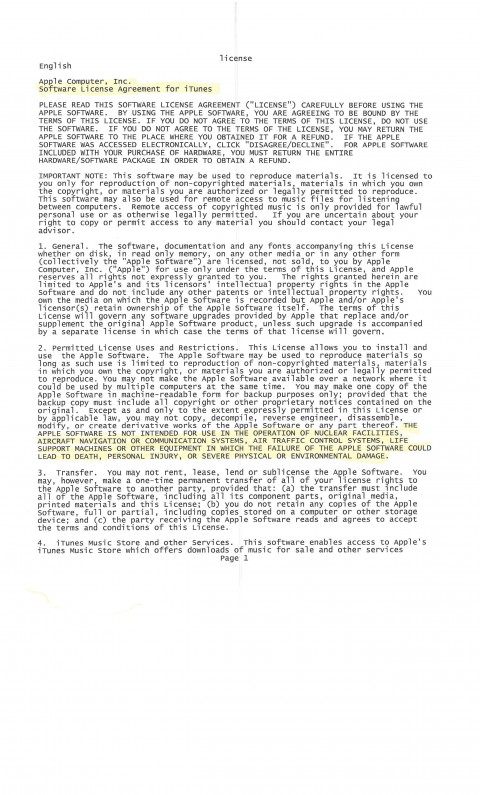
Apple iTunes software warningiTunes software is good stuff for downloading the latest crappola that the recording industry is outputting (editorial comment courtesy of a music lover still stuck in the 60s and 70s), but just remember that iTunes software is:

[N]ot intended for use in the operation of nuclear facilities, aircraft navigation or communication systems, air traffic control systems, life support machines or other equipment in which the failure of the Apple software system could lead to death, personal injury, or severe physical or environmental damage.

Tomatos are Vegetables as a Matter of Law, So Says the U.S. Supreme Court

Tomato
It's official. Tomatos are vegetables according to the Supreme Court.

The next time someone raises the age-old debate as to whether a tomato is a fruit or a vegetable, show off your legal acuity (or nerdiness) by informing them you have it on good authority that tomatos are vegetables. No, in fact, make that great authority. Who? The U.S. Supreme Court.

More than 100 years ago, in Nix v. Hedden, Justice Horace Gray, speaking on behalf of a unanimous Supreme Court, ruled that a tomato is a vegetable as a matter of law.

The Tariff Act of 1883 declared a 10 percent duty on all vegetables entering the country, but allowed fruit to enter duty-free. The New York Customs Collector saw an opportunity to increase revenue and declared the tomato to be a vegetable.

Angry importers sued and their case reached the Supreme Court, where Justice Gray said: “[A]lthough botanists consider the tomato a fruit, tomatoes are eaten as a principal part of a meal, like squash or peas, (and all grow on vines), so it is the court’s decision that the tomato is a vegetable.”

— Nix v. Hedden, 149 U.S. 304 (1893). Thanks to Lihwei Lin.

Judge has Ex Parte Conversation with a Talking Cat

Blackie the talking cat
“Excuse me, I’d like to have a few words with you about the litter box issue.”

Miles v. City Council of Augusta, GA—starring “Blackie the Talking Cat”—is our kind of case: completely WEIRD, so weird that it qualifies for Lawhaha.com’s Strange Judicial Opinions Hall of Fame.

The plaintiffs, Carl and Elaine Mills, were an unemployed, married couple who owned Blackie, a cat who could allegedly speak English. The plaintiffs were entrepreneurs in the true American mold, making their entire living marketing Blackie’s unique vocal abilities to the public. Although the closest Blackie ever came to making the big time was a $500 appearance on “That’s Incredible” in 1980, he generated steady income for Carl and Elaine by talking to strangers on the street in return for contributions.

After receiving complaints, the Augusta Police Department warned Carl and Elaine that they needed to obtain a business license to continue peddling Blackie’s talents on the streets of Augusta. Plaintiffs sued the city, alleging the occupational license tax was unconstitutional.

The whole opinion is interesting, but the craziest part was the trial judge’s disclosure in a footnote of an ex parte street encounter with Blackie (some paragraph breaks inserted):

In ruling on the motions for summary judgment, the Court has considered only the evidence in the file. However, it should be disclosed that I have seen and heard a demonstration of Blackie’s abilities.

The point in time of the Court’s view was late summer, 1982, well after the events contended in this lawsuit. One afternoon when crossing Greene Street in an automobile, I spotted in the median a man accompanied by a cat and a woman. The black cat was draped over his shoulder. Knowing the matter to be in litigation, and suspecting the cat was Blackie, I thought twice before stopping. Observing, however, that counsel for neither side was present and that any citizen on the street could have happened by chance upon this scene, I spoke, and the man with the cat eagerly responded to my greeting.

I asked him if his cat could talk. He said he could, and if I would pull over on the side street he would show me. I did, and he did. The cat was wearing a collar, two harnesses and a leash. Held and stroked by the man Blackie said “I love you” and “I want my Mama.”

The man then explained that the cat was the sole source of income for him and his wife and requested a donation which was provided. I felt that my dollar was well spent …

I never understood why a cat that could talk didn’t become more famous.

— Miles v. City Council of Augusta, Ga., 551 F. Supp. 349, 350 n.1 (S.D. Ga. 1982). Thanks to Richard McKewen.