Texas Federal Judge Tackles Itsy Bitsy Bikinis

Federal Judge Tackles Bikini Case
Federal judge a fan of this venerable exotic dancer.

Chief U.S. District Court Judge Fred Biery, W.D. Tex, had a great time writing a preliminary injunction order in a case in which the City of San Antonio passed an ordinance regulating topless dancers, including requiring them to wear more clothes. How much fun did he have?  The title of the order gives a good clue:

“The Case of the Itsy Bitsy Teeny Weeny Bikini Top v. The (More) Itsy Bitsy Teeny Weeny Pastie,” with a footnote to—you guessed it—the novelty hit, Itsy Bitsy Teeny Weeny Yellow Polka Dot Bikini (Knapp Records 1960). The order is a combination of lame sexually oriented wordplay and thoughtful analysis. Here are two sample paragraphs of the former (underline added):

An ordinance dealing with semi-nude dancers has once again fallen on the Court’s lap. The City of San Antonio (“City”) wants exotic dancers employed by Plaintiffs to wear larger pieces of fabric to cover more of the female breast. Thus, the age old question before the Court, now with constitutional implications, is: Does size matter?

The Court infers Plaintiffs fear enforcement of the ordinance would strip them of their Profits, adversely impacting their bottom line. Conversely, the City asserts these businesses contribute to reduced property values, violent crime, increased drug sales, prostitution and other sex crimes, and therefore need to be girdled more tightly.  Plaintiffs, and by extension their customers, seek an erection of a constitutional wall separating themselves from the regulatory power of City government.

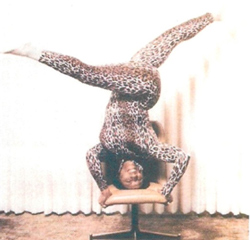
The order then veers into hyper-weirdland, explaining that while no amicus curiae briefs had been filed, the court had the benefit of input from volunteer “curious amigos” who performed on-site inspections. Judge Biery advises the volunteers “they would have enjoyed far more the sight of Miss Wiggles, truly an exotic artist of physical self expression even into her eighties, when she performed fully clothed in the 1960s at San Antonio’s Eastwood Country Club.” He even includes a picture of Miss Wiggles.  Er, thanks for that, Judge.

Things settle down at that point with an analysis of the request for preliminary injunction by the plaintiff club owners, pitting the government’s interests in reducing crime and protecting property values against the First Amendment.  Under the law, the club owners can get a license and let their dancers wear pasties or operate without a license and make them wear bikini tops.

Judge Biery wasn’t convinced female breasts were the cause of the government’s asserted ills, saying  he “doubts several square inches of fabric will stanch the flow of violence and other secondary effects emanating from these businesses” and speculating that “[a]lcohol, drugs, testosterone, guns and knives are more likely the causative agents.”

But he denied the preliminary injunction because the law does not require the government to prove causation in this instance, ending with more provocative wordplay (“Should the parties choose to string this case out to trial on the merits, the court encourages reasonable discovery intercourse as they navigate the peaks and valleys of litigation, perhaps to reach a happy ending.”)

(Postscript: A student sent me this, but many other sources have publicized this order, including Above the Law and the ABA Journal.)

—35 Bar and Grille v San Antonio, 35 Bar & Grille, LLC, et al. v. City of San Antonio, Civil Action No. SA-13-CA34-FB (W.D. Tex., Apr. 29, 2013) (Biery, J.)
Warning: Playing “Stairway to Heaven” Is Prohibited

guitar playing warningAs a hobby, I sing and play in Memphis rock cover bands.  At the Young Avenue Deli in the Cooper-Young neighborhood of Memphis, the sound guy has a sign posted warning bands: “$20 Fine for Playing Brown-Eyed Girl or Mustang Sally.”

If you’re a music fan, you might be thinking, “Why? Those are both great songs.”  They definitely are, which is why 90 percent of cover bands play them, which in turn is why sound guys hate them.

We encounter a similar phenomenon with guitar players.  Every guitar player learns or tries to learn certain fundmental songs and riffs, including Stairway to Heaven (first song I ever learned back in college), Smoke On the Water, and Sweet Child O’ Mine.

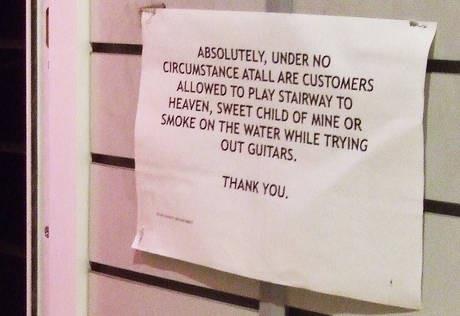
In response we get this admonishment from a music store that:

ABSOLUTELY, UNDER NO CIRCUMSTANCE AT ALL ARE CUSTOMERS ALLOWED TO PLAY STAIRWAY TO HEAVEN, SWEET CHILD OF MINE OR SMOKE ON THE WATER WHILE TRYING OUT GUITARS.  THANK YOU.

–Thanks to my bandmate Ron Lefkowitz for this one.

New Legal Humor: “Tales from the Courtroom”

Tales From the CourtroomA new book, Tales from the Courtroom, by English lawyer Brian Harris offers an interesting mix of historical, mysterious and humorous legal vignettes, mostly of UK origin, but also including a few American tales.

The book includes a fair share of dark legal humor, such as the tale of a Scottish judge named Kames who in 1780 found himself trying Matthew Hay, his former chess partner, for murder. When the verdict of guilty was returned, Kames chillingly remarked, “That’s checkmate to you, Matthew!” (Harris points out that the statement must be read in a Scottish accent for full effect.)

One of the best historical tales involves F.E. Smith’s (Lord Birkenhead) tiff with a sanctimonious judge:

F.E. had been briefed for a tramway company which had been sued for damages for injuries to a boy who had been run over. The judge was deeply moved. ‘Poor boy, poor boy’, he said. ‘Blind. Put him on a chair so that the jury can see him.’

F.E. said coldly: ‘Perhaps your honour would like to have the boy passed round the jury box.’

‘That is a most improper remark’, said Judge Willis angrily.

‘It was provoked’, said F.E., ‘by a most improper suggestion.’ There was a heavy pause, and the judge continued, ‘Mr. Smith, have you ever heard of a saying by Bacon—the great Bacon—that youth and discretion are ill-wed companions?’

‘Indeed I have, your Honour; and has your Honour ever heard of a saying by Bacon—the great Bacon—that a much talking judge is like an ill-tuned cymbal?’

The judge replied furiously, “You are extremely offensive, young man’; and F.E. added to his previous lapses by saying: ‘As a matter of fact we both are; the only difference between us is that I’m trying to be and you can’t help it.’

The book is available on Amazon. A review can be found on Harris’ TheAncientLawyer blog.

Firearms Policy and the Black Community

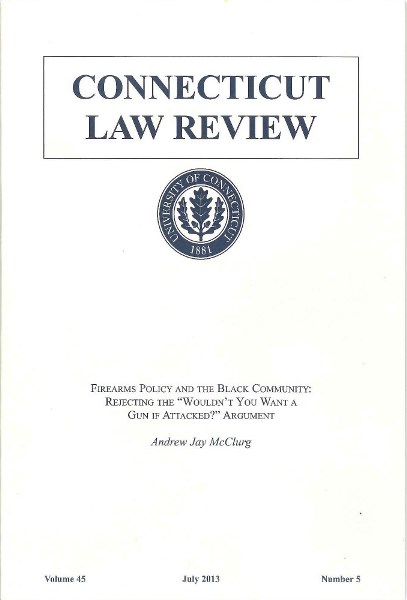
Firearms Policy and the Black Community cover jpgAndrew Jay McClurg, Firearms Policy and the Black Community: Rejecting the “Wouldn’t You Want a Gun If Attacked” Argument, 45 Connecticut Law Review 1773-1808 (2013).

The gun lobby has succeeded in focusing the gun debate on a narrow, oversimplified question: “If a criminal attacked you, wouldn’t you prefer to have a gun to protect yourself?” This article asserts that the question—which correlates with a “more guns” argument—is a red herring, a diversion that leads us off track and blinds us to the need for comprehensive strategies to address the complex, polycentric issues of gun violence in America.

In his article, Firearms Policy and the Black Community: An Assessment of the Modern Orthodoxy, Professor Nicholas Johnson pursues a version of the “Wouldn’t you want a gun if attacked?” argument particularized to black communities. Johnson uses the article as a platform for opposing black leaders who support gun regulation while essentially advocating for a “more guns” approach to violence in black communities.

This reply article highlights structural and rhetorical issues in Johnson’s arguments, but focuses on the reasoning fallacy inherent in concentrating the gun debate on a single, exaggerated utility of guns (i.e., the “Wouldn’t you want a gun if attacked?” argument) without fairly considering the offsetting risks or costs. It also asserts we should act quickly as a nation to invest in more research and data collection pertaining to the causes and prevention of firearms deaths and injuries, including the efficacy of guns for self-defense. Only with current, accurate information —which does not exist due in large part to efforts by the gun lobby to stifle gun research—can governments and individuals make rational firearms choices. The article concludes with a detour from the academic, theoretical world of gun debating to Memphis, Tennessee, one of America’s most violent cities.

Law Teacher Has Low Opinion of Legal Profession

–From Tony Arsenault, Laval University (Quebec), Date of event: Spring 2013

One of my friends took Legal Philosophy, a class whose teacher is known as a bit of a jerk and a little dismissive of lawyering as a profession.

They were discussing how to write the essay that was to be their final exam. Someone in the class asked: “Should we consider that the essay’s intended readers have any knowledge of law at all?”

The teacher said that they should write the essay as if a member of the Bar would read it.

The student drew a logical conclusion and asked if that meant the exam-takers should assume the readers were knowledgeable about law.

The teacher answered: “No. You should write as if your audience doesn’t know anything about law, doesn’t care about law and is probably intoxicated on various substances to boot.”

Spot the Tort: “Crowned with a Spike Right Through My Head”

Spot the tort: hanging spikeThere are potential torts and there are POTENTIAL TORTS. This hanging rusty spike stands out even on the gritty, tort-filled streets and sidewalks of downtown Memphis. As you can see in the second picture, it’s hanging at a level where a person could walk right into it.

I snapped this shot on my way to the annual law review banquet a week ago and was surprised to see it still hanging yesterday on my way back from lunch.

hanging spike wide viewThe headline reference, of course, is to a line from the Rolling Stone’s Jumpin’ Jack Flash.

Warning: No Scream Impressions or Diaperless Tots

In Torts, we were talking about product warning defects and, particularly, the warnings found on most plastic bags. These are warnings to adults to keep plastic bags away from babies, cribs, etc. because they present a suffication hazard. Using various bags as examples, we talked about the efficacy of such warnings in terms of size, placement and whether they needed to be in multiple languages. (We also discussed whether the risk is obvious, in which case there would be no duty to warn of it.)

This week a student brought me a plastic bag that attempted to solve the efficacy problems by omitting written warnings and relying solely on pictorial warnings. Did they succeed?  You be the judge.

Pictorial plastic bag warningFirst, we have this one. Here’s your test.

Question. This pictorial warning is intended to convey the following risk information:

(a) Keep plastic bags away from babies to prevent suffocation.

(b) Impressions of Edvard Munch’s The Scream are prohibited.

(c) Do not place large adult mitts around babies’ throats.

(d) This haz-mat suit does not work properly.

A is the correct answer.

This next one was on the same bag.

Question. This pictorial warning is intended to convey the following risk information:

Pictorial plastic bag warning(a) Keep plastic bags away from babies to prevent suffocation.

(b) Diapers required.

(c) Do not press pieces of toast against baby’s head.

(d) No balloon animals.

A is the correct answer.

Warning: Play-Doh Skill Level May Be Low

When you were a kid, or maybe still, did you ever wonder why, no matter how hard you tried, you couldn’t reproduce the product results with your toys similar to those represented in the advertising? These failures caused massive wounds to self-esteem to millions of children. The examples are too many too count. Legos, Erector Sets, Lincoln Logs. How were we supposed to build that 10,000-piece castle on the box with fifty pieces?

At least one modern manufacturer is paying attention to protecting the egos of today’s youth via product warnings. Play-Doh warns kids, at least the ones who read product warnings, to not get their artistic hopes up because:

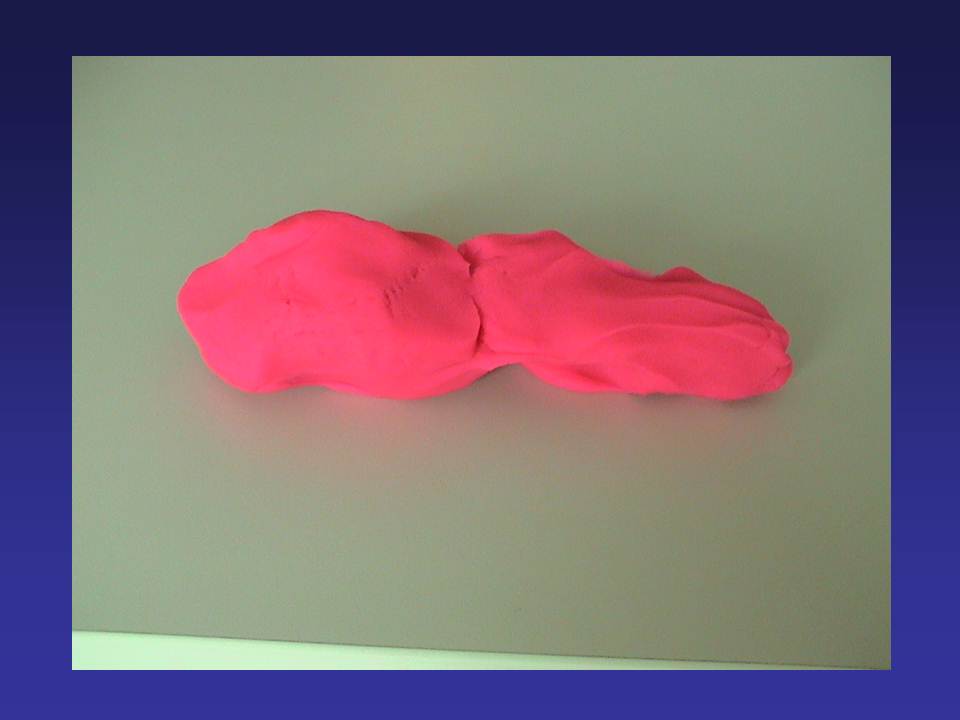
Reading this made me feel much better about myself because I recently attempted to replicate this delightful bug on the same packaging:

But ended up with this: