Ryan A. Malphurs conducted an interesting study of laughter in proceedings before the U.S. Supreme Court, following up on the work of Jerry Wexler for the New York Times. His entire article is must-reading for fans of legal humor, but this attention-grabbing opening excerpt from an oral argument in Safford Unified School District v. Redding certainly stands out:
Justice Breyer: In my experience when I was 8 or 10 or 12 years old, we did take our clothes off once a day, we changed for gym, okay? And in my experience, too, people did sometime stick things in my underwear–
(Laughter.)
Justice Breyer: Or not my underwear. Whatever. Whatever. I was the one who did it? I don’t know.
Studying all notations of “(Laughter)” appearing in the Court’s oral argument transcripts during the 2006-2007 term, Malphurs found 131 instances of ha-ha outbursts.
–Ryan A. Malphurs, “People Did Sometimes Stick Things in my Underwear”: The Function of Laughter at the U.S. Supreme Court, 10 Communication L. Rev. 48 (2010).
A Word Cloud reveals the stress and anxiety of 1Ls.
This is Part II of an exploration of psychological distress in law students. Part I explored empirical research showing the extent to which law students suffer from psychological dysfunction such as anxiety and depression. This part highlights a couple of non-scientific indicators of the problem.
Mid-semester, I asked a class of first-year Torts students to list their three top emotions about law school. Then I dumped all their answers into a Word Cloud program, which depicts entries by size according to how often the words are repeated. The results, as you can see from the picture, are not a pretty sight.
I also asked them to play Ernest Hemingway. You may have heard the legend that Hemingway once made a bet that he could write a complete story in six-words, and proceeded to write on a napkin, “For Sale: Baby shoes, never worn.” I assigned, as some other professors have done, my 1Ls to write a six-word story about law school. The majority of their stories reflected stress and anxiety. Here are some samples:
• Accepted application. Law school. Emotional wreck.
• Started school. Constant briefing. Now crying.
• Socrates meets Bentham under Sisyphus’ boulder.
If you’re a law student who is struggling, seek help. Talk to your professors about it. Visit the university counseling center. Do not accept depression or severe anxiety as normal consequences of law school. There is no shame in suffering these conditions. I was a wreck during my first year. You can read about it in my 1L story for the University of Missouri-Kansas City Law Review: Neurotic, Paranoid Wimps—Nothing Has Changed.
I talk to my students about these issues and each time I do, at least a couple of students contact me afterwards to say thanks and share their own experiences. In many cases, they take me up on my advice to seek help at the counseling center. When they do, invariably, they report back that they are doing much better.
On the Sunny Side. If you’re considering law school, do not let these posts scare you away. Law school isn’t all gloom and doom. The research just makes it look that way. No one has ever studied the positive aspects of law school, of which there are many. Here’s a happy statistic the might surprise you in light of what you’ve read in these posts: 83 percent of the 33,000 students who responded to the 2011 Law School Survey of Student Engagement reported that they found their law school experience to be either good or excellent.
Sure, law school is a challenge, but it’s supposed to be. It obviously is doable though, or we wouldn’t have 1.1 million lawyers in America. I love this comment from a student in response to a question asking whether her first year was better or worse than expected:
I love law school. I love the material, the professors, my classmates, and especially those few close friends I’ve connected with and grown close to. Law school is definitely more challenging in so many ways than I ever could have anticipated, but that’s what makes it great. If it was easy, I can say in all honesty that I would be disappointed. It’s supposed to be hard because it means something. The challenges are what help us grow and learn and open our minds and I wouldn’t have it any other way.
Hang in there! First-semester exams will be over before you know it.
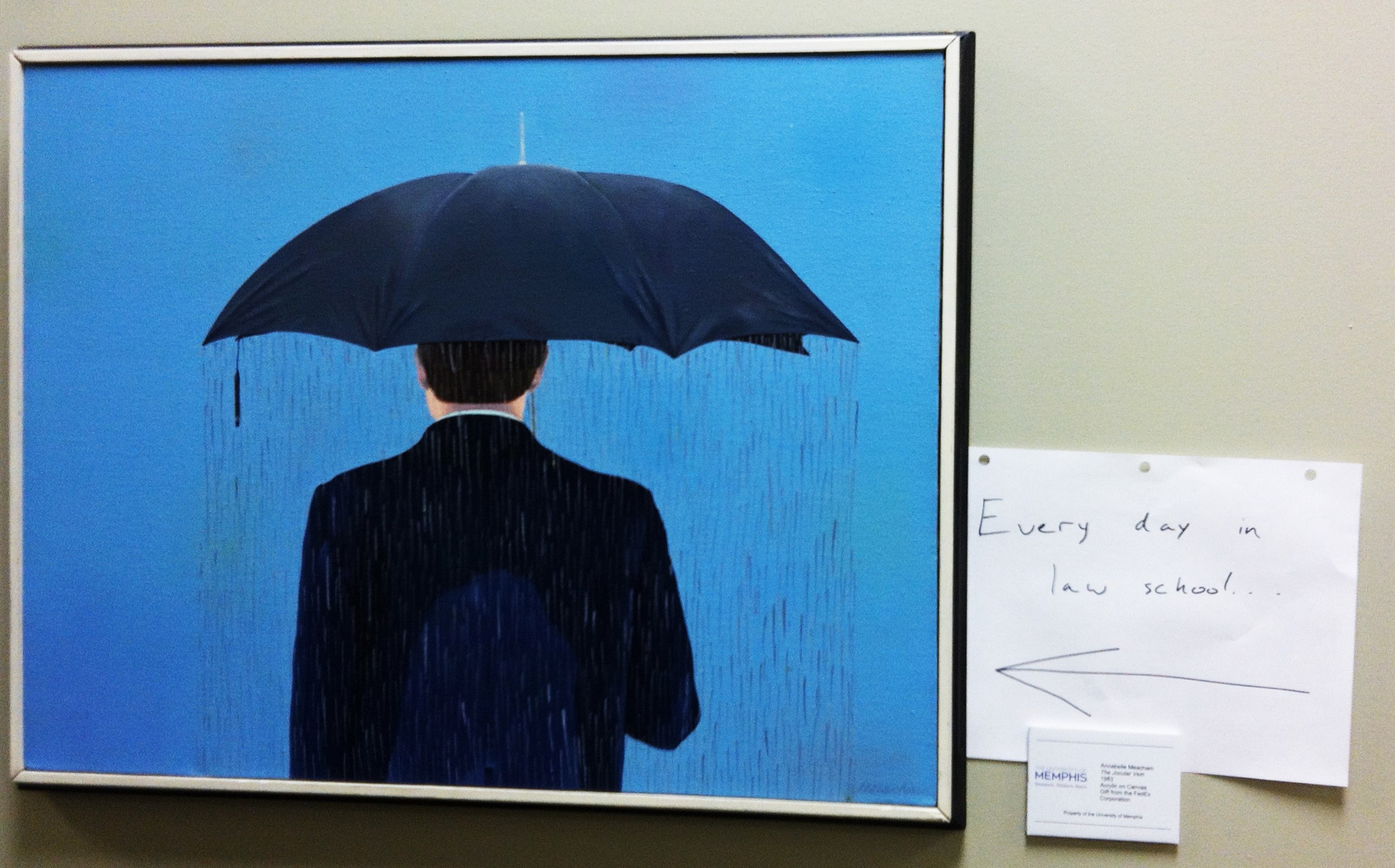
On my way to class recently, I came across this hand-written annotation posted alongside this rainy day painting hanging in our magnificent law school (recently ranked as the nation’s best law school facility).
Click to enlarge the picture and you’ll see it’s a man standing under a raining umbrella. The sign says: “Every day in law school”
As law students everywhere approach fall semester exams, it once again brought home the sad fact that many law students struggle with anxiety, depression and other psychological dysfunction.
As far back as 1957, a study found that psychological distress in law students significantly out-paces not only the general population, but other graduate student populations, including medical students. (Eron & Redmount, 1957).
A 1980s study of law and medical students at the University of Arizona found that law students scored significantly higher than both the general population and medical students in nearly every category of psychological dysfunction, including anxiety, depression, feelings of inadequacy and inferiority, hostility, and obsessive-compulsiveness. (Shanfield & Benjamin, 1985).
With regard to the chicken and egg question of whether law school causes psychological distress or attracts people who are already inclined toward it, one study found that law students begin school with psychopathological symptoms similar to the general population, but that those symptoms become substantially elevated during law school. The same study found that 17-40 percent of the participating law students suffered from depression. (Benjamin, Kaszniak, Sales & Shanfield, 1986). Comparatively, the Centers for Disease Control reports that 9 percent of the U.S. adult population show symptoms of depression, including 4.1 percent who suffer major depression.
In another study, researchers administered a battery of tests to entering law students to measure their states of happiness, life satisfaction, physical symptoms, and depression. The scores showed that the students were a mostly contented, normal group on arrival. By the end of the first year, however, they showed large reductions in positive affect, life satisfaction, and overall well-being, and large increases in negative affect, depression, and physical symptoms. (Sheldon & Krieger, 2004).
A 2000 study of University of Michigan law students found that half of the students showed symptoms of clinical depression by the end of their first year, and that these high levels remained throughout their law school careers. Comparing the law students’ scores on a standard depression scale to scores for other groups subject to extreme stress yielded startling results. The 50 percent depression rate for law students compared to rates of 40-45 percent for unemployed people, 50 percent for people experiencing the death of a spouse or marital separation in the past year, and 50-60 percent for persons being treated for substance abuse. (Reifman, McIntosh & Ellsworth, 2000). This isn’t to suggest, of course, that being a law student is as bad as those events, but law school can push the brain’s depression buttons.
To the extent law school is responsible for causing emotional distress in law students, one doesn’t have to look far for plausible explanations, including the make-it-or-break-it single-exam format, heavy emphasis on grades and class rank, lack of feedback, competitive environment, high student-teacher ratios, Socratic method, and intense workload. Added to these traditional woes are modern worries about heavy debt-load and finding a job. Intangibly, the adversarial nature of the legal system in which law students are immersed, the emphasis on objective analytical thinking over personal values and emotions, and strains on personal relationships can all add to psychological dissonance.
Law students: Be self-aware. Students are sometimes the last to know, or admit, that they are struggling. I once had a first-year student rush out of class thinking she was having a heart attack. I ran after her and found her sitting on a bench clutching her chest. Her face was flushed and she was sweating and trembling. But it wasn’t a heart attack. It was a panic attack.
Stay on the lookout for anxiety or depressed states that are excessive and prolonged and are impairing your ability to function. If you’re struggling, know you are not alone. Many students suffer silently, hiding their distress even from close loved ones. I felt that way as a student. It’s okay to feel bad. Take advantage of the university counseling center. Free and confidential, your fees pay for it.
Part II of this post will offer more insights, but if you have access to a copy of 1L of a Ride, read Chapters 19 (The Bleak Side of Law School) and 20 (Maintaining Well-Being). Also study Chapter 15 (Exam Preparation) for strategies on approaching exams in an organized, reduced-stress way. In the meantime, remember: this too shall pass.
Thanks to Al Sturgeon, Dean of Students at Pepperdine Law, for his insightful take on my chapter called Eight Things to NEVER Say to a Law Student, which include:
“Don’t Worry, You’ll Do Fine”
“Maybe You Weren’t Meant to Be in Law School”
“Remember, It’s Only a Test”
“Is That the Best You Could Do?”
“Do You Really Have to Work on That Tonight?”
“What Kind of Lawyer Do You Want to Be?”
“Do You Have a Job Yet?”
“Have You Heard the One About the Lawyer, the Shark, and the Pornographer?”
A fleeing bank robber made the mistake of seeking refuge in his 94-year-old great-grandmother’s home with pursuers hot on his trail. When the police arrived, the only ones present were the accused and great-grandma. At trial, the defendant, Mr. Jones, elected to represent himself, never a good idea.
The prosecution called his great-grandma as a witness. To say she wasn’t happy about the proceedings and, in particular, the conduct of her great-grandson would understate her disenchantment with sitting in the witness box.
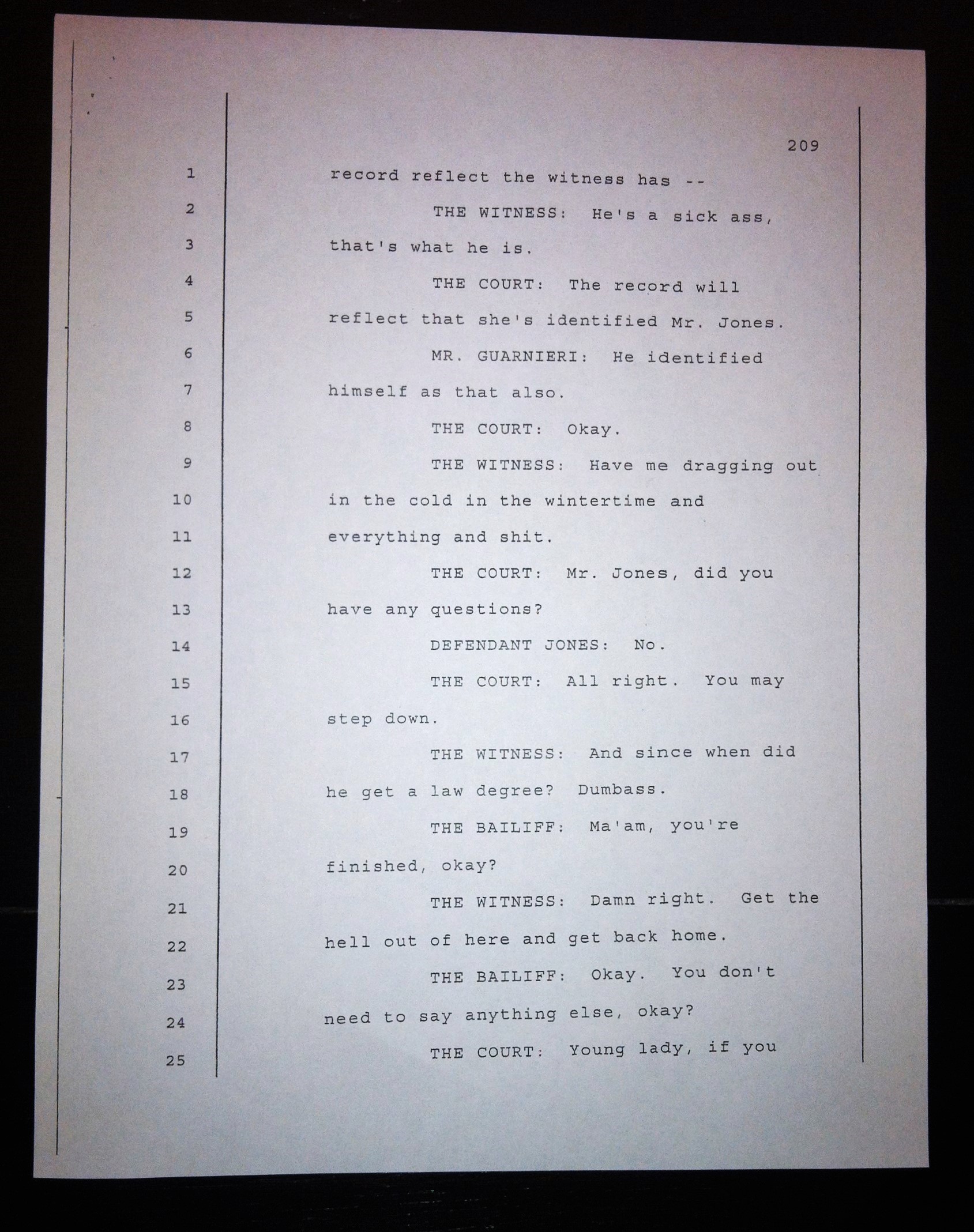
We’ll let her explain. Here’s the text of page 209 of the trial transcript shown in the photo, where she concludes her testimony:
THE WITNESS: He’s a sick ass, that’s what he is.
THE COURT: The record will reflect that she’s identified Mr. Jones.
…
THE WITNESS: Have me dragging out in the cold in the wintertime and everything and shit.
THE COURT: Mr. Jones, did you have any questions?
DEFENDANT JONES (the great-grandson): No.
THE COURT: All right. You may step down.
THE WITNESS: And since when did he get a law degree? Dumbass.
THE BAILIFF: Ma’am, you’re finished, okay?
THE WITNESS: Damn right. Get the hell out of here and get back home.
THE BAILIFF: Okay, you don’t need to say anything else, okay?
Law degree or not, give the great-grandson credit for the smart strategy decision not to cross-examine. Small wonder the prosecutor described the great-grandmother as “one of the most entertaining witnesses this writer has ever encountered” in the state’s appellate brief.
— Trial Transcript, State of Ohio v. Jones, Case No. 2014CA-00051, at 209 (Ohio 5th Ct. App.). Thanks to Laura Ozak.
Slipping on a banana peel is, of course, a classic clichéd accident depicted in cartoons. As my 1Ls get ready to tackle the famous trilogy of banana peel slip and fall cases in the Prosser, Wade & Schwartz Torts casebook next week, the nagging question that lingers is: do people really slip on banana peels?
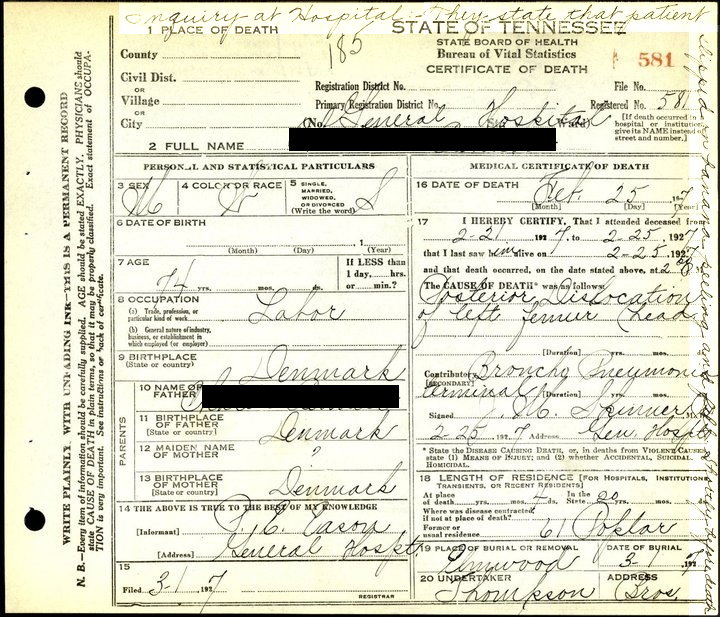
A previous post discussed this issue, but check this out. It’s a 1927 Tennessee death certificate for a 74-year-old hospitalized man. A bit hard to read, but the highlighted note written across the top and going down the right side says:
Inquiry at Hospital: They state that patient slipped on banana peeling and fell shortly before death.
We love pictorial warnings at Lawhaha.com, as shown by the samples here, here, here, here, and here. These are supposedly universal warnings designed to be understood by everyone. As in these warnings on the outside of a dehumidifier box, they are often accompanied by written warnings. But not everyone can read the written warnings, either because of language barriers or simply an inability to read.
So how do these pictorial warnings rate? When I look at the first one, all I can think of is the David Bowie song, “Let’s Dance.” What is it trying to convey? That you need two people to pick the thing up. I think that one probably works, assuming for the sake of argument that people need a warning not to pick up large heavy objects without assistance.
These next three warnings on the same box are a mixed bag. No idea what “4” stands for. Assuming it’s something on a scale, but “4” out of what? And what is it measuring? Please send word. The second one might be a warning to not put your wine glass on the dehumidifier, but, on the outside packaging, it’s probably a warning that the contents are breakable. The third one? Who knows? Don’t stomp on it? Don’t kick it? Hmm, maybe don’t stand on it, which I could see, but if that’s the case, shouldn’t they have a box under the boot?
We like to have fun with these, but let’s face it, the real problem is that it’s almost impossible to meaningfully convey most product warnings via a symbol.