August 14th, 2013  A litigation strategy the judge thought went too boldly beyond … In an order littered with Star Trek references, a litigation strategy involving obtaining the copyright to pornographic movies and then suing people for illegally downloading them irked U.S. District Judge Otis D. Wright (C.D. Cal.) to the extent that he levied hefty sanctions against those involved in various misdeeds.
According to Judge Wright, the plaintiffs had outmaneuvered the legal system:
They’ve discovered the nexus of antiquated copyright laws, paralyzing social stigma, and unaffordable defense costs. And they exploit this anomaly by accusing individuals of illegally downloading a single pornographic video. Then they offer to settle—for a sum calculated to be just below the cost of a bare-bones defense. For these individuals, resistance is futile; most reluctantly pay rather than have their names associated with illegally downloading porn. So now, copyright laws originally designed to compensate starving artists allow, starving attorneys in this electronic-media era to plunder the citizenry.
The following findings of fact flesh out the situation a bit more:
2. AF Holdings and Ingenuity 13 have no assets other than several copyrights to pornographic movies. There are no official owners or officers for these two offshore entities, but the Principals are the de facto owners and officers.
3. The Principals started their copyright-enforcement crusade in about 2010, through Prenda Law, which was also owned and controlled by the Principals. Their litigation strategy consisted of monitoring BitTorrent download activity of their copyrighted pornographic movies, recording IP addresses of the computers downloading the movies, filing suit in federal court to subpoena Internet Service Providers (“ISPs”) for the identity of the subscribers to these IP addresses, and sending cease-and-desist letters to the subscribers, offering to settle each copyright infringement claim for about $4,000.
4. This nationwide strategy was highly successful because of statutory copyright damages, the pornographic subject matter, and the high cost of litigation. Most defendants settled with the Principals, resulting in proceeds of millions of dollars due to the numerosity of defendants.
An apparent Star Trek fan, Judge Wright began his order imposing sanctions by quoting Spock from Star Trek II: The Wrath of Khan: “The needs of the many outweigh the needs of the few.”
Not sure of the exact relevance of this quotation. Was he referring to the needs of the many for illegally downloaded porn?
He continued mining the Star Trek vein at various parts of the order, stating, for example, that “though Plaintiffs boldly probe the outskirts of law, the only enterprise they resemble is RICO. The federal agency eleven decks up is familiar with their prime directive and will gladly refit them for their next voyage” and “[i]t was when the Court realized Plaintiffs engaged their cloak of shell companies and fraud that the Court went to battlestations.”
Order Issuing Sanctions, Ingenuity 13 LLC v. John Doe, Case No. 2:12-cv-8333-ODW(JCx), May 6, 2013, U.S. District Ct., Central District of California. Thanks to Michael Kong.
May 26th, 2013  Federal judge a fan of this venerable exotic dancer. Chief U.S. District Court Judge Fred Biery, W.D. Tex, had a great time writing a preliminary injunction order in a case in which the City of San Antonio passed an ordinance regulating topless dancers, including requiring them to wear more clothes. How much fun did he have? The title of the order gives a good clue:
“The Case of the Itsy Bitsy Teeny Weeny Bikini Top v. The (More) Itsy Bitsy Teeny Weeny Pastie,” with a footnote to—you guessed it—the novelty hit, Itsy Bitsy Teeny Weeny Yellow Polka Dot Bikini (Knapp Records 1960). The order is a combination of lame sexually oriented wordplay and thoughtful analysis. Here are two sample paragraphs of the former (underline added):
An ordinance dealing with semi-nude dancers has once again fallen on the Court’s lap. The City of San Antonio (“City”) wants exotic dancers employed by Plaintiffs to wear larger pieces of fabric to cover more of the female breast. Thus, the age old question before the Court, now with constitutional implications, is: Does size matter?
The Court infers Plaintiffs fear enforcement of the ordinance would strip them of their Profits, adversely impacting their bottom line. Conversely, the City asserts these businesses contribute to reduced property values, violent crime, increased drug sales, prostitution and other sex crimes, and therefore need to be girdled more tightly. Plaintiffs, and by extension their customers, seek an erection of a constitutional wall separating themselves from the regulatory power of City government.
The order then veers into hyper-weirdland, explaining that while no amicus curiae briefs had been filed, the court had the benefit of input from volunteer “curious amigos” who performed on-site inspections. Judge Biery advises the volunteers “they would have enjoyed far more the sight of Miss Wiggles, truly an exotic artist of physical self expression even into her eighties, when she performed fully clothed in the 1960s at San Antonio’s Eastwood Country Club.” He even includes a picture of Miss Wiggles. Er, thanks for that, Judge.
Things settle down at that point with an analysis of the request for preliminary injunction by the plaintiff club owners, pitting the government’s interests in reducing crime and protecting property values against the First Amendment. Under the law, the club owners can get a license and let their dancers wear pasties or operate without a license and make them wear bikini tops.
Judge Biery wasn’t convinced female breasts were the cause of the government’s asserted ills, saying he “doubts several square inches of fabric will stanch the flow of violence and other secondary effects emanating from these businesses” and speculating that “[a]lcohol, drugs, testosterone, guns and knives are more likely the causative agents.”
But he denied the preliminary injunction because the law does not require the government to prove causation in this instance, ending with more provocative wordplay (“Should the parties choose to string this case out to trial on the merits, the court encourages reasonable discovery intercourse as they navigate the peaks and valleys of litigation, perhaps to reach a happy ending.”)
(Postscript: A student sent me this, but many other sources have publicized this order, including Above the Law and the ABA Journal.)
—35 Bar and Grille v San Antonio, 35 Bar & Grille, LLC, et al. v. City of San Antonio, Civil Action No. SA-13-CA34-FB (W.D. Tex., Apr. 29, 2013) (Biery, J.)
October 26th, 2012  In this Halloween-themed case, the plaintiff bought a house, only to learn that it had a reputation in the Village of Nyack, NY, for being possessed by poltergeists, a reputation built in large part on the seller’s previous efforts to promote the house as haunted, which were unknown to plaintiff. On learning of the alleged haunting, plaintiff sued for rescission of the sale contract. In this Halloween-themed case, the plaintiff bought a house, only to learn that it had a reputation in the Village of Nyack, NY, for being possessed by poltergeists, a reputation built in large part on the seller’s previous efforts to promote the house as haunted, which were unknown to plaintiff. On learning of the alleged haunting, plaintiff sued for rescission of the sale contract.
The New York Supreme Court, Appellate Division, over one dissent, ruled for the plaintiff, going against the usual rule in New York of strict caveat emptor (let the buyer beware), which imposed no duty on house sellers to disclose even known defects. Based on the seller’s previous assertions that the house was haunted, the court said the seller was estopped from claiming otherwise and that the house was haunted “as a matter of law.”
So New York property owners take note: there is no duty to report collapsing roofs, faulty foundations, or termite infestations, but, after this opinion, suspected poltergeist infestations must be disclosed. (The case was decided in 1991; New York may have modified its caveat emptor rule since then.)
We’ll let the court–per Judge Rubin–unravel this hair-raiser. Turn the lights low, cuddle up, and prepare for the one and only judicial ghost story, a classic tale of a stranger arriving in a town where things aren’t quite what they seem. [Cue spooky music]:
The unusual facts of this case … clearly warrant a grant of equitable relief to the buyer who, as a resident of New York City, cannot be expected to have any familiarity with the folklore of the Village of Nyack. Not being a “local,” plaintiff could not readily learn that the home he had contracted to purchase is haunted.
Whether the source of the spectral apparitions seen by defendant seller are parapsychic or psychogenic, having reported their presence in both a national publication (“Readers’ Digest”) and the local press …, defendant is estopped to deny their existence and, as a matter of law, the house is haunted.
More to the point, however, no divination is required to conclude that it is defendant’s promotional efforts in publicizing her close encounters with these spirits which fostered the home’s reputation in the community. In 1989, the house was included in a five-home walking tour of Nyack and described in a November 27th newspaper article as “a riverfront Victorian (with ghost).” The impact of the reputation thus created goes to the very essence of the bargain between the parties, greatly impairing both the value of the property and its potential for resale. ….
While I agree… that the real estate broker, as agent for the seller, is under no duty to disclose to a potential buyer the phantasmal reputation of the premises and that, in his pursuit of a legal remedy for fraudulent misrepresentation against the seller, plaintiff hasn’t a ghost of a chance, I am nevertheless moved by the spirit of equity to allow the buyer to seek rescission of the contract of sale and recovery of his down payment.
New York law fails to recognize any remedy for damages incurred as a result of the seller’s mere silence, applying instead the strict rule of caveat emptor. Therefore, the theoretical basis for granting relief, even under the extraordinary facts of this case, is elusive if not ephemeral.
“Pity me not but lend thy serious hearing to what I shall unfold” (William Shakespeare, Hamlet, Act I, Scene V [Ghost] ).
From the perspective of a person in the position of plaintiff herein, a very practical problem arises with respect to the discovery of a paranormal phenomenon: “Who you gonna’ call?” as the title song to the movie “Ghostbusters” asks. Applying the strict rule of caveat emptor to a contract involving a house possessed by poltergeists conjures up visions of a psychic or medium routinely accompanying the structural engineer and Terminix man on an inspection of every home subject to a contract of sale.
It portends that the prudent attorney will establish an escrow account lest the subject of the transaction come back to haunt him and his client–or pray that his malpractice insurance coverage extends to supernatural disasters.
In the interest of avoiding such untenable consequences, the notion that a haunting is a condition which can and should be ascertained upon reasonable inspection of the premises is a hobgoblin which should be exorcised from the body of legal precedent and laid quietly to rest.
The court detailed New York’s strict caveat emptor rule, but ultimately couldn’t stomach the fact that it was the defendant who, in effect, created the defect by broadcasting the house’s haunted status, thereby impairing its value:
In the case at bar, defendant seller deliberately fostered the public belief that her home was possessed. … Where, as here, the seller not only takes unfair advantage of the buyer’s ignorance but has created and perpetuated a condition about which he is unlikely to even inquire, enforcement of the contract (in whole or in part) is offensive to the court’s sense of equity. Application of the remedy of rescission, within the bounds of the narrow exception to the doctrine of caveat emptor set forth herein, is entirely appropriate to relieve the unwitting purchaser from the consequences of a most unnatural bargain.
The dissenting judge wanted to stick with the caveat emptor rule, stating that “if the doctrine of caveat emptor is to be discarded, it should be for a reason more substantive than a poltergeist.”
–Stambovsky v. Ackley,169 A.D.2d 254 (N.Y. Sup. Ct. 1991)
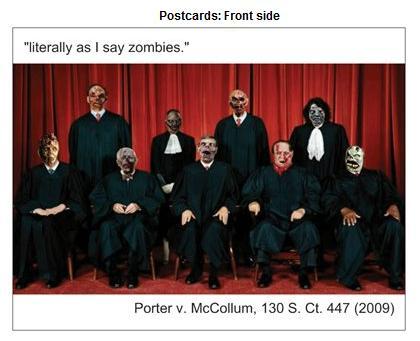
October 4th, 2012 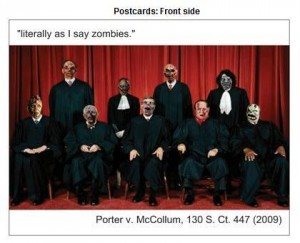 Good news for legally inclined zombie lovers. Joshua Warren has compiled a casebook on Zombie Law that “include[s] case opinions from the over 300 U.S. Federal Court opinions with the word “zombie” (and “zombies”, “zombi”, “zombis”, “zombified”, “zombism”, etc..).” These include cases from the zombified Supreme Court (available as postcards, along with zombie law teeshirts and zombie flashdrives). Good news for legally inclined zombie lovers. Joshua Warren has compiled a casebook on Zombie Law that “include[s] case opinions from the over 300 U.S. Federal Court opinions with the word “zombie” (and “zombies”, “zombi”, “zombis”, “zombified”, “zombism”, etc..).” These include cases from the zombified Supreme Court (available as postcards, along with zombie law teeshirts and zombie flashdrives).
Warren explains that this is a “serious” project. From his promotional website:
The “zombie” in federal courts are very interesting. Aside from the intellectual property cases that provide some reflection on modern zombie fiction, there are also ample metaphoric uses of the word in these judicial writings. Judges have referred to “zombie precedents” and “zombie litigation”. There are zombie corporations, zombie criminals, a significant number are social security cases in which people describe themselves in zombie condition and even a recent mentions of cybernetic zombies.
Unlike other works of zombie academia, the zombies in this book are all real. Most zombie scholarship uses hypothetical zombies as tropes to create entertaining and extreme fact patterns that can be used to explain complex subject matters. This has been used effectively for neuroscience (Schlozman, Voytek), international policy analysis (Drezner), public health (Center for Disease Control), geography (Kickstarter project: Zombie-Based Learning), survival skills (Brooks) amongst other subjects (See Zombie Research Society) including also academics who focus on the fictional character itself (Mogk, Brooks).
This Zombie Law book is different because it does not use zombies as hypotheticals to teach law. It is not conjecture about what zombies are or might be. This book is a compendium of real usages of the actual word in American jurisprudence. This book is a collection of real legal cases that literally include “zombies” (or similar word) in US Federal Court opinions..
The basic outline of the book will separate most cases into issues of corporations, medications, criminals and, of course intellectual property. Major sections will be devoted to Social Security (disability) law, corporate fraud and issues of criminal intent. There are noteworthy cases referring to post traumatic stress disorder and many recent Social Security cases regarding of fibromyalgia. The intellectual property cases are about popular zombie fiction and also so-called “vicious zombi” patents. In general, the idea of zombies in a mall is public domain for copyright but particular forms of zombie products are protected by trademark.
Frequently there is a sort of double meaning in the word. In Social Security cases, the word zombie is found as a symptom of pain, depression and anxiety but also the side effect of medications prescribed for those same symptoms. In criminal law, zombie appear in victim’s description of their assailant’s behavior but also as defense argument against criminal intent. For corporations the ironic question of corporate-personhood begs the question, ‘what is a person?’, which is often the implied question of zombie studies.
For all you law professors and other legal authors who thought there was no niche left to write about, Warren shows you just have to think outside of the box, in this case, the ones buried six feet under.
September 24th, 2012  Betting the professor was this federal judge’s favorite Gilligan’s Island character. In an opinion that is part period-piece shipwreck thriller and part Gilligan’s Island pop-culture fun, Chief U.S. District Judge William Steele (S.D. Ala.) attempted to unravel a dispute over the ownership rights to an unidentified shipwreck off the coast of Alabama. The wreck is believed to be either the Clipper Ship ROBERT H. DIXEY or the British barque AMSTEL.
Several parties, including the United States and Alabama, claimed title to the wreck. Unfortunately, whichever ship it was, it sank more than 150 years ago, leaving Judge Steele to observe in a footnote that historical scholars were better-suited than a federal judge to determine the ship’s identity:
FN4. This procedural posture is highly unusual. For starters, the proper identity of Shipwreck # 1 is a matter better suited for spirited scholarly discourse than black-letter judicial construction. Yet the parties have submitted their dispute to a federal judge, not a 19th century maritime historian. Furthermore, while both sides agree that 100% certainty as to the vessel’s identity is not possible, resolution of this factual issue does not turn on the sort of credibility determinations for which an evidentiary hearing would be appropriate. The underlying events having taken place a century and a half ago, there are no live witnesses to recount the circumstances under which the DIXEY and the AMSTEL sank. Nor are there dueling expert witnesses whose theories might be poked and prodded via cross-examination. Instead, as the DIXEY Claimants succinctly state, “[t]here is what there is.”
But Judge Steele did a pretty good scholarly job himself in recounting the interesting history of both ships, starting with the DIXEY, where he invoked the 1960s sitcom, Gilligan’s Island, for a unifying thread (Gilligan’s Island references have been bolded):
Just sit right back and you’ll hear a tale, a tale of a fateful trip. It did not start in a tropic port, nor aboard a tiny ship. On August 15, 1860, the Clipper Ship ROBERT H. DIXEY set sail that day from New York to Mobile, carrying a cargo described only as “miscellaneous hardware.” The DIXEY reached an anchorage in Mobile Bay on the evening of September 14, 1860. By inopportune coincidence, the DIXEY arrived at the Bay just hours ahead of a Category 1 hurricane. Wary of the approaching storm, Captain Dixey (by all accounts a skipper brave and sure) put out “double anchors and all chain” at 10 p.m., and took “all measures to ride out a storm.”
The hurricane struck at approximately 2:00 a.m. on September 15, 1860. The DIXEY actually weathered the first few hours of the storm well. With the winds out of the south, the DIXEY was sheltered by the buffering presence of Dauphin Island (to the vessel’s south) from the worst of the rough seas, at least initially. After 8:00 a.m., however, the eye of the hurricane passed, and fierce winds shifted to the north. The weather started getting rough, and the mighty ship was tossed. In its anchored position, the DIXEY was exposed to approximately 17 miles of open shallow water stretching all the way to Mobile. As a result, the DIXEY was pounded by the punishing winds and roiling seas. The first anchor’s chain broke at around 10:00 a.m. The DIXEY’s crew began working feverishly to cut away its masts and sails, thereby lightening the ship and reducing its wind exposure, even as the DIXEY took on water for over an hour. If not for the courage of the fearless crew, the DIXEY would have been lost. Alas, the gale continued to worsen and the other anchor chain snapped, causing the DIXEY to be buffeted by the hurricane, tossed around in the shallow water like a child’s toy. The wind and seas pushed the helpless DIXEY south down the shipping channel of Mobile Bay for some 12 miles. [The DIXIE ultimately was pounded to pieces by the storm.]
Judge Steele also recounted the AMSTEL’s fate, another interesting story, but left out any pop culture references. Aw, come on, Judge. As Sammy Hagar sang with Van Halen, you gotta finish what you started. Maybe he ran dry on Gilligan’s Island’s references, but he always could have switched to a Wreck of the Edmund Fitzgerald theme.
In the end, the judge ruled that the ship was the AMSTEL, but ordered the parties to continue gathering evidence and let him know if he got it wrong.
From the scholarly bent of this opinion–setting aside the Gilligan’s Island references–I’m guessing “The Professor” was Judge Steele’s favorite Gilligan’s Island character.
Fathom Exploration, L.L.C. v. The Unidentified Shipwrecked Vessel or Vessels, etc., in rem, Civil Action No. 04-0685-S-M. (S.D. Ala., Mar. 12, 2012).
August 17th, 2012 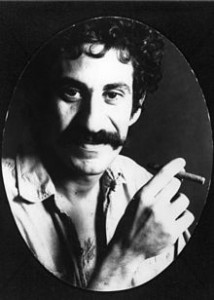 Court of Appeals used this guy’s tunes to find humor in alleged gun assault. One rule of thumb regarding amusing judicial opinions is that the higher up the judicial hierarchy one climbs, the fewer such opinions one encounters. But here we have the distinguished U.S. Circuit Court of Appeals for the Eleventh Circuit, per Judge Ed Carnes, having fun with a case that probably wasn’t amusing from the plaintiff’s point of view, assuming the allegations of his complaint are true.
As alleged: A mother, a state corrections officer, came home in uniform to find her daughter and plaintiff engaging in intimate relations. The complaint alleges she pulled her gun on the naked plaintiff, threatened to shoot him, forced him to his knees, handcuffed him, tried to have him arrested, and further assaulted and threatened him. He was ultimately released unharmed physically.
The young man sued the mother and the county sheriff, her employer, in a Section 1983 action. The claim against the sheriff was based on the allegation the mother acted under color of state law (in an official capacity) when she allegedly assaulted the plaintiff.
The Eleventh Circuit rejected that claim, endorsing the district court’s position that the mother was no more than “an angry parent who happened to be in uniform, have handcuffs, and a firearm, which she used for the private ends of assaulting and scaring a young man she caught in bed with her daughter.”
Judge Carnes had a great time with the opinion, starting and ending with references to Jim Croce songs. Okay, this is just a wild guess, but I’m thinking Judge Carnes has never been forced naked to his knees, handcuffed, at gunpoint, by someone threatening to shoot him. Here are some excerpts (I substituted “plaintiff, “defendant,” and “defendant’s daughter” for the actors’ names):
In one of his ballads, Jim Croce warned that there are four things that you just don’t do: “You don’t tug on Superman’s cape/ You don’t spit into the wind/ You don’t pull the mask off that old Lone Ranger/ And you don’t mess around with Jim.” He could have added a fifth warning to that list: “And you don’t let a pistol-packing mother catch you naked in her daughter’s closet.”
It all started with a phone call. Nineteen-year-old defendant’s daughter called plaintiff, who was of a similar age, and invited him to her house. Plaintiff responded to the invitation the way most young men over the age of consent would have—he went. …
Then they consented to do what young couples alone in a house have been consenting to do since the memory of man (and woman) runneth not to the contrary. The record does not disclose how long these two young people had known each other in the dictionary sense, but that afternoon in … the bedroom they also knew each other in the biblical sense.
That’s when the mother came home. Discovering plaintiff with her daughter, she allegedly pulled her firearm on him. She apparently asserted that she believed the plaintiff was attacking her daughter.
She told plaintiff that if he moved or did not follow her commands, she would shoot him.
Plaintiff tried to explain that her daughter had invited him to the house, but defendant insisted that he must have broken in. She had the still-naked plaintiff turn around, she handcuffed him, and she made him get down on his knees. After staying there “for a prolonged period,” plaintiff pleaded with defendant that he could not maintain that position any longer. Defendant responded by telling him to bend over or she would shoot him. She “made numerous threats against plaintiff, telling him that she would ‘kill him’ if he did not obey her commands.”
…
The amended complaint and plaintiff’s briefs leave no doubt that he feels mistreated, and with what appears to be some justification. If the allegations are true, defendant’s treatment of plaintiff was badder than old King Kong and meaner than a junkyard dog. She might even have acted like the meanest hunk of woman anybody had ever seen. Still, the fact that the mistreatment was mean does not mean that the mistreatment was under color of law.
Glad at least someone involved in the case had fun, Judge.
–Butler v. Sheriff of Palm Beach County, Case No. 11-13933 (11th Cir., July 6, 2012). Thanks to Paul Scott.
July 14th, 2012  One of Zim's classics. Remember “Golden Guides”? They were sort of the original “Dummies” series for kids, explaining a variety of scientific, geographic, and nature topics in succinct terms understandable even by 10 year olds.
Zim v. Western Pub. Co. arose out of a dispute between the guy who wrote or co-wrote many of these masterpieces—Dr. Herbert Zim—and the Golden Guides publisher, Western Publishing. Zim penned such classics as Rocks and Minerals, Reptiles and Amphibians, Trees, and my personal fav, Fishes.
Judge Goldberg of the U.S. Court of Appeals for the Fifth Circuit apparently also thinks highly of Zim, elevating him to biblical proportions:
In the beginning, Zim [Fn.1] created the concept of the Golden Guides. For the earth was dark and ignorance filled the void. And Zim said, let there be enlightenment and there was enlightenment. In the Golden Guides, Zim created the heavens (STARS) (SKY OBSERVER’S GUIDE) and the earth. (MINERALS) (ROCKS and MINERALS) (GEOLOGY).
[Fn.1] Dr. Zim is a noted science educator with a Ph.D. in science education from Columbia University. His special expertise is in the presentation of scientific subjects to popular audiences. The major focus of his efforts has been the development of a multivolume series of books on scientific subjects, the “Golden Guides.” …
And together with his publisher, Western, he brought forth in the Golden Guides knowledge of all manner of living things that spring from the earth, grass, herbs yielding seed, fruit-trees yielding fruits after their kind, (PLANT KINGDOM) (NON-FLOWERED PLANTS) (FLOWERS) (ORCHIDS) (TREES), and Zim saw that it was good. And they brought forth in the Golden Guides knowledge of all the living moving creatures that dwell in the waters, (FISHES) (MARINE MOLLUSKS) (POND LIFE), and fowl that may fly above the earth. (BIRDS) (BIRDS OF NORTH AMERICA) (GAMEBIRDS). And Zim saw that it was good. And they brought forth knowledge in the Golden Guides of the creatures that dwell on dry land, cattle, and creeping things, (INSECTS) (INSECT PESTS) (SPIDERS), and beasts of the earth after their kind. (ANIMAL KINGDOM). And Zim saw that it was very good.[Fn.4]
[Fn.4] According to Zim’s brief before this court, well over 100 million of the Golden Guide books have been printed under Zim’s name, earning him “millions of dollars” in royalties.
Then there rose up in Western a new Vice-President who knew not Zim. And there was strife and discord, anger and frustration, between them for the Golden Guides were not being published or revised in their appointed seasons. And it came to pass that Zim and Western covenanted a new covenant, calling it a Settlement Agreement. But there was no peace in the land. Verily, they came with their counselors of law into the district court for judgment and sued there upon their covenants.
And they put upon the district judge hard tasks. And the district judge listened to long testimony and received hundreds of exhibits. So Zim did cry unto the district judge that he might remember the promises of the Settlement Agreement. And the district judge heard Zim’s cry, but gave judgment for Western. Yea, the district judge gave judgment to Western on a counterclaim as well. Therefore, Zim went up out of the court of the district judge.
And Zim spake unto the Court of Appeals saying, make a sacrifice of the judgment below. And the judges, three in number, convened in orderly fashion to recount the story of the covenants and to discuss and answer the four questions which Zim brought before them …
Maybe it’s just because I loved Golden Guides, but this one goes in the Strange Judicial Opinions Hall of Fame.
— Zim v. Western Pub. Co., 573 F.2d 1318, 1320–21 (5th Cir. 1978). Thanks to Professor Ken Swift.
July 6th, 2012  Siskel and Kozinski? Judge Alex Kozinski, of the U.S. Court of Appeals for the Ninth Circuit, was well-known for his sparkling prose in writing opinions, but his most classic opinion was U.S. v. Syufy Enterprises, in which he weaved in more than 200 movie titles.
In Syufy, the federal government sued Las Vegas movie-chain owner Syufy for antitrust violations. In affirming the trial court’s dismissal of the antitrust charges, rumor had it that Judge Kozinski wove more than 200 movie titles into the text of his fourteen-page opinion.
But did it really happen? Was it urban legend? Bourbon legend?
It really happened. Daniel Solzman of the Tarlton Library at the University of Texas law school assembled the entire list of movies Kozinski managed to cram into Syufy as part of its Law in Popular Culture Collection. Here are the movie titles in the order they appeared:
M, Suspect, Giant, Nevada, Illegal, Monkey Business, Platoon, David, 8 1/2, The Power, The Competition, Greatest Hurdle, Gone are the Days, Popcorn, Something for Everyone, Manpower, The Producers, Formula, Splash, Shame, Stir, Titanic, Easy Money, No Holds Barred, Upper Hand, Rivals, Rocky, Until September, September, Midway, The Big Picture, Do the Right Thing, Brass Knuckles, The Accused, Humongous, Little Big Man, Chances, Vice Versa, Always, Nuts, The Seven-Ups, Big, Ordinary People, Possessed, Foul Play, The Survivors, Personal Services, Time after Time, Challenge, Testimony, Riding High, Captured, Utopia, Dark Horse, Invitation, Major League, Against all Odds, Fighting Fire with Fire, Trading Places, The End, Country, Losing Ground, Short Circuit, Lock Up, Dead Heat, Personal Best, Absolute Beginners, Staying Alive, Big Business, Network, Shopworm, Witness, High Tide, The Law, Wisdom, The Hand, Guilty, Illicit, Satisfaction, The Victim, Raw Deal, The Evil, Above the Law, Down by Law, Off Limits, The Enforcer, Fear, The Villain, The Weapon, Champion, The Natural, Deliverance, The Disappearance, The Challenge, Running, The Other, Top Gun, Players, The Trial, Paid, Head, The Squeeze, Seven Days, Cold Feet, Gambit Backfire, Contract, Cold Turkey, Lost, Plenty, After Hours, The Judge, The Trap, Leviathan, Stick, Tough Enough, Making It, Risky Business, Squeeze Play, Sitting Ducks, Boomerang, Big Trouble, The Principal, House of Cards, Tribute, America, Target, Paper Tiger, Distance, Local Hero, Being There, Fire Sale, Abandoned, The Lawyer, You and Me, Avalanche, Surrender, The First Time, Hard Choices, Showdown, Fail-Safe, The Great Race, Relentless, The Fountainhead, Out, House, Volunteers, October, 1984, Over the Top, Ran, Trapped, The Gate, Hard Times, Partners, California, Barrier, Five, Colors, Exposed, Switching Channels, Checking Out, Fame, Great Expectations, Without a Trace, Perfect, Out of Bounds, Offbeat, Critic’s Choice, The Longshot, The Sure Thing, Misunderstood, Boom Town, Static, Alien, Things Change, High Hopes, The Jackpot, Drive-in, Performance, New Faces, The Thing, The Crucible, Violated, All the Right Moves, The Creator, Interiors, Clue, Fashion, Winner Take All, Any Number Can Play, Insignificance, The Harder They Fell, Missing, Shakedown, Ruthless Predator, Dangerous, Critical Condition.
Kozinski never confirmed or denied the rumors about intentionally loading up Syufy with movie titles.
— United States v. Syufy Enterprises, Inc., 903 F.2d 659 (9th Cir. 1990); see also The Syufy Rosetta Stone, 1992 BYU L. Rev. 457 (1992).
June 3rd, 2012  Triple Crown threat Funny Cide caught up in weird judicial opinion. The total weirdness of Florida Court of Appeals Judge Farmer’s opinion in Funny Cide Ventures, LLC v. Miami Herald Publ’g Co. gets the case into Lawhaha.com’s Strange Judicial Opinions Hall of Fame.
Here’s a first in judicial writing: an appellate judge writes an opinion in an offbeat fiction-style based on a tune from Guys and Dolls, can’t get the other judges to go along with his approach, so decides to attach his creative opinion to the court’s per curiam opinion together with a lengthy preface explaining his unique approach to written adjudication.
Confused? Let’s back up. In 2003, Funny Cide won both the Kentucky Derby and the Preakness, one race away from the Triple Crown.
After the Kentucky Derby, the Miami Herald published an article implying that the jockey cheated by using some kind of illegal battery-powered device during the race. The Herald later admitted it made an error and retracted the story. Meanwhile, Funny Cide placed third at the Belmont, missing out on becoming only the twelfth horse in history to win the Triple Crown.
In a lawsuit for injurious falsehood against the Herald, Funny Cide’s owners claimed the article caused substantial damage, including the chance to win the Belmont because “the article caused the jockey to over-ride the horse in the Preakness in an attempt to vindicate himself.”
The defendant moved for summary judgment, which was granted on the ground that the plaintiffs had not alleged direct and immediate damages from the article. The appellate court affirmed in a brief per curiam opinion.
So far, so good.
Then the reader stumbles on Judge Farmer’s … not sure what to call it … tacked on at the end of the court’s opinion. It’s not a concurring or dissenting opinion, and is not labeled as an appendix.
His “attachment” to the majority opinion is not a dissent from the reasoning of his brethren’s opinion, but the boring way in which they expressed it.
Judge Farmer starts by assailing traditional stilted judicial opinion writing, then explains why a humanized, pot-boiler narrative approach might be better. He concludes by suggesting readers compare the two approaches–his and the majority’s–and decide which is better.
Basically, he seemed to be saying: “Hey, I labored over writing this really fun and wild opinion, but these dudes I work with on the court are too straitlaced to get it, so here it is for your reading pleasure.”
Here are excerpts, first, from his attack on traditional judicial opinion writing:
Most [judicial opinions are] … dreary and tedious. …
A surprising number are way too long. There is often a painstaking account of background and trial which turns out to be unnecessary to grasp the essential issues to be decided. Many have extended discussions of rules and principles no one really challenges, or few would dispute. Judges pile on needless details of date, time and place, modified by confusing identifying terms (appellant-cross appellee-defendant) without regard to clarity. Extended comparative quotations alternate with exposition of one sort or another. Legal issues are analyzed through mind-numbing, many-factored “tests”. Each factor is unloaded nit by nit, as though the judges actually decided the dispute in precisely that way. Arcane legal terminology is woven in and out, even though simpler, plainer words could be used. Simplicity, tone, style, voice, personality, levity-all are shunned.
Judge Farmer concedes he’s been guilty of what he describes, then sets out to change his opinion-writing ways:
From the very moment of my appointment as a judge, I have chafed under this norm for appellate opinion writing. How did it become conventional? Who made it required? Why hasn’t it been changed?
I struggled against it. There must be other styles, different tones, alternate voices. Not for every opinion. But for some.
One technique occurred to me. This idea would have an opinion in some of the forms, styles and characteristics associated with fiction. Good fiction is set in human experience. Good fiction illuminates.
***
I had decided that the style of some opinions could-and should-be unconventionally changed for greater openness to all readers. I would try to write some opinions in styles and tones calculated to make legal reasoning clearer for those without law degrees. Then came this case.
When the panel conferred after oral argument, I did not detect any disagreement. … So after thinking on the matter, I conceived of an unconventional approach. I would try a style, a tone, a voice to make apparent even to non-lawyers what I believed is the basic defect in their argument. The very style of the opinion itself would illuminate the legal analysis and outcome.
As it turns out, the other two members of the panel could not endorse the opinion or even some slightly altered version. They had concerns. Some other judges shared them. So I give this explanation for what I wrote, laying my version along side the panel’s substitute. Readers can compare a conventional opinion with an unconventional style-the pious with the impious.
Then comes the opinion. Here’s an excerpt, inspired by the opening song of Guys and Dolls, Fugue for the Tinhorns:
Then the horse won the Preakness Stakes. And it’s not even close. Wins by nearly ten lengths. The horse is so far out front, looks like he could make it past the wire and into the barn before they can take the photo. Hardly anyone asked if the horse ran out of gas for the Belmont. Are you kidding? Racing was all stirred up about the Crown. The feedbox noise grew hot.
Was it a dream, or did I hear stories about a guy who read in the paper the horse wins it all by a half? About another guy who said it was no bum steer, it was from a handicapper that’s real sincere? Even about a third guy who knew this is the horse’s time because his father’s jockey’s brother’s a friend?
Whatever. It’s a lock. Two jewels for the Crown. Make room for the third.
Only, wait a minute. Did I hear another story about this one guy who wasn’t so sure? Said it all depends if it rained last night?
For the life of me, I can’t understand why the other judges on the panel were hesitant to join in this opinion.
— Funny Cide Ventures, LLC v. Miami Herald Publ’g Co., 955 So.2d 1241, 1243–47 (Fla. Dist. Ct. App. 2007). Thanks to Kevin McDowell and James Heelan.
May 11th, 2012 U.S. Seventh Circuit Court of Appeals Judge Terence T. Evans, who passed away in 2011, was well-known for his opinions jammed with sports trivia (see here and here).
But in a criminal case involving witness tampering and “too many Murphys” (the defendant, his son and the trial judge were all named Murphy), Judge Evans mined a different pop culture-vein in an opening footnote necessitated by a court reporting error in the trial transcript:
1. The trial transcript quotes Ms. Hayden as saying Murphy called her a snitch bitch “hoe.” A “hoe,” of course, is a tool used for weeding and gardening. We think the court reporter, unfamiliar with rap music (perhaps thankfully so), misunderstood Hayden’s response. We have taken the liberty of changing “hoe” to “ho,” a staple of rap music vernacular as, for example, when Ludacris raps “You doin’ ho activities with ho tendencies.”
Give credit to Ludacris. Cited as authority by the distinguished U.S. Court of Appeals for the Seventh Circuit. Maybe his next release will be a hornbook.
— United States v. Murphy, 406 F.3d 857, 859 n.1 (7th Cir. 2005). Thanks to the several folks who sent this opinion.
December 16th, 2011
 Friend your trial judge on Facebook. Facebook is creating a quickly growing pile of novel legal issues in a variety of areas. Here’s one of the first to reach a state supreme court: Does a witness’ wishing a trial judge happy birthday on the judge’s Facebook page violate the rules on ex parte communications?
The plaintiff in Onnen v. Sioux Falls Independent School District # 49-5 worked as the registrar for Southeast Technical Institute in Sioux Falls—an entity of the Sioux Falls School District. Plaintiff was terminated from employment in August 2007 due to improprieties relating to the registrar’s duty to verify a student’s compliance with graduation requirements. Among other things, some 28 students had been improperly awarded degrees, while 40-50 students entitled to a diploma did not receive one. The plaintiff appealed the termination. The trial court affirmed the decision and the South Dakota Supreme Court affirmed the trial court’s decision.
Among the issues raised on appeal, the plaintiff argued that a “major witness” for the School District had improperly engaged in an ex parte communication with the trial judge by wishing him “Happy Birthday” on the judge’s Facebook profile page. The court held that the trial judge was not required to disqualify himself and that an uninvited and unresponded-to happy birthday greeting on Facebook does not rise to the level of an improper ex parte communication.
I’m assuming the witness (who apparently was a distant relative of the judge) was a Facebook friend of the judge to be able to post a birthday greeting. If so, is that a problem? Some states have rules prohibiting judges from being on Facebook. Is that a free speech violation? An interesting legal question raised by social networking–one of first of what is going to be a long list.
— Onnen v. Sioux Falls Independent School District, Case No. 49-5, 2011 S.D. 85 (2011). Thanks to Professor Roger Baron.
November 27th, 2011 State v. Terrazas, a 1999 case out of the Texas Court of Criminal Appeals, turned on the meaning of a statement made by a state investigator to a defendant that led to the defendant confessing. The issue reminded dissenting Judge Price of a legal brainteaser from the movie Let Him Have It based on the controversial true story of a young man who was hanged for murder in 1953. Here’s Judge Price’s footnote on the matter (paragraph breaks inserted):
1. This issue calls to mind the film “Let Him Have it” which was based on the famous Derek Bentley Confession case in post-WWII England.
Two boys who were trying to break into a building were cornered on a rooftop by a policeman. One of the boys had a gun. The policeman calmly reached out his hand and asked the boy to hand over the gun.
The other boy said, “Let him have it.” The boy with the gun pulled the trigger and killed the officer.
What did the phrase, “Let him have it,” really mean? There are two possibilities: “Hand over the gun!” Or “Shoot him!” A British jury decided upon the second possibility and the boy, a retarded young man named Derek Bentley was convicted of murder and hanged.”
The legal tip from this case is that it’s always smarter to always use nouns and articles rather than pronouns when responding to police commands.
— State v. Terrazus, 4 S.W.3d 720, 729 (Tex. Crim. App. 1999) (Price, J., dissenting). Thanks to Senior Judge James Barlow.
November 27th, 2011 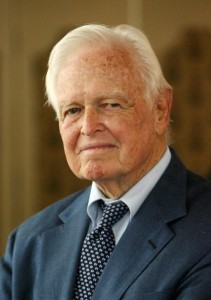 U.S. District Judge James C. Paine – A totally awesome dude. [U.S. District Judge James C. Paine, Southern District of Florida, passed away in 2010 after 28 years of distinguished service on the federal bench.]
In a 1992 case, U.S. District Judge James Paine (or maybe a law clerk) took pains to spice up an order rejecting federal removal jurisdiction by managing to work in several references from the movie “Wayne’s World.”
These include subheadings like “Hurling Chunks” and “NOT!”, and the observation that the attempted removal of the case from state to federal court “is untimely and is a defect deemed ‘way’ improvident.”
He concluded his trip to Wayne’s World as follows: “In short, Prime Time’s most bogus attempt at removal is ‘not worthy’ and the Defendants must ‘party on’ in state court.”
To which we say, “WHOA, Judge Paine, was, like, a totally awesome judicial dude!”
— Noble v. Bradford Marine, Inc., 789 F. Supp. 395 (S.D. Fla. 1992). Thanks to Melissa Williamson.
November 24th, 2011
 Prosecutor used Celine Dion's and Enya's music to soften up jury. Salazar v. Texas was a grisly murder case involving a victim and alleged dope dealer named Jonathon. Jonathon’s cohorts turned on him and killed him by beating him with baseball bats and strangling him with wire.
At the punishment phase of the trial, over the objection of defense counsel, the state played a professionally edited video montage of Jonathon’s life, complete with music by Enya and Celine Dion!
The defendant appealed on the ground that the videotape was prejudicial. Here’s how the appellate court described the videotape (paragraph breaks inserted):
This video is an extraordinarily moving tribute to Jonathon Bishop’s life. It consists of approximately 140 still photographs, arranged in a chronological montage. Music accompanies the entire seventeen-minute video and includes such selections as “Storms in Africa” and “River” by Enya, and concludes with Celine Dion singing, “My Heart Will Go On,” from the movie Titanic.
Almost half of the approximately 140 photographs depict the victim’s infancy and early childhood. The pictures show an angelic baby, surrounded by loving parents, grandparents, unidentified relatives, and other small children. Later photographs show Jonathon as a toddler, playing the piano, frolicking at the beach with other friends, happily riding on a carousel, laughing in a field of bluebonnets, and cuddling with a puppy.
The video also includes numerous annual school pictures showing Jonathon’s progression from a cheerful child to a equally cheerful young man. It catalogs his evident and early prowess as a young soccer player and eventually as a football player. There is a picture of him and his date, presumably going to their prom, and more candid shots of the victim and his teen-age buddies. The video includes many family reunion portraits showing Jonathon’s entire extended family.
Understandably, this professional and polished production portrays Jonathon in a very positive light and it is entirely appropriate for a memorial service. The music, too, is appropriately keyed to the various visuals, sometimes soft and soothing, then swelling to a crescendo chorus. In sum, it is a masterful portrait of a baby becoming a young man. It is also extraordinarily emotional.
The court held it was reversible error to admit the videtape into evidence on the ground that its relevance was outweighed by its prejudicial value, stating:
[The] prejudicial effect is enormous because the implicit suggestion is that the appellant murdered this angelic infant; he killed this laughing, light-hearted child; he snuffed out the life of the first-grade soccer player and of the young boy hugging his blond puppy dog.
— Salazar v. State, 90 S.W.3d 330, 333–34, 337 (Tex. Crim. App. 2002). Thanks to Texas Senior Judge James Barlow.
November 24th, 2011 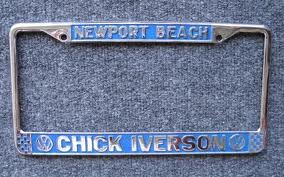 Chick Iverson left his mark in more ways than one. California lawyer Frank Zotter sent in Iverson v. Iverson, a California divorce case in which the trial judge, in Frank’s words, “demonstrates once again the wisdom of the old saying, ‘it’s best to keep your mouth shut and have everyone think you a fool than to open it and leave no doubt.’”
The case involved the validity of a prenuptial agreement and the question of which of the parties had initiated the idea of marriage. The trial judge concluded that surely the wife had pursued the marriage. After all, the judge said, she was “lovely,” but “[h]ad nothing going for her except for her physical attractiveness.” Specifically, she “did not have much of an education, and did not have much of a background in business, and did not have much by way of material wealth.”
The judge simply couldn’t fathom the notion that the husband, Chick Iverson, would have been crazy enough to pursue marriage when “[h]e had just gone through a divorce which cost him a million dollars.” Marriage, the judge said, “would be the last thing on his mind. And why, in heaven’s name, do you buy the cow when you can get the milk free, as we used to say. And, so, he’s getting the milk free. And Cheryl is living with him in his home.”
The Court of Appeals reversed, ordering a new trial before a different judge on the basis that the trial judge’s sexist perceptions of the couple’s relationship made it impossible for the wife to have received a fair trial.
Who the hell was Chick Iverson? The case makes it sounds like he’s a big deal and he must have been because he told John Wayne he wanted The Duke to be best man at the wedding. Internet research discloses Iverson was the first Volkswagen dealer in L.A.
McClurg footnote: A source who requested anonymity sent this interesting follow-up information about the Iverson case:
Chick Iverson and John Wayne were best friends. That’s why John Wayne was the best man at his wedding to Mrs. Iverson. Mr. Iverson has since passed away and is actually buried next to John Wayne.
Chick Iverson owned the first VW dealership in Orange County, not LA. He imported the first Porsches to the west coast after WWII, and established a Volkswagen, Porsche, Rolls Royce, Audi and Chevrolet dealership in Newport Beach in the 60s which was sold in the 80s. It was the largest and best selling Volkswagen dealership in the United States.
Mr. Iverson made a hefty sum selling the wonderful bug to many a hippie. Mr. Iverson and Cheryl Iverson had a bitter divorce that would rival any Dynasty episode. The judge’s screw-up with his comments costs Mr. Iverson close to a million dollars in attorneys’ fees as he was paying for his attorney and Mrs. Iverson’s. Eventually, Mr. Iverson won and the prenuptual agreement was upheld.
Another McClurg footnote: More inside info about the colorful Chick Iverson, courtesy of Carl “Skip” Williams, a friend and former employee:
“Who the hell is Chick Iverson?” I had to laugh when I read that. You’re not from Orange County, CA. Let me add these few choice pieces to the article.
John Wayne and Chick were like Oprah and Gail. John Wayne was the Godfather to Chick’s son, who died at the age of 21 when he took a used Jaguar of the lot and ran off the cliff on his way to Laguna. Chick introduced John Wayne to his wife who worked on his ranch in South America. Chick Iverson was the executor to John Wayne’s Estate and controlled all the money for his children.
Chick Iverson was lucky in business and a genius. He was the son of immigrants. He had the largest cattle ranch in Oregon and the sixth largest in the US. He started as a salesman selling cars, with a high school education. His biggest decision was a fluke. He worked his way from salesman to general manager at a Porsche dealership in Chicago. He then opened up the first Porsche dealership in Orange County. Two years later he went looking to add another brand. His first choice was American Motors, second was Volkswagen.
When he decided to go with American Motors; he invited the representatives over to his house. One made a remark that offended his wife, so he went with Volkswagen and the rest is history.
— In re Marriage of Iverson, 11 Cal. App. 4th 1495, 1499 (1992). Thanks to Frank Zotter.
November 24th, 2011  Judge used Leann Rimes tunes to solve her contract dispute. In Rimes v. Curb Records, Inc., country music sensation LeAnn Rimes sought to void a recording contract on the basis that she was a minor when she signed it. Judge Jerry Buchmeyer, one of the original legal humorists, upheld a forum selection clause in the contract and granted the defendant’s motion to transfer the case to Tennessee—and he did it all to the tune of LeAnn’s hit songs.
Here’s a sample (footnotes omitted):
STATEMENT OF FACTS
(To be sung to the tune of LeAnn Rimes, “How Do I Live.” Copr. & (R) 1997 Curb Records, Inc.)
LeAnn Rimes
A very rich and famous star
Wasn’t so rich in times afar
But what a talent she had!
Enter Curb
To sign a contract, they hoped
After her talent they scoped
They saw the cash in her eyes
But LeAnn
Who at twelve was hardly dumb herself
Wanted to retain her future wealth
Oh
If you could have seen
Baby those attorneys changed everything
But so many lines!
They missed one thing.
CHORUS #1
Why did you sign, LeAnn Rimes?
So long ago
Off on that choice of forum?
Your attorneys didn’t know?
They made lots of changes, but one thing survived …
Forum clause, to that clause, what weight do we give?
INSTRUMENTAL INTERLUDE
VERSE #3
Many times
Back and forth from judge to attorney
Both in Texas and in Tennessee
There was so much to review
And LeAnn
With a guardian to oversee
She disavowed her own minority
Oh
Now she believes
Her age will invalidate everything
She ever signed
We must decide
CHORUS #2
How do we read the forum clause?
Binding or no?
How could she see, at age twelve
Or truly know
That the Curb-Rimes relations, would never survive?
Forum clause, to that clause, how much weight do we give?
Judge Buchmeyer wrote separate lyrics for the “Legal Analysis” and “Conclusion,” making the opinion a LeAnn Rimes Greatest Hits collection.
— Rimes v. Curb Records, Inc., 129 F. Supp. 2d 984, 985–86 (N.D. Tex. 2001). Thanks to Melissa Williams.
November 24th, 2011  Imagine you and me. How can you not love U.S. District Judge William G. Young, chief judge for the District of Massachusetts, for his candor and willingness to come clean on an error he made in a case?
Confronted with a motion for new trial based in part on his allegedly erroneous jury instructions, he stated candidly: “[D]espite case-specific guidance from the court of appeals, I botched the instructions to the jury.”
Even better, Judge Young began his opinion in Suboh v. Borgioli by setting forth the lyrics to “a derisive ditty going around the courthouse” set to the music of “Happy Together” by the Turtles.
The original version of “Happy Together,” penned by Gary Bonner and Alan Gordon, reached No. 1 on the Billboard charts the week of Mar. 25, 1967. I’m not sure this version (from a group of lawyers who call themselves the Bar and Grill Singers) poking fun at the high-mindedness of federal judges, will reach that level of success, but it’s still fun.
Here’s a taste of the song as set forth in Judge Young’s opinion:
Imagine me as God. I do.
I think about it day and night.
It feels so right
To be a federal district judge and know that I’m
Appointed forever.
…
[CHORUS]
I’m a federal judge
And I’m smarter than you
For all my life.
I can do whatever I want to do
For all my life.
Appointed Forever, Bar & Grill Singers.
— Suboh v. Borgioli, 298 F. Supp. 2d 192, 194 (D. Mass. 2004). Thanks to Michael Hirschowitz.
November 22nd, 2011  Mr. Spock for Supreme Court. In an otherwise dry (due to subject matter), but well-written opinion involving legislative police power and retroactive laws, Texas Supreme Court Justice Don R. Willett invoked the ultimate high authority for Baby Boomers everywhere.
No, not the U.S. Supreme Court. Star Trek!
Quoting the utilitarian principle that “the needs of the many outweigh the needs of the few,” Justice Willett cites to Charles Dickens and Mr. Spock from Star Trek II: The Wrath of Khan. Here’s the footnote:
The film references several works of classic literature, none more prominently than A Tale of Two Cities. Spock gives Admiral Kirk an antique copy as a birthday present, and the film itself is bookended with the book’s opening and closing passages. Most memorable, of course, is Spock’s famous line from his moment of sacrifice: “Don’t grieve, Admiral. It is logical. The needs of the many outweigh …” to which Kirk replies, “the needs of the few.”
As Star Trek sources go, The Wrath of Khan is a good one. Definitely more authoritative than, say, The Trouble with Tribbles.
— Robinson v. Crown Cork & Seal Co., 54 Tex. Sup. J. 71, 99 n.21 (Tex. 2010). Thanks to Tamara Davis by way of wired.com.
November 21st, 2011 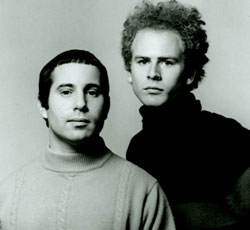 Simon and Garfunkel - Noted admiralty law experts. In U.S. v. McPhee, the defendants were charged with conspiracy to import marijuana, after their boat, the Notty, was intercepted by Coast Guard cutters off the coast of Florida.
A key jurisdictional issue was whether the boat was intercepted within the territorial waters of the Bahamas. Defendants argued it was, on the basis that the interdiction occurred within 12 miles of Saint Vincent Rock, which defendants asserted is a Bahamian island. The government argued that Saint Vincent Rock is only a “rock” and does not qualify as an “island.”
The U.S. Court of Appeals for the Eleventh Circuit agreed with the government, although it conceded the question was not without its nuances, citing Simon & Garfunkel as authority (paragraph breaks inserted):
FN 9. The Government argued that the Notty was in international waters or on the “high seas” because “Saint Vincent Rock is a rock. If it was an island, it would be called Saint Vincent Island, not Saint Vincent Rock.” Ultimately, we must determine whether it is a rock or an island according to the statutory definitions provided by the Archipelagic Act.
We note in passing that for some purposes, the label is not altogether satisfying. Thus, for example, in the metaphysical sense, we can discern no reason why something could not be both a rock and an island at the same time.
See Paul Simon and Art Garfunkel, I am a Rock, on Sounds of Silence (Columbia 1966) (“A winter’s day, in a deep and dark December. I am alone, gazing from my window, to the streets below, on a freshly fallen silent shroud of snow. I am a rock, I am an island. I’ve built walls, a fortress deep and mighty, that none may penetrate. I have no need of friendship, friendship causes pain. It’s laughter and it’s loving I disdain. I am a rock, I am an island. Don’t talk of love. Well I’ve heard the word before. It’s sleeping in my memory. I won’t disturb the slumber of feelings that have died. If I never loved, I never would have cried. I am a rock, I am an island. I have my books and my poetry to protect me. I am shielded in my armor. Hiding in my room, safe within my womb, I touch no one and no one touches me. I am a rock, I am an island. And a rock feels no pain. And an island never cries.”).
The court did note, however, that “neither Simon nor Garfunkel has been identified as a nautical expert.”
Maybe the government could have bolstered its jurisdictional case by citing John Mellencamp and arguing that the “R.O.C.K. [was] in the U.S.A.”.
— United States v. McPhee, 336 F.3d 1269, 1279 n.9 (11th Cir. 2003). Thanks to Michael Hirschkowitz.
— See also United States v. Horn, 185 F. Supp. 2d 530, 551 n.37 (D. Md. 2002) (“She blinded me with science!”). Thanks to Kevin Cross for providing this Thomas Dolby-influenced citation in the same vein pop-music theme as McPhee, in proper Bluebook-form no less.
November 18th, 2011 Several grounds exist for a judge denying a lawyer’s motion. Now we have a new one: incomprehensibility.
Displeased with a lawyer’s inartful motion-drafting, U.S. Bankruptcy Judge Leif M. Clark (W.D. Tex.) entered an order captioned “Order Denying Motion for Incomprehensibility.” The judge couldn’t figure out what the heck the defendant was requesting in a motion titled, “Defendant’s Motion to Discharge Response to Plaintiff’s Response to Defendant’s Response Opposing Objection to Discharge.”
Judge Clark said: “The court cannot determine the substance, in any, of the Defendant’s legal argument, nor can the court even ascertain the relief that the Defendant is requesting. The Defendant’s motion is accordingly denied for being incomprehensible.”
Perhaps worried that the defendant might miss his point, Judge Clark appended a footnote in which he invoked the following quotation from the Adam Sandler movie, Billy Madison:
Mr. Madison [Sandler’s character], what you’ve just said is one of the most insanely idiotic things I’ve ever heard. At no point in your rambling, incoherent response was there anything that could even be considered a rational thought. Everyone in this room is now dumber for having listened to it. I award you no point, and may God have mercy on your soul.
— Order Denying Motion for Incomprehensibility, In re King, Case No. 05-56485-C, Feb. 21, 2006. Thanks to Sharee Moser.
November 17th, 2011  Changing venue because of a volcano? Sure, it sounds far-fetched, but don’t blow your stack. Changing venue because of a volcano? Sure, it sounds far-fetched, but don’t blow your stack.
It really happened in U.S. v. McDonald, a 1990 federal bribery prosecution in Alaska. Fearful that an unpredictable volcano named Mt. Redoubt would act up and disrupt the trial, Judge James M. Burns granted a motion to change venue for the trial from Fairbanks, Alaska to Tacoma, Washington.
Judge Burns noted he could find “no precedent for changing venue because of an earthquake, hurricane, tornado, flood, volcanic eruption, or other natural disaster,” but said Mt. Redoubt was “entitled to a modicum of judicial respect.”
Judge Burns might be a Jimmy Buffett fan. Usually, when you think of Buffett, you think frozen margaritas, not frozen tundra, but footnote 17 quotes the entire lyrics of the Jimmy Buffett song “Volcano,” observing that Buffett’s lyrics express feelings apropos to the circumstances of the case.
Buffett sang, “I don’t know, I don’t know where I’m a-gonna go when the volcano blow.”
Here they knew. The judge sent everyone to Tacoma.
— United States v. McDonald, 740 F. Supp. 757, 764 nn.17 & 18 (D. Alaska 1990) (Burns, J.). Thanks to Tom Gaylord.
November 17th, 2011  As a kid, I couldn’t wait to get my hands on each new issue of MAD Magazine. Alfred E. Neuman and company had a lot to do with shaping (warping) my sense of humor. One of my favorite features, and the first thing I looked at every month, was the folding back covers, which showed one picture unfolded but ingeniously formed a different, wacky picture when folded. As a kid, I couldn’t wait to get my hands on each new issue of MAD Magazine. Alfred E. Neuman and company had a lot to do with shaping (warping) my sense of humor. One of my favorite features, and the first thing I looked at every month, was the folding back covers, which showed one picture unfolded but ingeniously formed a different, wacky picture when folded.
I’m glad to see that MAD has not been forgotten, even in the hallowed halls of justice, as shown by Cabiness v. Town of James Island, South Carolina Supreme Court case.
The case involved a third failed attempt by the Town of James Island to incorporate itself. The complicated facts aren’t important for our purposes. Suffice it to say that one of the biggest issues was the “contiguity” of certain property.
In considering this issue, the court said the most convincing evidence were the courtroom exhibits of maps, which apparently, resembling MAD fold-in back covers, showed the all-important contiguity of certain properties at issue in the case:
Perhaps the most convincing exhibits illustrated the “but for” concept of contiguity in a “MAD Magazine” style back-page folding manner, where a map of two areas alleged to be contiguous was folded in such a manner as to eliminate the previously-annexed publicly-owned property.
Perhaps worried, as I am, that this great literary device is being forgotten, Justice Hearn, in a footnote, directed readers “not familiar with this reference” to a New York Times interractive compilation of MAD Magazine fold-in covers.
— Cabiness v. Town of James Island, Opinion No. 26989, S.C. Sup. Ct, June 20, 2011. Thanks to Jim Bogle.
November 16th, 2011  A washing machine laughing hysterically at Judge Brown's opinion. In 1973, the Fifth Circuit struck down a Dade County detergent labeling ordinance, finding that the ordinance, intended to reduce pollution from ingredients found in household detergents, was preempted by the Federal Hazardous Substance Labeling Act.
Chief Judge John Brown concurred, managing to work in the brand names of just about every detergent product available, becoming a humorous opinion-writing path-breaker.
Let us know if we’re wrong, but Judge Brown’s opinion–published in 1973–may be the first overtly intentional effort by a federal court of appeals judge to write a clever and funny opinion. It’s a lot easier for a state judge to get away with being amusing than a federal judge, certainly a court of appeals judge.
So, while the opinion isn’t particularly hilarious, Judge Brown’s boldness and innovation gets this case into the Strange Judicial Opinions Hall of Fame.
Here’s a taste of his detergent-filled ruling (italics inserted):
As Proctor of this dispute … the Court holds that Congress has specifically preempted regulatory action by Dade County. Clearly, the decision represents a Gamble since we risk a Cascade of criticism from an increasing Tide of ecology-minded citizens. Yet, a contrary decision would most likely have precipitated a Niagara of complaints from an industry which justifiably seeks uniformity in the laws with which it must comply. Inspired by the legendary valor of Ajax, who withstood Hector’s lance, we have Boldly chosen the course of uniformity in reversing the lower Court’s decision upholding Dade County’s local labeling laws. And, having done so, we are Cheered by the thought that striking down the regulation by the local jurisdiction does not create a void which is detrimental to consumers ….
…
And so we hold. This is all that need be said. It is as plain as Mr. Clean the proper Action is that the Dade County Ordinance must be superseded, as All comes out in the wash.
— Chem. Specialties Mfrs. Ass’n v. Clark, 482 F.2d 325, 328–29 (5th Cir. 1973) (Brown, C.J., concurring). Thanks to Craig A. Wilson.
November 14th, 2011 U.S. Ninth Court of Appeals Judge Alex Kozinski is well known for sprinkling pop culture references throughout his opinions, particularly in the famous Syufy opinion, which wove in the titles of more than 200 movies. (See “Coming Soon to a Footnote Near You”)
A less noticed, but just as fun pop culture-laden opinion was his dissent to an order denying rehearing en banc in White v. Samsung Electronics America, Inc., a case where the Ninth Circuit upheld a “right of publicity” claim by former game show hostess Vanna White against Samsung for using a robot resembling her game show persona in a television commercial.
Complaining that, “[u]nder the majority’s opinion, it’s now a tort for advertisers to remind the public of a celebrity,” Kozinski excoriated the court for over-extending intellectual property rights in an opinion jammed full of pop culture references.
(That’s one thing to love about Kozinski’s writing: he can be pithy, insightful, and amusing in less than twenty words.)
Pop culture ran amuck in a single footnote (footnote 6) that includes references to (in order): grunge rocker Tad Doyle, the Hell’s Angels, Marvel Comics, Breakfast at Tiffany’s, Breakfast of Champions, The Electric Kool-Aid Acid Test, Looking for Mr. Goodbar, The Coca-Cola Kid, The Kentucky Fried Movie, Harley Davidson and the Marlboro Man, The Wonder Years, Wonder Bread, Joseph and the Amazing Technicolor Dream Coat, Janis Joplin, Paul Simon, Leonard Cohen, Bruce Springsteen, Prince, dada, Monty Python, Roy Clark, Mel Tillis, the Talking Heads, Andy Warhol, REO Speedwagon, 38 Special, Jello Biafra and the Dead Kennedys.
— White v. Samsung Elec. Am., Inc., 989 F.2d 1512, 1512 n.6, 1514 (9th Cir. 1993) (Kozinski, J., dissenting from order denying rehearing en banc). Thanks to Katherine Shipman.
November 14th, 2011 Where do scandals go when they die? They travel upwards, of course … to a U.S. Court of Appeals. At least if they’re scandals involving the saga of President Bill Clinton’s sexcapades.
U.S. Ninth Circuit Court of Appeals Judge Alex Kozinski faced an appeal in a defamation suit filed by former lounge-singer Gennifer Flowers against Hillary Rodham Clinton, James Carville and George Stephanopoulos. With that cast of characters (including Judge K), you know it’s going to be an interesting opinion.
This is an opinion to be admired as much for its lucidity as its colorful take on the events. Here’s a taste from the opening paragraphs (some paragraph breaks inserted):
Long after the public spotlight has moved on in search of fresh intrigue, the lawyers remain. And so we find ourselves adjudicating a decade-old dispute between Gennifer Flowers and what she affectionately refers to as the “Clinton smear machine”: James Carville, George Stephanopoulos and Hillary Clinton. Flowers charges that said machine destroyed her reputation by painting her as a fraud and a liar after she dis-closed her affair with Bill Clinton. We decide whether Flowers’s claims are timely and, if so, whether they survive a motion to dismiss.
Background and Proceedings Below
In the heat of the 1992 presidential primary campaign, the Star—that ubiquitous supermarket source for celebrity scandal—ran a story claiming that Bill Clinton had carried on an affair with an Arkansas woman named Gennifer Flowers. Clinton and Flowers both denied it at first, but a few days later Flowers (doubtless realizing that honesty is the best policy after all) sold her story to the Star.
Clinton continued vigorously denying the allegations and appeared on 60 Minutes with his wife to say they weren’t true. The following day, Flowers responded by holding a press conference where she played recordings of intimate phone calls from Clinton that she’d secretly taped. Later news reports suggested that the tapes may have been selectively edited.
According to Flowers, Hillary Clinton and her two “henchmen,” George Stephanopoulos and James Carville, conspired to protect Bill Clinton’s presidential candidacy from Flowers’s damaging revelations. Flowers claims that during the 1992 campaign and in later political memoirs and interviews, Carville and Stephanopoulos defamed her and painted her in a false light by claiming that she had lied in her story to the Star and “doctored” the tape-recorded phone calls.
Hillary Clinton, the alleged mastermind of the conspiracy, not only orchestrated the defamatory exploits, but also exposed private information about Flowers and organized break-ins of her residence. Flowers claims that, as a result of all this schemery, her reputation has wilted and her blossoming career as a Las Vegas lounge singer has been nipped in the bud.
It’s like the beginning of an intriguing political spy novel you want to keep reading. In the not-as-exciting climax, the Ninth Circuit panel felt compelled under the law to reverse the district court, which had dismissed all of Flowers’ claims.
Meanwhile, Kozinski gave us another Syufy-type mystery (see “Coming Soon to a Footnote Near You!”) by burying an amusing reference in one of the citations. I won’t spoil the mystery. See if you can find it.
— Flowers v. Carville, 310 F.3d 1118, 1122 (9th Cir. 2002) (Kozinski, J.). Thanks to Elise Hendrick .
November 14th, 2011 As a member of a Memphis rock cover band that plays several Beatles songs and a huge Beatles fan, I have a special appreciation for Montana Judge Gregory R. Todd’s order in a 2007 criminal case.
After the defendant pleaded guilty to burglary, he was asked to fill out portions of a pre-sentence investigation report. In response to the question, “Give your recommendation as to what you think the Court should do in this case,” the defendant replied, “Like the Beetles say, ‘Let It Be.’”
Judge Todd took issue with both the defendant’s apparent plea for leniency and also his misspelling of the name of the Beatles, for whom Judge Todd obviously has great fondness. The judge penned a caustic sentencing memorandum, written to the defendant, that managed to work in the titles of thirty-nine Beatles songs:
Act Naturally
Baby It’s You
Bad Boy
Carry That Weight
Come Together
Day in the Life
Do You Want to Know a Secret?
Fixing a Hole
Fool on the Hill
Get Back
Hard Day’s Night
Hello Goodbye
Help
Here, There and Everywhere
Hey Jude
Honey Don’t
I Don’t Want to Spoil the Party
I Feel Fine
I Should Have Known Better
I, Me, Mine
I’ll Cry Instead
I’ll Get You
I’m a Loser
Let It Be
Long and Winding Road
Magical Mystery Tour
Misery
Mr. Moonlight
Nowhere Man
Run for Your Life
Something
Strawberry Fields Forever
The Word
Think for Yourself
Ticket to Ride
Wait
We Can Work It Out
When I’m 64
You Really Got a Hold on Me
Here’s a taste from the last paragraph of the memorandum:
Later when you thought about what you did, you may have said I’ll Cry Instead. Now you’re saying Let It Be instead of I’m A Loser. As a result of your Hard Day’s Night, you are looking at a Ticket To Ride that Long and Winding Road to Deer Lodge. Hopefully you can say both now and When I’m 64 that I Should Have Known Better.
Judge, what can I say, but Thank You Girl, er rather, Your Honor. Til There Was You, most judicial opinions were just so Yesterday. I hope we have a chance to Come Together for lunch or Something. Why? Well, just Because.
— State v. McCormack, No. DC06-0323, Montana Thirteenth Judicial District, Yellowstone County, Feb. 26, 2007. Thanks to Pat Smith.
November 14th, 2011  The Kinks got it right in their song, “Destroyer,” when they sang that paranoia will destroy ya. The Kinks got it right in their song, “Destroyer,” when they sang that paranoia will destroy ya.
It certainly did so for the defendant in a case where, after getting paranoid at a 1999 Phish concert in Oswega, NY, presumably while under the influence of an hallucinogenic drug, he became convinced the police were following him and that the band was sending him messages through the music. Fleeing the concert, he traveled 250 miles on foot and by hitch-hiking, convinced the police were after him the whole way. (He believed that every car with an “A” in the license number contained police officers.)
Some thirty-six hours later, he finally turned up at the police barracks in Westport, NY, where he told an investigator, “You know who I am.” When the cops didn’t know who he was or why he was there, he told them he was growing marijuana plants back at his home in Rochester, NH. He then consented to a search of the house.
When the cops in Rochester searched the house, they found marijuana plants and liquid acid. Though a New Hampshire Superior Court ultimately ruled that the evidence should be suppressed (because of insufficient proof the defendant received and waived his Miranda rights), the University of Memphis law student who sent me this opinion correctly opined that it should serve as “a gentle reminder to any students planning to reunite with Phish over the summer break.”
— State v. Augur, Case Nos. 01-S-388, 01-S-389, 2001 N.H. Super. LEXIS 17 (N.H. Super. Ct., Oct. 22, 2001). Thanks to Adam Ragan.
November 7th, 2011 Think judges of the U.S. Tax Court are staid? Well, yes, probably. But in 1983, one of them cut loose with a rhyming opinion in a case involving country singer Conway Twitty’s defunct “Twitty Burger” restaurants:
Twitty Burger went belly up
But Conway remained true
He repaid his investors, one and all
It was the moral thing to do.
His fans would not have liked it
It could have hurt his fame
Had any investors sued him
Like Merle Haggard or Sonny James.
When it was time to file taxes
Conway thought what he would do
Was deduct those payments as a business expense
Under section one-sixty-two.
In order to allow these deductions
Goes the argument of the Commissioner
The payments must be ordinary and necessary
To a business of the petitioner.
Had Conway not repaid the investors
His career would have been under cloud,
Under the unique facts of this case
Held: The deductions are allowed.
Interesting factoids in the opinion include the revelations that Conway Twitty’s real name was Harold Jenkins and that he began his career in rock and roll before crossing over to country music in 1965.
— Jenkins v. Comm’r, 47 T.C.M. (CCH) 238 (T.C. 1983). Thanks to Professor Jose Gabilondo.
November 6th, 2011 Michigan Circuit Court Judge Deborah Servitto rapped part of her recent decision dismissing a defamation case brought against Eminem.
Eminem’s 1999 CD, “The Slim Shady LP,” included a song called “Brain Damage” in which Eminem accused one DeAngelo Bailey of bullying and battering him while the two were in elementary school: “Way before my baby daughter Hailey, I was harassed daily by this fat kid named DeAngelo Bailey … He banged my head against the urinal until he broke my nose, soaked my clothes in blood, grabbed me and choked my throat.”
Bailey sued for defamation, denying that he ever bullied or battered Em. Servitto dismissed the complaint on the ground that the statements in the song were mere rhetorical hyperbole, rather than statements that could be construed as stating actual facts about a person.
Thanks to several loyal lawhaha.com visitors, we now have the full text of the attempted rap for you, which is found in the last footnote of Servitto’s 14-page opinion:
11. To convey the Court’s opinion to fans of rap, the Court’s research staff has helped the Court put the decision into a universally understandable format:
Mr. Bailey complains that his rap is trash
So he’s seeking compensation in the form of cash
Bailey thinks he’s entitled to some monetary gain
Because Eminem used his name in vain
Eminem says Bailey used to throw him around
Beat him up in the john, shoved his face in the ground
Eminem contends that his rap is protected
By the rights guaranteed by the first amendment
Eminem maintains that the story is true
And that Bailey beat him black and blue
In the alternative he states that the story is phony
And a reasonable person would think it’s baloney
The Court must always balance the rights
Of a defendant and one placed in a false light
If the plaintiff presents no question of fact
To dismiss is the only acceptable act
If the language used is anything but pleasin’
It must be highly objectionable to a person of reason
Even if objectionable and causing offense
Self-help is the first line of defense
Yet when Bailey actually spoke to the press
What do you think he didn’t address?
Those false light charges that so disturbed
Prompted from Bailey not a single word.
So highly objectionable it could not be
–Bailey was happy to hear his name on a CD
Bailey also admitted he was a bully in youth
Which makes what Marshall said substantial truth
This doctrine is a defense well known
And renders Bailey’s case substantially blown
The lyrics are stories no one would take as fact
They’re an exaggeration of a childish fact
Any reasonable person could clearly see
That the lyrics could only be hyperbole
It is therefore this Court’s ultimate position
That Eminem is entitled to summary disposition
Will Bailey appeal? Judge Servitto probably would advise him to just “peace out, dawg.”
— Bailey v. Mathers, Case No. 2001-3606-NO, slip op. at 13 n. 11 (Macomb County Circuit Court, Oct. 17, 2003). Thanks to Jason Blalock, Geoff Brown, Mark Rodan, and Melanie Ware.
November 6th, 2011 In a copyright battle between two British rap bands, an English court ruled that rap lyrics should for practical purposes be considered a “foreign language,” requiring expert testimony as to their interpretation.
British band Ant’ill Mob sued another band, Heartless Crew, alleging the defendant disparaged the band’s copyright for its 2001 hit song, “Burnin’,” by remixing the song using lyrics the plaintiff considered objectionable because they allegedly refer to drugs and violence, including the terms “shizzle my nizzle,” “mish mash man,” and “string dem up.”
Even after playing the record at half speed and consulting the Urban Dictionary, Judge Kim Lewison said he could not determine the meaning of the phrases without an expert witness.
The amusing predicament of three uppercrust, white, middle-aged judges trying to unravel rap slang was not lost on Judge Kim, who commented on the “faintly surreal experience of three gentlemen in horsehair wigs examining the meaning of such phrases.”
According to the Urban Dictionary (urbandictionary.com), “shizzle my nizzle” means:
a bastardization of “fo’ sheezy mah neezy,” a bastardization of “for sure mah n—,” a bastardization of “I concur with you wholeheartedly my African-American brother.
— Confetti Records v. Warner Music UK Ltd, [2003] EWHC 1274 (Ch). Thanks to Cynthia Cohan, Elise Hendrick, and Catherine Seville for sending this opinion. Catherine is the Director of Studies in Law at Newnham College in Cambridge and reports that Judge Lewison is “a good Cambridge man.” Indeed.
November 6th, 2011  Barbie, looking effervescent despite lawsuit loss. In 1997, the Danish band “Aqua” released a parody of America’s favorite thin plastic girl, Mattel’s Barbie®, called “Barbie Girl.” Mattel sued for trademark infringement and dilution. The federal district court in California granted summary judgment against the plaintiff, ruling the song was protected parody.
The U.S. Court of Appeals for the Ninth Circuit affirmed in an opinion by Judge Alex Kozinski. Judge K opened by posing the case as an epic battle between free speech and intellectual property rights. In his words, “[i]f this were a sci-fi melodrama, it might be called Speech-Zilla meets Trademark Kong.”
In ruling against Mattel, Kozinski opined that Barbie is much more than a mere product in the American conscious. She also had a more colorful past than you might realize:
Barbie was born in Germany in the 1950s as an adult collector’s item. Over the years, Mattel transformed her from a doll that resembled a “German street walker,” as she originally appeared, into a glamorous, long-legged blonde. Barbie has been labeled both the ideal American woman and a bimbo. She has survived attacks both psychic (from feminists critical of her fictitious figure) and physical (more than 500 professional makeovers). She remains a symbol of American girlhood, a public figure who graces the aisles of toy stores throughout the country and beyond. With Barbie, Mattel created not just a toy but a cultural icon.
It’s true. Barbie is a myth, a legend, and, for better or worse, represents the dreams of little girls everywhere. My daughter used to own probably a dozen Barbies. At what point, if any, can a product image become part of the public domain because it has become woven into the fabric of culture itself?
As Kozinski said in discussing Mattel’s trademark-infringement claim:
The problem arises when trademarks transcend their identifying purpose. Some trademarks enter our public discourse and become an integral part of our vocabulary. How else do you say that something’s “the Rolls Royce of its class”? What else is a quick fix, but a Band–Aid? Does the average consumer know to ask for aspirin as “acetyl salicylic acid”? Trademarks often fill in gaps in our vocabulary and add a contemporary flavor to our expressions. Once imbued with such expressive value, the trademark becomes a word in our language and assumes a role outside the bounds of trademark law.
Don’t remember Aqua’s one-hit wonder novelty song? No worries. The court attached the lyrics as an appendix. Here’s the chorus to refresh your memory:
I’m a Barbie girl, in my Barbie world
Life in plastic, it’s fantastic
You can brush my hair, undress me everywhere
Imagination, life is your creation
Come on Barbie, let’s go party!
Here’s the Official YouTube video.
Mattel, this is more humor. Don’t sue.
— Mattel, Inc. v. MCA Records, Inc., 296 F.3d 894, 898, 909 (9th Cir. 2002).
November 6th, 2011  Appellate court doesn't like drug agents talking like this guy. In suppressing evidence in a drug case, the U.S. Court of Appeals for the Ninth Circuit had some harsh words for the federal drug agents who were involved. The Court also did not take kindly to the trial judge threatening to put one of the lawyers in jail for failing to answer phone calls from the court reporter about a disputed bill.
But first, the court’s indictment of Dragnet-ese. The court did not like the way the drug agents talked, as it explained in a footnote (paragraph breaks inserted):
1. The agents involved speak an almost impenetrable jargon. They do not get into their cars; they enter official government vehicles. They do not get out of or leave their cars, they exit them. They do not go somewhere; they proceed. They do not go to a particular place; they proceed to its vicinity. They do not watch or look; they surveille. They never see anything; they observe it. No one tells them anything; they are advised.
A person does not tell them his name; he identifies himself. A person does not say something; he indicates. They do not listen to a telephone conversation; they monitor it. People telephoning to each other do not say “hello;” they exchange greetings. An agent does not hand money to an informer to make a buy; he advances previously recorded official government funds.
To an agent, a list of serial numbers does not list serial numbers, it depicts Federal Reserve Notes. An agent does not say what an exhibit is; he says that it purports to be. The agents preface answers to simple and direct questions with “to my knowledge.” They cannot describe a conversation by saying “he said” and “I said;” they speak in conclusions. Sometimes it takes the combined efforts of counsel and the judge to get them to state who said what.
Under cross-examination, they seem unable to give a direct answer to a question; they either spout conclusions or do not understand. This often gives the prosecutor, under the guise of an objection, an opportunity to suggest an answer, which is then obligingly given.
As a side issue, the opinion contains a lengthy discussion of an incident in which the trial judge humiliated one of the defense lawyers in court and threatened to send him to jail for raising questions about the court reporter’s fee. The court reporter, who charged by the page, indented the text on each page so it began in the middle of the page, used only 25 lines of type per page instead of the standard 28, and used a font that was larger than normal. The lawyer tried to present an affidavit establishing that the transcript was twice as long as it needed to be, and thus twice as costly. The judge’s response? Here’s a snippet:
MR. LANGER (defense counsel): You say you spoke to me?
THE REPORTER: No. [TO JUDGE:] He wouldn’t even answer my phone calls.
MR. LANGER: Your Honor–
THE COURT: I know it. That is another thing. I ought to throw you in jail for not doing that, for not answering the phone calls of the reporter.
The Ninth Circuit disapproved of the trial judge’s conduct.
— United States v. Marshall, 488 F.2d 1169, 1171 n.1, 1200 (9th Cir. 1973). Thanks to Frank Zotter.
November 6th, 2011 Give credit to a sneaky law clerk to U.S. Circuit Judge Reynaldo Garza, who pulled off an adventurous Syufy-like prank all the way back in 1987. (U.S. v. Syufy is the opinion where Judge Alex Kozinski slipped in more than 200 movie titles. See “Coming Soon To A Footnote Near You.”
In United States v. Abner, a law clerk wove in twenty-five references to the names of albums and songs by the rock group Talking Heads, reportedly in an unsuccessful bid to win some concert tickets. The prank escaped the notice of Judge Garza according to a source.
— United States v. Abner, 825 F.2d 835 (5th Cir. 1987).
November 1st, 2011  As a University of Florida alumnus and Florida Gator fan, I couldn’t help but be tickled by Wright v. State of Georgia Dep’t of Natural Resources, from the Georgia Court of Appeals. As a University of Florida alumnus and Florida Gator fan, I couldn’t help but be tickled by Wright v. State of Georgia Dep’t of Natural Resources, from the Georgia Court of Appeals.
Few college football rivalries are as intense or long-running as that between the Florida Gators and the Georgia Bulldogs. Held in Jacksonville, FL and billed as “The World’s Largest Cocktail Party,” the Florida-Georgia game is a sacred rite of autumn in the two states. The Bulldogs ruled the series for what seemed like an eternity, inflicting untold suffering on the Gator Nation courtesy of players like Herschel Walker and Lindsay Scott. Then Coach Spurrier and Company came to the rescue, winning 10 of 11 games from 1990-2001.
Which brings us to Wright, a lawsuit in which the plaintiff claimed that certain actions by the Georgia Department of Natural Resources constituted a government “taking” of some alligators that were born and raised on plaintiff’s Georgia farm.
Judge Smith, obviously a jurist with keen political sensibilities, included this footnote:
1. Several times in this opinion, we refer to “Georgia alligators.” We do so reluctantly and soley for the sake of convenience and brevity. We recognize that for literally millions of Georgians and Floridians, the term “Georgia Gators,” or any approximation thereof, is an inherently offensive oxymoron. We apologize for any pain or distress caused by this unfamiliar and unfortunate juxtaposition.
We’ll let it slide this time, Your Honor, but if you ever happen to take up a dog-bite case involving a pug-faced nonresident defendant to the south, please don’t start talking about “Florida Bulldogs.” It would be more than we could stand.
— Wright v. Georgia Dep’t of Natural Res., 562 S.E.2d 515, 517 (Ga. Ct. App. 2002). Thanks to Jessie Cranford.
October 31st, 2011  In Hormel Corp. v. Jim Henson Productions, Inc., Hormel sued the Muppet master for infringing the trademark of its delicious product SPAM® by naming a character in the 1996 movie, Muppet Treasure Island, “Spa’am.” The U.S. District Court for the Southern District of New York rejected Hormel’s claims and the Second Circuit affirmed. Among the highlights: In Hormel Corp. v. Jim Henson Productions, Inc., Hormel sued the Muppet master for infringing the trademark of its delicious product SPAM® by naming a character in the 1996 movie, Muppet Treasure Island, “Spa’am.” The U.S. District Court for the Southern District of New York rejected Hormel’s claims and the Second Circuit affirmed. Among the highlights:
• Hormel was worried that sales of SPAM would suffer if they were linked with Spa’am, the movie character, a wild boar puppet allegedly depicted as “evil in porcine form.” Not to worry. An expert in children’s literature persuaded the court that Spa’am, although not “classically handsome” and introduced as a threatening character at the beginning of the movie, ultimately becomes a positive character when he befriends the Muppets and helps them escape from the film’s villain, Long John Silver. Thank goodness we could find an expert in children’s literature to unravel that puzzle. Would that kind of testimony pass Daubert scrutiny?
• The court opined that Hormel should lighten up because, even though SPAM is a high-quality product, it is already the butt of jokes because of “the public’s unfounded suspicion that SPAM is the product of less than savory ingredients.” The court pointed out that in the television cartoon, Duckman, Duckman discovers the secret ingredient to SPAM as he gazes upon “Murray’s Incontinent Camel Farm.” The court also quoted a columnist who joked that SPAM contained all five major food groups: snouts, ears, feet, tails and brains. The court said that, given all the ribbing, “one might think Hormel would welcome the association with a genuine source of pork.”
• The court also rejected Hormel’s claim that Jim Henson Productions’ merchandising of the Spa’am character would interfere with Hormel’s own merchandising of SPAM, including its character, “SPAM-man,” a giant can of SPAM with arms and legs.
Hormel lost the case, but may have had the last laugh. It has sold more than five billion cans of SPAM . SPAM is eaten in 30 percent of American homes. I probably ate a thousand fried SPAM sandwiches when I was a kid, although I try not to think about it.
— Hormel Foods Corp. v. Jim Henson Prods., Inc., 73 F.3d 497, 501–02 (2d Cir. 1996). Thanks to Lihwei Lin.
|
Funny Law School Stories
For all its terror and tedium, law school can be a hilarious place. Everyone has a funny law school story. What’s your story?
|
Product Warning Labels
A variety of warning labels, some good, some silly and some just really odd. If you come encounter a funny or interesting product warning label, please send it along.
|
Tortland

Tortland collects interesting tort cases, warning labels, and photos of potential torts. Raise risk awareness. Play "Spot the Tort." |
Weird Patents
Think it’s really hard to get a patent? Think again.
|
Legal Oddities
From the simply curious to the downright bizarre, a collection of amusing law-related artifacts.
|
Spot the Tort
Have fun and make the world a safer place. Send in pictures of dangerous conditions you stumble upon (figuratively only, we hope) out there in Tortland.
|
Legal Education
Collecting any and all amusing tidbits related to legal education.
|
Harmless Error
McClurg's twisted legal humor column ran for more than four years
in the American Bar Association Journal.
|
|
|